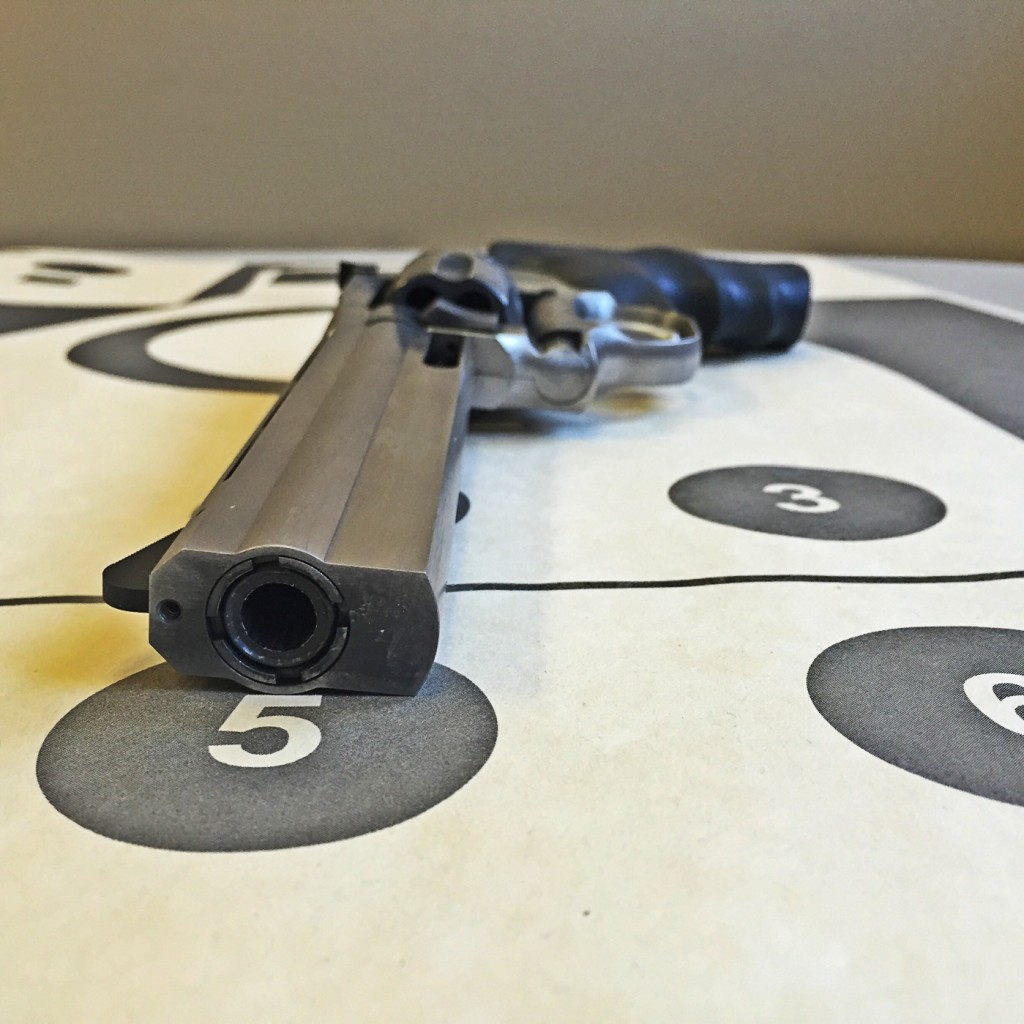
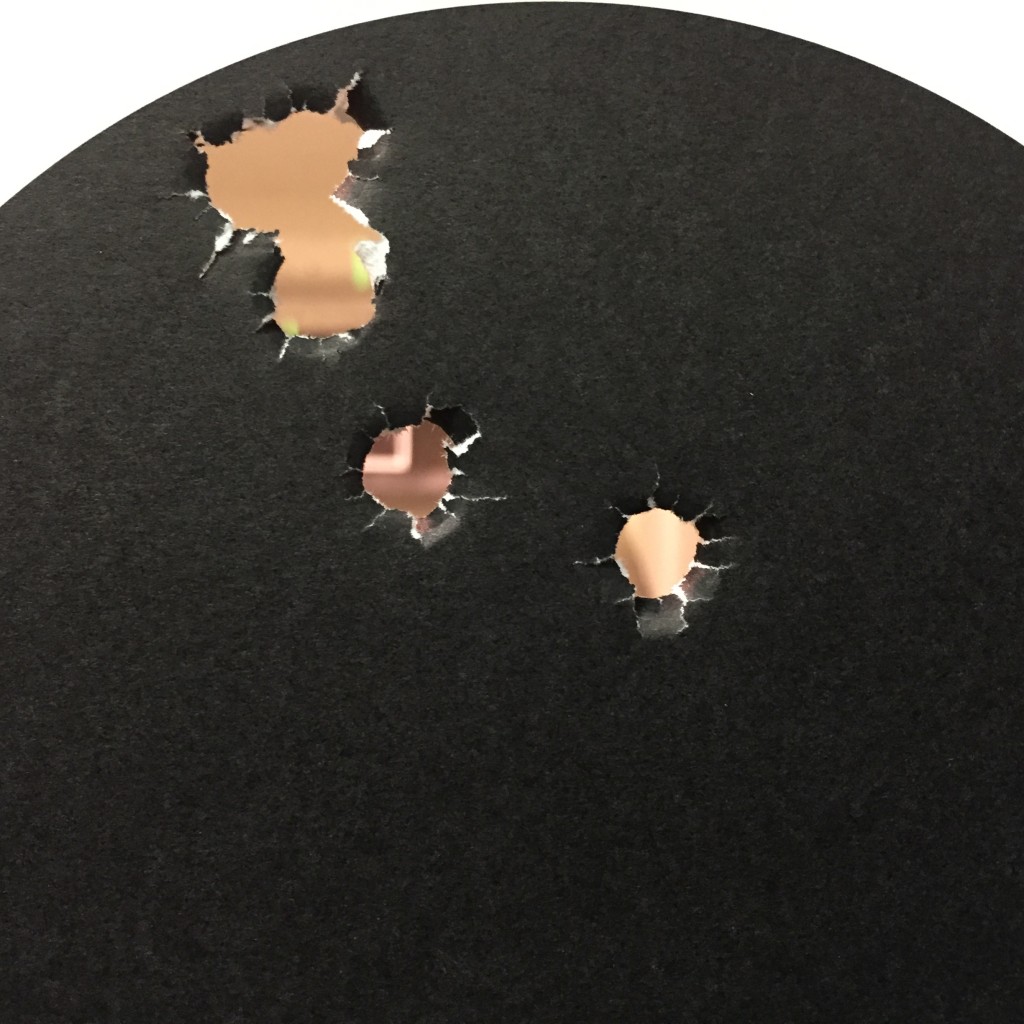
Dan Wesson revolvers occupy an interesting place in the world of enthusiasts. The company itself was founded by the great grandson of the original Daniel Wesson, and Dan Wesson II’s roundguns eventually gained a respectable cult following in revolver circles. Their party trick was an interchangeable barrel system, which allowed the end user to swap barrel lengths at their leisure, making a 6-inch silhouette gun into a 4-inch duty gun or a 2-inch carry gun with relative ease.
I had the good fortune of attending the Rangemaster Tactical Conference this past weekend. It’s a pretty unusual event in the firearms training business where attendees have the opportunity to take instructional blocks with a number of instructors teaching on a wide range of topics. Rather than write one absurdly long opus on my experiences at the conference, I figured it would be more productive to focus on the classes I took and what I got out of them. First up was “Surviving the Knockout Game” with instructor Cecil Burch.
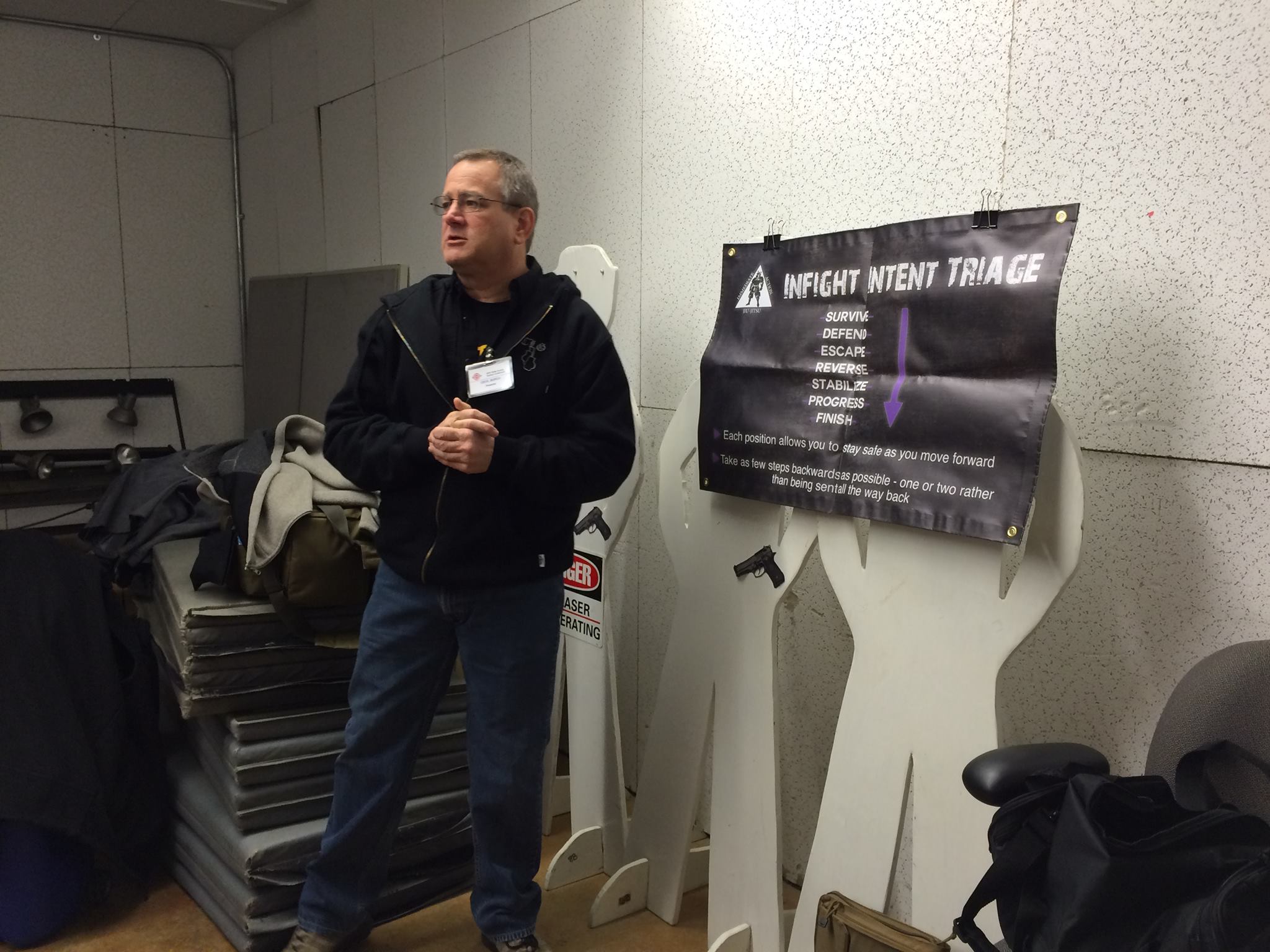
Cecil Burch presents his philosophy of always working to achieve the next level of control in a fight.
Cecil is a life-long martial artist with accomplishments in a number of different disciplines, but he is most accomplished in Brazilian Jiu-Jitsu where he holds a black belt and has won medals in international competitions. His Immediate Action Jiu-Jitsu program is aimed at teaching effective defensive techniques for the weapons-based environment that human beings usually find themselves in. I’m by no means an expert in hand-to-hand combat in general or in BJJ specifically, but I can tell you that criminal assaults differ from consensual mutual combat scenarios in a number of important ways…not least of which is the presence of lethal weapons. Typically nobody brings a gun or a knife into a rolling session at the local dojo for obvious reasons. The guy on the street trying to rob/shoot/stab you, on the other hand…
The typical IAJJ class with Cecil is a multi-day affair that covers a fairly decent range of possible assault scenarios, but with only a three hour block of instructional time Cecil presented a tightly focused mini-course on staying conscious and on your feet during the initial moments of a blind-sided assault. These types of assaults made headlines fairly recently:
Criminal assaults almost always happen via ambush. The idea of the “knockout game” might be new to people in the press, but it’s a pretty well-established phenomenon with a long history. Some people will assault another human being simply for the sport of having done so, sometimes inflicting lethal damage in the process. This is not novel. It is an unfortunate feature of human nature.
I know what you’re thinking…situational awareness. Yes, if you pay attention and listen to some sensible instincts you can often avoid the attack but I’ll let you in on something I’ve noticed over the years: I have yet to meet a person with absolute situational awareness at all times. If you believe you can’t be caught off guard then I have to say you are either the most extraordinary specimen of humanity I have ever encountered, or you are kidding yourself.
The program Cecil presented at this year’s Tactical Conference was aimed at helping you stay conscious and on your feet in the crucial initial seconds of the fight that you couldn’t avoid. He began the discussion by outlining the target areas on the human body most vulnerable to a knockout blow and demonstrated a sort of “cage” technique you can assume very quickly. The “cage” offers protection of those areas and stabilization of the head and neck to prevent the sort of violent movement of the head that causes the brain to collide forcefully with the skull. (A primary knockout threat) The “cage” properly applied should allow you to stay conscious in the initial moments of the fight.
The lower half of your body, meanwhile, needs to participate as well if you are going to stay on your feet. Getting into a good athletic stance with your hips squared up to the incoming attack gives a solid platform you can use to drive into the threat allowing you to fight back effectively. After using some very clever ways of explaining these concepts Cecil taught some simple but effective ways to gain an advantage on your assailant with the goal of eventually breaking contact with him altogether.
The progression was logical…mitigate the impact of the incoming blow, drive into the threat to keep him from continuing to throw powerful ranged strikes, maneuver into a position of advantage on the assailant which renders him at least temporarily harmless, and then if possible get to his back where you can either break contact or take more forceful actions if the situation calls for it. No one will master that process in a 3 hour block of instruction but students learned the techniques and how to practice them so that hopefully they spend time training on the techniques to reproduce them under stress. Practice should be relatively easy to accomplish as all you need is one other person and just a little bit of empty space. You don’t even need pads or mats.
“Surviving the Knockout Game” was essentially an amuse-bouche presentation of effective empty-hand techniques for close range self defense against an ambush like the knockout game style assault. It didn’t make me an elite street fighter and Cecil never promised it would. It was designed as a relatively high-percentage technique that ordinary joes (meaning non-martial artists) could learn in a fairly brief time. Certainly not the greatest solution to every conceivable attack, but a pretty damn good solution to most of the attacks that actually happen on the street.
Cecil could certainly lecture for extended periods of time about the intricacies of various aspects of BJJ, but his Immediate Action program is tailored for the needs of the average citizen or police officer. The ability to distill a lifetime’s worth of knowledge and experience into a relatively simple yet effective program for people who do not have a comparable background is often very difficult to achieve, but Cecil pulled it off. Again, it won’t make you a medal-winning expert in MMA disciplines. It will, however, teach you techniques that will likely be enough to help you through a criminal assault should you find yourself the victim of one.
Enough isn’t everything, but it’s still a wonderful thing.
If you’re looking for quality instruction in solid techniques that are likely to be enough, look into Cecil’s schedule. I don’t believe you’ll be disappointed…and who knows? If you sign up for an IAJJ class I might just see you there!
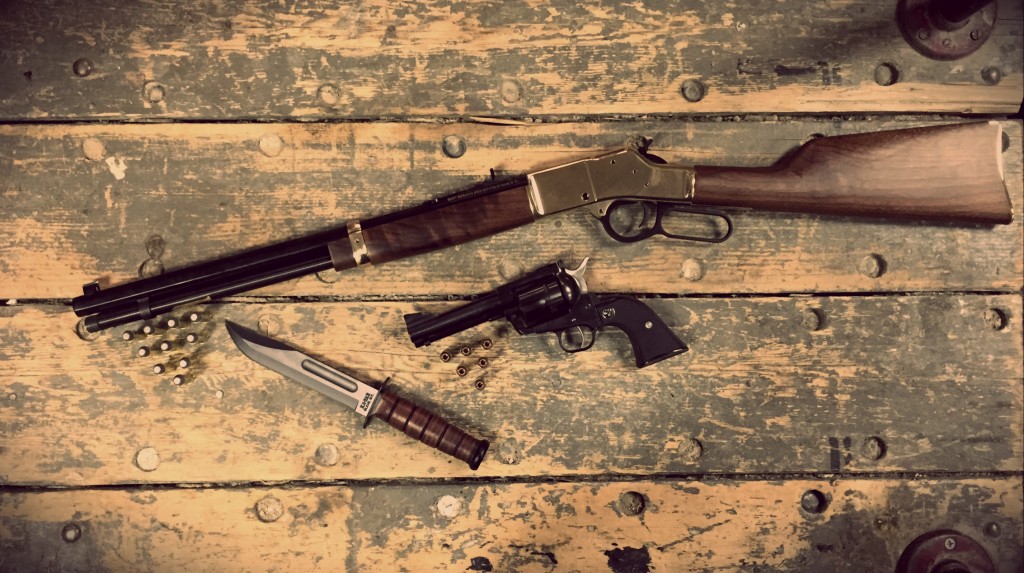
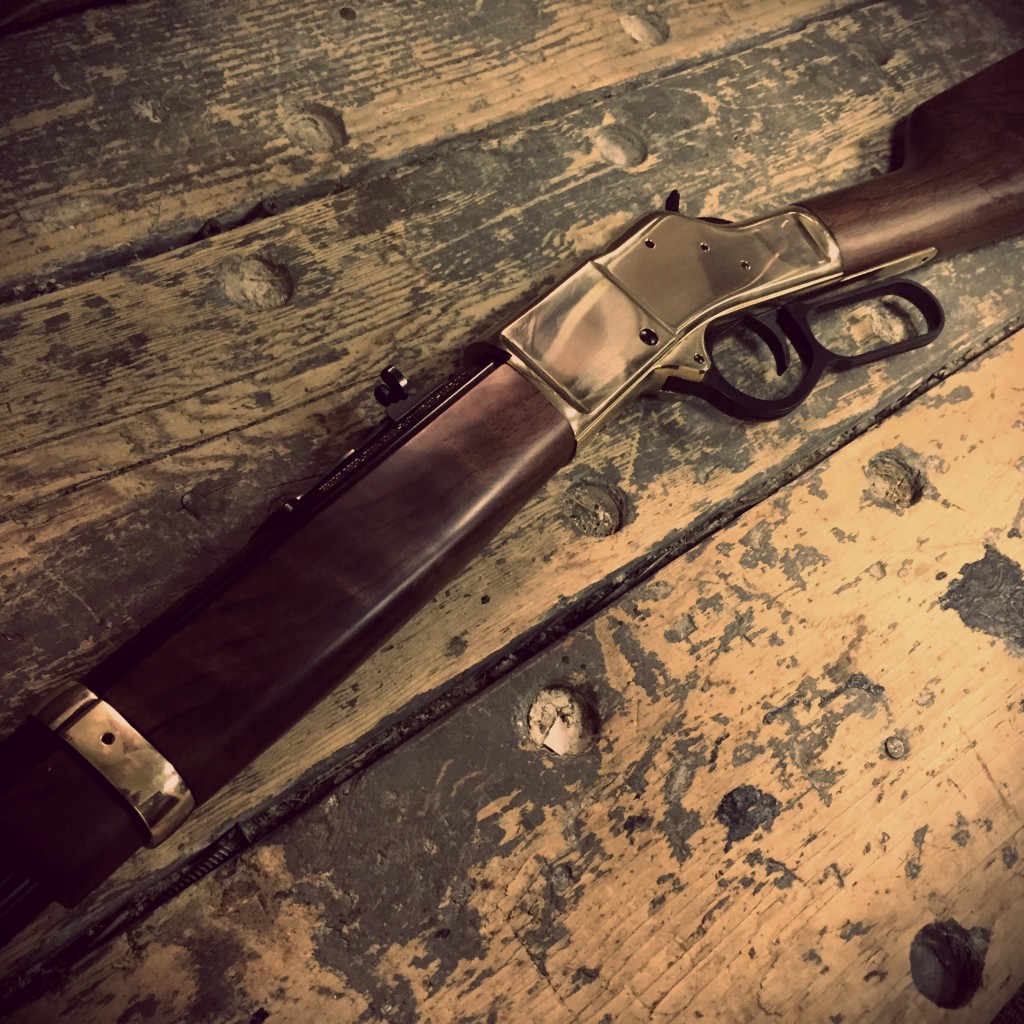
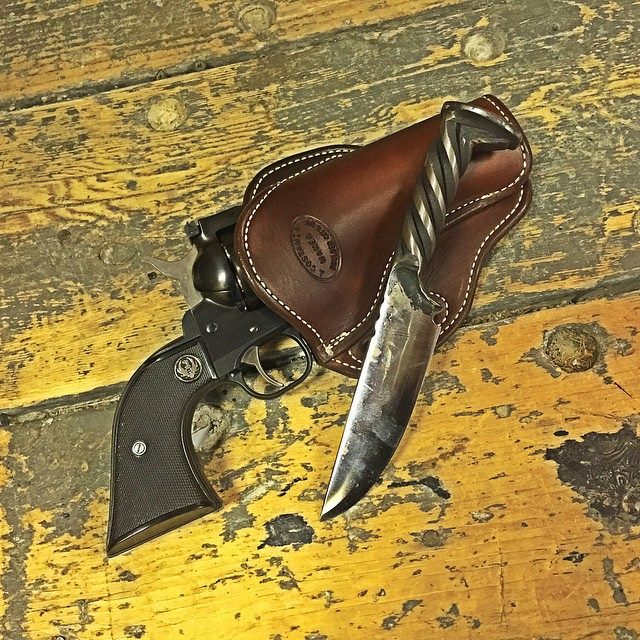
I’m not saying that I’m prepping to survive an 1800s zombie apocalypse, but the thought did occur to me. In the photo: Henry Big Boy .45 Colt, Ruger Blackhawk .45 Colt, Ka-Bar, Hornady 255gr LRN, and Winchester 225gr PDX. Click more for a couple more photos.
Carrying a gun does not make me special. It doesn’t make me different, it doesn’t make me a sheepdog, and it shouldn’t be treated like an occasion. The act of every day concealed carry should be no more interesting or dramatic than the act of buckling your seatbelt, washing your hands during flu season, or changing the batteries in your smoke detectors.
What we do when we carry a gun is reinforce the statement that “I am responsible for my own safety.” That’s why I chose the example of seatbelts, hand washing, and smoke detectors. Doing those things are all common-sense activities that any rational adult would agree reduce your risk factors. But the gun community has this weird cognitive dissonance about CCW, where on the one hand we want it to be normalized and accepted, but on the other hand we want it to make us special and different.
Unless of course you’re talking about an actual dog that herds and/or protects sheep, stop using the word sheepdog. It’s stupid, and it encourages a toxic mindset that ruins lives. You think I’m kidding? You know who thought he was a sheepdog? George Zimmerman. How’d that work out? Sure, he was legally justified, but he ended up killing a guy who probably didn’t need killing, and has now had his life completely ruined. All because he was a “sheepdog.”
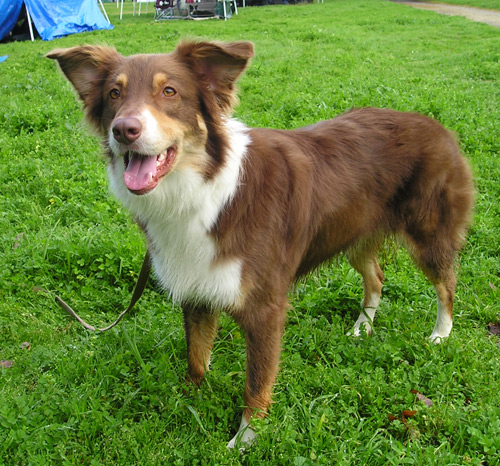
This is a sheep dog.
Now, let’s backtrack a little bit. Most of you are going to read that first paragraph and jump down to the comments section anyway, so I can take the next several hundred words to go into detail here. Last week I wrote a post called “Five reasons you’re carrying your EDC wrong” which included the following section:
3. You think you’re a sheepdog
You’re not a sheepdog. You’re just a dude. And there is literally nothing wrong with being “just a dude.” When you get this idea in your head that you’re carrying a gun to “protect your community” you’re going about it the wrong way. Carrying a gun should be a boring, mundane, thing. You get up, you put your pants on, your clip your knife in your pocket, you buckle on your gun. The same as buckling your seat belt. You don’t do it because you’re cool, you do it because you’re a responsible adult who takes care of his own safety.
Predictably, certain parts of the internet got rather hurt in the ass about that, specifically the gun related sections of Reddit and Dave Grossman fanboys (some crossover). People who think of themselves as sheepdogs. But before I can deconstruct this term, I want to look at what part of it people get so attached to. You can pretty much draw everyone’s romantic association with the term back to this paragraph by Grossman:
But what if you have a capacity for violence, and a deep love for your fellow citizens? Then you are a sheepdog, a warrior, someone who is walking the hero’s path. Someone who can walk into the heart of darkness, into the universal human phobia, and walk out unscathed.
That does sound rad, and it’s easy to see how people would get attached to that, because it does important things for the average CCW holder’s mind. Primarily, it feeds the ego. It makes you feel special, different. It sets you apart because you’re different in a good way. That kind of thinking is absolutely addictive, it’s like crack. Once you get a taste you can’t get enough. And the best part of it? No effort is required. You don’t have to join the military, be a cop, take any sort of training, you can just show up with your CCW and say “I’m a sheepdog” and think that makes you special.
It doesn’t. And in fact, that sort of mindset gets people killed. This is where we revisit the tragic case of George Zimmerman. And it is tragic, because a person is dead and another man’s life is ruined. Whenever this topic comes up, people who claim to be sheepdogs and defend the idea always have this idealized version of how things go down in their head. To these people, it’s always clear cut: you come across a masked man with a machete about to rape and murder a cute blonde girl or a little old lady. You whip out your CCW Badge, yell “SHEEPDOG! DROP THE KNIFE, SCUMBAG” and then when he turns to attack you, drop him with two well placed shots from your Kimber 1911. Always clean cut, always neat and tidy. Unfortunately, real life doesn’t really care about your sheepdog fantasy land.
This is where everything falls apart, and where my problem with the use of the term really begins. As humans, we excel at many things. Foremost on that list? Lying to ourselves. That really is the problem with the whole concept of “the sheepdog.” Because it feeds the ego and because there’s no effort required to become a sheepdog, it’s easy to slide ourselves into the idea that we’re better than all the people around us because we carry a gun. It creates a mental divide between citizens, where these self-appointed sheepdogs look down on people who choose not to carry. It’s so easy to slip into that. I fall prey to it all the time in small ways. What’s tremendously ironic is that the people who refer to themselves as sheepdogs are also frequently the most vocal critics of “militarized policing” – yet they’re guilty of the same “us vs. them” mindset that they criticize the police for having.
A concealed carry permit isn’t a junior G-man badge, and it’s not a license to go looking to get into someone else’s gunfight. I’m not saying don’t get involved, in fact I want to say the exact opposite. What’s most toxic about the way the term sheepdog is used today is just what I stated above, that it creates and feeds a culture of us vs. them. The truth is that we’re not protectors of our community, we’re not warrior-heroes walking the path of righteousness. Most of us, myself included, are just folk. I’m just a guy who carries a gun because I want to have the most effective tool available to defend my life, and the lives of my family members. I’m not saying don’t get involved, in fact I would encourage you to get more involved. If you claim to be a sheepdog but you don’t know your neighbor’s names, you’re just lying to yourself. If you really believe you should protect your community, don’t set yourself apart from it. Be a part of it. Get to know your neighbors, create relationships. If George Zimmerman had really been a part of his community, he wouldn’t have been patrolling the neighborhood alone after dark. Those are the actions of someone who has set himself apart from the people around him, someone who’s invested more in his own self-image than the actual safety and protection of his fellow citizens.
Here we are, 1000 words in. If you’ve made it this far, thanks for actually reading the article. I want you to take this one point away from this entire thing: there is nothing wrong with wanting to protect your community. There’s nothing wrong with carrying a gun, with getting training, and with being active and involved in your community. Why I hate the term sheepdog is simple. It allows people to mentally set themselves apart from the very same people they claim to be protecting. Don’t set yourself apart from the people around. Be a part of the community, get to your know your neighbors. I’d much rather be a neighbor than a sheepdog.
Do you carry a gun regularly? If so, there’s a good chance that you’re probably doing at least one of these things that you shouldn’t be doing. Here are five reasons you’re carrying your gun incorrectly, and how to fix them.
1. Your belt is a piece of s***
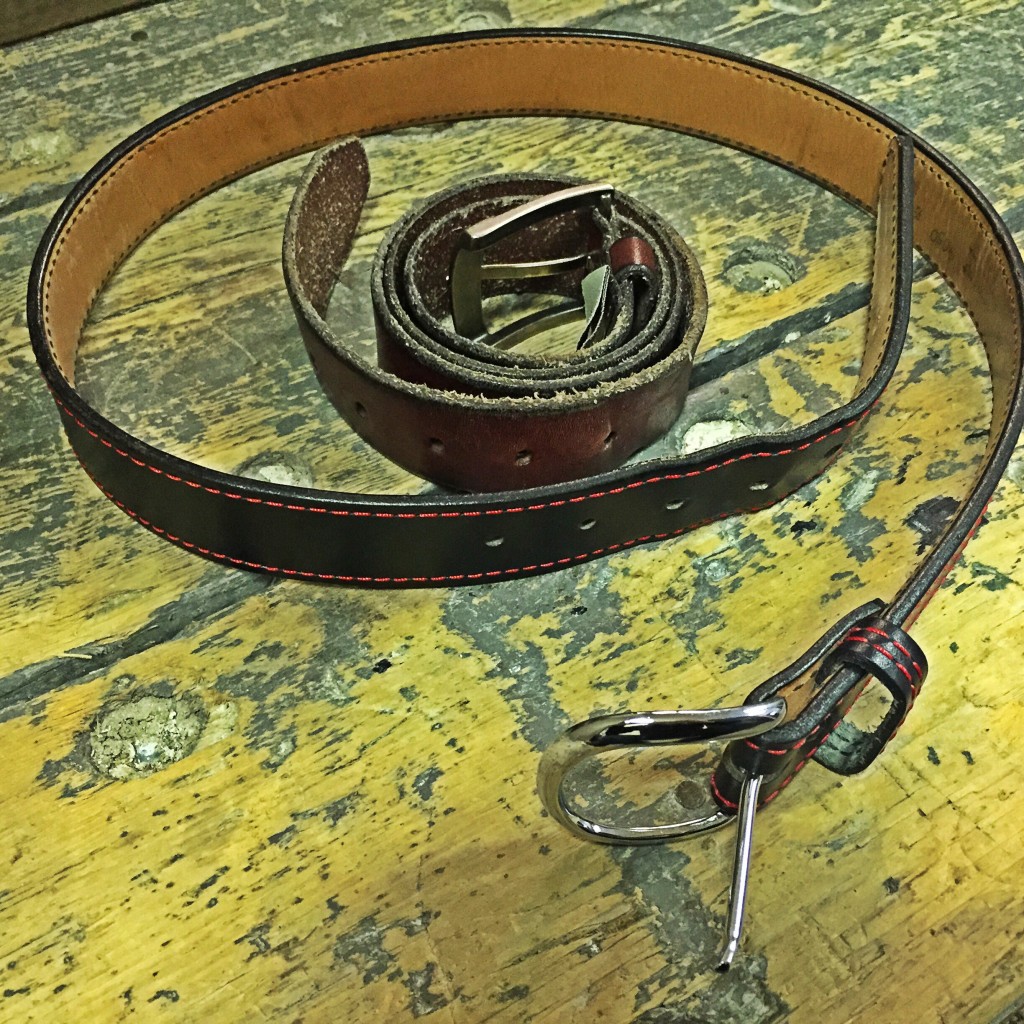
Look at these two belts. The one in the middle that’s all nicely rolled up is from Fossil. It’s not a gun belt. It’s not reinforced, and under the weight of any gun larger than a NAA Black Widow it sags. It’s a perfectly fine belt…if you’re not carrying a gun. If you are carrying a gun, it’s a piece of s***. The other belt, the one that’s around it? That’s a gun belt. It’s a leather belt that’s been reinforced with an inner layer of kydex so that it doesn’t deform and doesn’t sag. I can’t roll it up, because it’s too rigid. It is a great gun belt, and also looks quite nice. Get a good belt.
This week Tom Givens, one of the most admired firearms trainers in the business, highlighted a video of a self defense shooting over at Pistol-Forum.com that teaches a lot of key lessons about successful self defense.
How many times have you heard the phrase “You can’t beat a drawn gun” before in discussions of self defense? Well, this gentleman did. The bad guys busted through the door with guns in hand and he decisively beat them back, leaving one with only gunshot wounds to show for his robbery attempt. So how did he do this?
1. Paying attention
The first key to success here was situational awareness. The term “situational awareness” gets used quite a bit but often the conversation is pretty silly. Some folks talk like situational awareness is some sort of superpower that repels bad guys. In some cases it’s certainly true that paying attention to what’s going on will allow you to avoid a dangerous situation, but sometimes paying attention just means that you get an extra couple of seconds notice that trouble is coming.
Note how quickly this all went down. The bad guys stormed in the front door and covered most of the empty space to the guard station in just a couple of seconds. Had the good guy been unaware of their approach until they’d covered all that space he would have had a much bigger problem on his hands. A couple of seconds doesn’t seem like a lot of time but in life or death situations increments of time we ordinarily dismiss as insignificant make the difference between life and death.
Paying attention buys you time, and time is opportunity. In this case paying attention bought him the opportunity to keep the bad guys from establishing control and determining his fate. They came in like a wrecking ball…they left as quick as they came in, scared out of their wits and bleeding.
2. No hesitation
When he saw those guys coming through the door he knew instantly what was up and reacted immediately with the judicious application of lethal force. Once again I encourage you to listen to this interview with William Aprill and pay particular attention to what he says about “schemas.” The security guard in this video clearly recognized that someone may well try to kill him and made some important decisions about that well before the moment when he had to pull a gun. Creating that “mental parking spot for violence” made all the difference.
Accepting that it may be necessary for you to use violence in self defense is an important part of the defensive process. Criminal violence happens fast and usually by complete surprise. The three thugs here perpetrated a full-on ambush on the security guard…but he had apparently already recognized that as a possibility he faced in life.
In the aftermath of dangerous events you often hear people mention something like “and then my training took over.” What they mean by that is precisely what you see in that video. The instant their mind recognized a situation they had deliberately prepared for, their body produced the actions they had rehearsed without hesitation.
When you accept that it may happen, learn the signs that it is happening, and make reasonable preparations on how to respond…the chances of a happy outcome increase dramatically.
Note that when the bad guys saw him move and draw that pistol it completely destroyed their plan of action. They were thrown into absolute panic by the sight of somebody who reacted to their initial assault with immediate violence. Someone with a gun and the apparent resolve and skill to use said gun will scare the living excrement out of most bad guys. Those who are too stupid or mean to be scared and run away will usually end up being shot.
3. Aiming
Note how the security guard drew to a two-hand hold with the pistol in his line of sight. This tends to work pretty well for getting hits…as is shown in the video. Ignore anyone who tells you it isn’t possible to intelligently direct bullets under gunfight conditions. Those people are idiots.
4. Movement
Note how the security guard moves off the line of attack. It’s not a vast distance, but a moving target that is shooting back with reasonable accuracy is a pretty tough problem to deal with.
5. Intelligence
Note how, once the shooting has stopped, he places himself in a corridor where he can monitor the entrance while exposing almost none of himself in the process. It was over, but he didn’t know that. You usually don’t know when it’s over in the moment. This guy was giving himself every advantage he could even after the shooting stopped.
Outnumbered, outgunned, and yet he inflicted his will on the would-be aggressors so effectively the one who was shot crawled out of there without his gun or even his own damn shoes. Ponder that for a moment…one older guy with a gun and the mindset and skill to use it effectively put three violent felons into a state of absolute terror.
Seems like a pretty good template for self defense to me.
Last week, I took the Ruger Blackhawk in .45 Colt to the range for accuracy testing. I worked with three different loads, Hornady 185 grain Critical Defense, Winchester 225 grain PDX, and Fiocchi 250 grain LRN cowboy ammo. The above group is from the Winchester PDX, and it shot into a hair over 2 inches at 50 feet from a standing freestyle position.
We use cookies to optimize our website and our service.
Functional
Always active
The technical storage or access is strictly necessary for the legitimate purpose of enabling the use of a specific service explicitly requested by the subscriber or user, or for the sole purpose of carrying out the transmission of a communication over an electronic communications network.
Preferences
The technical storage or access is necessary for the legitimate purpose of storing preferences that are not requested by the subscriber or user.
Statistics
The technical storage or access that is used exclusively for statistical purposes.The technical storage or access that is used exclusively for anonymous statistical purposes. Without a subpoena, voluntary compliance on the part of your Internet Service Provider, or additional records from a third party, information stored or retrieved for this purpose alone cannot usually be used to identify you.
Marketing
The technical storage or access is required to create user profiles to send advertising, or to track the user on a website or across several websites for similar marketing purposes.