Dear OC activists: please stop comparing yourself to Rosa Parks or other civil rights activists. What you’re doing is obeying the law in an annoying and childish fashion. Rosa Parks actually broke the law to act as a test case for an unjust and immoral segregation law. You’re not Rosa Parks. If you want to compare yourself to real civil rights activists, try engaging in some real civil disobedience.
Photo of the day: Defensive 3-gun gear

Taking defensive guns to games: Remington 870 Magpul, Troy Lamb Carbine, and HK VP9 with Taylor Freelance +5. Sure, the shotgun gives up capacity, the pistol doesn’t have a five inch slide, and the rifle is a little too heavy, but if you take this to a 3-gun match you’ll probably have a pretty good time.
And you’ll have the best looking gear at the game, that’s for sure.
Remington 870 Tactical Magpul FDE review
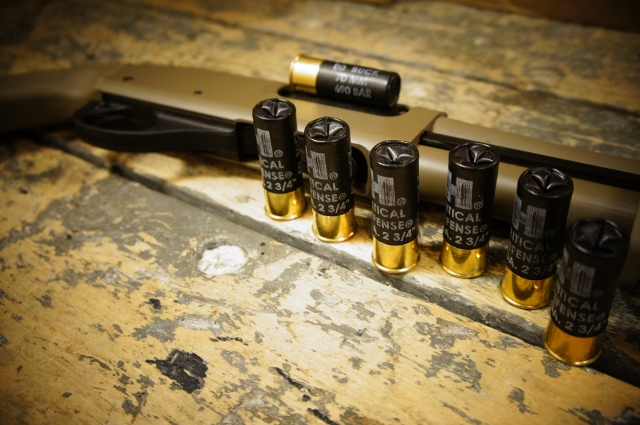
One of the dangers of working in a gun shop is you can see dealer level pricing on guns. One of our distributors had a special on Remington 870 Tactical Magpul shotguns in FDE, for a stupid low price. I dipped in my rainy day fund (it was raining that day so it counts) and ordered one. It’s a really good looking gun right out of the box.
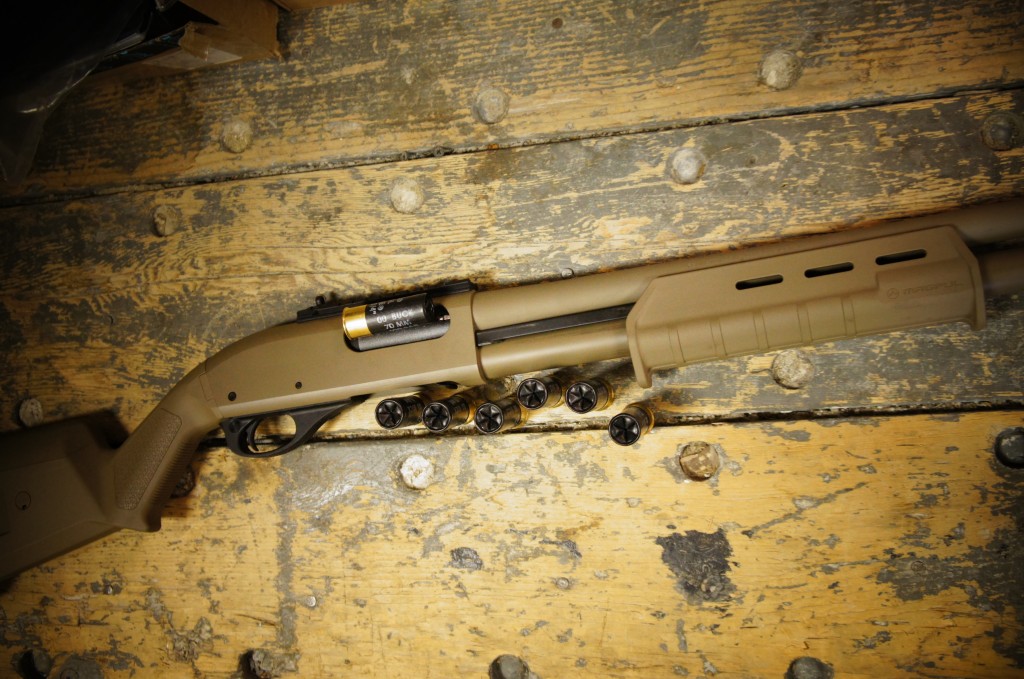
The Specs
The 870 Magpul FDE is a pump-action, 12 gauge shotgun. It features a Magpul forend, Magpul stock, XS Ghost ring sights, a breacher brake, and a 6+1 capacity. The trigger pull breaks at 4.5 pounds on this model. Barrel length is 18.5 inches, and the barrel is threaded for chokes. The gun also features what Remington refers to as their SuperCell recoil pad, which is designed to reduce the felt recoil of the gun.
Shooting
Initially, the pump on the 870 would occasionally stick to the rear with the bolt in the open position, requiring some considerable force to return the shotgun to battery. I suspect this is because of the cerakoting on the gun, which adds just enough material to the internal receiver parts to occasionally make things stick. This was fixed by dry and live fire until the contact points had worn down a bit.
At the range, the gun performed as expected, with no feeding or extraction issues. Like you’d expect an 870 to perform, so to speak. The SuperCell pad did an admirable job of reducing felt recoil, even when patterning the gun with various defensive buckshot loads. Speaking of buckshot, the gun held relatively tight patterns with most loads; the best two performers were the pictured Hornady Critical Defense buckshot and Federal buckshot. Both held approximately 3-4 inches at 10 yards, with the pattern going exactly to point of aim with the XS sights. The worst patter was with Hevi-Shot Hevi-Duty #4 buck; at 10 yards pellets were off the paper, making this load not suitable for home defense from this gun as it is currently configured. That was too bad, because the #4 load from Hevi-Shot was quite pleasant to shoot.
Also used were various all-lead target loads, to test the gun’s suitability for 3-gun use. While a pump isn’t the optimal choice for 3-gun, and certainly not a pump with a 6 shot tube, there is value to using your defensive firearms in competition. This lets you pressure your guns and gear in the only live-fire stressful environment this side of a gunfight. The 870 kept a relatively tight pattern out to 15 yards, tight enough to knock down a pepper popper at least. If I were going to run this gun in 3-gun in a pump-friendly division, I’d ditch the “tactical” choke in favor of a modified, and slap on an extended mag tube.
The Magpul stuff
Are the Magpul products really worth the extra money? Actually…yes they are. Especially the stock. The forend is fine, but I could honestly take it or leave it. The SGA stock on the other hand is probably the best factory shotgun stock on the market today. It grips well, it shoulders easily, and the adjustable risers really do allow you to change the cheek weld if you’re using optics or some other kind of sights. It really is pretty awesome.
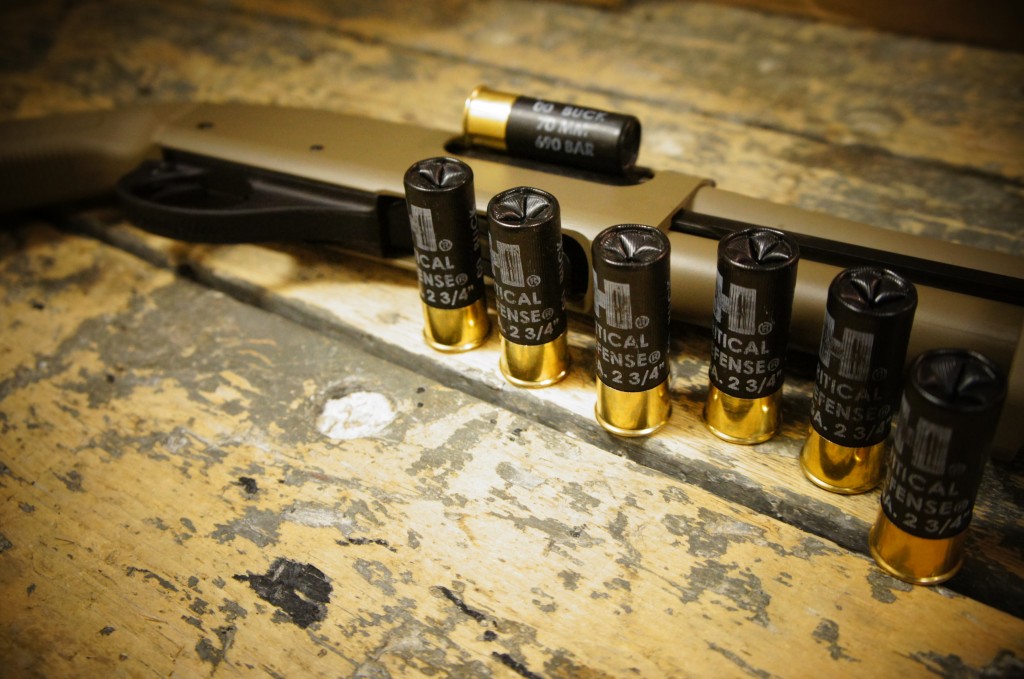
The Verdict
I like this gun. I am also a sucker for 870s, things in FDE, and thoughtfully designed products like the SGA stock. Now that the price on these guns has fallen below $600 at retail, I think they’re absolute a great deal if you’re looking for a no-nonsense pump gun that’s well set up right out of the box. If you’re in the market, or you just want another cool shotgun, you can find brand spanking new Remington 870 Magpul guns on Gunbroker for in the 500 dollar range. Pick one up, shoot it a bunch, and be happy. I’m going to throw a light on this gun shortly and it will live next to my bed.
Racist Open Carry in Ohio is not a Bloomberg False Flag
Over the weekend, this video of some Open Carry scumbags in Ohio went viral (for gun community levels of virality):
I originally saw it at Bearing Arms, which notes that now 2 of the 4 idiots in the video have been arrested. Good. But that’s not what we’re talking about today, because if you read the comments at BA or any of the other sites, you’ll see a repeated theme pop up. People assume/accuse the folks in the video of being plants, or a false flag operation. I have sour news for you, Jack: it’s not.
Myths & Truths: 3 Gun Pro Squad
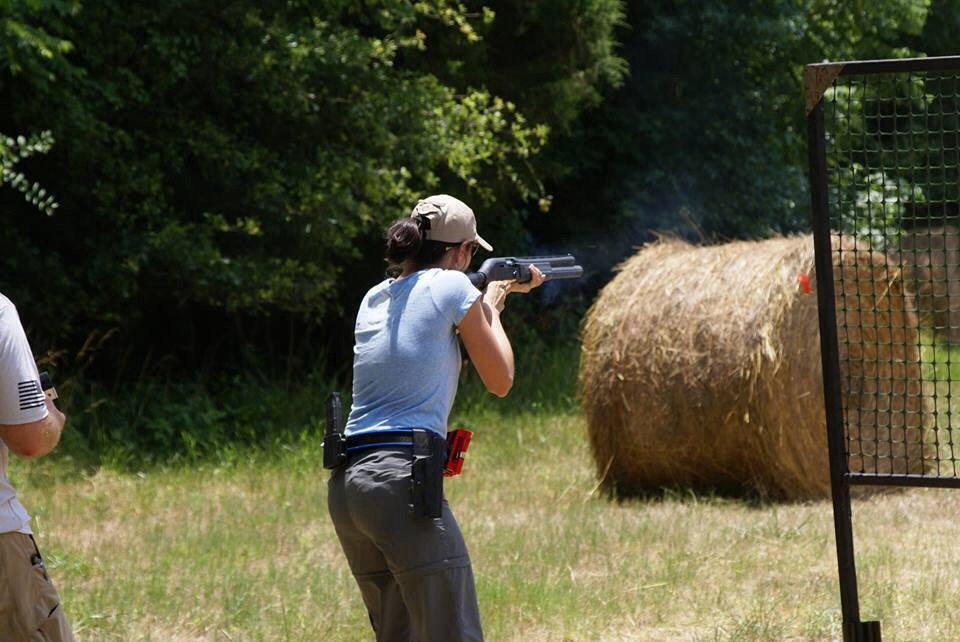
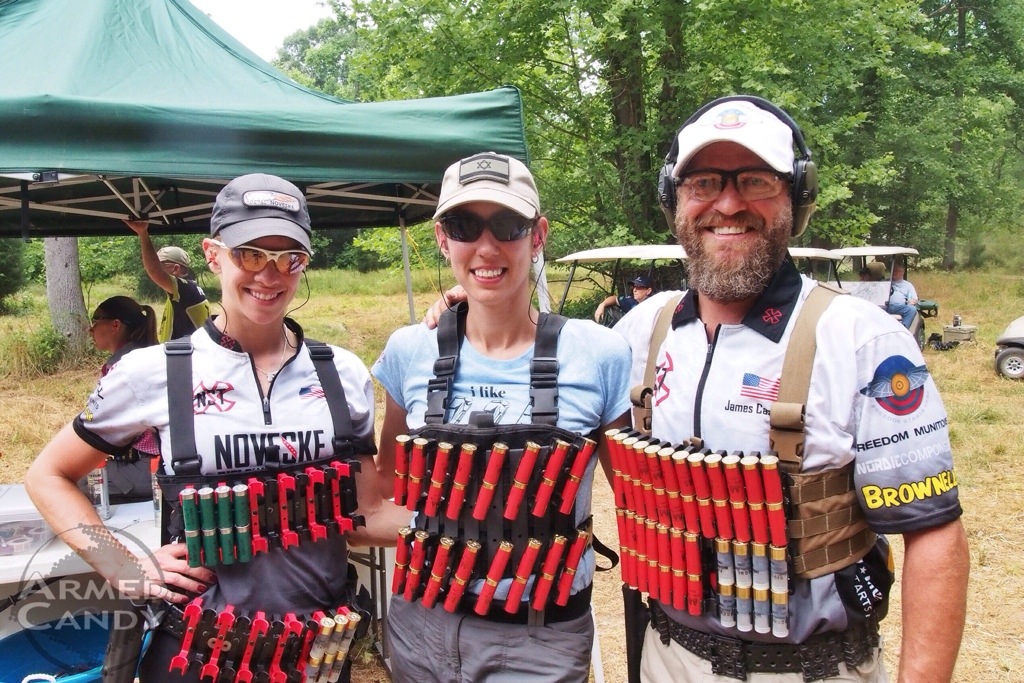 At many major 3 gun matches, big name, sponsored, professional shooters are placed on a squad together. This tends to keep them out of reach of the other shooters at the match. Because of this system, the pro squad seems to hold some mystique. I have heard some people’s beliefs about being on this elusive squad and some of these opinions really make me giggle. So, after shooting the Freedom Munitions Memorial Match at Clinton House Plantation in South Carolina last weekend and being the greenest member of the pro squad, I feel it is my duty to set the record straight.
Fun with shotguns
Next week’s 90 second gun review is going to be full of tube-fed goodness.
Deconstructing derp: Pistol Caliber Carbines
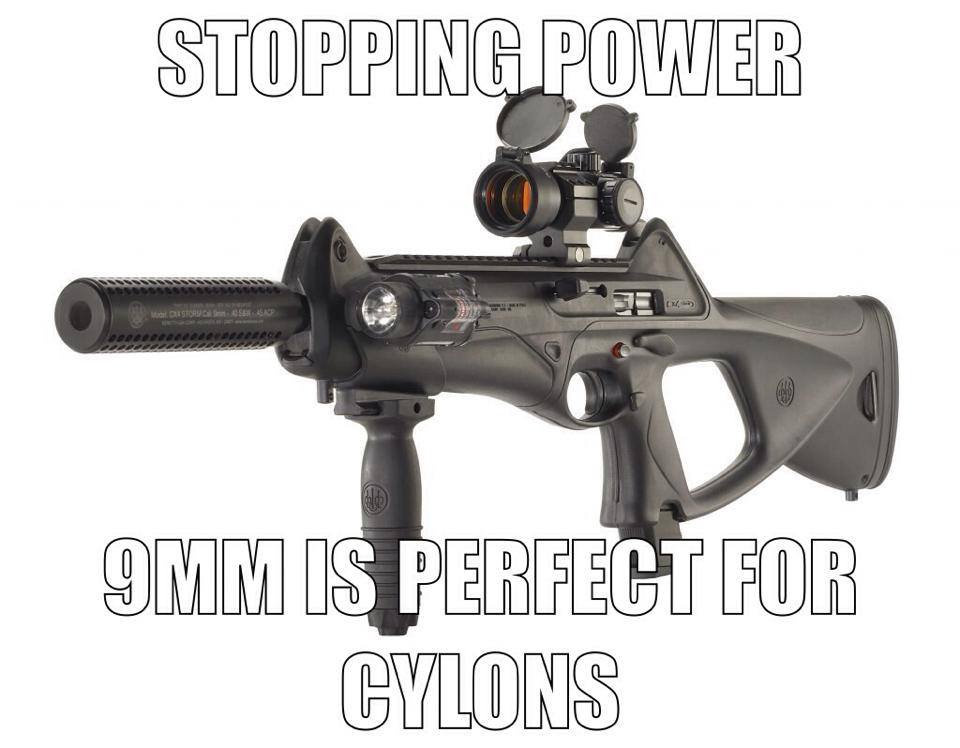
I love the idea of pistol caliber carbines the same way I love the idea of the M1 carbine. A good PC should be lighter than an average AR (6 pounds or less), take common pistol magazines, and be accurate and reliable. What it does in this roll is give shooters the ability to extend their zone of domination or whatever silly tactical phrase you want to use out past the effective range of a pistol. Essentially, someone who can effectively fight within 10 yards with a pistol becomes capable out to 50 yards with a pistol carbine.
They’re also great range toys, especially in 9mm. What’s frustrating is when people try to make a PC into something it’s not, like a replacement for a proper rifle in a serious service caliber (.223 and up) or they derp it up like a range toy and tell you that it’s a serious gun. Remember, the goals of a good PC are to have a lightweight, fast handling, reliable gun. On that note however, there is basically no situation I can think of where I’d rather have a pistol caliber carbine than either a 12 gauge shotgun or a .223 caliber rifle, logistics being equal.
But, that’s not the point. What we do want to talk about today is selecting a pistol caliber carbine, and how to set it up smartly. To do that, let’s look at those criteria established above: weight, accuracy, reliability, and commonality of magazines. Interestingly, if I’d been writing this post 15 years ago, during the dark days of the Clinton AWB (yes holy s*** it was that long ago) we would have had a lot more choices for carbines. Today, because of the AR revolution, anything you can do with a PC you can do better with a 16 inch AR, or if you’re feeling froggy a pistol AR with an SB15 brace. So today, what are our mainstream choices for a pistol caliber carbine?
- Beretta Cx4 Storm
- Kel-Tec Sub2000
- Hi-Point 9mm Carbine
- AR in 9mm
Running down that list, the first thing we can do is toss out the 9mm AR carbine. The platform has too many variables, and if you’re going to get an AR, just get an AR in .223 and do it right. So then to rank them in order of preference, the best bet is the Cx4 Storm, then the Hi-Point carbine, and finally the Kel-Tec. The Storm is the best bet because it’s made by a reputable company, weighs less than 6 pounds, and accepts common magazines, either Beretta 92 mags or Px4 Storm magazines. It’s also available in .45 ACP if that’s your cup of tea, and to be honest, I kind of dig it in .45. But 9mm is the smarter choice.
The Hi-Point is next because if you’re not going to buy from a quality manufacturer, you should spend as little money as possible. And frankly, the Hi-Point carbines are the only Hi-Points I actually like. They also tend to work pretty well, because they feed from a single stack 10 round magazine and use a bone simple gas blowback operating system. So yes, they’re cheap (although not as cheap as they used to be) generally reliable, and easy to shoot well. While the mags aren’t terrible standardized, they’re also cheap (15 bucks) so you can buy plenty.
The last choice one is the Kel-Tec Sub2000. What you get with the Sub2000 is 1/3 the quality of the Beretta for 2/3rds of the price, and that’s just a bad deal. I certainly wouldn’t bet my life on a gun that folds in half in front of the receiver. You’re better off buying the Hi-Point, because it will be half the price of the Kel-Tec, and will probably be more reliable. The only thing the Kel-Tec has going for it is that you can get one that takes Glock 17 magazines.
Now that you’ve picked your carbine, here’s how to set it up for victory. I don’t really believe that you need an optical sighting system on a pistol caliber carbine, but if you must get one than your best bet is to keep it small, and keep it light. Don’t get a cheap POS dot like a UTG red dot for $34.99 at your local Wal-Box. Get a decent quality dot. If you’re on a budget, get a Burris FastFire III. If you’re not on a budget get an RMR or an Aimpoint Micro. Remember, the goal is to NOT sacrifice the gun’s lightness. As far as lights go, just get a Crimson Trace RailMaster. They’re like $120, have 100 lumens, and are a good product made by a reputable company. You’re not fighting hadji in the mountains here, so you don’t really need a face-melting 600 lumen death ray. You need to be able to 1) see your target, and 2) hit your target. That’s it.
A sling would be good depending on the gun’s operational plan. If you have children and use a long gun for home defense, a sling is mandatory. If no kids, it’s optional.
A note on the accessories: if you go the Hi-Point route, don’t bother with an optic. Their rail system isn’t really stable enough for that, and you’ll find your zero constantly shifting. Just stick the light on there and call it good. The same goes with the Kel-Tec, because the rail system they make doesn’t really anchor very well, and your zero is going to jump around like crazy. Put a light on it, and stick with the iron sights.
That’s pretty much it. While I will still recommend a proper rifle or a shotgun over a pistol caliber carbine, if you keep your purpose clear, you can set one up pretty well for home defense. Light rifles are right rifles, so keep it clean, keep it light, and don’t ruin a lightweight, fast handling rifle by hanging a bunch of derpy parts on it.
Letter from USPSA President Phil Strader on the Paul Hendrix cheating scandal
Posted this morning on Facebook:
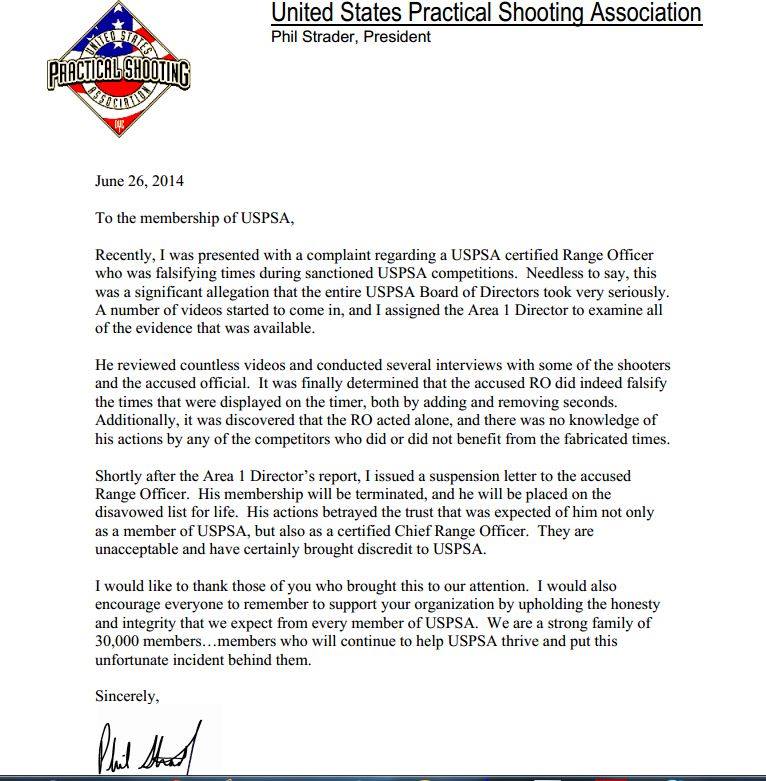
I think that this is a solid, reasonable, and balanced response. Lacking any way to prove that Hendrix colluded with others conclusively, the punishment should fall squarely on his shoulders, and a lifetime ban is the only appropriate punishment.
My only question is why this was posted on Facebook, and not emailed to the entire membership at large?
Shooting the Humbler – 700 point aggregate
Last week I wrote about training with limited time and ammo, and I specifically called out two drills you can use to train on and test your improvement. The first was the 99 Drill, which I didn’t shoot this week, and the second was the 700 point aggregate, or the Humbler. Today I’m going to take you through the drill string by string and talk about what you can do to shoot it better.
First, the drill itself. It is shot on an NRA B8 target at 25 yards. I recommend using one B8 target and several repair centers to make things easier. You’ll need 70 rounds of ammo, a good belt/holster, and a stopwatch or a shot timer. A shot timer is preferable, but a stop watch with a countdown function can work as well.
Stage 1: Slow Fire
10 rounds
freestyle
time limit: ten minutes
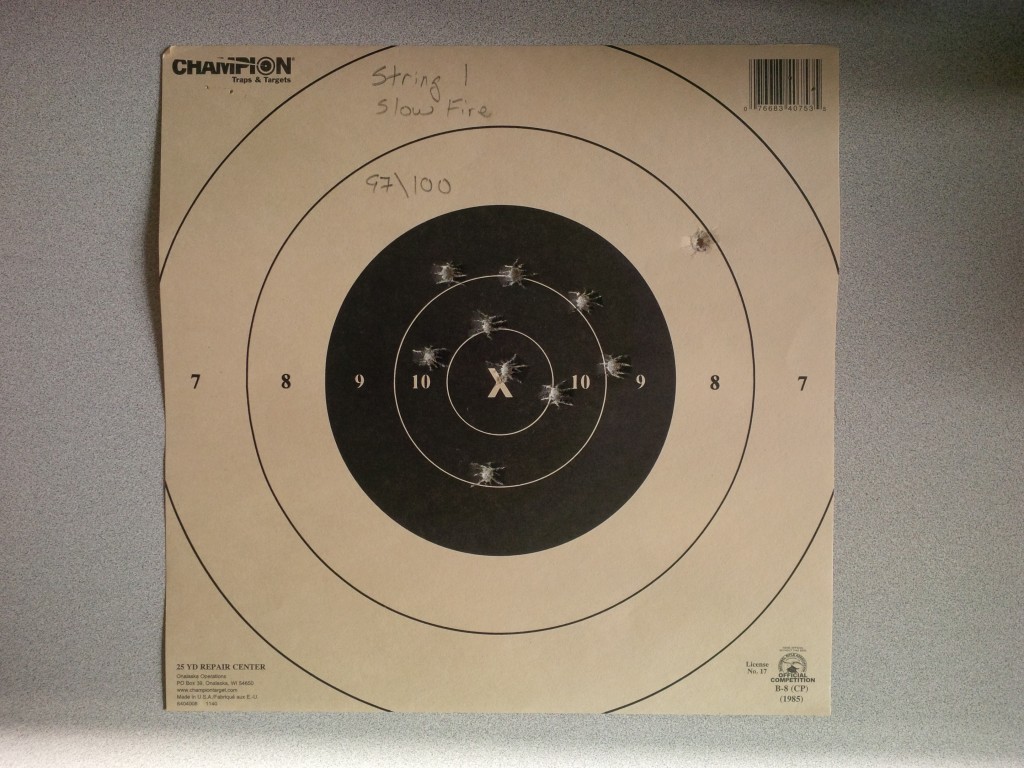
First target is one string of 10 rounds, shot slow fire. 10 minutes is functionally the same as unlimited time. I recommend taking at least 30 seconds per shot here, and holstering in between shots. There’s no reason that with an accurate gun I shouldn’t be cleaning this string. As it is, shooting it cold I dropped 3 points, one 9 and one 8, those other shots in the 9 ring are touching the line, so they’re 10s. This string is all about being as accurate as you can be under basically no time pressure. 8s are unacceptable.
Stage 2: Timed Fire from the holster
5 rounds
freestyle from the holster
time limit: 20 seconds
repeat a second time for total of 10 rounds fired
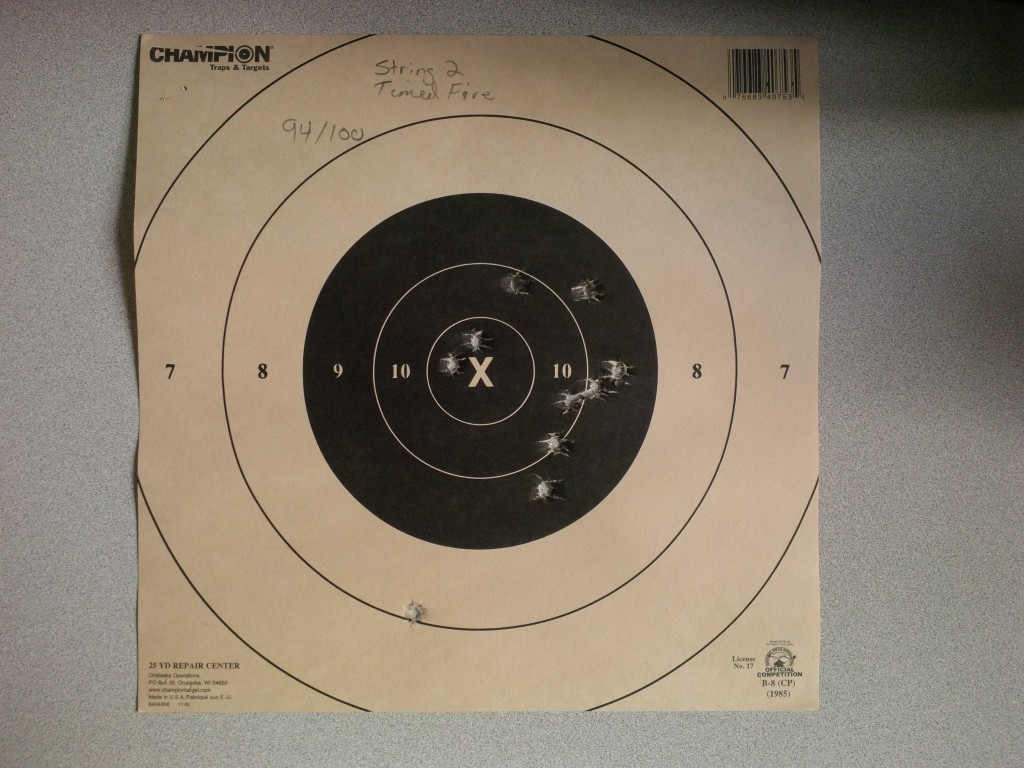
Timed fire means 5 shots in 20 seconds, from the holster. I don’t believe in shot cadence, or trying to time your shots every certain number of seconds. Having a 20 second time limit means that you have enough time on every shot to make sure the sights and trigger are “good” and you can even back off a trigger pull if you don’t like what the gun is doing. On this timed fire target, I’m pretty clearly drifting the gun a little right. I dropped four 9s and the one 8 at the bottom.
Stage 3: Rapid Fire from the holster
5 rounds
freestyle from the holster
time limit: 10 seconds
repeat a second time for total of 10 rounds fired
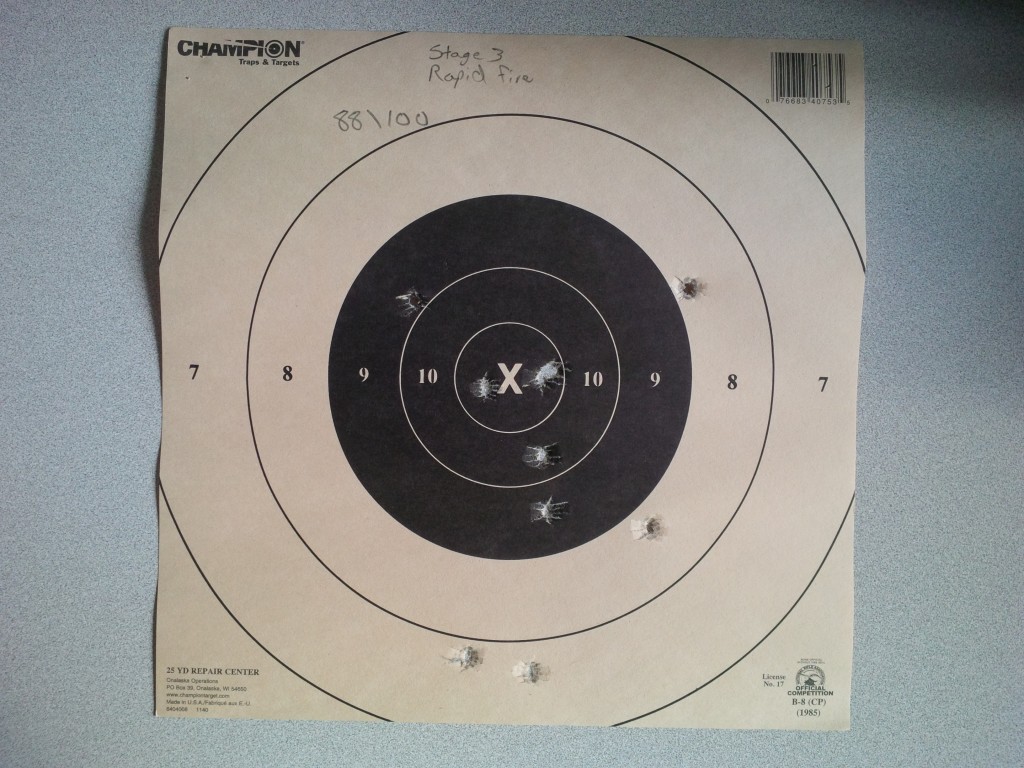
You can tell that on the rapid fire things got a little loosey-goosey. The two 7s down at the bottom are pretty clear indicators of seeing the sight picture I want and thinking “oh man the sights look great I should pull the trigger really hard RIGHT NOW” which invariably drives the muzzle down. Still, five shots in 10 seconds is a pretty long time, even from the holster. I shouldn’t be rushing here, I should be focusing on clean trigger presses.
Stage 4: SHO Slow Fire
5 rounds
strong hand only
time limit: five minutes
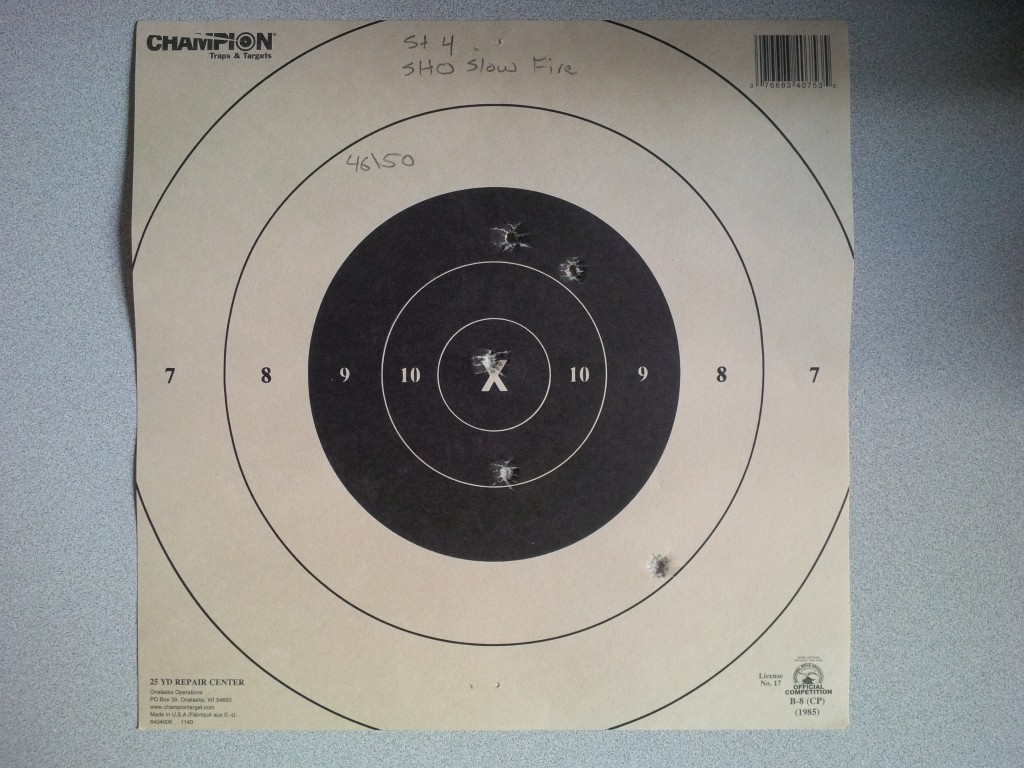
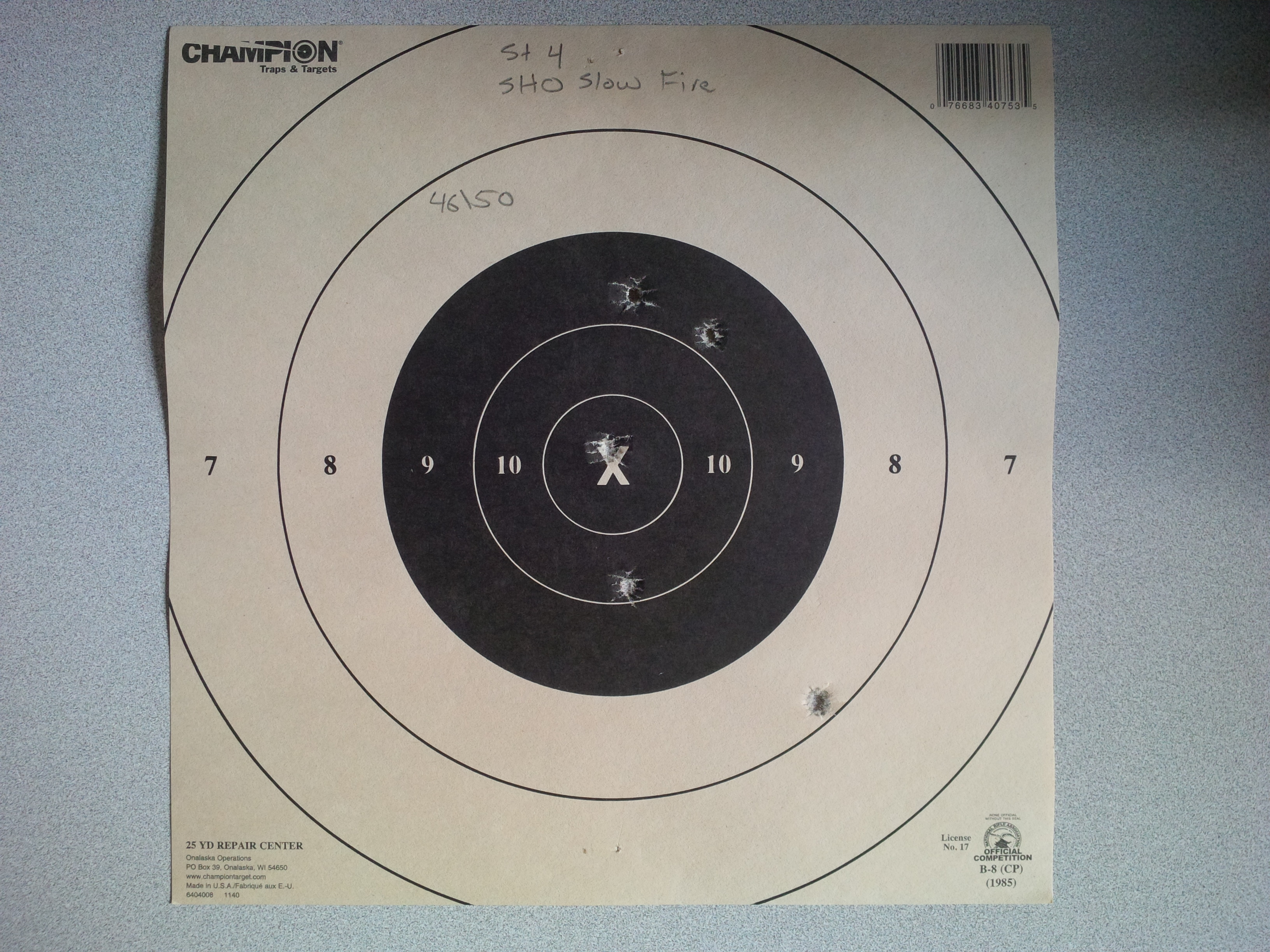
Back to slow fire, this time strong hand only. The slow fire stuff should be automatic. There’s no excuse for me to be dropping 8s here, because I have the time and the opportunity to make each shot absolutely perfect. I can live with a 9 or two, but the 8s shouldn’t be happening on slow fire strings. There’s just too much time, so much time that if a shot feels bad, I can back it off, take a deep breath, and start it over again.
Stage 5: SHO Timed Fire from the holster
5 rounds
strong hand only from the holster
time limit: 20 seconds
Stage 6: SHO Rapid Fire from the holster
5 rounds
strong hand only from the holster
time limit: 10 seconds
I shot these on the same repair center because I was getting lazy with changing targets.
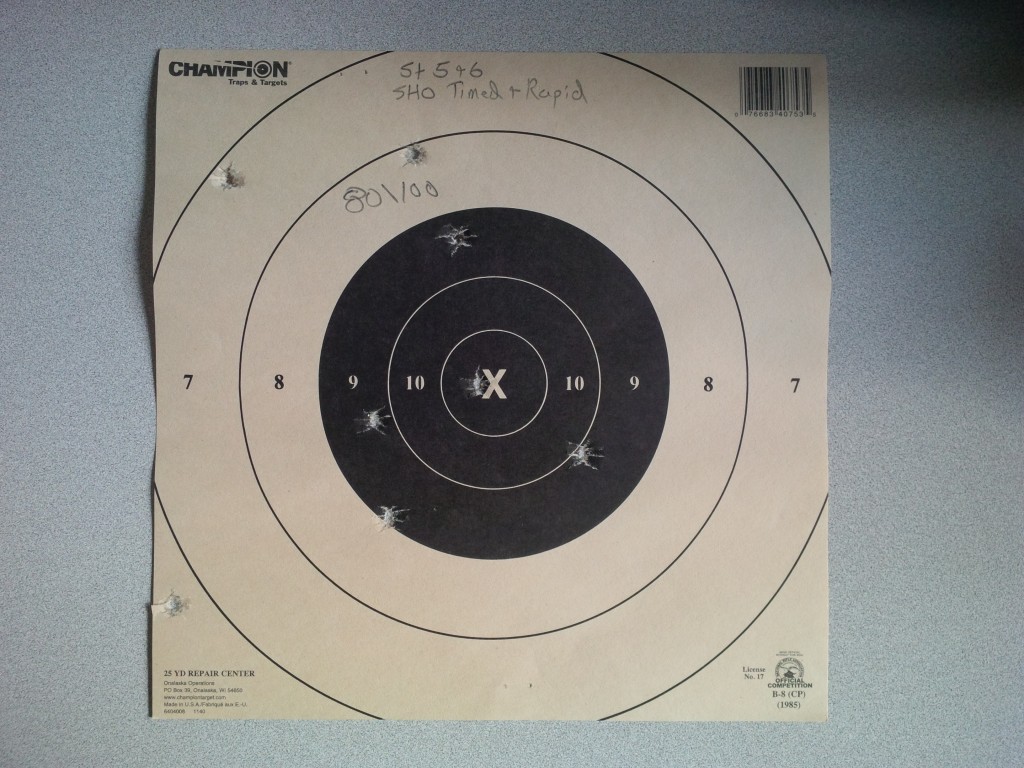
This got pretty wild. I dropped a total of three 6s, one you can see in the bottom left hand corner of the target and then two more on the full B8. Pretty awful shooting on my part. The timed fire string wasn’t that bad, I dropped one 6 on timed fire and that lonely 8 as well. This target shows me that I’m pushing the gun left when I’m shooting SHO at speed, as all my misses are left. It’s a recoil recovery issue – the gun tracks up and left, so when I jump the shot returning from recoil, I miss left.
Stage 7: WHO Slow Fire
5 rounds
weak hand only
time limit: five minutes
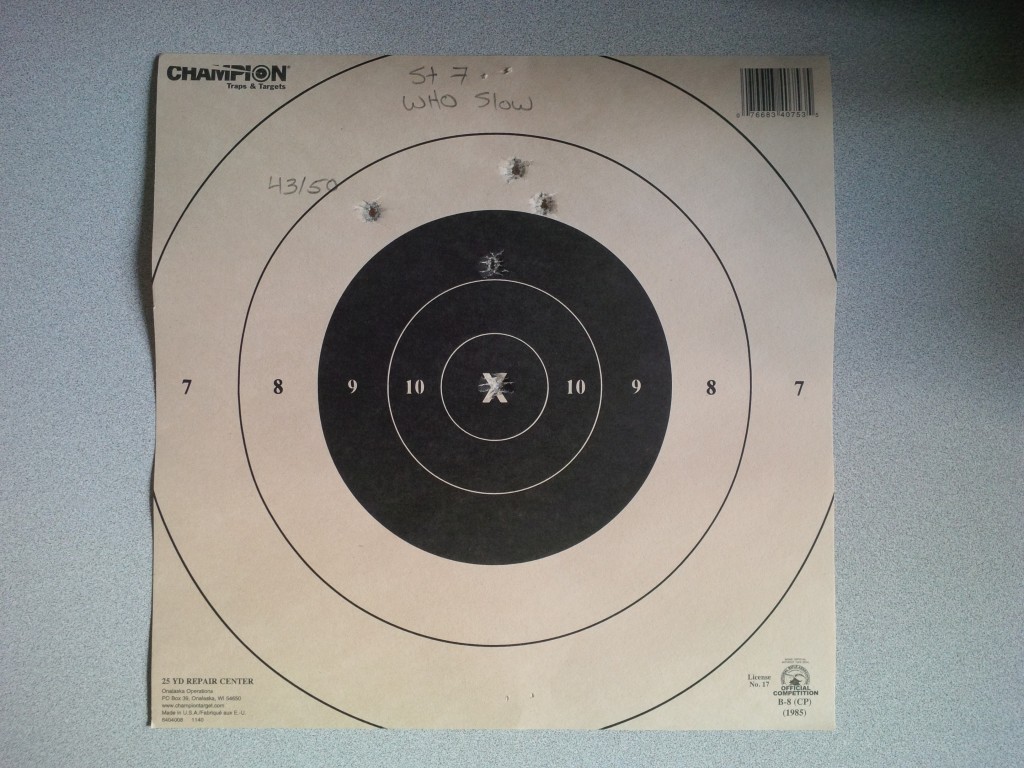
Again, I should not be shooting 8s on the slow fire stuff. If you look, I have a pretty good group up in the 8-9 region. That’s all sights. The way I interact with the sights when I’m shooting WHO is a bit different, I tend to shoot a little high. The front sight post wants to climb, and I need to either a) adjust my point of aim or b) be more disciplined.
Stage 8: Kneeling Slow Fire
5 rounds
kneeling freestyle
time limit: five minutes
Stage 9: Kneeling Timed Fire from the holster
5 rounds
begin standing, draw and kneel at buzzer
time limit: 20 seconds
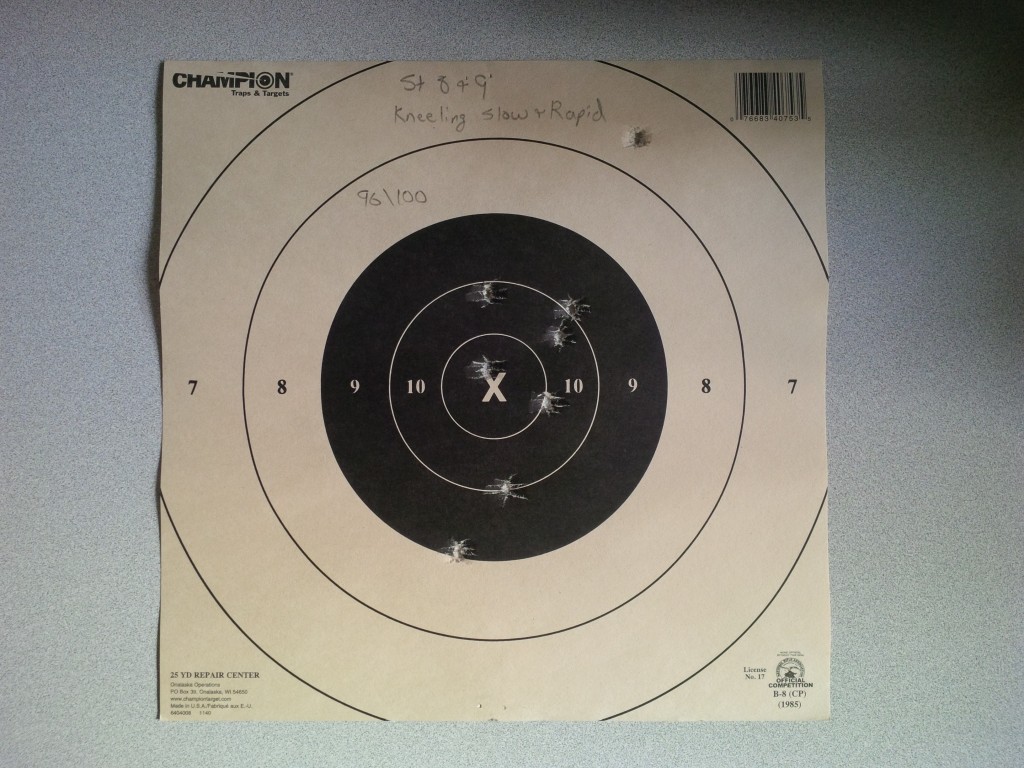
The kneeling stuff I shot all on one target, and the same with the prone. Kneeling is a gimme – it’s even more stable than standing, so the points dropped should be on par with the freestyle stuff at the start of the string. There is no excuse for me to have dumped a 7 up at the top there, just lazy sight alignment and taking a “good enough” shot on the timed fire.
Stage 10: Prone Slow Fire
5 rounds
prone freestyle
time limit: five minutes
Stage 11: Prone Timed Fire from the holster
5 rounds
begin standing, draw and go prone at buzzer
time limit: 20 seconds
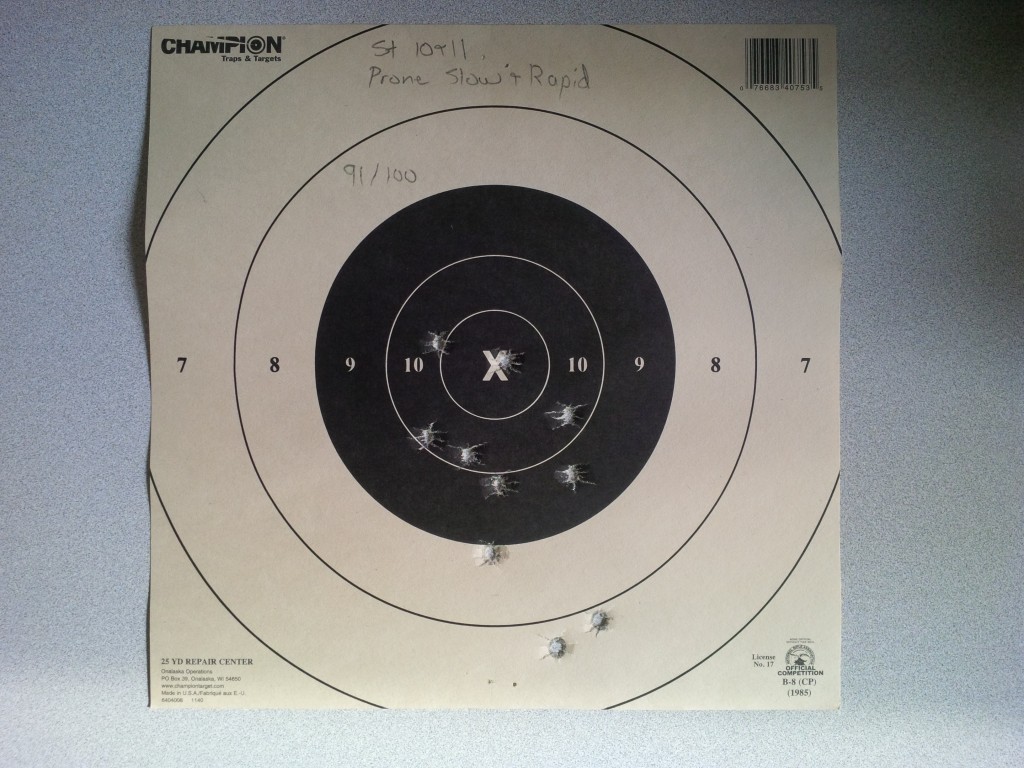
The last two strings are prone. Slow fire, then timed fire. On the slow fire, I smoked it. All 10s, nice and clean. On the timed fire, I rushed the first two shots because the gun wasn’t grounded as well as it should have been, dropping those two 7s. The trick on prone for me was to use the +5 Taylor freelance basepad and just drive the mag into the ground to get a stable hold. After two bad shots, I slowed down, adjusted my sight picture, and salvaged the string with three straight 9s. The prone stuff can really mess people up, but I think I can easily shoot a 95 or better here.
There it is, my first run through the Humbler. Total score, 635. Average shot value, 9.07 points. I shot 90% of the available points cold, which honestly isn’t too bad. I shot the whole test using an HK VP9 with Tula 115 grain FMJ steel cased ammo. I have two goals for the Humbler: shoot 650 consistently cold, and break 690 at least once.
How much accuracy do you need?
If you’ve spent more than 2.5 seconds on internet gun forum, you’ve probably had someone tell you that M&P pistols aren’t accurate. I feel like a lot of it is overblown, because how many people are really shooting their guns at ranges where a real lack of accuracy would be noticeable? But, in the interest of science, I decided to pull at random one of the 5 M&Ps we have in the house and see. The gun selected was an M&P full size, with a 4.25 inch barrel and Sevigny sights. It’s an older gun, we’ve had it for at least three years.
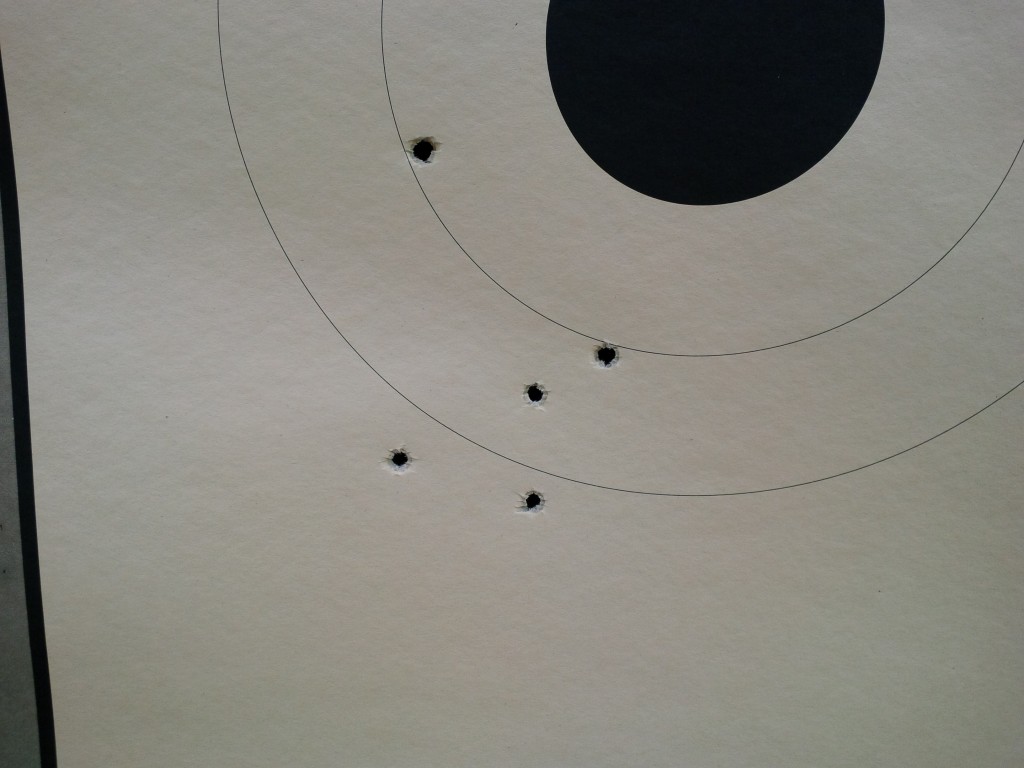
At 25 yards, using a six o’clock hold, the M&P put together this group. This was the best five shot group I could get out of the gun. I noted that point of impact for elevation was right at the tip of the front sight, and about 2 inches left. The group size is 5.1 inches, counting the flier at the top. Without that flier it’s 3.2 inches. Under ideal circumstances, that would make this probably a 4 or so inch gun with perfect conditions and trigger pulls every time. This was all slow fire, no time pressure, no nothing.
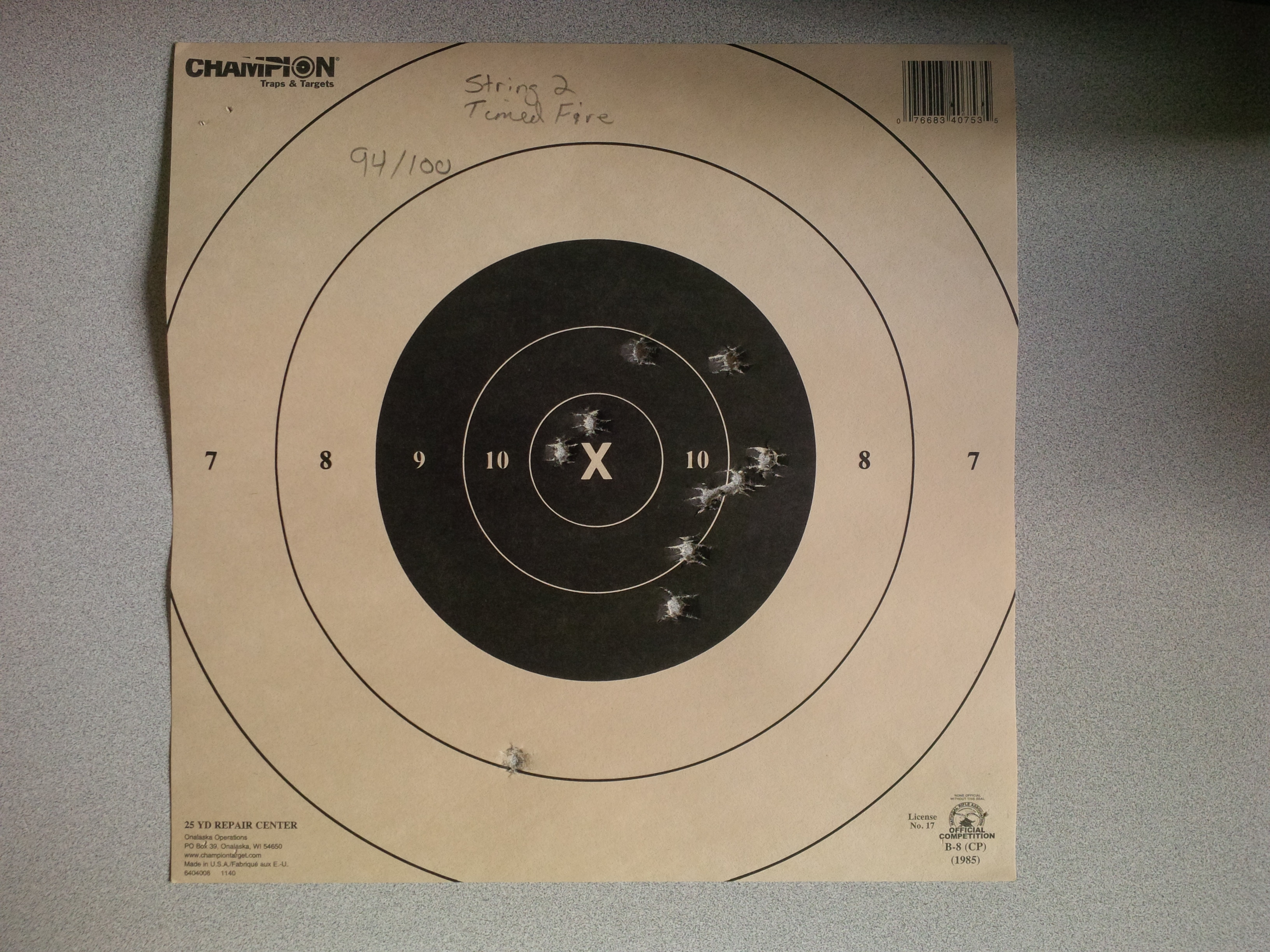
This target is from my first attempt shooting The Humbler. This is the Timed Fire target; shot freestyle at 25 yards. It’s two strings of 5 shots with a 20 second time limit. Under the pressure of a (very long) time limit using a very accurate gun, I was able to shoot a group that is better than the “ideal conditions” group I shot with the M&P. If you remember from the HK VP9 Review, it is an extremely accurate handgun, shooting sub two inch groups all day long.
Because the VP9 is more mechanically accurate than the M&P, I know that under less than perfect circumstances I’ll be able to get better hits with the VP9. But here’s the real question: does it really matter? The answer, of course, depends. But it depends on two things, your mission and you skills. If your mission is to win Production division at Bianchi Cup, it absolutely matters. Or if you want to shoot a 699 on the Humbler, it definitely matters. But if you want to be able to defend yourself? The difference between a gun that shoots 4 inch groups and 2 inch groups becomes a lot less important.
The other area is skill. Let’s be honest with ourselves for the moment. The average shooter/gun owner simply isn’t good enough at shooting to appreciate the difference between a 2 inch gun and a 4 inch gun. I don’t say that to be harsh, it’s just the truth. The average shooter is frequently incapable of keeping 5 shots on the paper at 25 yards, much less shooting something that resembles a group. That’s why you see people content to blaze away, shooting basketball sized groups at 7 yards. That guy is the average gun owner – he doesn’t take classes, and he certainly doesn’t compete, because he’s “minute of badguy accurate” at 7 yards.
If you’re serious about shooting, you obviously want the most accurate gun you can get for your purposes. If you have an M&P that runs great and shoots 4 or 5 inch groups at 25 yards, I wouldn’t toss it in the garbage just because it’s not accurate “enough.” For self defense work or USPSA competitions, that’s plenty accurate. Especially if you shoot your M&P well. If you want a more accurate gun, there are plenty of choices available.
I wrote this post primarily because I’m tired of seeing people on forums complain that “M&Ps aren’t accurate” when those people have probably never shot a 25 yard group in their lives. There are some people I’d listen to when they say that. But “9mmLvr4eva” on some derpes infested clown-show forum isn’t.