Still talking about products from SHOT Show 2016, today we have the new limited edition carbine from Troy Industries, the GAU-5/A/A. That designation stands for “Gun, Aircraft, Unit” – that odd designation indicates this gun is the Air Force version of the XM117E2 Commando Carbine. What makes this significant is that Troy is offering this limited edition to commemorate the 45th Anniversary of the Son Tay Commando Raid, also known as Operation Ivory Coast. The Son Tay raid was a large scale commando operation during the Vietnam war that inserted over 50 Green Berets deep into enemy territory with the goal of extracting US POWs. Unfortunately, the POWs had been moved before the raid; however the raid itself was a tactical success. The commandos successfully inserted, raided and searched the compound, killed quite a few of the enemy, and then extracted with no loss of US lives.
The GAU-5/A/A was the rifle they used, and now Troy is offering a faithful reproduction that you can pre-order today from My Service Rifle.
The TROY GAU-5/A/A is the most authentic, fully functional military carbine replica ever produced. These 5.56MM semi automatics, are manufactured to exact military specifications. The flash suppressor and grenade ring are permanently mounted to the chrome lined 1/12 twist barrel (OAL 16”). The replica US Gov’t markings on the side of the receiver combined with the conspicuous placement of Troy’s markings on the bottom of the receiver make this firearm nearly indistinguishable from the actual military issue GAU.
Here’s the thing I really like about this rifle. Yes, it’s an awesome reproduction/collector’s item, but at 1200 it’s also a quality, compact carbine that you could use for serious work if needs be. Sure it’d be hard to mount a light on it, but other than that? Compact OAL, lightweight, built like a tank? Sounds like a pretty solid working gun to me.
One of the interesting things about not attending SHOT Show was I got to observe all the product related chatter that goes on around the products announced at the show. Usually when you’re actually there, you sort of get stuck in the “SHOT bubble” and don’t necessarily get a good track of what’s resonating with consumers outside the show. This year, I was able to do that, and it was pretty eye-opening. The reason it was enlightening was the product that was the most talked about wasn’t a gun, it wasn’t ammo, it wasn’t even really gun related.
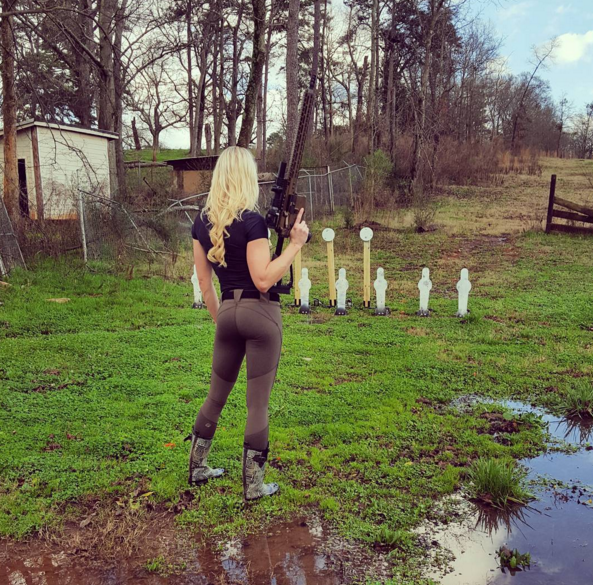
Photo courtesy Janna Reeves
It was a pair of tactical yoga pants. I’m not even kidding. When 5.11 announced their Raven Range Capri (the product’s official name), it was instantly everywhere on social media, on gun blogs, you couldn’t get away from it. It outstripped even the Kimber K6s Revolver for mentions on twitter, which is pretty impressive. Most of the talk around the tactical yoga (toga?) pant has pretty positive, although there are some criticisms leveled by female shooters which make sense in context. I won’t get into those here, because I think these pants are great.
I’m a big fan of 5.11 gear, and I wear my 5.11 Ridegeline Pants just as often as I wear jeans. They’re lightweight, comfortable, and because they don’t have huge cargo pockets don’t scream “TACTICAL” when you look at them.
But the real question is what do you think about the new yoga pants from 5.11? Awesome? Silly? Sillyawesome? Let me know in the comments.
Last week I wrote a post blasting the new shooting competition American Marksmen for their policy that disqualifies many talented amateur shooters from competing. What I didn’t know at the time was who the creative team behind American Marksman was. As it turns out, the driving force behind American Marksman is my friend and mentor, Michael Bane. I have a tremendous amount of respect for Michael, so I emailed him and invited him to comment on the post. Here’s what he had to say:
Hi kids! Caleb, you know I respect your opinion and your knowledge — hell, you wrote for Marshal and I on DRTV back in the Back When — but I don’t think you see the vision we have here. You know my resume…I’ve been involved in the start-up of USPSA, IDPA and NSSF RIMFIRE CHALLENGE…I’ve shot pretty much every shooting sport, including obscure things like Summer Biathon and odd shotgun sports. My goal here, the goal of everyone at OUTDOOR CHANNEL and Kroenke Sports Entertainment, is to bring a huge number of new people into the shooting sports. I have been involved in American Marksman since Meeting 1, and I have been adamant that it would be a shooting completion…not a slingshot, throwing tomahawks or whatever crap TOP SHOT devolved into. Accordingly, I insisted on bring in Mark Passamaneck as the technical director…Mark and I worked together to create one of the first IDPA clubs in the beginning.
Mark is a top 3-Gun competitor, trainer and match director. He has shot USPSA, IDPA, RIMFIRE CHALLENGE, is the founder of Carbon Arms and a lifelong hunter. He has also served for 2 years as the match director of the NSSF RIMFIRE CHALLENGE World Championships. Frankly, he is one of the finest match directors/match designers in the world today.
While I appreciate the work it takes to succeed at a specific shooting discipline, shooters made the choice to shoot those disciples. My goal — my job, if you will — is to “grow the pie,” change the baseline for the shooting sports. My job is not to reward people who worked hard to succeed in sports in which there is no money.
After years of ratings, I am in the unique position of having a “data base” of what people are interested in watching. I can tell you categorically they are NOT interested in “professional” shooters. Not even a little tiny bit. In fact, with a few notable exceptions (ahem…the Miculek family), if I put a professional shooter on the screen, I can hear remotes clicking across the country.
The reason there is no money in “professional” shooting is there are not enough people in the sport to support a professional cadre in any true sense of the word. If you got into the shooting sports for any reasons other than fun, the camaraderie and the personal challenge, with the added bonus of learning a skill that could contribute to saving your life, you are in the wrong sport. IF you want more money in shooting, get more people in shooting…which is, parenthetically, what I’ve been trying to do for decades.
I sat down with Mike Foley, the new Prez of USPSA, this morning to see what we can do to move that sport forward. I am in regular contact with Joyce Wilson at IDPA and NSSF on the Rimfire. This season on SHOOTING GALLERY we’re featuring IDPA, 3-Gun and part of the Precision Rifle Series.
My producing partners Tim Cremin (GUN STORIES WITH JOE MANTEGNA; THE BEST DEFENSE) and John Carter ( SHOOTING GALLERY and SHOOTOUT LANE) and I will be in charge of the televised finale for AMERICAN MARKMAN…we have more experience than anyone else in the world on producing shooting sports programming. Period. It will be spectacular.
And it will be amatuer.
Your friend,
Michael B
I took the time to read that through and digest it, and I have to say that it changed my opinion on American Marksman. Yes, I still think that Master class and GM shooters should be allowed to compete, but now I understand what they’re trying to do. I think that the ultimate goal of creating an accessible and interesting shooting competition that puts the lens on true amateurs has value. What’s especially interesting to me is Michael’s data backed observation that with very few exceptions, the gun owning public doesn’t care about professional shooters. It’s one of those things that you can easily forget about when you’re deep into the competition shooting world. Outside of the Miculeks, Dave Sevigny, and Rob Leatham, the professional shooting community is basically unknown to the general gun owning populace.
To wrap things up, I was wrong about American Marksman. I wish all the best luck to Michael and his crew with American Marksman. I’ll follow along as the show progresses. I still think if you’re an A-class USPSA shooter and unclassed in IDPA, you should enter! Take a swing at 50k!
Everyone’s bought a used gun before. When buying a used 1911, or any time I change out internal parts on a 1911, I run it through the three function checks in the video. What these test are the sear and the disconnect. If a 1911 fails any one of these, it’s unsafe for carry and has the possibility of turning into an unintentional machine gun.
Edited January 26, 2016: I mentioned Kydex loops, but that is not true. ABS thermoset plastic loops are acceptable. Kydex loops break as easily as Kydex clips.
With this article I will wrap up my Folly of Chasing Gear series with a focus on CCW holsters and belts. I been rather fortunate when it comes to holsters and belts as sheer luck has kept me from making too many bone head choices. Nevertheless, here are some things to take away.
Nylon Holsters:
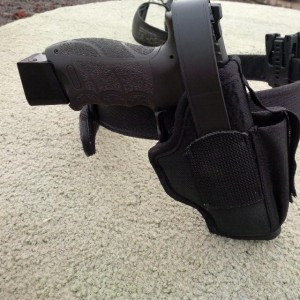
I have owned exactly one of these affronts to humanity. In fact, I actually owned it prior to getting my Concealed Handgun License. The sole purpose for this holster was to carry my jam-o-matic Rock Island 1911 when hunting. I tricked it up with a drop attachment to maximize its worthlessness and leave no doubt that I was ignorant and inexperienced.
The result is that I was knowledgeable enough to avoid Uncle Mike’s when I got my CCW. Unfortunately a lot of people don’t. My recommendation? AVOID NYLON HOLSTERS AT ALL COST.
Nothing says “Well thought out holster” like nylon
Lesson: You shouldn’t put your $400 gun in a $15 holster and then expect it to carry or have similar retention as a quality holster.
Fobus:
About 7 years ago I actually bought a Fobus holster solely to destroy it. I had seen videos where people had sheared them off of the mount and wanted to try it for myself. Those videos are indeed true, the holster is easily broken off its mount. Fobus is made from the cheapest plastic one could choose for injection molding and they are easily broken off of a belt. Fobus is craptastic.
Lesson: Avoid cheap plastic holsters, especially Fobus.
Remora / Sticky Holsters:
I actually keep a couple of these around because they serve a purpose; and within the realm of what they do, they work really well. The two biggest drawbacks I found were: no belt clip to retain the holster during a struggle on the ground, and the top collapses when the gun is removed, which requires the carrier to remove the holster from their person in order to reinsert the gun. With that in mind they have a place. With a lightweight gun (J-Frame 642) they carry well with pants you wouldn’t normally carry IWB. If I am leaving the house to run to the ATM or a fast food drive-thru window I will use this when going to and from my car, placing the weapon in my console while driving. When I mow in the summer I normally wear gym shorts atop my tractor and find this holster works well in that role.
Lesson: Test your holster and determine its limitations. Don’t try to make it something it is not and don’t compromise; if it doesn’t work move on.
Kydex Belt Clips:
This should be no surprise to anyone. Kydex belt clips will break. This is not a case of if but a case of when. Murphy was alive and well the day I broke the belt clip in the photo; as I was in the Men’s room of a while out shopping. I was lucky in that the clip didn’t fail completely so I made it work until I returned home.
Lesson: Kydex clips fail, period. A great many defensive trainers will preach this and I knew it would fail eventually. It took about 6 months of everyday carry but fail it did.
ABS or leather belt loops are always preferable.
What if it had broken on the draw while defending myself?
Belts:
Surprisingly I only recently purchased a “real” carry belt. For years I have used thicker leather belts manufactured for blue-collar types and had great success. Truth be told, the only reason I recently bought a real carry belt was a 50% off clearance price. I can say that cheap or thin belts don’t work. But a real quality belt, even if not labeled for holster use, is what you need.
Lesson: Don’t buy a thin, wimpy belt for CCW, but don’t think you have to buy a “gun” belt either. The leather doesn’t care what it is labeled. Just buy a thick holster made of quality leather.
So there you have it, solid lessons for those with newly minted concealed carry permits. Even if you don’t agree I hope you find this thought-provoking and learn something from my mistakes.
If I failed to mention a holster type, i.e.: leather or combination leather and Kydex it is because I have limited experience with them.
The ultimate lesson in this entire series is plain and simple – do your homework when choosing guns and gear as it will help you avoid gimmicks and cheaply made products. The money you save can be used for ammo and training, which is always preferable to the “gun of the week”.
If you leave it up to choice or chance, there’s a chance you’ll choose the wrong choice. – Steve Anderson, Dry fire guru and USPSA Grand Master
Switching gears this morning to bring you the worst of SHOT Show, and we begin with a company called Fostech, best known for making the AK Bumpski stock, which is a fun piece of kit for turning money into smoke and noise. At SHOT, they announced their new drop in AR trigger, called “Echo.” Here’s what it is, and why it’s derp: when you pull the trigger to fire your AR, it fires a round. Then when you let the trigger reset, it fires another round! It’s such a dumb, pointless, and potentially unsafe idea I predict it will sell like hotcakes to derpy-clownshoe guys who just can’t wait to drop one into their shitty homebuild AR so they can do wicked sick double taps at the range with their idiot friends. Ugh.
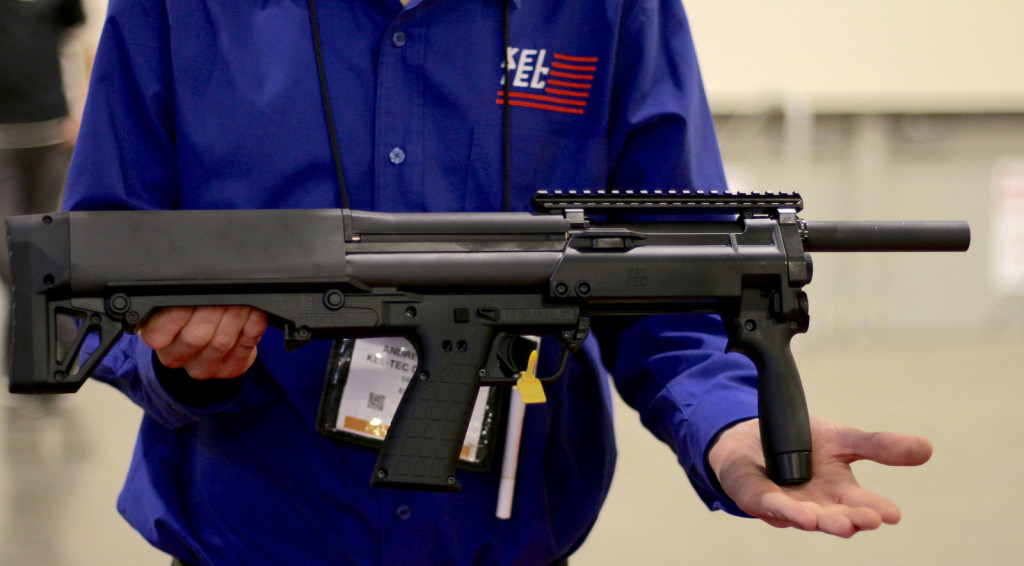
Up next in red-hot derp, we have the perpetual purveyors of putrid products, Kel-Tec. Oh yes, my favorite whipping boy is bringing out three new products, which means they’ll ship two to Oleg Volk for photography and never actually send any to dealers. First up, is an NFA-ready Kel-Tec Shotgun, to which I have to ask…why? Who wanted this product? The only people who actually own Kel-Tecs are some pretend operators who throw them around padded rooms. Anyway, now they have a version that drops the capacity by four rounds and shortens it up so it’s an NFA item. It also comes with a vertical handguard that will probably shear off under vigorous operation so can pump a round into your hand!
NFA ready KSG photo courtesy Outdoor Hub, click to view their coverage
They’re also introducing a new version of their Sub-2000 carbine, which is a gun I really want to like except for that fact that I’ve seen two of them blow right the hell up from out of battery detonations. But now you can blow yourself up using M&P magazines, or Sig P226/Beretta 92 mags all in the same gun! Awesome!
But really, the worst offender is this stupid trigger. It’s just dumb. It’s also potentially dangerous, but then again the sort of people who buy it probably aren’t really overly concerned with safety anyway.
Have you heard of American Marksman? It’s a new shooting competition where amateur shooters have a chance to win $50,000 in an interesting competition. You can read the official rules here; the idea is local shooters can qualify at their home range, then if they shoot well enough they can move up to the national competition, which will be televised and could win $50,000. Seems pretty cool, right? Except for this one little part about eligibility:
If you have ever placed in the top 10%, in any category, at any of the events listed below, you are not eligible to participate in American Marksman.
Amateur Trapshooting Association – AIM Grand Championships
CMP – CMP National Trophy Rifle and Pistol Matches
GSSF – Any GSSF event
ICORE – ICORE National Championship
IDPA – Indoor National Championship, US National Championship
International Handgun Metallic Silhouette Association – IHMSA World Championship
IPSC National Championship – Any
Military – Any Branch that picks its member based on marksmanship ability (ex – Navy Seal Sniper)
National Bench rest Shooters Association – Long Range Nationals, SR Score Nationals, LR Score Nationals, Group Nationals
National Skeet Shooting Association – World Skeet Championships
National Sporting Clays Association – National Sporting Clays Championship
NRA – National Matches at Camp Perry, National Small-bore Championship, Collegiate Rifle National Championship,
Collegiate Pistol National Championship, Precision Pistol Competition (National Police Shooting Championships), Action
Shooting National Championship
NSSF Rim fire Challenge – World Championship
Outlaw 3 Gun – Any Outlaw 3 Gun match
Precision Rifle Series – PRS Championship Match
SASS – National Championships Winter Range, Mounted Shooting National Championships
Steel Challenge Shooting Association – SCSA World Championship
US Clay Target Association – USA Shooting National Championship
USPSA National Championships – Multi-Gun Nationals, Single Stack Nationals, Revolver Nationals, Production Nationals, Carry
Optic Nationals, Limited Nationals, Open/Limited 10 Nationals
There’s another piece of their eligibility requirements as well that makes me shake my head:
This tour is built on the idea that amateur shooters should have the chance to compete, improve and win. The guidelines below describe how American Marksman classifies an amateur shooter:
Does not have any level of sponsorship (under a shooting contract of any kind, receive product, cash or match entries from a third party)
Has never placed in the top 10% of national level or higher competitive shooting event in any division or category.
Has never been ranked in the top 10% in any national competitive shooting organizations classification system.
Is not a member of a shooting team that is selected based on shooting skill.
So, it’s pretty obvious that they don’t want any professional or sponsored shooters playing their game, which I guess is fine. I mean, if I was going to have a competition to crown someone “the American Marksman” I’d probably want the best shooters in the country to try out for it, but whatever, it’s not my 50 grand.
So you’re probably think “well, I’m not a sponsored shooter, but I’m a USPSA master, so I could probably dust this competition and make some sick cash!” Yeah, not so fast, bucko. My friend Thomas from Precision Response had that exact thought, so he sent American Marksman an email. Here’s the response he received:
Hi Thomas,
Based on the sponsorship criteria provided me, you are correct. You would still be eligible.
As for the second part of your question, you are also correct. Anyone who is a GM or M in USPSA, or an M or EX in IDPA is NOT eligible for this competition. (emphasis added)
Please let me know if you have any other questions!
Best of luck!
You read that right. No IDPA Masters or Experts, and no USPSA GMs or Masters. That…well let’s be honest, that tells me everything I need to know about this competition, and what it says is they’re not interested in getting good shooters. It also tells me that they don’t know anything about the skill disparity between an IDPA Expert and a USPSA Master. I mean take me for example, at my best in USPSA when I was shooting regularly and training regularly I was a high A-class shooter, and I’m an IDPA Master.
Now, here’s the thing. You know what I want to see? I know there are plenty of talented A-class USPSA shooters that aren’t classified in IDPA, and if that’s the case I want all you people to register for this competition and wreck shop. This is actually your chance to make some money, so I want you to get out there and kick ass. Because that’s the only thing that will lend any sort of legitimacy to this farce of a competition. Because by intentionally excluding the most talented shooters in the nation, they’ve created a competition where the winner gets the best participation trophy ever. I know for a fact I won’t watch it when it gets to TV, because I don’t want to see a bunch nobodies compete for a bunch of money, I want to see the best shooters in the world duke it out. Since American Marksman isn’t interested in showing us that, I want all you A-class sonsabitches to get out and there and register for this. Wreck their curve!
One of the new products for 2016 that I’m legitimately interested in is LiNQ from Crimson Trace. In simple terms, it brings the best feature of Crimson Trace’s laser grips, instinctive activation, to the world of AR15 pattern rifles. How does it do this? Dark sorcery Science. Here’s Crimson Trace’s explanation:
LiNQ™ combines a green laser sight and 300-Lumen LED white light with Instinctive Activation™ for AR-Type Modern Sporting Rifles. Utilizing a secure, individual connection, LiNQ offers complete wireless control of the laser and light module. The replacement grip is ergonomically designed for quick activation and mode changes, eliminating the need to reach for the rifle’s forend to operate.
Bluetooth in guns? What a fascinating modern age we live in. Hit up Crimson Trace’s website for more information.
Last night at Badlands Gun Range I ran the Springfield Armory Range Officer through the 10-8 Performance Function Test. The gun had a total of 3 failures to complete its cycle of operations during the test, meaning that it did fail. I shot an additional 200 rounds through the gun with no issues of any type. What does this mean? Not much, the gun clearly wants to have a magazine in it to function, other than that? No issues. We’ll see over the next 1750 rounds!
You may have noticed that the site has been on a bit of a 1911 kick lately. Caleb has decided to test out a couple of 9mm 1911 pistols. He even invented a rating system to give some sort of objective score for the guns he’s testing. I’m probably partially to blame for that.
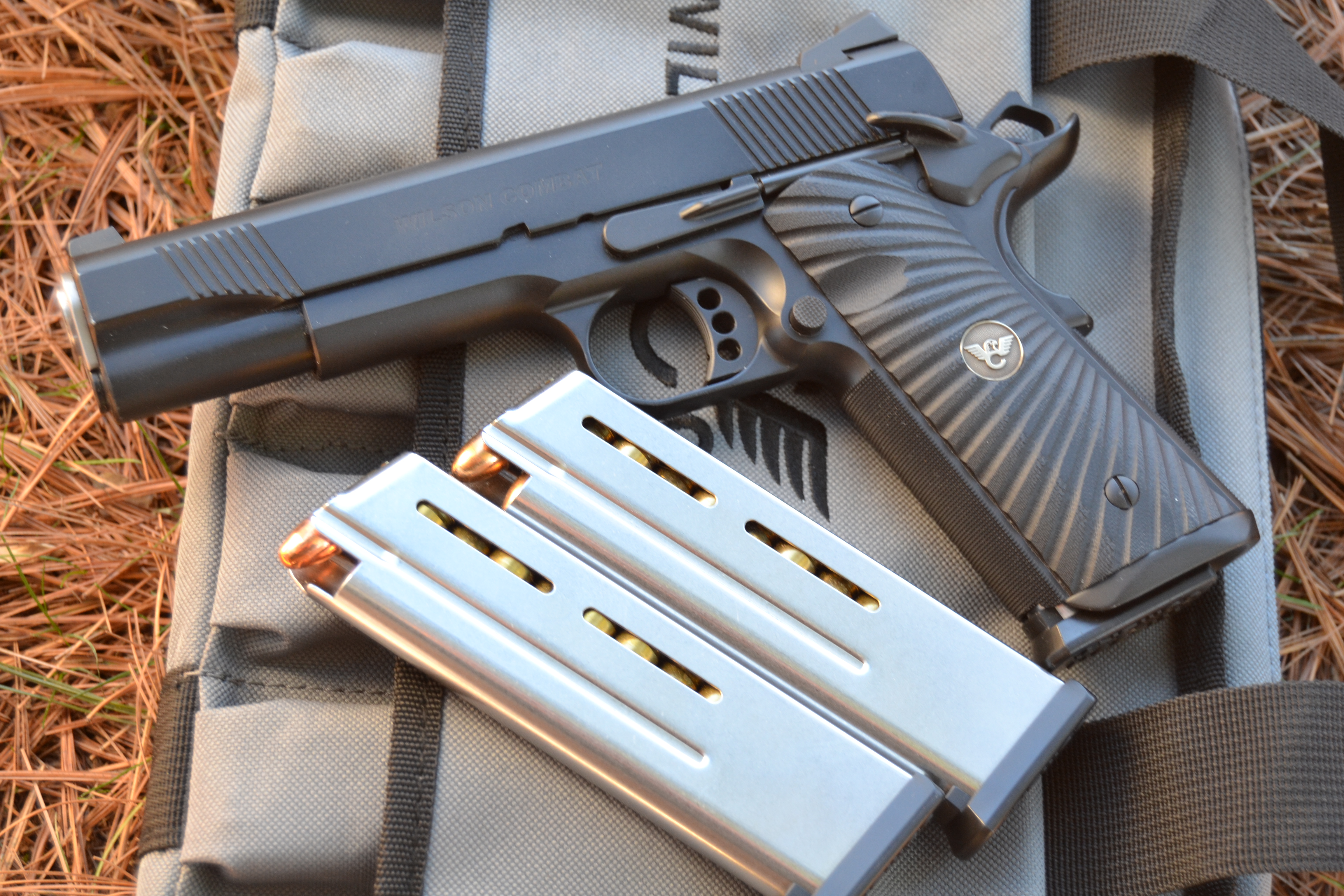
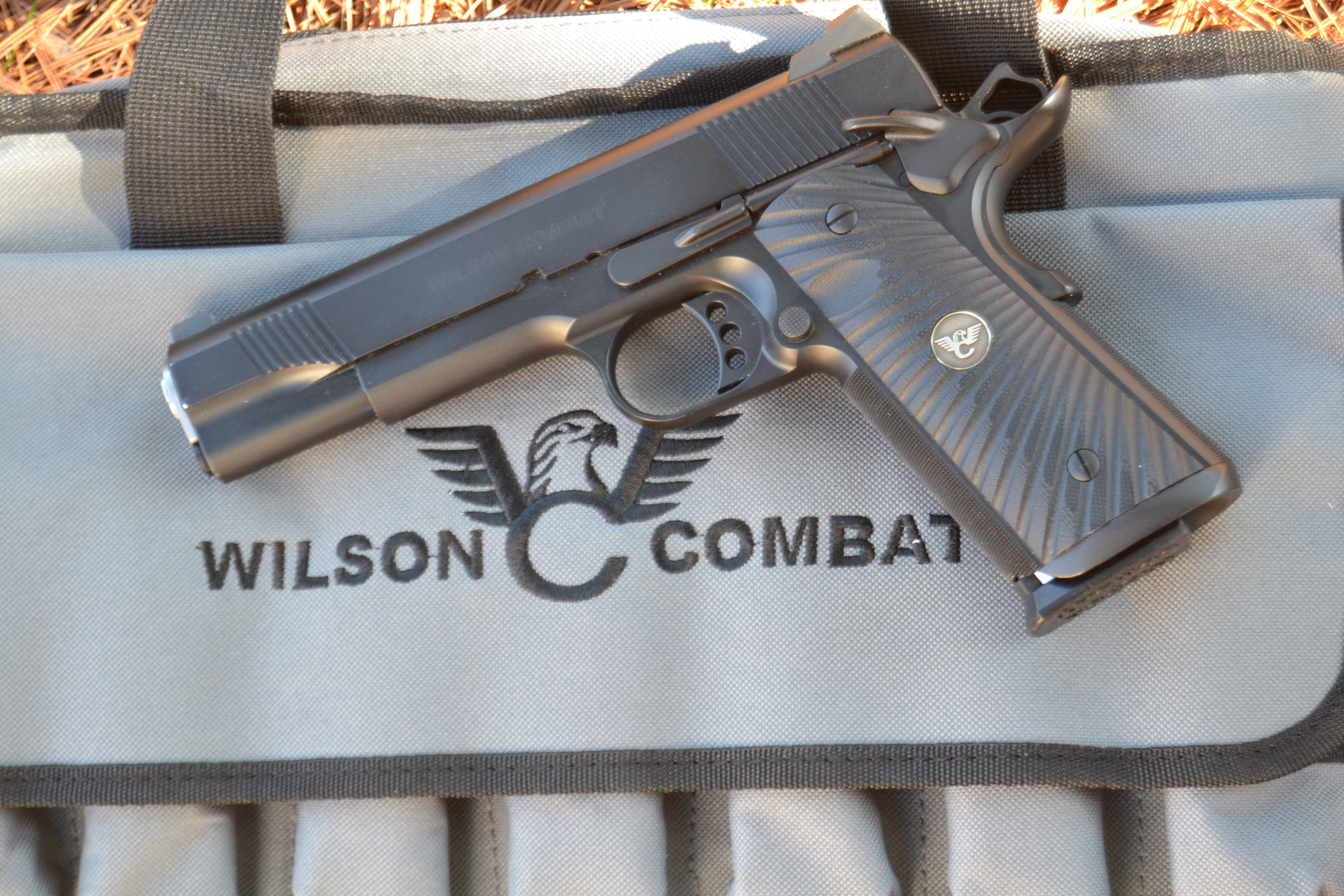
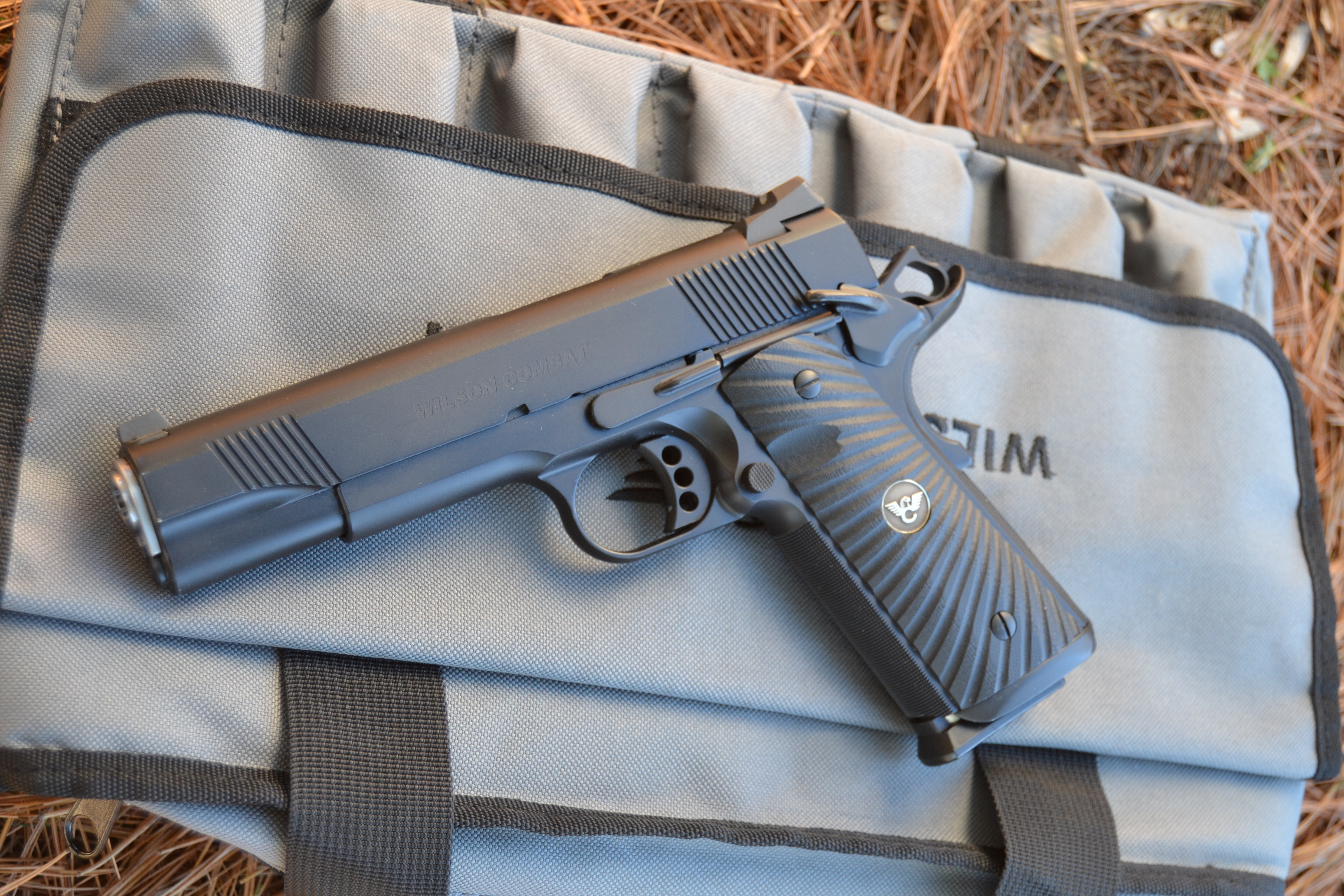
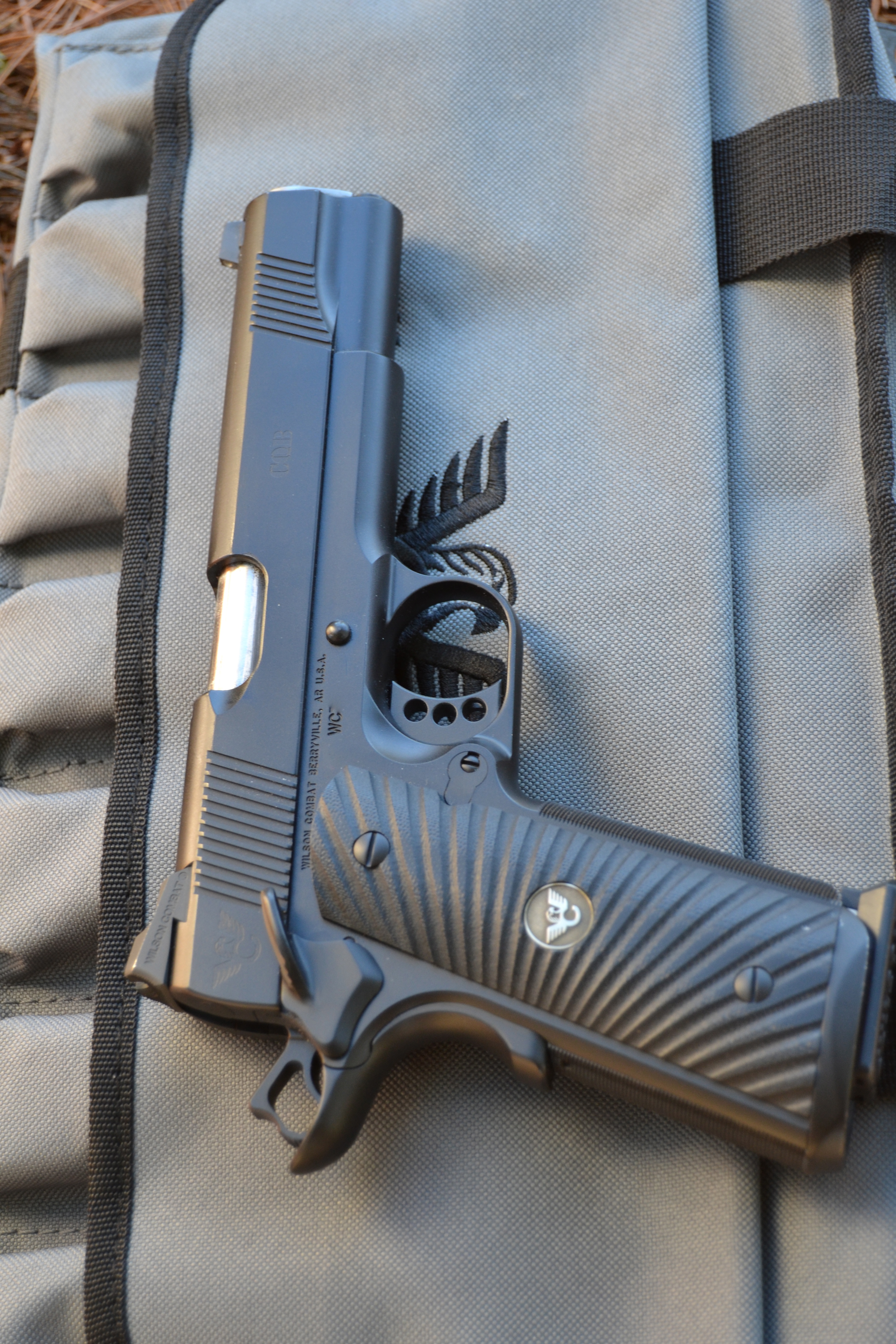
In November of 2014 I took a friend of mine to run a half marathon in Richmond, Va. When he finished up I stopped in at Colonial Shooting Academy to say hello to a good friend of mine who works the gun counter there. They have a pretty solid selection of handguns, including an entire display case of 1911 pattern pistols. My friend, who we often refer to as “El Diablo” because of his knack for dangling shiny temptation in front of his friends, knows my weakness for John Moses’ semi-automatic Peacemaker. He began taking guns out of the case and handing them to me. In the course of the conversation I mentioned how Todd Green’s experience with the Warren spec 9mm 1911 had me thinking hard about the 9mm 1911 as a concept. I never thought about investing in one until I saw Todd’s test and how much he loved the gun. “El Diablo” sensed his opportunity and handed me a Wilson CQB in 9mm that he had just received in the store.
I was a goner the second I held it. By the end of the day I had put down a deposit on the gun and I was listing a bunch of stuff on Gunbroker to pay for it.
Since I’ve been living with my Wilson for more than a year and since we’re on a 9mm 1911 review kick lately, I figure why not write one for the CQB?
Accuracy:
The Wilson CQB exhibited superb accuracy from the very first shots.
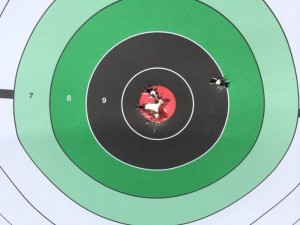
I didn’t have the chance to shoot the pistol until a few weeks after I’d purchased it, deep into December. The first thing I wanted to do was make sure it actually worked properly, so I loaded up a magazine of American Eagle 124 grain FMJ ammo and asked my buddy to stand by and watch for inconsistent ejection. (This is part of the 10-8 test, you’ll recall) The first shot I attempted was from the bench while wearing heavy gloves. I couldn’t really get a solid grip on the gun and I felt it shift in my hand right at the point of ignition. For the next five I ditched the gloves and fired off-hand at the 25 yard target. I had a moment of panic because it looked like I wasn’t even on paper. My mood improved dramatically when I got closer to the target.
For reference, the red dot in that bullseye target measures one inch in diameter. I’m certain that with a more skilled meat puppet behind the trigger the Wilson could shoot an even better group than the one pictured. To be honest, I was firing those rounds more to test function than for accuracy so I didn’t expect to see a sub 1″ group at 25 yards. When I saw that group I laughed out loud and my range buddy said “If I hadn’t just witnessed that I would never have believed it.”
Function:
My big worry with a 9mm 1911 was whether or not I could get one that worked. Todd’s test was really an eye opener for me because prior to that I believed the conventional wisdom about the inherent unreliability of the 9mm 1911. I didn’t want to spend money on a 9mm 1911 and have to futz with annoying details like figuring out what magazines the gun would like. I figured if I bought a Wilson gun and fed it with Wilson magazines, it should work reliably.
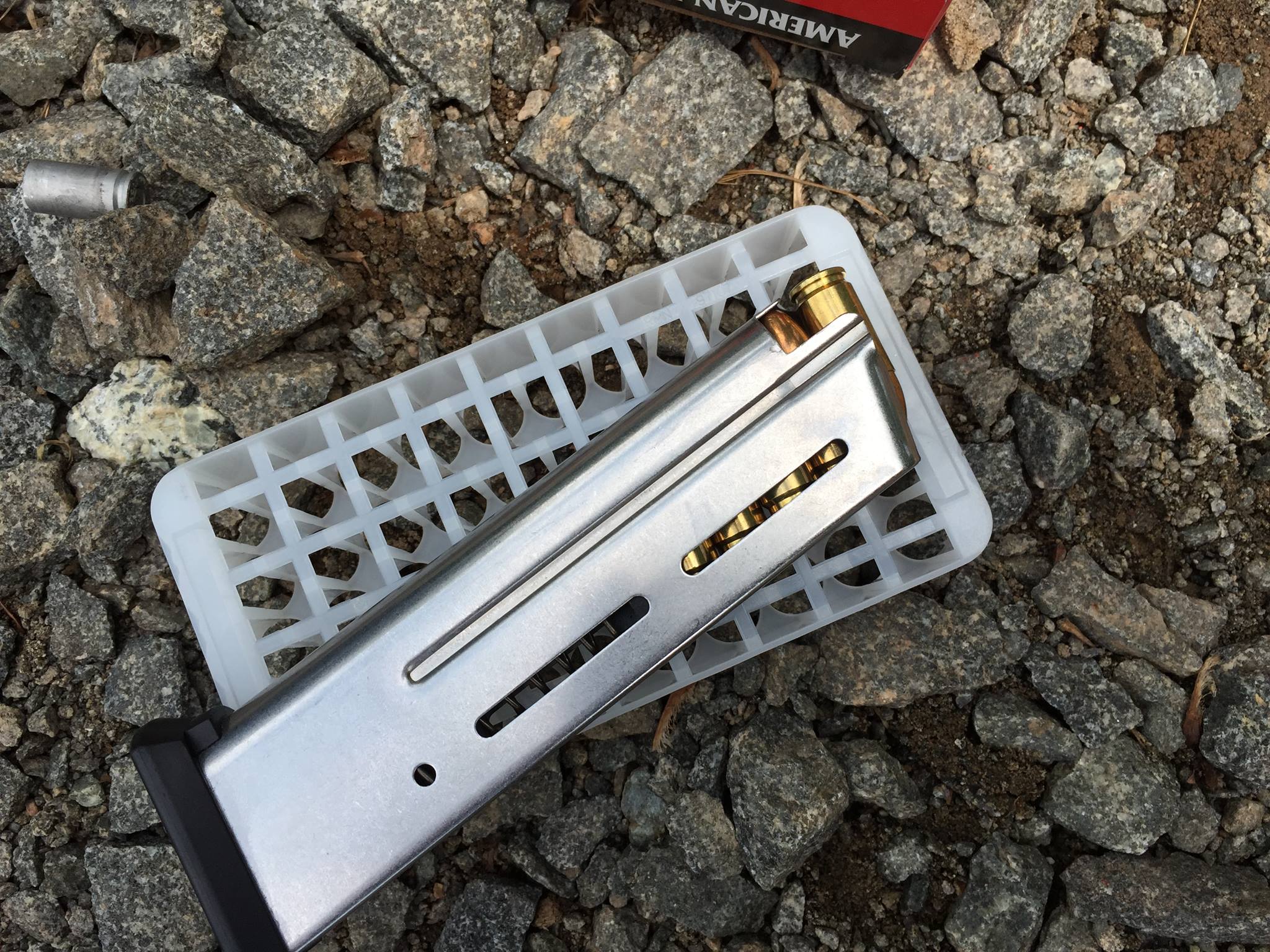
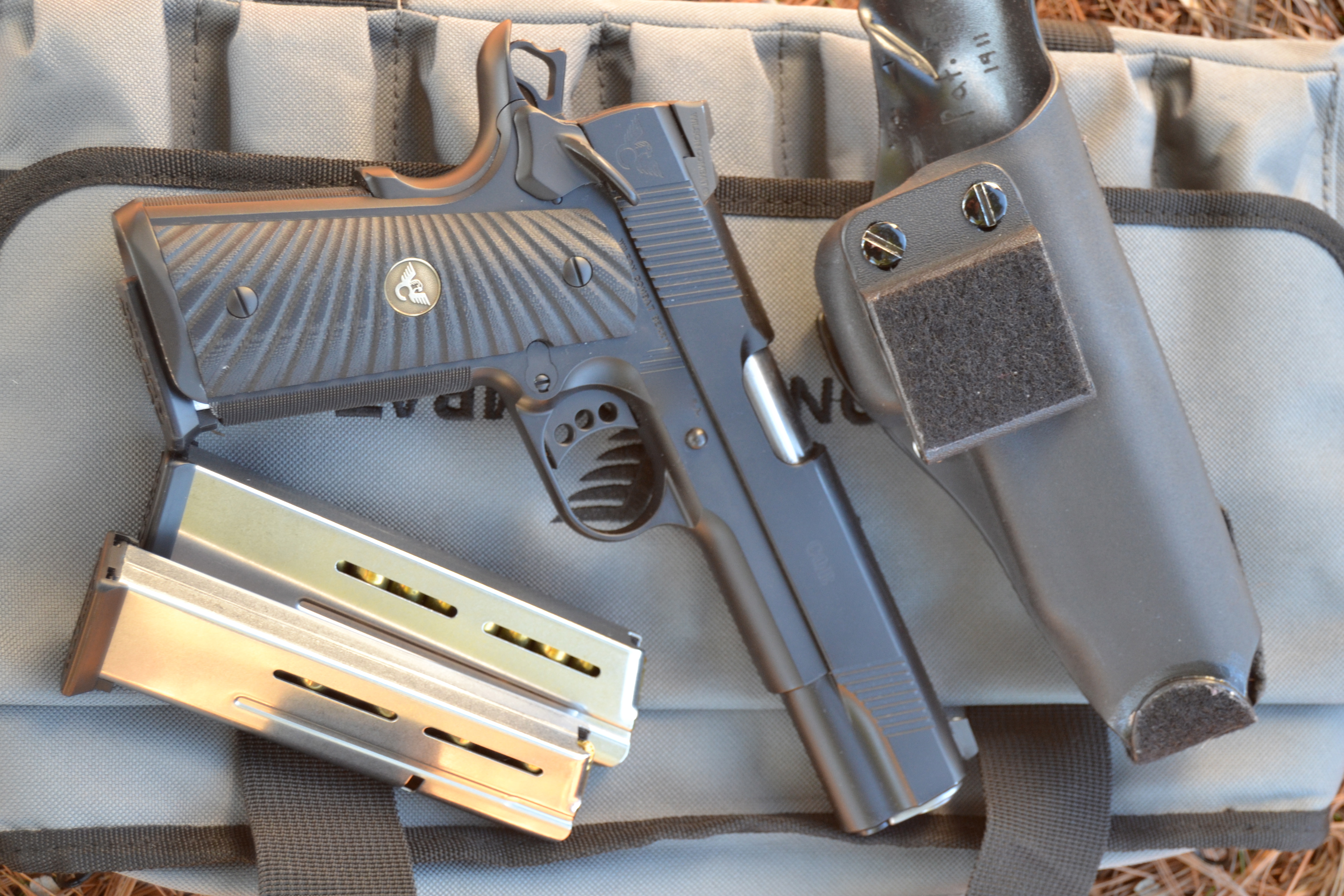
With more than 3,000 rounds through the gun at this point, that has proven true. The pistol has not experienced a single stoppage or malfunction. The pistol came with three 10 round magazines and I ordered seven more after purchasing the pistol. It looks, though, like Wilson has actually changed their 9mm magazines since I bought mine as mine all have plastic followers and no numbering stamped into the body of the magazine. Even so, none of the magazines have given me any problems.
I performed the 10-8 function test on the Wilson recently and it passed with a perfect score. (I had performed bits of the test when the gun was new, but I didn’t go through the one reload one section of the test at that point) Even with no magazine in the pistol, ejection is positive and consistent.
In 2015 I used the Wilson in multiple class settings including Intensive Pistol Skills with Tom Givens, Concealed Carry: Vehicle Environment Skills with FPF Training, and Concealed Carry Foundation Skills with FPF Training. The pistol performed splendidly in every class, never giving me a moment’s trouble. The only unusual moment I’ve experienced on the range with the pistol came during the Intensive Pistol Skills class. On a string of fire calling for a reload, I ejected a partially loaded magazine and somehow when it hit the ground it managed to flip the top round in the magazine backwards. I have tried, but I haven’t been able to make this happen again.
When Todd Green told me that he was going to do a 50,000 round test on 9mm 1911 pistols, I laughed. I told him I couldn’t wait to check in on his site and read about how the heinously unreliable pistol was making his life a little more miserable with each new week. It didn’t turn out that way for him and thankfully it didn’t turn out that way for me, either. My Wilson CQB has been one of the most boringly reliable pistols I’ve ever purchased…which I’m quite chuffed about.
Maintenance:
I haven’t cleaned the pistol. Ever.
I have kept the pistol lubricated with Wilson’s Ultima Lube. The CQB is an all steel gun and as such you do need to pay attention to lubrication. The “Armor-Tuff” finish on the pistol is impregnated with molybdenum (a substance used in quality motor oil to prevent metal wear and friction in your engine) and likely provides some room for error if you were to under-lubricate the pistol, but your ownership and shooting experience with a 1911 will be dramatically better if you properly lubricate the pistol regardless of how awesomely functional the finish may be.
I haven’t done anything to the pistol other than lubricate it and shoot it. Although with more than 3,000 rounds through it I will likely replace the recoil spring and Shok-Buff soon.
A little bit of wear on the high points of the slide are evident after thousands of presentations from a kydex holster.
Quality:
The quality of the pistol is superb. There are no cast or MIM parts on the gun. When you handle the gun it’s readily apparent that somebody sweated the details. One of the first things I check when I handle a 1911 pistol is how the grip safety is fitted on the gun. Many 1911 pattern pistols are shipped out with a grip safety that has to be pressed just so for it to reliably disengage and allow the weapon to fire. I often encounter people who say they don’t like the 1911 because they struggle to reliably disengage the grip safety when presenting the gun in a hurry. Sometimes that’s due to physiology, but often when I’ve checked out the gun they are using I find that the grip safety has not been properly designed or properly fitted. The end result is that they present the pistol from the holster and you watch them press on a dead trigger and then begin to futz with the thumb safety trying to correct the problem.
You don’t get any of that with this CQB. The grip safety reliably disengages no matter how bad a grip I have on the gun. That only happens when someone actually takes the time to fit the grip safety properly. Doing so requires patience and a process of putting the part on the gun, testing for function, and then removing the part and filing on it just a bit more. Then lather, rinse, repeat until the part works properly. I’m certain that the experienced smiths building the Wilson guns using parts of known specifications and quality have become very efficient at performing this process, but it still takes a bit of patience to get it right.
The Wilson Bullet Proof tactical ambidextrous thumb safety is fantastic…especially if you are a lefty.
The thumb safety is one of Wilson’s Bullet Proof units with the “tactical” extended levers. Generally the ambidextrous safeties you see on 1911 pattern pistols are Swenson style. Wilson took a fresh look at the 1911’s thumb safety and designed an ambi safety with a lot more contact between the two halves of the safety, making the whole arrangement stronger. If you are left handed or do a lot of left handed shooting with a 1911, you may want to give the Wilson Bullet Proof levers a hard look for your pistol.
The sizing of the “tactical” levers is perfect. At first glance I thought they would be too small to reliably disengage from the draw because I’ve been spoiled by the wider levers of the typical Swenson-style safeties used by other manufacturers, but hands-on time with the “tactical” levers has converted me. They are sized perfectly for my needs and the smaller profile helps the gun ride a little more snugly against the body when carrying concealed.
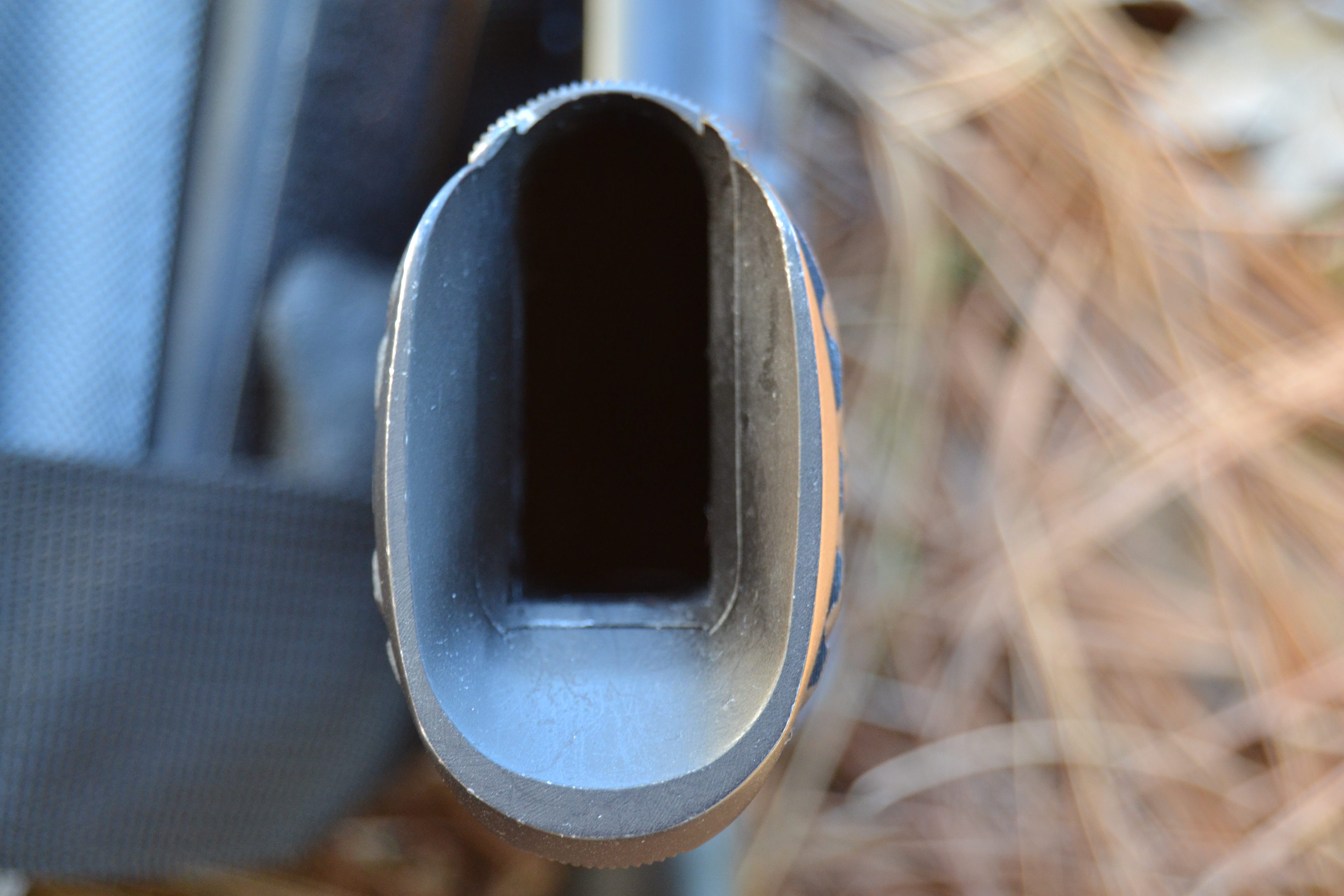
This CQB is equipped with one of Wilson’s one piece magazine wells. In the past I’ve been ambivalent about having a mag well on a 1911 pistol meant for non-competition duty, but here again experience with this gun has converted me. Reloading at speed can be a challenge on single stack guns, but mag wells are often sufficiently large and clumsy to hinder concealment on what is already a pretty critical dimension of the pistol. The Wilson part is so well designed and blended so nicely with the frame that it makes reloads much easier without adding any appreciable length to the pistol’s grip dimensions. (For me, at least)
Capacity:
This pistol holds ten rounds in the magazine and one more in the chamber. In the classes and range time I’ve done with the pistol I’ve felt the absence of those extra double-stack rounds on more than one occasion. Tom Givens has said multiple times that his rule of thumb is to count on it taking about 5 rounds from a pistol to convince a bad man to stop what he’s doing. With that math, the 1911 in .45 ACP is a one bad guy gun. This pistol with the ten round magazines is about a two bad guy gun. The capacity is right on the margin for what I’m comfortable with in a carry gun.
I’m a big fan of the mag well on the CQB…any 1911 I get in the future will have one.
Shootability:
The capacity concern is somewhat ameliorated by how easy it is to precisely place a bullet with this pistol. The trigger is superb with just enough travel to let you know you’re actually pulling the trigger and a clean break. The excellent trigger combined with the good sights and the pistol’s mild recoil make it an absolute joy to shoot. If you told me I had to take a hostage shot, this is the pistol I would want to use. My hope is that should I ever need to use this pistol in self defense, I can place every shot in an area that counts so that it takes less convincing overall for the bad man to stop his obnoxious behavior.
If you’ve never fired a 9mm 1911 pistol, you should. It’s not, as many suppose, like shooting a .22LR. It still feels like a reasonably powered center-fire handgun, but it stays put in your hands during recoil and you don’t have to contend with much muzzle rise. It’s almost like cheating.
Value:
This pistol is expensive. Make no bones about it: You can buy two Glock 19’s, new sights for them, a holster, spare mags, a couple of thousand rounds of ammo and a good class for what it cost to just buy a CQB equipped this way. This pistol will not kill bad guys any deader than those Glocks will. You do not buy this kind of pistol because you are looking for the most practical purchase you can make, at least not unless you are faced with extraordinary physical circumstances that makes the shootability of this pistol more of a necessity than a nicety.
I didn’t buy this CQB…and let me be absolutely clear that I bought this gun myself without any discount from Wilson Combat…because I needed a practical 9mm pistol. I bought this pistol because I really like it. I enjoy owning it more than I enjoy most of the guns I’ve owned over the years. I enjoy shooting it more than I’ve enjoyed shooting most of the guns I’ve owned over the years. When I was listing my lovely 6″ nickel-plated S&W model 27 to help pay for the Wilson, I wondered if I would eventually regret the decision to part with such a nice revolver. The answer is no. Not even for a second. I liked that model 27, but I never fired it. (Seriously…I never busted a cap through it. It was too pretty.) I’ve used this CQB like I would any of my carry guns and I’ve enjoyed every bit of it.
For me, this pistol was absolutely worth the price.
What I would do differently:
As I mentioned in the opening paragraph, this is a pistol I bought off the shelf at a store. It was an impulse purchase. Ordinarily when you buy a Wilson you spec out the gun to your preferences and wait a while (quite a while, sometimes) to get the gun. I honestly believe that if I hadn’t had the pistol in hand I wouldn’t have purchased it, so I certainly don’t regret the purchase at all…but there are some things I would do differently if I was ordering the gun directly from Wilson.
No checkering on the front strap. The checkering on this pistol is superbly done (whether by machine or hand I don’t know…likely by machine) but I am not a fan of front strap checkering on a 1911. I don’t find that it really aids my strong hand grip on the gun, but it does make me bleed after a longer range session or during a multi-day class.
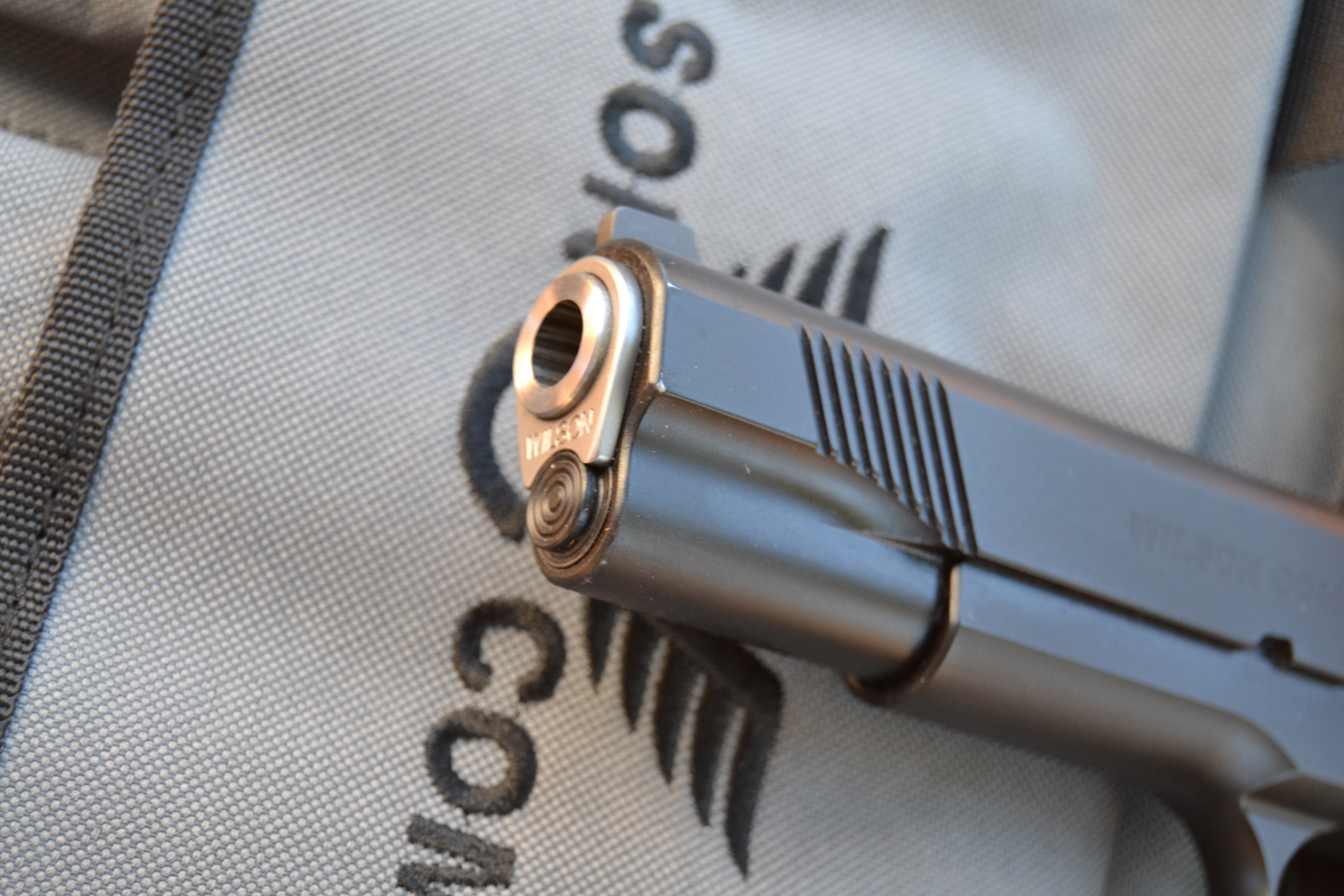
Recess the muzzle crown. Mainly to add a little bit of protection to the crucial crown of the muzzle against impact, but also because it-looka-nice!
Ball cuts on the slide. Purely an aesthetic preference.
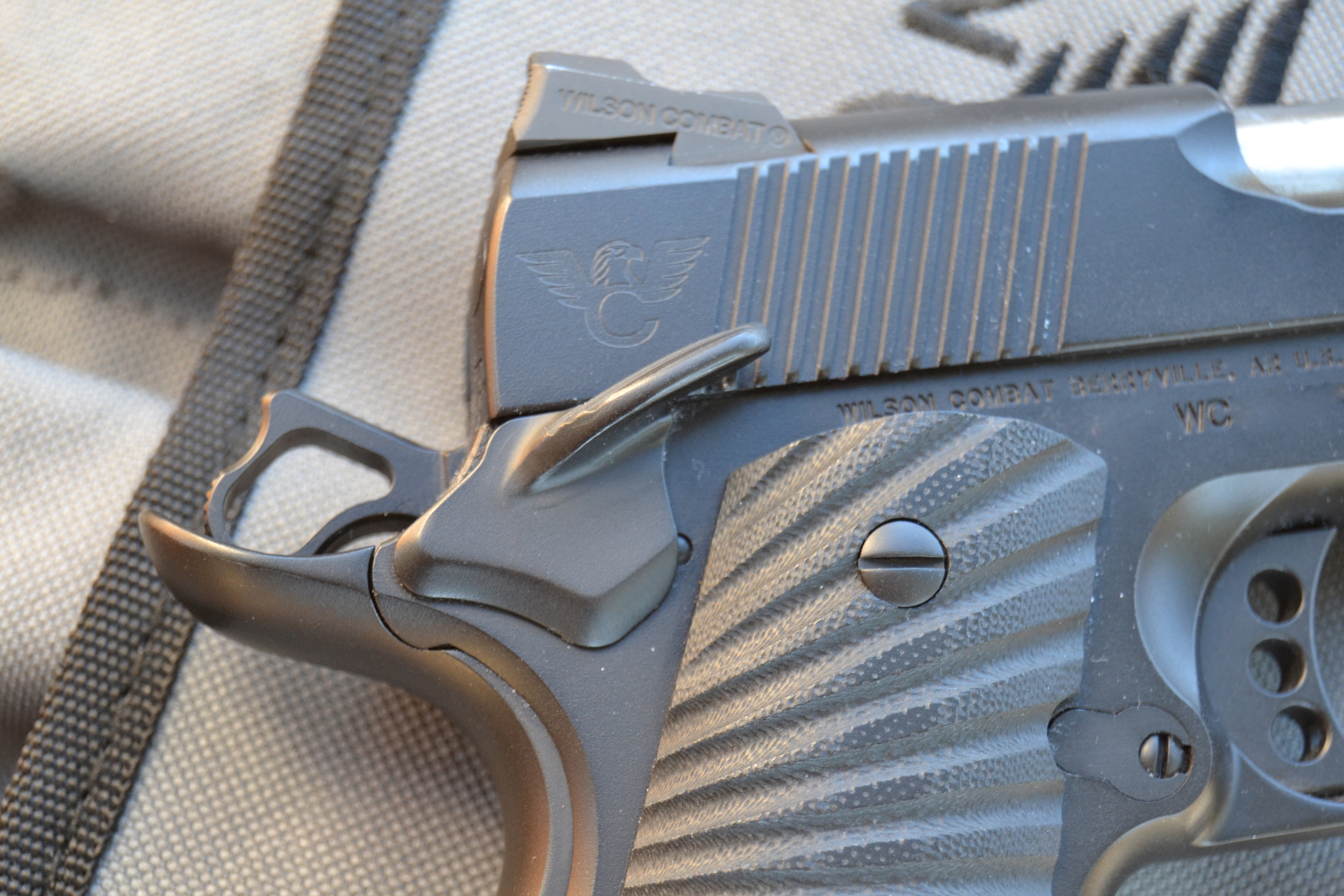
Solid trigger. Again, purely for aesthetic reasons. I really prefer not to have the speed holes in my 1911 trigger.
No CQB logo on the slide. Aesthetic reasons.
Conclusion:
Using Caleb’s rating system, the CQB scores an A+ 100/100. It passed the 10-8 test with flying colors, and hasn’t ever failed to fully cycle when firing with a variety of JHP and FMJ ammunition with more than 3,000 rounds through it. It’s made to an exceptionally high standard and every little bit of the gun works in splendid harmony with the rest of the pistol. It’s laser-beam accurate and an absolute joy to shoot. It has become my primary carry gun, carried in the excellent Keepers Concealment “Keeper” holster. The thin profile of the single-stack 1911 and the nicely designed holster make every day AIWB carry a breeze, even for such a big, relatively heavy pistol.
The only real downside to this Wilson is that you could literally buy half a dozen other pistols for the price of this one gun…but if you are a 1911 guy odds are that none in that half dozen will tickle your fancy quite the way that this one can.
This should also remind everyone that guns that look similar on the outside are not necessarily alike. There are a lot of 1911 pattern pistols on the market but while they may look very similar there are a lot of important differences which are evident in the price and performance that they offer once you get them out of the gun store.
We use cookies to optimize our website and our service.
Functional
Always active
The technical storage or access is strictly necessary for the legitimate purpose of enabling the use of a specific service explicitly requested by the subscriber or user, or for the sole purpose of carrying out the transmission of a communication over an electronic communications network.
Preferences
The technical storage or access is necessary for the legitimate purpose of storing preferences that are not requested by the subscriber or user.
Statistics
The technical storage or access that is used exclusively for statistical purposes.The technical storage or access that is used exclusively for anonymous statistical purposes. Without a subpoena, voluntary compliance on the part of your Internet Service Provider, or additional records from a third party, information stored or retrieved for this purpose alone cannot usually be used to identify you.
Marketing
The technical storage or access is required to create user profiles to send advertising, or to track the user on a website or across several websites for similar marketing purposes.


 just as often as I wear jeans. They’re lightweight, comfortable, and because they don’t have huge cargo pockets don’t scream “TACTICAL” when you look at them.