It occurred to me the other day, while walking around downtown Memphis that I’ve lived the majority of my adult life either in cities or large suburbs of cities. I am about as far from “country” as you can get. Since moving to South Dakota, I’ve been exposed to proper hunting for the first time, first with pheasant hunting, then coyotes, then prairie dogs. As it turned out, I actually like hunting.
Tactical First Aid and “System Collapse” Medicine with Active Response Training
If you carry a firearm for personal defense, you do so because you recognize a basic reality: Should you find yourself the target of criminal violence it will be entirely up to you to protect yourself from the immediate danger. Bystanders are typically useless and police response will be too slow to do you any good. You are on your own. Most of us are probably pretty comfortable thinking about being on our own for the act of violence due to the lag time in police response, but what about dealing with an injury sustained in the struggle?
An excellent average response time from EMS would be about 5 minutes from the time the call goes out. A major arterial bleed can be fatal in 2-4 minutes. That means even excellent average EMS response time will be too late…and unfortunately there is no guarantee that EMS response time will be excellent. Consider the shooting in Aurora Colorado. Police were on scene and had the shooter in custody within a few minutes, but EMS response was delayed:
“On the police radio transmissions, officers said they lacked sufficient medical support for about 30 minutes after the 911 calls came flooding in around 12:39 a.m. and that medical teams didn’t report getting inside the theater for about 24 minutes. It wasn’t clear whether police efforts to secure the multiplex contributed to the delay in getting medical teams inside.”
Combine legitimate worries about more than one shooter, dispatchers swamped with 911 calls, poor communication and lack of coordination between police, fire, and EMS responders and you get this result. People died because of this delay, folks. Do not assume that once the bad man has been dealt with that EMS will be on scene immediately to help you. You’d best be prepared to do some things to help yourself.
The Tactical First Aid and “System Collapse” Medicine course offered by Active Response Training is aimed at giving the layman enough solid information to help them respond effectively to the sorts of wounds that happen in a combat environment. Penetrating trauma from bullets, knives, fragmentation from explosives, or even traumatic amputations from blast injuries aren’t terribly common in the United States therefore most of our first aid protocols and training don’t really take them into consideration. The US Military, on the other hand, deals with lots of penetrating trauma and has developed some extremely effective protocols and equipment to save people’s lives. Greg Ellifritz borrows heavily from the military’s protocols that have proven to be so effective at saving lives in the GWOT for this course.
Greg began class by breaking down an extensive DOD study on combat deaths and highlighting the types of injuries that could be helped with proper intervention. Some wounds are fatal and there’s no amount of intervention that’s going to help it…but careful study of the ways people died in combat found that the leading causes of preventable death were:
60% – bleeding to death from extremity wounds

33% – Tension pneumothorax
6% – airway obstruction
Greg rolls into class with a bunch of big plastic bins full of different types of tourniquets, pressure dressings, and various other goodies that you actually use under his supervision during the class. Each different type is pulled out and demonstrated. The strengths and weaknesses are discussed and then you have a go putting it on yourself and on a training partner. This may not seem revolutionary, but I’ve been through a couple of Red Cross classes before complete with certifications and I never once actually applied a pressure dressing…much less had the chance to try out all the major types of them to see which one I liked the best. (The OLAES and the Cinch-Tight are my faves, BTW…as for torniquets, I think the SOF-T is king of the hill. I bought 8 of them.) The ability go go hands on with this stuff and learn how to apply them efficiently beats the hell out of trying to read the printed instructions on the packaging while someone is bleeding out.
In addition to the commercial products Greg discusses ways to effectively improvise tourniquets and pressure dressings in a pinch. You learn the why in this class which helps you get a good handle on the how of doing something useful about it. Along the way a lot of tips and tricks are thrown in as well. It’s because of something Greg mentioned (“Sure, you know how to use this, but what if you are the one who is injured and someone else is trying to use your first aid kit to help you?”) that I’m keeping the instruction card for my SOF-T’s rubber-banded to the TQ itself just in case someone has to put one on me.
A great deal of time was spent discussing proper use of a tourniquet, (As high up on the bleeding limb as possible, never on a joint) including ways to convert an applied TQ to a pressure bandage to prevent any damage to the tissue downstream from the TQ in a situation where the casualty can’t get proper medical attention in a timely manner. A TQ can be left on a limb for 2 hours with no ill effects, and in most situations here in the United States that should be plenty of time to get someone to a hospital where they can get competent care. If you can’t get to a hospital within 2 hours conversion might be necessary. If a TQ has been on for 6 hours or more, it cannot be removed outside a hospital setting.
In addition to discussing TQ’s and pressure dressings, Greg explained the various hemostatic agents on the market. The most widely known probably being the granular Quick-Clot and Combat Gauze. Granular Quick Clot has been discontinued but there is still a bunch of it floating around out there, especially in military surplus medical kits. It’s pretty nasty stuff that, as Greg explained, basically boils away the liquid component of blood to leave only the bits of blood that will help form a clot. It’s certainly better than bleeding to death, but it causes intense heat and the wound it’s applied to has to be very carefully cleaned by surgeons afterwards. It’s also possible for small particles of it to end up floating around in the air getting in the eyes of the ones trying to help the casualty. Imagine the feeling of the moisture on your eye boiling for a second.
Combat gauze is gauze impregnated with a special type of clay that simply absorbs moisture, producing no heat and making no messes that surgeons have to clean up. It’s extremely effective and about the best you can do on a major bleed where you can’t apply a TQ. It’s also kind of expensive…but Greg happens to be an authorized dealer for the stuff and if you’re in one of his classes he’ll sell you some at cost.
…and all of that just barely touches on my notes from just the instruction on massive bleeding. Greg covered the rest of the MARC protocols (H was beyond the scope of 1 day of instruction) in the morning section at a quick pace that still allowed for a lot of hands on and questions. Again, this was intended to be enough information and exposure to give folks options for that period of time when they are on their own. It doesn’t make somebody an EMT or a doctor. It’s very targeted instruction aimed at helping someone take useful action to survive long enough to get into the hands of competent high-level medical intervention.
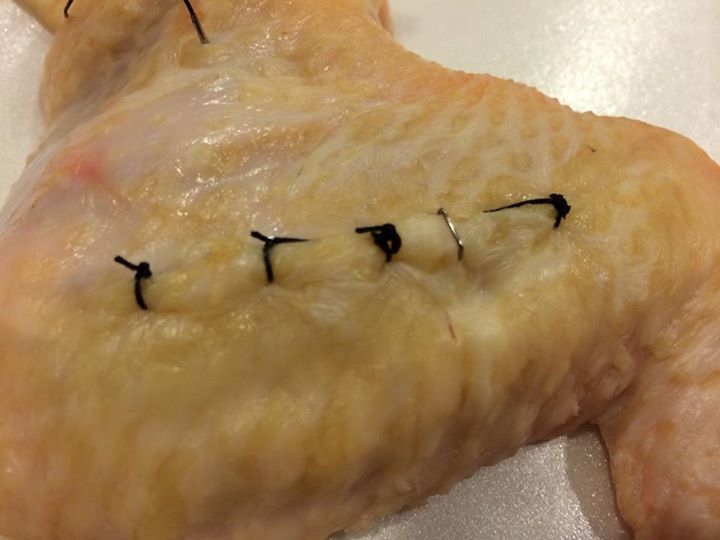
The “System Collapse” portion of the course was even more interesting as Greg explored the ramifications of a short term disruption in social order on medical support. Ebola is all over the news right now, but folks forget about events like Katrina when hospitals and ambulance crews were out of commission for quite some time. Riots, natural disasters, disease outbreaks, and acts of terrorism can place such a burden on our medical infrastructure that it may not be available for all of your needs. Greg likes to go to remote places of the globe where there is no medical infrastructure and has learned to keep himself (and others) alive and healthy without ready medical support on standby. He shares some of his strategies with his students, and even teaches them some of the skills he’s found useful. The highlight has to be going hands on applying sutures to a cut Greg made in some chicken wings. First the demo:
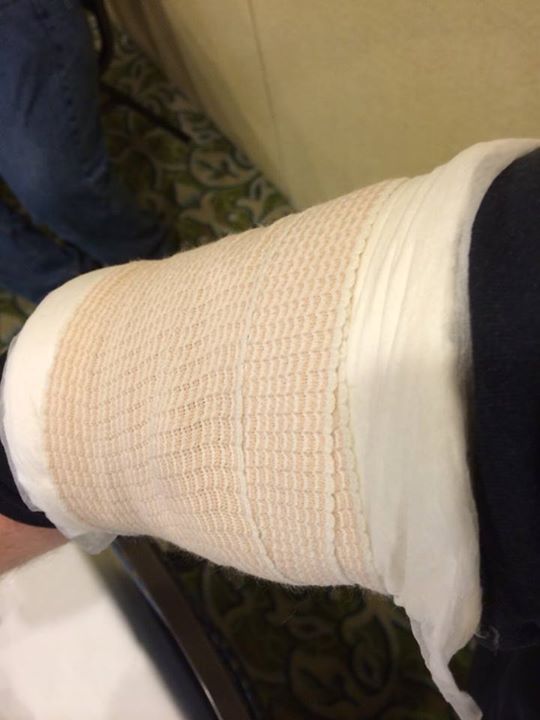
Then you get hands on with your own chicken. (Chicken skin is much thinner and more delicate than human skin) Never having stitched anything in my life, I was rather pleased with the results I got on my chicken wing.

The course throws a lot of information at you and good notes are essential for getting the most out of it…but I walked away retaining a lot of excellent information that I will hopefully never have to actually use. I’m a huge fan of training in general, but this kind of training should be at a much higher priority than it’s given by lots of folks in the gun world.
The world is not going to become a calmer place anytime soon, folks. With ebola all over the news and radical islamists carrying out individual acts of jihad it could well be you that’s able to make the difference if you have the right training and equipment. One man with hardly any formal training made the difference in several lives by applying improvised tourniquets in the immediate aftermath of the Boston bombing. The training you get in this course could be the thing that saves your life or the life of a loved one. If you’re able to get into this class with Greg or a similar class with another reputable instructor, do so with all speed.
Knowledge and skill aren’t necessarily connected
Yesterday, some idiot on YouTube offered this as the reason why everyone should believe him that the thumbs forward grip on a revolver is bad:
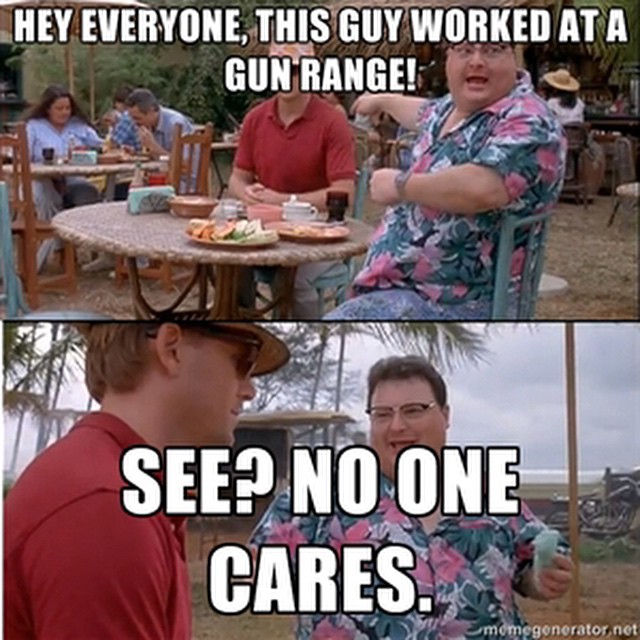
I worked in a gunshop for 15 years and I’ve seen it all
You can imagine how impressed I was, and I immediately rescinded everything that I’ve learned from shooting tens of thousands of rounds out of revolvers over the last four years. Actually I didn’t, and instead I made this meme:

I posted it on Facebook, and what I originally intended as a snarky shot at the sort of bloviating silverback experts you tend to find in gunstores turned into an actual, semi-thoughtful discussion about how frequently experience/knowledge aren’t really connected, or even required, for someone to be skillful. A long time ago, a friend of mine who happens to be a world class USPSA GM mentioned that until recently, he didn’t know the technical difference between centerfire and rimfire. Sure, he knew that rimfire = .22 and it was smaller, recoiled less, and was less reliable than a 9mm; but he couldn’t have told you the difference between centerfire ignition and rimfire ignition. While the vast majority of internet gun users would scoff at that, take a moment and ask yourself this: would him knowing that piece of technical knowledge help him win more matches? The answer if we’re honest is “no, no it won’t” so why would he waste memory space on what is essentially useless technical trivia?
In the same conversation on FB, Tam made the excellent point that you could be a hardcore 11B Slayer of our Nation’s Foes and still not really have any idea what’s going on inside your issued Thunderstick beyond “line up sights, make bad man go away” followed by “clean until shiny.” Actually, there’s a whole separate post in that alone about how basically everything the military teaches about weapons maintenance is wrong and outdated, but I don’t want to enrage the entire internet today. Back to the point (to the point no fakin, cookin MCs like a pound of a bacon) of knowledge being disconnected from skill. It is quite possible for someone to spend 15, 25, 30 years owning guns, and knowing everything about how they work down to the tiniest technical detail, and still be a shitty shooter who doesn’t really know how to run them.
The reverse is also true, that it’s possible to be able to run a gun hard and fast without really knowing what’s going on inside your gun other than “pull trigger make explosion bullet go zoom.” To my mind, being a shooter first and a writer second, I find this mindset preferable. Because these people are focused on the actual art of shooting, not endlessly preening over their gear and how meticulously clean their rifles that never get shot are. I prefer the company of shooters to gun owners, because I can talk to shooters on equal terms about skill development and training, even if they’re better than me or vice versa. There’s common ground.
I don’t really have any common ground with gun owners, other than “I like guns.”
So what’s the point, you’re asking? I guess the point is that before you dive into a conversation, you should try to be aware of what you don’t know. If you’ve worked a gun range for 15 years and owned a lot of guns, don’t go telling a guy who shoots thousands of rounds a year out of revolvers in competition how to hold his f***ing gun. If you’re an experienced competition shooter with no military or LE experience, don’t go telling a career LAPD officer how to handle a traffic stop that goes sideways. I’m not going to go all LAV on your and say “stay in your lane”; instead I want to suggest that we stop using internet encounters to prove how awesome we are and score imaginary Internet Arguing Points, but instead try to learn from people whose experiences and knowledge may be outside our own.
Unless you’re talking to me of course, in which case I’m right, you’re dumb, and shut up. 😉
Thumbs forward grip on a revolver
Every time I film a revolver video holding my gun with the thumbs forward grip, there’s always some “helpful” aspie in the comments saying “hurr durr ur gonna shoot ur thumb off hurrrrrrrr.” They’re wrong, and here’s why.
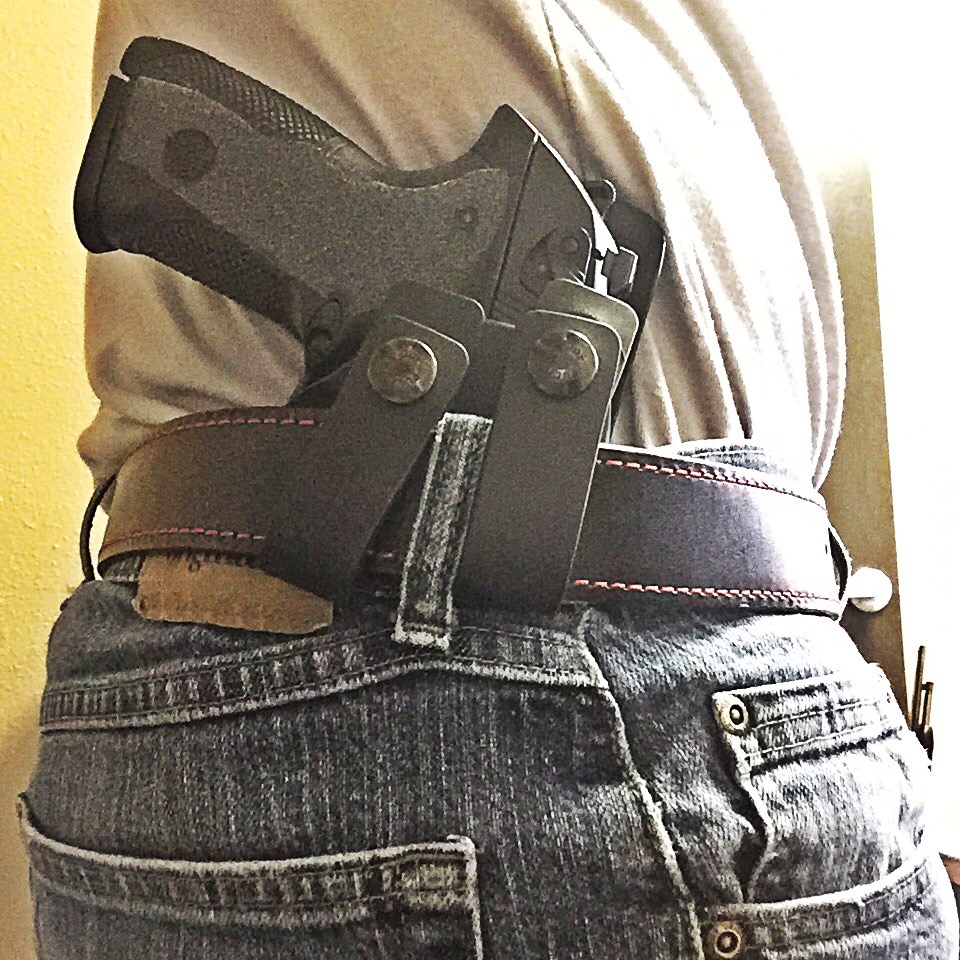
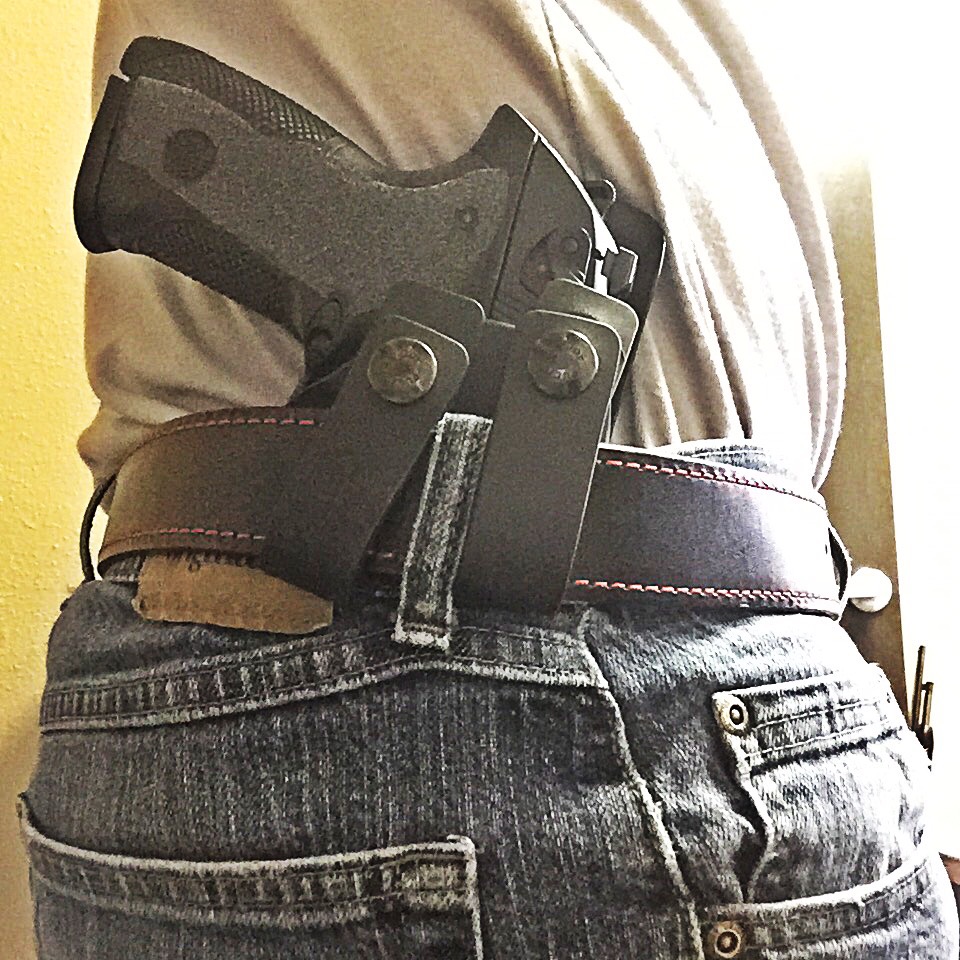
Why I ditched appendix carry
There’s no question that appendix carry is the hotness right now. I personally know a lot of serious, switched on dudes and ladybros using that system as their go-to for CCW. I also know of a lot of Internet derp-artists who are using it without really thinking through how to do it safely or smartly. But that’s none of my business.
If you peruse the archives here on the blog, you’ll see that I’ve spent some time with AIWB carry, experimenting with several different kinds of guns and holsters to see if I can make it work for me. To date, I’ve only ever been able to make it work with small automatics like the S&W Shield or Beretta Nano; or with small frame revolvers like J-Frames or SP101s. When it comes to full size guns like 1911s and Glocks, I’ve never been able to get it to work for me the way other people have.
I have spent a decent amount of money on holsters for AIWB, some of which have worked better than others, but haven’t had any luck with really getting full size guns to conceal
So I’ve switched back to tradition 4 o’clock behind the hip carry. There is another good reason for this – it’s how I spend most of my practice time. I am primarily a competition shooter, not a defensive trainer, so the bulk of my practice time is spent training for competition. That means that most of my draws are done from strong side at the 3-4 o’clock position. Using appendix carry on a daily basis would mean spending practice time on another carry position. With my practice time already pretty limited, it’s important to focus good reps on skills that translate across CCW and competition.
The final reason I changed back to traditional behind the hip IWB carry is that for me, it just works better. I carry a full size gun a lot easier behind the hip, it’s more comfortable for all day carry for me, and I don’t have to remember to put my shoes on before I put my gun on.
There is no “one size fits all” carry solution. Different body types, different concealment needs, different tastes in carry guns – all of these will affect how you can carry. I tried AIWB and it didn’t work for me, but what works for me may not work for you, and vice versa.
US Border Patrol deadlining rifles at a rate that is detrimental to officer safety
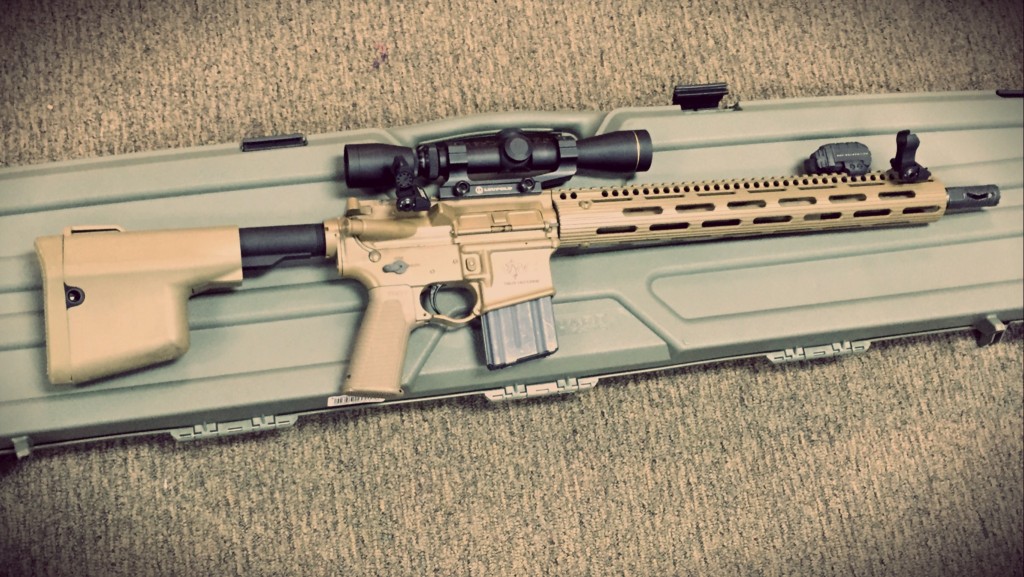
Within this past month, CBP (Border Patrol) stations were hit hard by an inspection performed by agency armorer/inspector from CBP Harper’s Ferry campus on their issued Colt M4 rifles. These details were passed on to me from a confidential source and were released in the name of officer safety.
The CBP stations were given a perfunctory warning but were surprised by the level of detail of the inspections. The following parts were replaced on the spot:
- Gas rings
- Firing pins
- Upgraded buffers to Colt H2 buffers (heavier than the standard H buffer)
- Cotter pins
- Buffer springs (amazingly for armorers they had a ruler to measure these)
- Bolt carriers
What are your thoughts on more than three agents sharing one rifle?
Pat: The weapon is a life support system. People will feel more comfortable/ confident when they are intimately familiar with that piece of equipment. People will also exercise more care with their own equipment then with pool equipment.
Do you think that the varying zeros of the issued rifles is an issue?
Pat: Zeros are critical with irons, but less so with
RDS (Red Dot Sights such Eotechs and Aimpoints). Mechanical offset is inherent 15m and in, and then necessary only for high
percentage shot. A 2.6” center mass hit will still be efficient under 90% of the circumstances.
Your response to the armorer/inspectors’ quibbles regarding weapons cleanliness and lubricant of choice?
Pat: CLP is notoriously sub par. It needs to be shaken vigorously before application, and even then it is not efficient in either cleaning, lubricating or preserving. I have used TW25 in the past, but for the past 14 years, only SLIP 2000- which has an NSN…Over the past twenty years we have supervised several hundred thousand rounds of 5.56mm ammo in AR15/M16/M4 variants down range every year. Our observations are that the gun will run when dirty as long as it is generously lubed. It will not run as well or as long when dry.Filthy 14 has 43,320 rds down range. It broke 2 bolt lugs at 16,000 rds. It had the rail loosen at 40,000 rds.It was only cleaned three times. On each of the above, and once when it was getting to be a hazmat issue in the armory (as in Linus blanket Hazmat)
I have not used a bore brush on any of my guns since 1995 (this includes the M-14’s I have shot in High Power and went Distinguished and High Master with). I did use wet/ dry patch with those guns, but now only put a patch through when exposed to salt water, or extremely dusty, muddy environmental conditions.
I have five M4s that have an average of 20k with minimal cleaning, but generously lubed.
Note- I do not carry a gun for a living anymore and do not advocate this for guns used at work.
However, the obsessive cleaning as pushed by the unknowing has ruined more guns then shooting them. If it takes more than 20 minutes to clean an M4, you are probably wasting time.
Troy 45 degree offset BattleSights
Close Quarters Pistol with Active Response Training
One of the benefits of the recent uptick in concealed carry permits is a growing interest in obtaining training in the use of the firearm as a instrument of self defense. Quality training in the principles of self defense, the mechanics of using the firearm properly under stress, and the legal considerations attendant to the use of force in self defense can make a world of difference in the outcome you get from a bad situation.
When it comes to bad situations, it doesn’t get a whole lot worse than a close-quarters tangle with someone who intends to do you serious harm. The 0-3 yard realm of self defense is probably the least understood and least trained. When it is brought up many would simply tell you to not let a bad guy get that close in the first place. It’s certainly a good idea to keep potentially threatening people as far away from you as possible, but that’s not always the way things work in reality. You need at least some options for the close range fight…and you need good options, not goofy ones. I mention goofy ones because unfortunately there is no shortage of strip-mall dojo “black belts” out there peddling utter nonsense that looks really cool when they’re working with a cooperative student but that utterly fails when you try to apply it against a real resisting opponent.

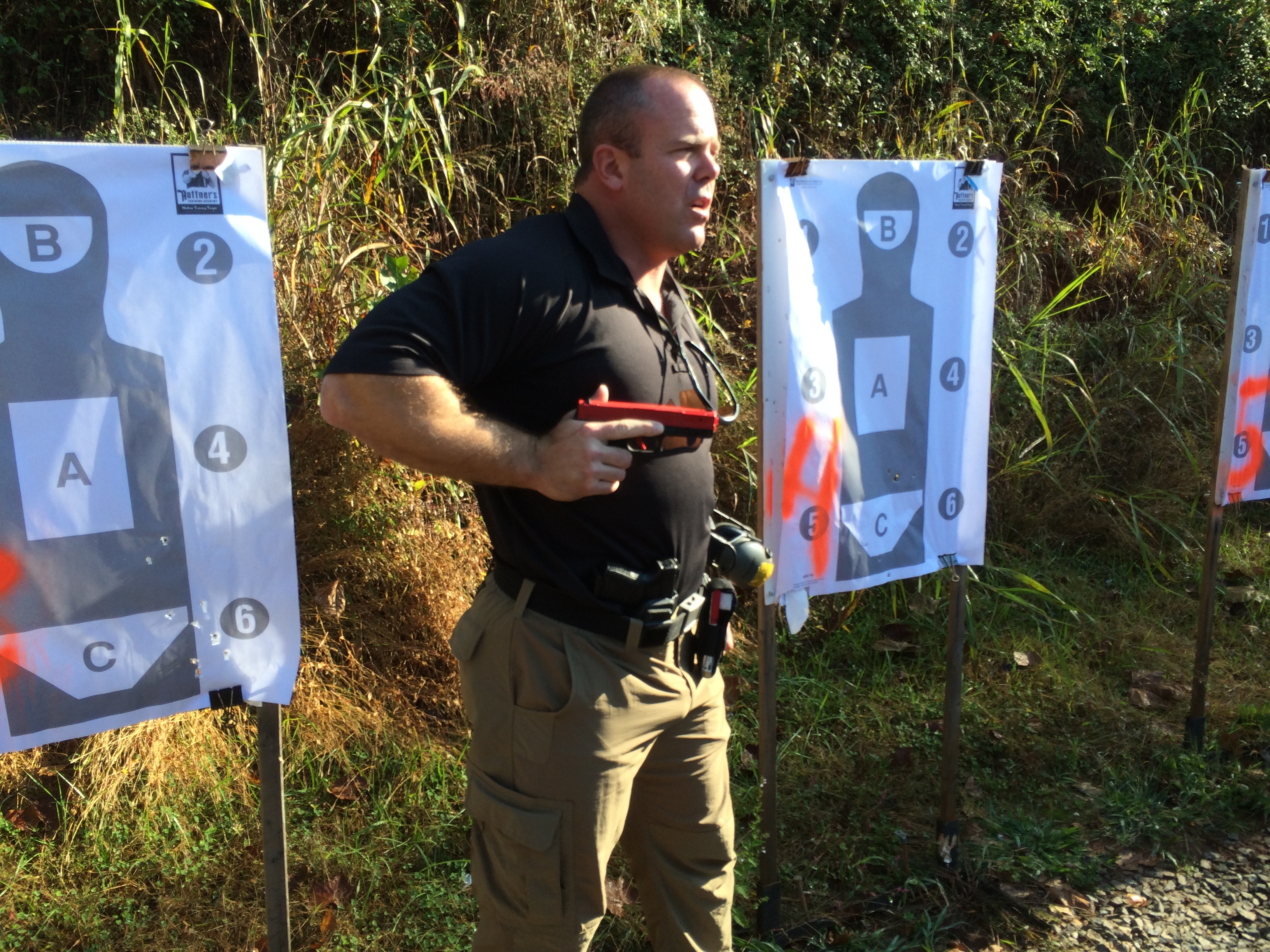
Greg Ellifritz has considerable experience working against real resisting opponents both in training and on the street. For more than a decade the primary focus of his job was training his fellow officers in techniques that would help them prevail in a fight with violent felons. He’s widening the focus of his instruction to folks who don’t carry a badge these days, giving more people the chance to benefit from his program.
Speaking of law enforcement, let’s dispel a myth while we’re at it: the general public tends to think that police officers receive high quality training in hand-to-hand combat and the use of firearms, but nothing could be further from the truth. Most of the training that police receive with firearms and in defensive tactics is rudimentary at best IF they’ve received training at all. You’d probably be shocked at how many police officers are rolling on patrol today with almost no practical training in defensive tactics. Faced with limited resources and police officers of widely varying levels of physical fitness and capability, combatives and firearms training often gets very little emphasis in many departments. There’s some training in an academy setting but little ongoing training once an officer hits the streets.
Faced with almost stifling constraints on time and resources, trainers like Greg have to come up with efficient programs that teach enough to hopefully get an officer through a horrible situation on the side of a dark road one night. Greg has used his impressive training resume, personal experience, and what he’s learned from his martial arts background to come up with a targeted program of instruction designed to take somebody with limited (or completely non-existent) hand-to-hand skill and give them some useful defensive techniques for the undertrained and under-appreciated 0-3 yard range.
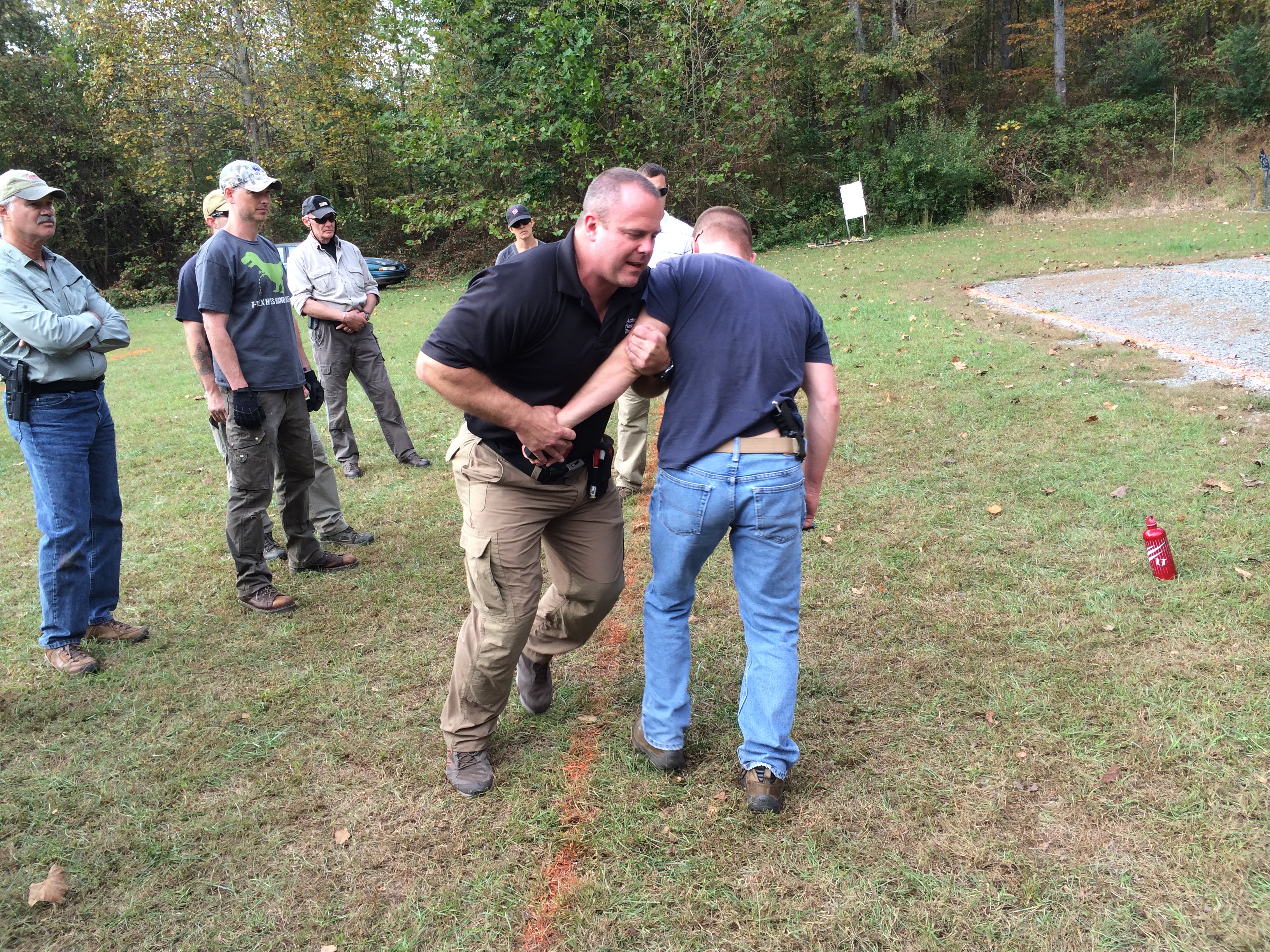
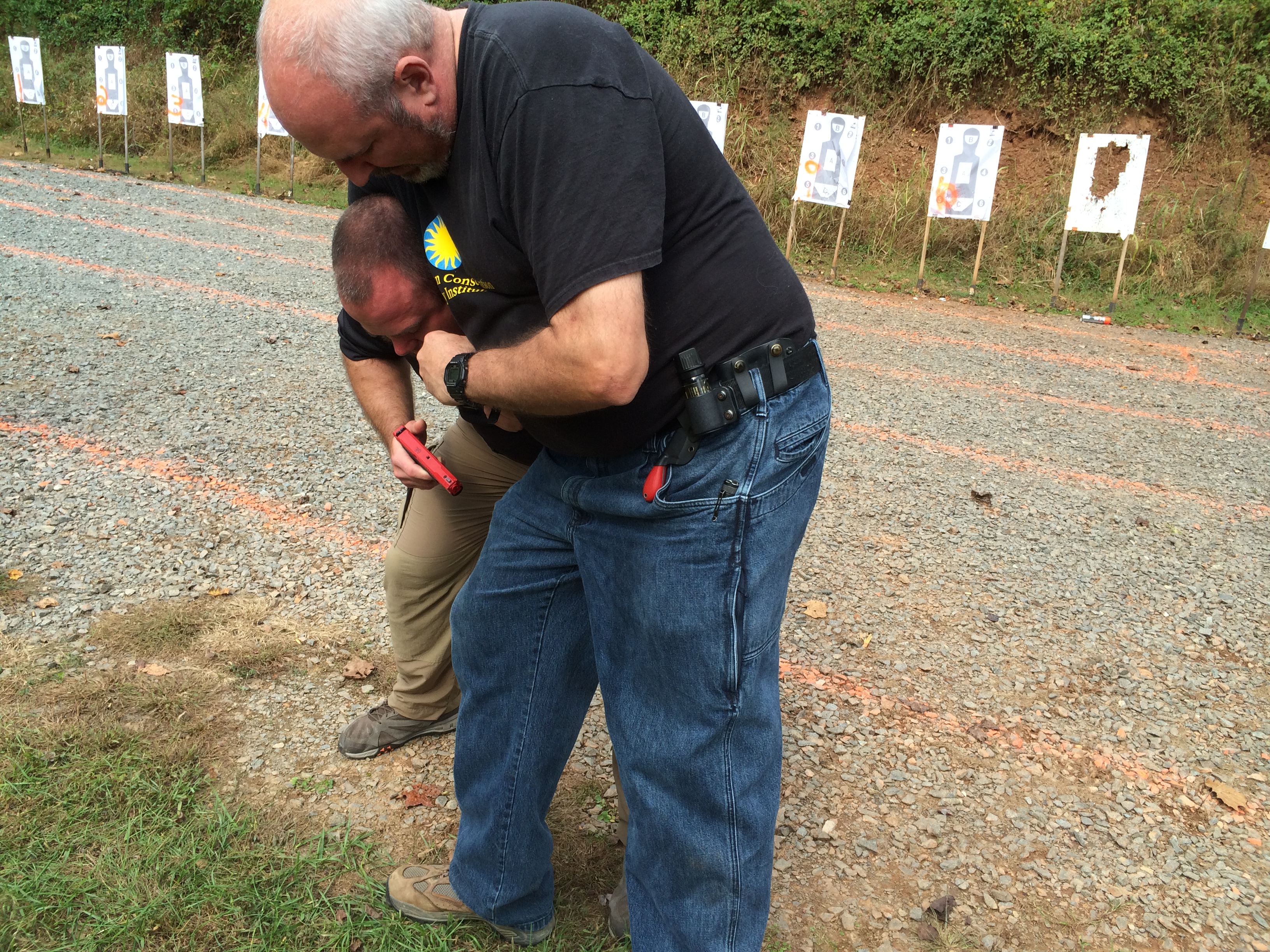
Greg himself is a 250 pound power lifter with 20 years experience in martial arts. I imagine wrestling with him is about as pleasant and productive as wrestling with a bulldozer…but his program does not depend on being that big, that strong, and that well trained to work. During much of the class my partner was a man older than me, almost 6″ shorter than me, and almost 100 pounds lighter than me. When we practiced defense against a disarm attempt he applied one of the defense techniques Greg showed the class and I was able to lift him completely off the ground and throw him around with little trouble…but I could not take control of his pistol.
The class is a precision instrument…basic concepts are introduced, demonstrated, and then students practice them with partners as Greg circles around offering feedback and correction. The pace is fairly quick, but students spend enough time working through the concepts that they’re able to retain the information and since the layers build on one another they get enough time applying the fundamentals to even self diagnose when something isn’t right. Hip and shoulder position are crucially important if you’re trying to avoid being slammed to the ground in a fight and throughout the day I watched as some brand new students ingrained those fundamentals and began offering correction when their partner left themselves in a bad position.
The progression moved from basic hip and shoulder positioning to methods for achieving solid in-fight weapons access, protecting your weapon from an attempted snatch, snatching someone else’s weapon, and stopping someone else’s attempt to draw a weapon. Working with your partner you get to be on the giving and receiving end of the techniques enough to gauge how effective they would be. I was easily able to stop my partner’s attempt to take my gun, but when I had him lifted entirely off the ground shaking him without being able to make his pistol budge and inch it really hit home how effective Greg’s method is.
Greg doesn’t blow any sunshine up your skirt. He’s not claiming his program is going to make you a lethal street fighter in a day. What it can do, however, is give you the ability to buy some time to do enough to prevail in most bad situations. If you can effectively stop someone’s initial weapon grab attempt you likely buy yourself a couple of seconds to get a secondary weapon into play or to deliver some strikes that can get separation and distance enough to get your handgun into play as an asset rather than a liability. That may not sound like much but I assure you it’s much more than you realize…and it’s a lot better than the big fat nothing that most folks toting a gun have right now.
Nobody likes to think about the possibility of having to fight somebody for their gun, but it is a possibility. As I’ve mentioned in previous columns, bad guys do not come at you barking like a rabid dog from 50 yards out. They want to get as close to you as possible with some sort of ruse (Greg actually studied this in his area and found that the top 3 ruse requests are asking for the time, asking for a cigarette/light, or asking for change) and then they whip out the gat. Your odds of a happy outcome are much higher if your first thoughts about dealing with a dude trying to draw a pistol on you at arm’s length away aren’t happening in the real thing. 
I was impressed by how much I took away from a single day of training, one of the most productive training days I’ve ever experienced. (Just like ECQC, the more you take into the class the more you’re likely to get out of it) You don’t have to be in incredible shape to learn something, nor do you run a significant risk of serious injury in the course. Everybody in the class I attended had a good attitude and even though some folks went at each other pretty hard everybody knew the limits and kept well within them. You don’t need to be worried about getting hurt or beat up in this class. In the initial introduction of the class Greg said “I try not to break students because I’ve found that injured students do not become repeat customers.”
If you’ve never had any training dealing with the 0-3 yard problem, Greg’s course is an excellent start. Even if you’ve done a class like ECQC before, as I have, Greg’s course is a great refresher on some of the basics and it will give you some new tips and tricks to boot. It’s a great course and a great value. If you find that Active Response Training is going to be in your neck of the woods definitely make plans to attend. You won’t be disappointed.
Epic Wheel Time
Revolvers at 240 fps.
Taurus 82 range report and review
Before I get this post going, I want to make something clear. I really wanted to like this gun. The idea of a medium framed revolver chambered in .38 Special at an affordable price is really appealing to me. So I bought this Taurus with my own money to see if it would work in that role. Right off the bat, there were problems. The innards were rough, and the mainspring strut was actually bent. So, those problems got fixed. Nothing drastic, just straightened the mainspring, and gently buffed the bearing surfaces to remove any high spots that would cause an uneven trigger pull. That was part 2. After that minor work, yesterday I took the revolver to the range.
The range protocol was simple: accuracy testing, than endurance testing. For accuracy testing I’d fire multiple six shot groups using three loads that have proven to be incredibly accurate performers with other revolvers, and get the results. These would be fired at 25 yards, standing unsupported. First up was Federal 148 grain full Wadcutter, from our friends at Lucky Gunner. Contrary to my usual practice, I fired all these groups single action, because the 15 pound DA trigger on the Taurus was just proving to be a real problem (more on that later).

The first group gave me hope. The Federal WC is a famously accurate load, and out of the Taurus is shot under 3 inches, coming in at 2.78 to be exact. Up next I paired a Brazilian gun with some Brazilian ammo, specifically Magtech 158 grain LSWC.

That was disappointing to say the least, coming in at 6.34 inches. For comparison, the same load shot 2.94 inches out of a 2 inch barrel Ruger SP101. The last load was one of my favorite Special loadings, DoubleTap’s epic 158 grain LSWC at 1000 FPS. If you ever need to shoot clean through…stuff, this is the .38 load for you.

At 6.12 inches, this load was disappointing. Again, we’ll compare it to the same load out of a small snub gun, the SP101 fired this into a 3.043 inch group. 50% smaller from a gun that is considered much harder to shoot well.
On the accuracy front, the Taurus was disappointing; 6 inches with ammo that’s generally considered very accurate using the SA trigger is just not good. I also noticed that rounds impacting consistently to the left of the sights relative to the target, the fix for something like this on a gutter sight wheelgun is to open up the rear notch on the right sight to adjust the point of impact. That would require the use of tools that I’m not comfortable applying to the gun, because whenever you have to remove metal, you’re getting into the danger zone of ruining things.
After the accuracy test, I performed one of my favorite revolver tests: the endurance test. This may seem silly and a waste of ammo, and to a certain extent it is. However, revolvers are more likely to have problems when the get hot than they are for a single cylinder of cool ammo. The endurance test is simple: line up at least 6 boxes of 50 rounds of ammo in the trays so you can access the bullets. Shoot the gun as fast as you can, and then reload by twos out of the trays, repeating until you’re done. I used 420 rounds of ammo for this (because it was what I had left). When I was done, my support hand thumb was black from lead and powder, my trigger finger was exhausted, but I was having fun.
The reason I like this test for wheelguns is because it will expose any issues the gun might have with cylinder binding under heavy use, binding from lead fouling, etc. If a gun makes it through this test, it’s generally good to go on a durability standpoint. To its credit, the Taurus made it through the durability testing just fine, digesting over 400 consecutive rounds of the dirtiest lead ammo I could find, everything from 158 gr LRN to the aforementioned DoubleTap trainwreckers; even some Hornady Critical Defense and Federal 130 grain FMJ mixed in for good measure. However, it wasn’t all smiles and giggles, because the endurance test exposed a serious problem.

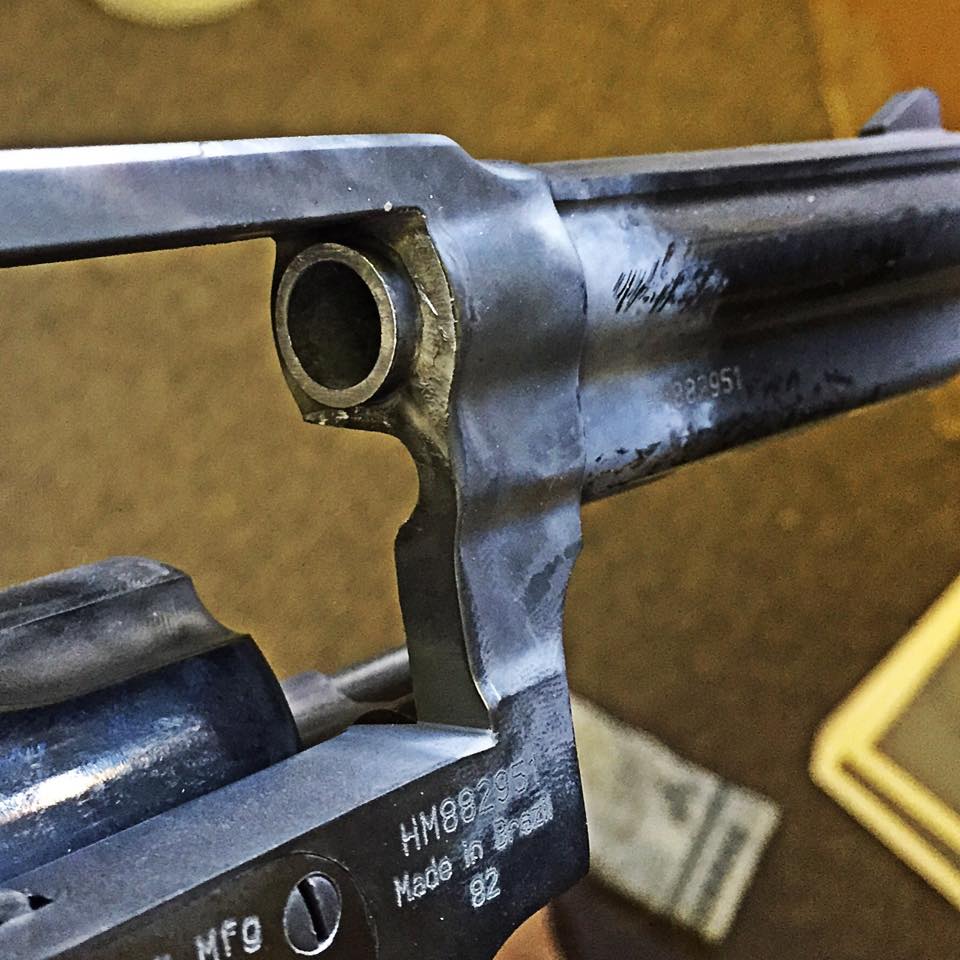
That’s the right side of the gun after the test; the silver discoloration you see that spreads out in an arc from the forcing cone is lead. Here’s the left side of the gun, notice that it’s lacking similar spray patterns:

What this tells me about the gun is that it’s out of time. One or more of the cylinders isn’t lining up correctly with the forcing cone, so as the round travels the cylinder it’s hitting the right side of the forcing cone and shaving itself off a little bit as it enters the barrel. That is the job of the forcing cone mind you – to make sure rounds enter the barrel properly, and this cone is technically doing that job. However, what you should see is a relatively even distribution of fouling around the forcing cone, indicating that the revolver is properly timed and the rounds are striking roughly centered on the cone. This revolver, as you can see, has rounds striking the right side of the cone, with little to no indications of fouling on the left side of the gun.
Also, in the left side photo, you can see bright spots on the inside of the frame under the forcing cone. Those bright spots are where the cylinder crane is impacting the frame under recoil. That’s also not supposed to happen, but in theory could be fixed by tightening down the yoke screw. However, there is no easy fix for the forcing cone issue. Fixing that would involve replacing the barrel and forcing cone entirely, or re-cutting the forcing cone at a slightly larger angle to allow the bullets an easier path. Either of those is beyond my mechanical skills by a long way.
So the final verdict on the Taurus 82? Yes, I know that this is just a sample of one, but even this sample of one has been deeply problematic. Coming from the factory with a bent mainspring strut and internals that looked like they’d been finished with a flint axe was bad enough; but those are things that can be fixed at the armorer level. The fact that a brand new revolver that’s never been shot was completely out of time to the point where I’d consider it dangerous to keep using it? That is a problem, and it’s a problem that can’t be fixed by the average gun owner.
The question now is “what to do” with the gun? I will probably send it back to Taurus, although because there’s documented evidence that I’ve had the sideplate off, that will likely void the warranty. I might keep it around the office as a grim reminder to my other revolvers to not misbehave. What do you think I should do?