IPSC Classic vs. Metric target

A while back in Front Sight, the official USPSA magazine, Phil Strader had an article advocating for the exclusive use of the IPSC Classic target over the currently popular “metric” target.  The discussion was picked up on the Brian Enos forum with varying opinions. For a little background, IPSC (and USPSA) originally used what we now know as the “metric” target – the familiar humanoid silhouette with the scoring regions detailed as you see in the picture to the right.  What’s interesting is that the target now known as the “Classic” target didn’t come in to existence until after the metric target had been the standard target for quite some time.

Since then, the Classic target has been adopted for full time use by IPSC; which means all matches sanctioned under IPSC rules (which are different from USPSA) use the Classic target.  Essentially, if you shoot an IPSC match anywhere in the many countries that the sport exists, you will not see the metric target, but instead you’ll see this target.

Meet the Classic target.  Sharp eyed readers will immediately see the difference between the Classic and metric targets – the Classic target lacks the upper head box that you see on the metric target.  It also eliminates the “B” zone entirely, leaving the scoring region on the target at A, C, and D.  In his own words, here’s Phil’s argument for using the Classic target exclusively:

I’ll never give up on my OPINION that using the Classic Targets would help better promote the sport to outsiders looking in. To be clear, outsiders like pro-gun interested hobby shooters, pro-gun potential sponsors, pro-gun potential media, etc. I’m not stupid enough to think that any anti-gun group would ever accept our sport as anything other than a bunch of civilian militia training ourselves how to kill other people…regardless of whether we’re shooting sweet fuzzy humanoid targets with big bunny eyes or swinging plates, square glass, or 12″ exploding circles (Top Shot shout-out).

I have spent a lot of time thinking this over (the Enos thread started back in July) and I have to agree with Phil.  Hear me out, because I know that not everyone is going to agree with me on this one.  I think using the head-box targets, which are obviously human-looking targets can deter potential advertisers and sponsors that would support the shooting sports such as bullseye or sporting clays but may be a little turned off by the “combat” nature of our sport.  That being said, I hate feeling like we’re making a concession to political correctness.  But you can view this without that particular “PC” element.  If you look at it purely from a marketing/media point of view, then what you have is a target that hinders media exposure (the metric) and a target that doesn’t (the classic).  No matter which way you slice it, the classic target is going to be me more friendly to more people, and that means more money and more exposure.  If the end goal is to get USPSA covered on ESPN (which I would love to see even though I know it won’t ever happen) then the classic target is an obvious choice.

But like I said, I also know that not everyone is going to agree with me here.  My personal opinion is that switching to the Classic target and doing away with the metric target would be in the best interests of USPSA and the end goal of growing and expanding the sport.  For people that want to keep the “practical” element of competition and enjoy the more traditional silhouette targets, there is always IDPA – which I love and would continue to shoot even if USPSA went to an all Classic target format.

For more on Phil Strader, check out his Facebook page and personal website, Straighter Solutions.
New gear reviews coming to Gun Nuts

Stuff you’ll be seeing in the next few weeks on Gun Nuts:

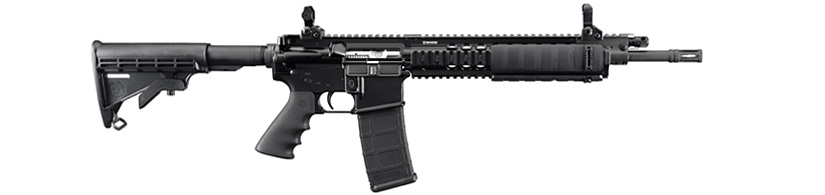
The Ruger SR-556 is coming, and we’re going to shoot it in a bunch of 3-Gun matches, some tactical classes, and wherever else we can.  This is going to be an awesome long term review, much like the SR9c that we’re running in the Quest for Master Class at Downrange.TV.

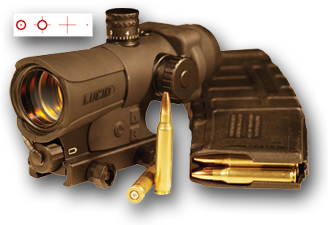
Also coming is the Lucid HD7 Red Dot optic. I have seen reviews for the Lucid on a few of the popular gun forums, but it really hasn’t been subjected to any kind of serious round count that I’ve been able to determine.  I got in touch with the owner of Lucid when I found out it runs on AAA batteries, and we’re getting a unit out here at Gun Nuts HQ to run in the aforementioned 3-gun and tactical carbine classes.  That means lots of rounds through a hot gun – we’ll definitely find out what this thing can do!

Obviously, the Ruger SR40 is also going to under review as well as used for the Quest for Master Class as we continue our trek towards IDPA 5-Gun Master.  After that, look for content about improving your skill at USPSA, as we’ll be shooting different USPSA classifiers and trying to move up the ladder there as well.

We’ll also have a look at products from Surefire, Crimson Trace, Magpul, XS Sights, Colt Firearms, Galco, and plenty of other great companies.  Additionally, and most interestingly, Gun Nuts has now reached a point where we have expanded and hired our first true employee, someone that you’ll be seeing on this site very soon in the future, but more on that later.

Needless to say, the future is looking good here at Gun Nuts, and I’m excited to have you guys along for the ride.  If there’s a product or piece of gear you’d like to see reviewed, send me an email at [email protected] and we’ll see what we can do!

Galloway Precision

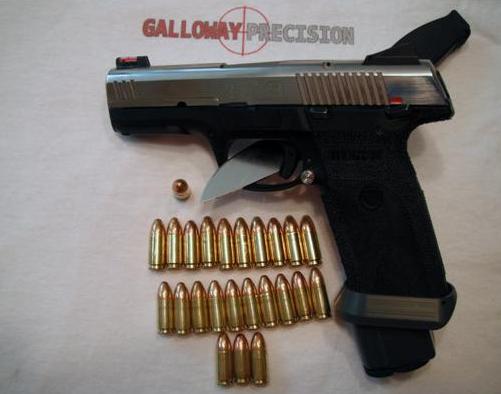
Thanks to a reader, I’ve discovered Galloway Precision.  A firearms accessory company that specializes in making competition accesories for the Ruger SR family of firearms.  In addition to a magazine well, which will be perfect for my plans to shoot the SR40 in Limited-10 and ESP, they also manufacture magazine extensions to enhance the already significant magazine capacity of the SR9/40 series.  In the end, you can build yourself a pretty serious looking SR9 or SR40 pistol for competition using the parts that they have in stock.

Obviously, I’m extremely interested in the magazine well.  While it does remove the gun from Production and SSP in terms of legality, the magazine well will greatly enhance reloads when shooting Limited-10 or ESP, and even the 1 or 2 reloads necessary if I shoot Limited.  A great big Gun Nuts Thank You to reader Jeff who pointed me to Galloway Precision, and hopefully we’ll be featuring some of their products here on Gun Nuts in the next couple of weeks.

Things you don't want to hear from a gun shop clerk

Marko has his list of things you don’t want to hear as someone that works in a gun shop.  In a fun bit of role reversal, here is a short list of things you don’t want to hear from that clerk behind the gun counter.

  • A little lady like you needs a snub nosed revolver
  • The Taurus Judge is a great defensive weapon (for any reason)
  • You don’t want to use buckshot in a house, use birdshot.
  • You don’t want to see Gun Y, you want to see Gun X because I think it’s better.
  • “10mm”

And the list goes on and on!  I think honestly the worst thing I ever overheard in a shop was a guy explaining to a customer how it was totally safe to fire 5.45 Russian through his AR because “the metric numbers convert to the same thing, .223”.

Feed the beast

So you’ve settled on a 1911 from our look at Entry-Level 1911s yesterday.  We’ll say for the sake of giggles that you picked the one I would have picked, the STI.  Now it’s time to feed your 1911, and believe me you have a plethora of choices out there in 1911 magazines.  From the cheapest gun show specials that may or may not work all the way up to the top tier of pistol magazines, the magazines will affect the reliability of your pistol in a significant fashion.  In general terms, the first thing I would recommend is avoid gun show “GI” magazines.  Unless of course you like practicing failure drills, that is.

When it comes to quality magazines for your 1911, here are my favorite choices though.  I honestly like to keep it simple, as there are a world of options out there, however I’ve had positive experiences with all three of these brands of magazines.

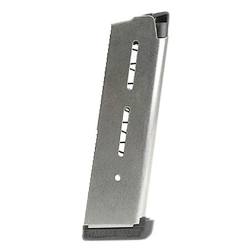
Wilson Combat 47D – this is one of the best regarded magazines in the world of 1911s.  I know lots of serious shooters that absolutely swear by these magazines and their reliability.  I have used Wilsons in a couple of different 1911s with zero issues whatsoever, and would recommend them without reservation to anyone looking to run their 1911 as efficiently as possible.


Chip McCormick – This are probably my favorite mags, both the PowerMags and the Shooting Star mags.  For my money, they’re the best combination of reliability and price so that I can afford to buy a box or so of them and not worry about one of them getting wrecked.  I can’t say that so much about the Wilson magazine, which usually costs 5-10 bucks more than the Chip McCormick magazines.

With that being said though, I have had some readers tell me about reliability issues with the Shooting Star magazines.  So the caveat “test your friggin’ mags” applies here.

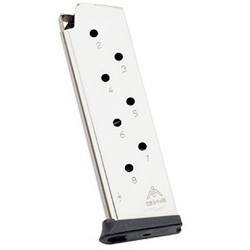
Last but not least is the Mec-Gar 8 round magazine.  I have the least amount of experience with this magazine, however what limited experience I have had has been positive.  I’ve only shot these again in very limited numbers, so take that with a grain of salt.  Plus, the Mec-Gar has the same retail price as the Chip McCormick, so honestly?  I’d buy the Chip magazines over these.

You may have noticed though that with all of these magazines I’ve had the caveat that you absolutely must test your gun with them.  I stand by that, because each individual 1911 from a different maker may prefer different magazines.  Once you find a brand that works in your gun, stick with it and buy lots and lots of them.

If you search the archives here at Gun Nuts, you’ll find we’ve hit on the topic of 1911 magazines before.  The best way I can explain is that Glocks are like Big Macs – you can buy a Big Mac from any McDonalds in the nation and it’s guaranteed to be the same no matter where you go.  Same for a Glock.  A 1911 on the other hand is more like a gourmet cheeseburger, which means it’s going to vary from chef to chef…or manufacturer to manufacturer.  That’s why it’s imperative to test your 1911 with a variety of magazines to find out which one works the best with your gun.