Don't think about pink elephants

Now what are you thinking about?

I’ve had some difficultly lately with my mental game.  My head is an interesting place and sometimes I just don’t want to leave.  I used to have the same problem when I was shooting skeet down at Mitchell’s in Salem, OR.  For me shooting is a constant struggle against my own propensity to over-think the situation.

As a skeet shooter I’ve taught myself that there is only one thing I need to see: that chunk of orange clay.  I have discovered that if I just let myself see the bird and stop thinking about everything else it tends to end up a cloud of dust.  It took a lot of training and time for me to stop thinking about how I was standing, where the bead on the gun was and, what I struggled the most with, to stop staring at the space between the gun and the bird – you look at the space, you shoot the space.

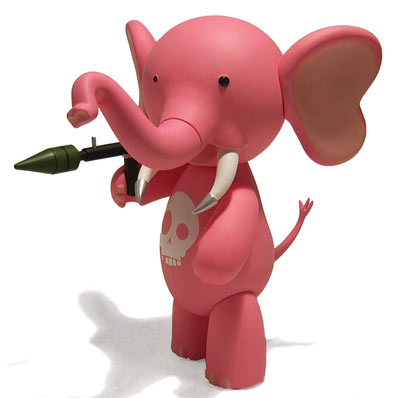
I’ve discovered the same mentality rolls over into shooting handguns and rifles.  All I want to see is the front site.  On days when I’m not stressed out and thinking about recoil and having a smooth trigger pull I tend to put the bullet where I want it to go.  While these days are getting more common it still takes a lot of effort for me to clear my mind enough to only worry about seeing that front site, and the problem is that a lot of time that effort just results in a downward spiral where I’m thinking about not thinking about it and therefore end up thinking about it.  It’s the “Don’t think about pink elephants” concept that Insight’s Training Center’s John Holschen espouses.  The idea is that as soon as you hear “Don’t think about pink elephants” you are thinking about pink elephants.

I’ve found that the best thing I can do for myself is just not worry about it.  If I think about over-thinking I’m already over-thinking.  When I was running a DA revolver, I wasn’t worried about anything other than the front sight and a clean trigger pull.  I ended up being much more accurate than I was used to, specifically because I had less expectation of my performance than I would normally have.

I guess it’s time to get out of my own head and stop thinking about those pink elephants.
Class on trusts

I spoke earlier this week about the benefits of setting up a firearms trust.  If any of you here in the northwest are interested in setting up a legitimate trust and learning more about them Dennis Brislawn will be holding a class at West Coast Armory on Wednesday, December 29th.  You can find out more at West Coast Armory’s blog or Facebook page or just shoot me an email.

Ramping up for SHOT

Gun Nuts will be at SHOT this year!  We’ll be attending the 2011 SHOT SHOW in Las Vegas, so starting now I want to know what you guys want to see.  We’ll be doing Media Day the day before the show opens, we’ll likely hit up the Glock press conference, but I want to know what you guys would like to see.  Let me know your SHOT SHOW requests in the comments!

Guns are serious business

I take shooting very seriously.  Partly because it’s my job, and partly because I believe that I should strive for excellence in anything I put my hands too.  I practice hard, I train hard, and in the end I want to make sure my shooting is as good as I can physically make it.

But that doesn’t mean I don’t want this to be fun.  Which brings me to the subject at hand, namely zombie targets.  Some guy is upset because he thinks zombie targets make us look bad or something.  Luckily, Tam did all the heavy lifting and said the smart stuff that I was going to say about how zombie targets are largely a socially acceptable way to train against a semi-realistic human silhouette without offending the majority of the other shooters in the range.  They’re also fun.  One of the ranges I frequent has Santa Zombie targets.  You can’t tell me that blasting that jolly-old undead elf right in between the eyes after you get another ugly sweater from your in-laws wouldn’t feel good.

But the point of what I wanted to talk about is that as an industry and sub-culture, we ignore pop culture phenomenons at our peril.  Zombies are popular right now in media, and the firearms industry has a tremendous opportunity to attract new shooters by offering them the chance to do in real life what they would only do in video games or see in film – shoot zombies in the head.  This then creates a training opportunity for us in the industry as well.  Take a video game/zombie film aficionado and take them to the range and have them try to make a reliable head shot on a static target at 7 yards in less than 2 seconds.  It’s not easy, and then that opens the door for us to try and steer that person towards action shooting, professional training, and hopefully making them a life-long shooter and hobbyist.

Zombie targets are fun.  Zombie stages at IDPA matches are lots of fun.  If we constantly sit around pooh-poohing everything that doesn’t mean our lofty standards of “serious shooting” then we run the terrible risk of alienating the current youthful demographic.  I don’t know about you, but I want to still be running USPSA and Steel Challenge matches when I’m 70, but if we don’t still have a shooting culture by then, it won’t be possible.

The circle is now complete

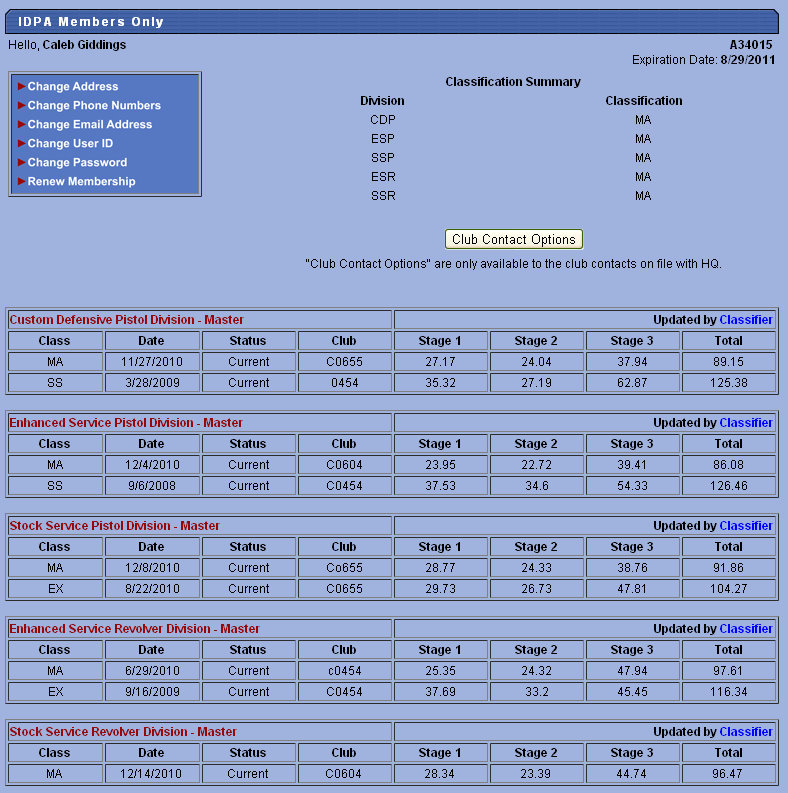
I shot my fifth and final Master-Class classifier on Tuesday at Norpoint Range.  Here is a complete list of every gun I’ve used in training and actually shooting the classifiers:

  • ESR – S&W 625
  • SSR – S&W 686SSR
  • CDP – Kimber Pro CDP II
  • SSP – Ruger SR40, Ruger SR9c, and S&W M&P40 Pro Series
  • ESP – Ruger SR40, Ruger SR9c, and S&W M&P40 Pro Series

I need to thank a lot of people for helping with this.  On the gear side, obviously Ruger Firearms.  The SR40 and the SR9c have been the primary firearms used for this, and I’ve shot literally thousands of rounds through them while practicing, training, and eventually shooting SSP Master with Ruger’s guns.  My holsters and mag carriers have exclusively been Comp-Tac or Blade-Tech products.

Most importantly though I need to thank the facilities that have invited me in to shoot – starting primarily with Norpoint Range, just north of the Seattle Area where I shot my ESP, SSP, and SSR Master Class runs.  They have a great IDPA program that I help run as well, one of two indoor ranges in Washington that run IDPA matches.

I shot my ESR run what feels like forever ago at Atlanta Conservation Club in Indiana, before I moved out to Washington.  My first Master Class run and still the one I’m most proud of.  ACC holds great matches, and if you’re in the Indianapolis area you should definitely check them out.  I’m trying to figure out the logistics on how I’m going to get back there in 2011 to shoot their state championship match.

My CDP run was shot at West Coast Armory in Bellevue, WA.  I ran this one on a total fluke with a Kimber Pro CDP II.  WCA also holds IDPA matches, and I have to say between them and Norpoint it’s nice to be able to shoot IDPA in the winter and stay dry.

I also need to thank Downrange.TV and the staff over there.  Shooting the classifiers and putting together the training videos has also given me a chance to watch my own shooting which has been a huge step in improving my game.  I can’t say enough of how much that’s helped me.

And last but certainly not least, I need to thank Cheaper than Dirt.  Since coming on board with them last month I’ve had a ton of opportunities to shoot, and that level of practice has really allowed me to punch down the walls I’d been encountering.

We’re going to keep going with the Quest for Master Class as well – just because I’ve hit my goal doesn’t mean the journey is complete.  The day I stop learning and improving my shooting technique is the day they hang a toe-tag on me!

Reinventing my swing

Right after Tiger Woods won something like a zillion championships his first year on the PGA, he went back to the drawing board and totally broke down his swing to see if he could improve.  He did end up getting even better, and while Tiger admittedly isn’t a great example for some other stuff, he is a good example of mastery of a sport.

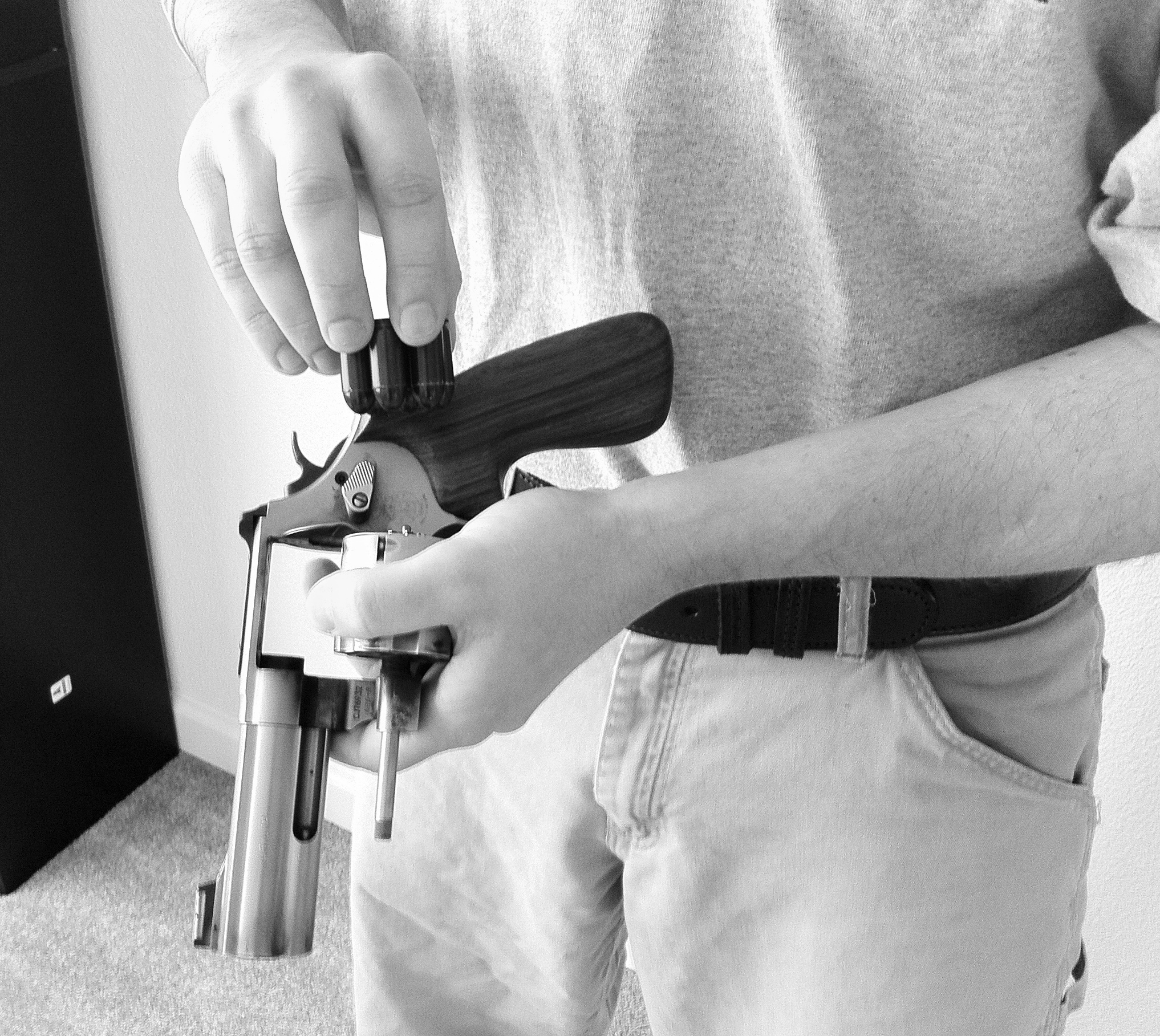
I’ve recently started screwing around with my revolver reload.  Previously, I did the “Miculek” or “swap” reload, where the gun transitions to the weak hand and your strong hand grabs the moonclip/speedloader to recharge the gun.  Even with practice I always had lots of trouble with the part of this load where I had to re-establish my firing grip.  As you can see in the photo, my weak stabilizes the gun while my strong hand drops the moonclip (in this case) in the cylinder.  The reload works the same for speedloaders, and if you’re using HKS style speedloaders is really the most effective way to recharge the gun.

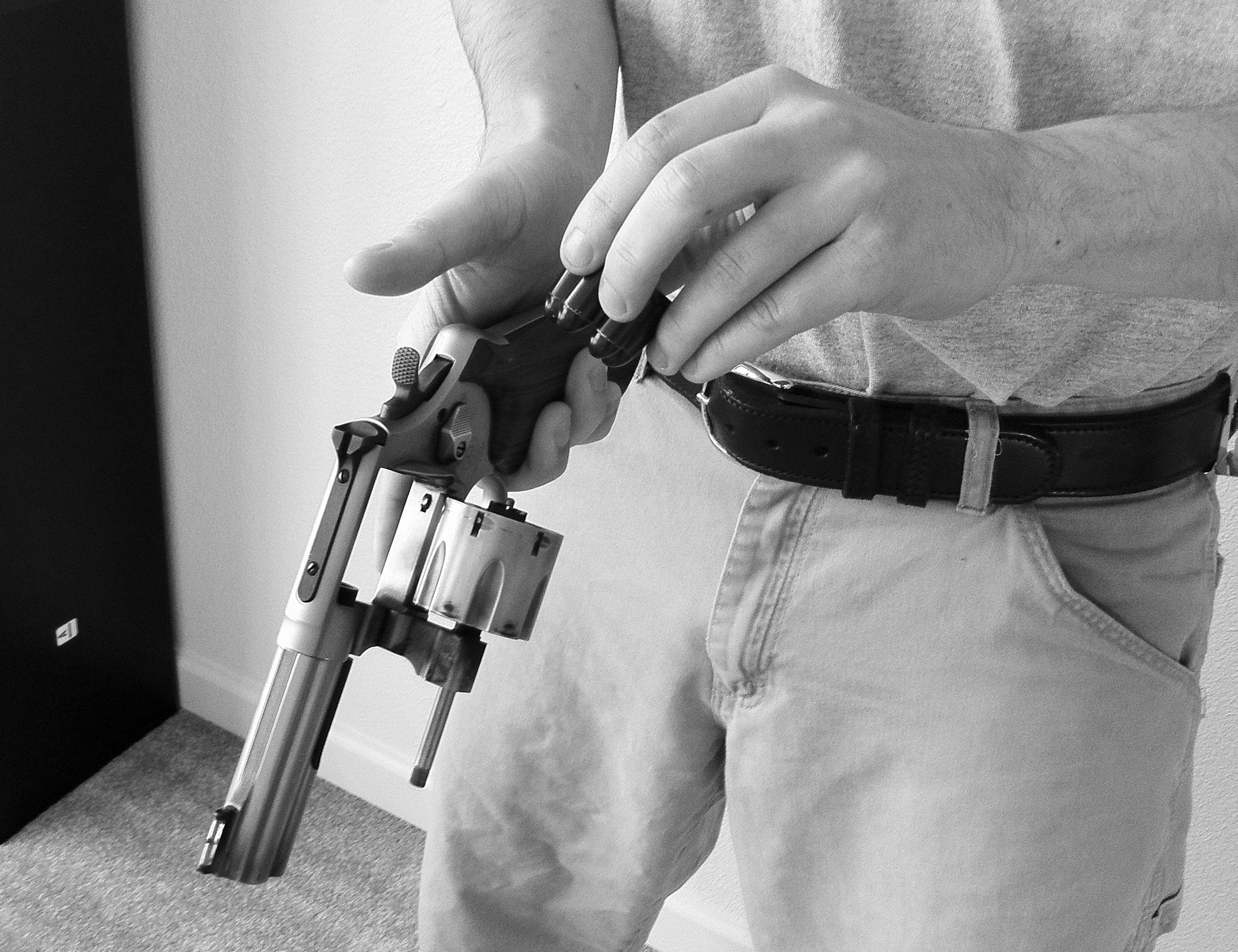
The weak hand method pictured at right retains the gun in the firing hand.  The weak hand goes to the belt line to grab the moonclip or speedloader which is then dropped or pushed in the cylinder.  This method only works really well with Safariland speedloaders and Jetloaders, which require you to push them in the gun instead of twisting the release knob.  I ran this reload exclusively at the last IDPA classifier I shot using my 686SSR revolver, and with Safariland Comp-III speedloaders it worked very well.  For lack of a better explanation, it feels smoother doing this reload.  I think that if a shooter is transitioning from a bottom-feeder to a revolver, this would be a more familiar motion for them to get used to.  Again, this straight up won’t work with HKS speedloaders unless you reach through the frame to stabilize the cylinder.  With a Safariland or moonclip, the cylinder can rotate all it wants while you’re reloading.

The gun pictured is my S&W 625, which wears a HiViz Fiber Optic front sight and the Cylinder and Slide Extreme Duty rear sight, which is the same rear sight that the S&W 325 Night Guard wears.

I’m going to run some “on the clock” drills today with a par time set – the goal is to be around 2 to 2.5 seconds for a moonclip and 3 to 3.5 seconds with a speedloader.  Under match conditions at the classifier my reloads on the El Pres came in at 3.6 seconds, and shooting FAST with a revo and this technique I’m clocking in around the same area.  My best revolver run on FAST is still 6.86 seconds with a moonclip gun.

Mobster clowns come in shooting

A commentary on IDPA by the inestimable Pete Palma.

I love IDPA. It was the first shooting sport I played post bullseye, and it’s still one of my favorites. That doesn’t mean that we don’t have a lot of dumb rules and a ridiculously subjective rulebook ripe for abuse by martinet SOs that hate “gamers”. Uh…what I meant to say was I love IDPA.