Gun Locker
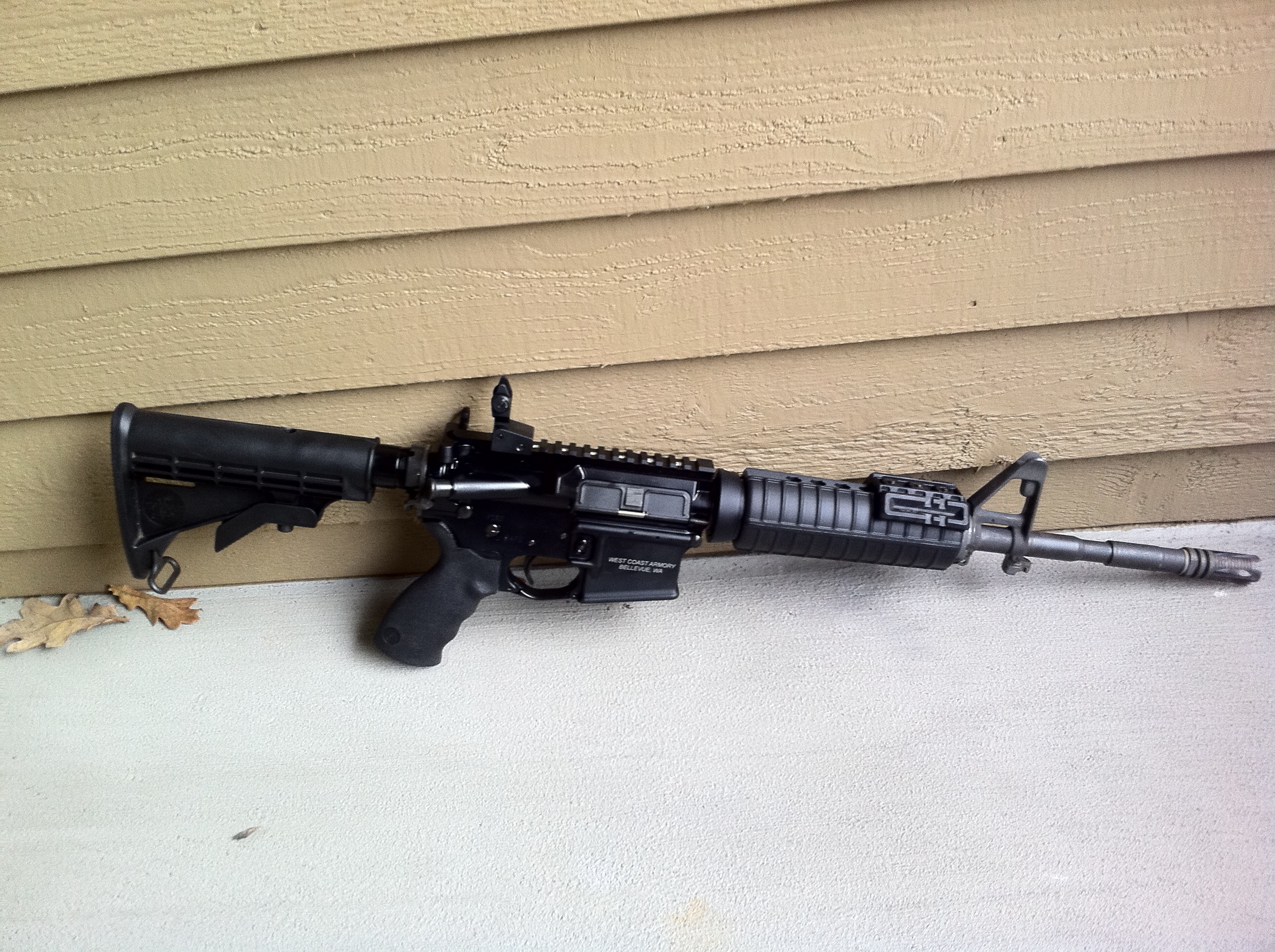
People have the tendency to pick up my AR and go “Wow, this is light!”. Yes it is and it’s going to stay that way. Having a light rifle is extremely important to me since running and gunning is a lot of work and I’m a little girl. I don’t need a front heavy rifle weighing me down when it’s not necessary. I am trying to design a rifle that is easy to carry around, easy to shoot, reliable and accurate. Given that quality parts will keep it reliable and I’m not going to be able to out-shoot what I have now for a long time I am focusing on keeping my rifle light and making it easy to shoot.
Right now my AR is nice but very basic. The “West Coast Armory” stamped Tactical Machining lower was a birthday present from work and the Daniel Defense upper a gift from the infamous SamFromWades, I have a Colt bolt group (another birthday gift) from a coworker and gunsmith Jim Corollo from West Coast Armory did a really nice trigger job for me. After that I threw on a used 14.5″ light weight Colt barrel bought off a friend, a hand-guard, an extended charging handle, a Bushmaster stock and a Magpul sling mount. It all kind of fell together over the period of a week.
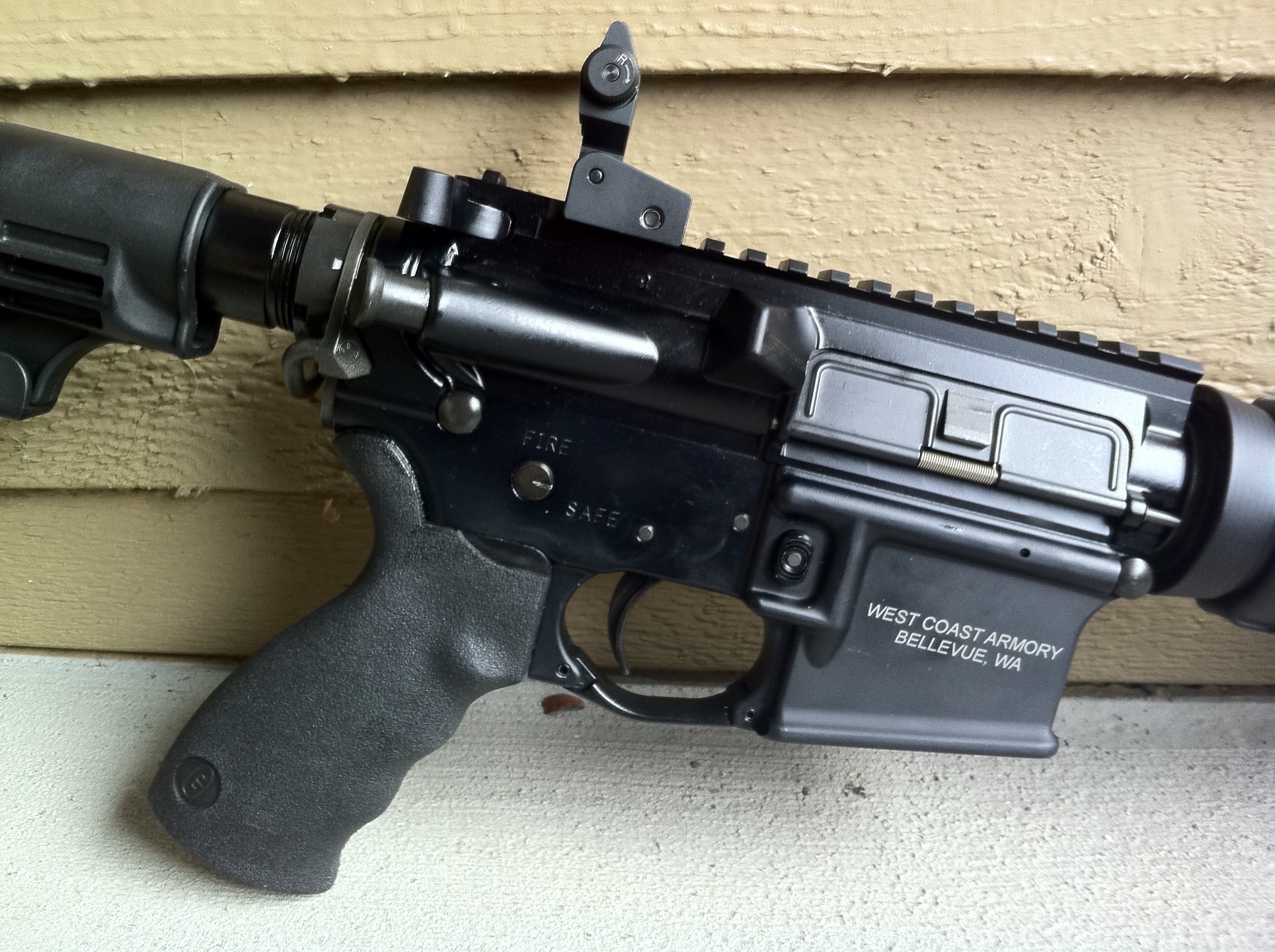
My future plans are to pick up a Noveske 14.5″ Afghan and have it dimpled then have Sparky, my AAC Blackout flash hider, pinned on. I am then considering picking up the Daniel Defense 10″ Lite Rail on which I plan to put a Crimson Trace MVF. Then I’ll put a Trijicon RMR on top and a Magpul CSR stock on back and call it good. I will have a good looking, reliable gun with a reflex sight, a laser and a flashlight that will hit where it’s pointing. What more could I ask for?
So you want to buy a can
One of the ways to expedite the purchase process for a suppressor is to set up a trust. It’s easy to waltz into your local gun shop and set up a free trust. Most gun stores around here at least, have a 1-4 page scripted trust document they are more than happy to slap your name on in the interest of selling you the can behind the counter, but that doesn’t create the magical legal shield you imagine in your head.
Early in November estate lawyer (loyal customer, retired airborne ranger and fellow firearm fanatic) Dennis Brislawn sat down with the West Coast Armory ninjas to give us a class on trusts, and it was an eye-opener. It turns out that most of those free trusts are worth every dime you spend.
I’m going to start out this series by attempting to describe what a trust is as simply as I can. As explained to us in the class, conceptually a trust is a “box” in which property is kept. As grantor (settlor, trustor, donator, creator…), I own this box and I put my stuff in it; I can provide benefits from this box to the people I select (benificiaries), and I can appoint someone to operate the box: a trustee, who must follow and enforce all the rules of the box as I have written them. (I can be this trustee.)
This means if I have a silencer stored in my box, then anyone I’ve listed as a benficiary also gets to play with my silencer, as long as they follow the rules of the box. It’s the trustee’s job to make sure they follow these rules. So what can these special “boxes” do for gun owners?
First of all, it means we can buy NFA regulated items without a CLEO signature. Since it is a legal entity purchasing the item, and not the individual, this necessity is bypassed – as well as the need to submit fingerprint cards and photographs. (You will still go through a NICS check, though.) The ATF will review the complete trust; if your trust owns unregulated firearms, they may need to be disclosed. In one submission of a trust by attorney Dennis Brislawn, he provided a Schedule B that lists any unregulated firearms but left it blank as “not required”. The ATF may reject the trust for this reason, but he wanted to see.
A trust also provides a convenient place to list all of your firearms. In our trusts we established “Schedule B” as a listing of all our unregulated toys: guns, holsters, mag pouches, slings, anything we want. I have all my firearms, descriptions of each and serial numbers listed in one happy place. I have a legal registry of my documents that still retains my privacy. (While information about your assets can be subpoenaed if you are sued, a trust isn’t a matter of public records – it’s between you and your lawyer.) As someone who used to work in insurance I get far too excited over this notion. Take that insurance companies.
Trusts are helpful for estate security, as well. They provide a distrubution plan for all your assets without necessitating probate. So you can parcel out your items without having to go to court, keeping your property out of the public eye. A well written firearms trust also assures that, even if your loved ones don’t have knowledge of firearms laws, your guns will be safely and legally transferred during life or after. The extra security provided is particularly important for firearms because of the state to state differences regarding transfer and ownership. Providing for your firearms in a trust gives you the opportunity to leave specific instructions on what to do with your firearms upon death or incapacity. This means not leaving your black rifle to Aunt Melinda in Connecticut or your handgun to your 5 year old, where it isn’t legal for them to do the transfer, or for them to accept or own the firearm. Do be careful with this, though, as a trust can be worded to include ALL your possessions or ONLY those listed, and can trump your written will.
I’m going to write a little bit more on trusts, because I think it’s an important topic for firearms owners to be aware of. In the mean time, if you want to find out more you can check out the NFA Gun Trust Lawyer Blog.
Springfield XDM Compact
No, not the one with the 3.8 inch barrel. I mean, wait yes this has a 3.8 inch barrel but it has a compact grip too – no, not the other XD compact it’s different because…oh hell just look at it.
Winchester PDX1 .410 ammo review
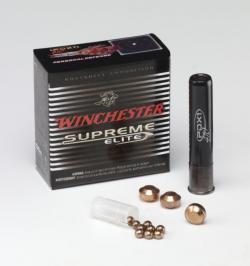
Last year around this time, Winchester introduced their new “defensive” .410 load for shotguns and the Taurus Judge.
The PDX1 round was pretty obviously designed for the Judge, as there are already decent buckshot and slug loads out there for .410 shotguns. This round uses three “defense disks” which are backed by 12 BB-sized shot pellets. The defense disks will actually engage the rifling on a Judge and be somewhat more accurate than the shot, which will get spun out in a circular pattern on target.
I recently had the opportunity to pattern the PDX1 ammo at 7 yards from an actual Taurus Judge. At 7 yards, all three defense disks impacted the target center of mass in approximately a 2-3 inch spread. The 12 BBs? 7 hit the target, 4 more hit the paper, and the 12th was a total miss. At 7 yards. Now, I have no doubt that if I had run the same load through a conventional shotgun, the BB group would have been acceptable, but out of the Taurus Judge even at 7 yards the shot spread is too wide to be safe for defensive use in any circumstances. The penetration on the defense disks leaves something to be desired, as outside testing has shown they’ll only penetrate 10 inches in bare gelatin from the Judge.
I am considering testing this ammo out of a .410 shotgun – while I wouldn’t use this as defensive ammo out of a Judge, it might have some benefit out of a full size shotgun with a proper barrel.
Life is too short…
…for crappy magazines. That’s something that you’ll hear me say from time to time if you ever shoot matches with me, or even if you read this blog for any extended period. It’s not just magazines though, because I believe that life is too short for crappy gear, period. In the comment section at my co-blogger’s excellent post about the difficulty of managing a DA revolver trigger we’ve been following a rabbit trail off the main subject an in to The Woods of Crappy Guns. For those that haven’t been following it, here are the broad strokes:
- Team Gun Nuts believes that a revolver is a fine defensive firearm if you’re willing to invest the time necessary to master the DA trigger.
- I personally believe that every law abiding citizen has a right to own a gun for self defense, and has a right to defend themselves.
- It then follows that I believe that everyone should be given the option to have the best tools possible to defend themselves.
The counter arguments run as thus:
- Lots of people just want a gun for protection and don’t want to practice with it at all
- 90% of DGUs don’t involve a shot being fired, so it’s not actually important if the gun works or if the person is skilled in the use of the gun
- With the 90% statistic in mind, people are better served buying cheap guns than spending the money on a “good” gun.
Point by point, let’s examine those. The first point, that lots of people want a gun for protection and don’t want to practice with it is true. I think that as professionals and enthusiasts in the industry, we have an obligation to encourage people to get training and practice with their defensive firearms, as having educated and competent gun owners is a benefit for everyone.
The second point I find rather alarming. In all likelihood, my co-blogger will never need to draw her carry gun to defend herself. However, if that 0.1% situation actually happens and she needs to use her gun to defend herself, I want her to be as well prepared for that moment as possible. It’s the same reason why I attended a defensive driving class – and those are skills I’m much more likely to need.
The third option is pure madness. Let’s take a look at one of the cheaper guns on the market, the Bersa .380. Quality ranges from good to unreliable owing to poor QC at the factory, so one of these could either be dead reliable or a complete dog. I owned one of these guns, it was actually my first carry gun before I switched to a 10mm Glock and then to a revolver. My particular Bersa was okay, but I also didn’t shoot it very much. On Gunbroker, the average price for a new Bersa is around $250-300.
For the same $300 you could get a Gen2 Glock in .40 S&W, the same gun used by police departments across the nation. Or for less than the cost of a Bersa or a Taurus you could get a used S&W K-frame revolver, which was essentially the Glock of the 1960’s-80’s. Even with my objections about the DA trigger for newbies, I’d rather see a thousand used K-frames sold before someone buys something that’s not reliable.
A gun is a very simple tool to use, but unlike a vaccine which is just injected in the end user and then does its own thing, a gun requires the end user have a modicum of skill to use effectively. Stray rounds and misses are legal liabilities that we don’t want to have, which again is why I feel strongly about encouraging people to seek training and practice. The same goes with getting good gear – the last news story I want to read is about some 80 year old woman who was beaten to death in her own home because the cheap gun that someone sold her because “she’s not going to practice” failed her in her time of need.
At the end of every episode of the Quest for Master Class, I admonish people to carry their guns. But life is too short for crappy guns and crappy gear, and if you’re going to buy a gun simply for peace of mind of having a gun, why not make sure it’s the best gun you can buy?
The Double Action Trigger
Buying a carry gun is difficult for women, trust me, I know. It’s hard to decide where to conceal, how to work around fashion and what sacrifices we’re willing to make for the gun and for our lifestyle. As a young woman who frequents gun shops I’ve been pitched a lightweight .38 as great first carry gun more than once. I have never agreed with this pitch, and to that point I’ve been carrying around Caleb’s Model 60 j-frame for the past couple weeks.
I already explained how I’ve benefited from revolvers, now it’s time to let you know my feelings on them as a woman’s first carry gun.
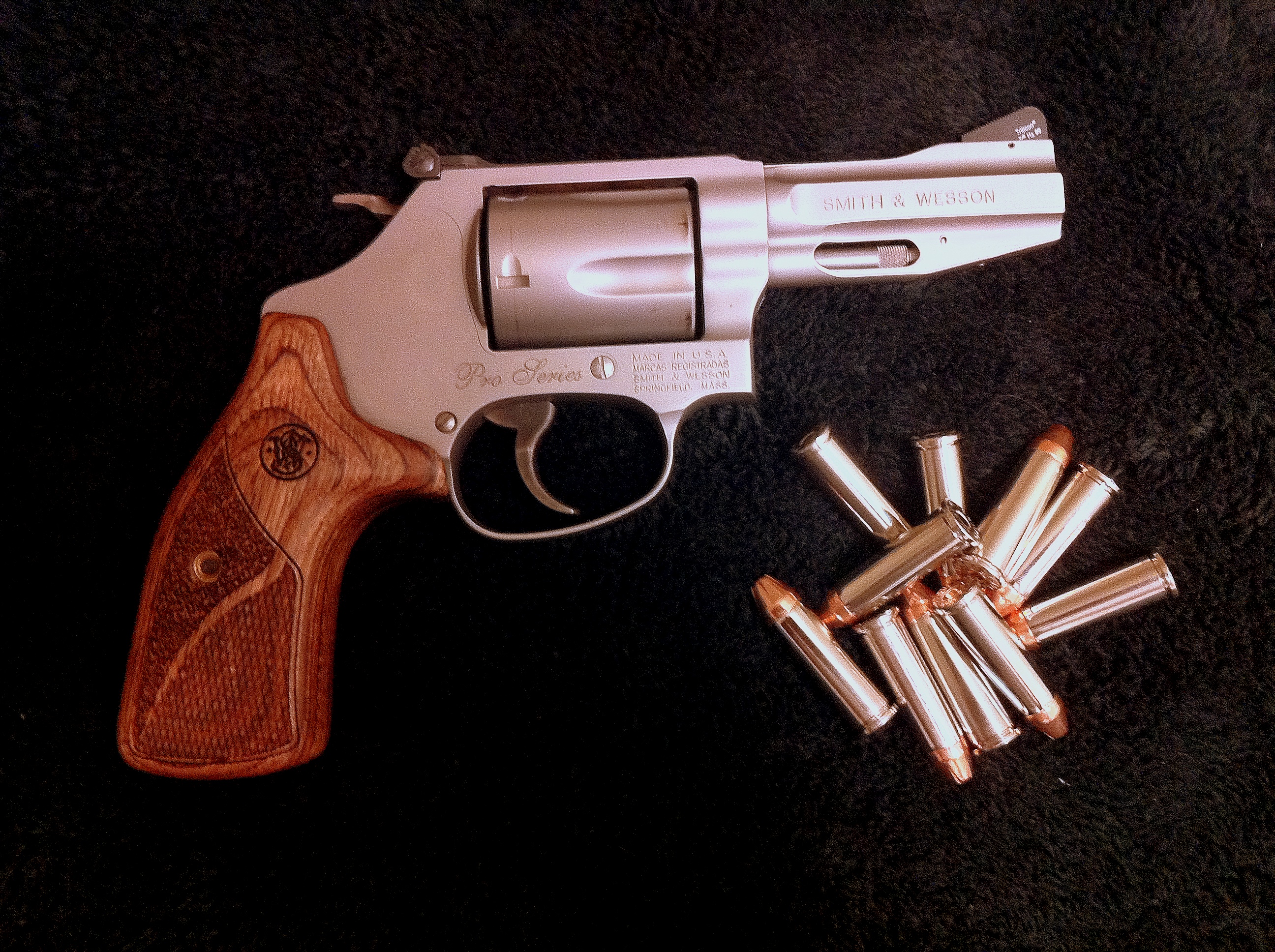
I understand why this is such a popular notion: These guns are small, extremely light, very concealable, reliable and easy to use, while still having the “adequate stopping power” of a .38 or even .357 (versus, for example, a .380.). But there’s something you boys aren’t taking into account: forearm strength.
I get fatigued from the double action trigger pull on the Model 60 after about 6 rounds, from the 686 after about 12. Halfway through a box of ammo my wrist was actually hurting from the Model 60. The simple fact is that women don’t have the same forearm strength as men do, and you can’t expect me to want to sit around and plink with a double action trigger when it fatigues me so quickly.
I’m by no means saying we can’t do it, I can do a 100 round training session with a revolver and it’s not so bad. But I know that being handed something on one of your first times out shooting is a completely different experience than me standing in the open movement bay working through my trigger slap. If someone’s arm is getting tired after 30 rounds they aren’t going to go “Oh, this is fun, I should do this more.”
Another argument you hear for selling revolvers to women and first time gun buyers is that it’s less complicated to operate than a semi-automatic pistol. The problem with that theory is that today I’ll drive a manual transmission Jeep to and from work, successfully operating more controls at 60 MPH than you would find on a 1911. Often coupled with that argument is the thought that a revolver is a good gun for a woman (or even a man) that’s going to buy a carry gun and then not shoot it. I take issue with that because even if the purchaser isn’t going to shoot the gun that often, they still deserve to be sold a gun that they won’t find physically unpleasant or exhausting to shoot.
I recognize that a carry gun is not going to be fun to shoot, they aren’t designed that way. But there are plenty of carry options out there for women now that aren’t double action revolvers. There’s no reason they shouldn’t work into that arm strength through striker fire guns like the Ruger SR9c or even a single action such as my little Sig Sauer P238. With less-fatiguing yet still light and reliable options available there is no reason these little revolvers should be pushed onto unsuspecting first time gun buyers.
Flat shooting handguns
Tam talks about the trajectory differences when shooting pistol cartridges. Hint: there really isn’t much of a difference.
For the fanboys
Don’t say I never do anything for you.
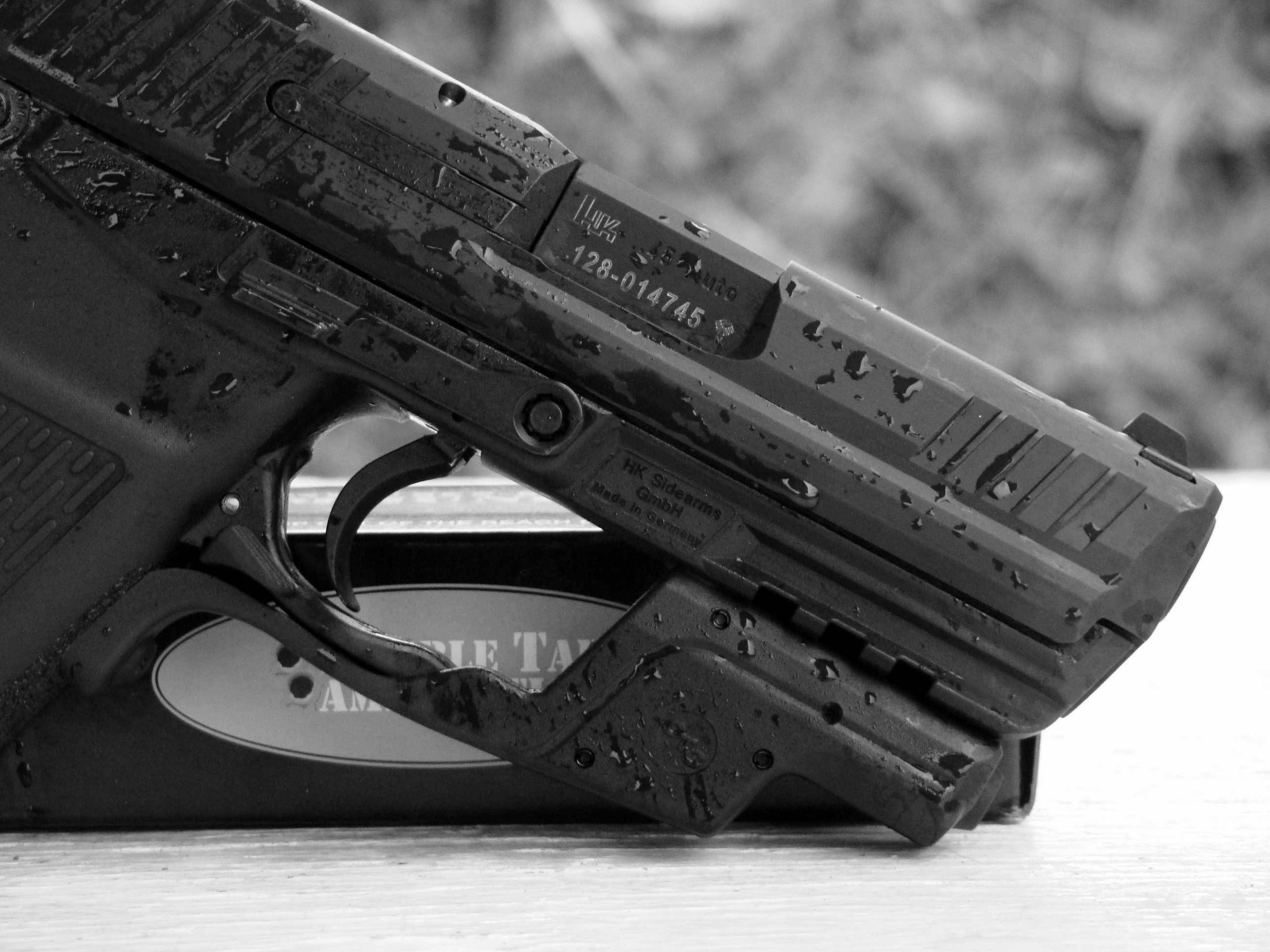
That’s an HK45c equipped with a Crimson Trace LG-645 LaserGuard.