Our government at work

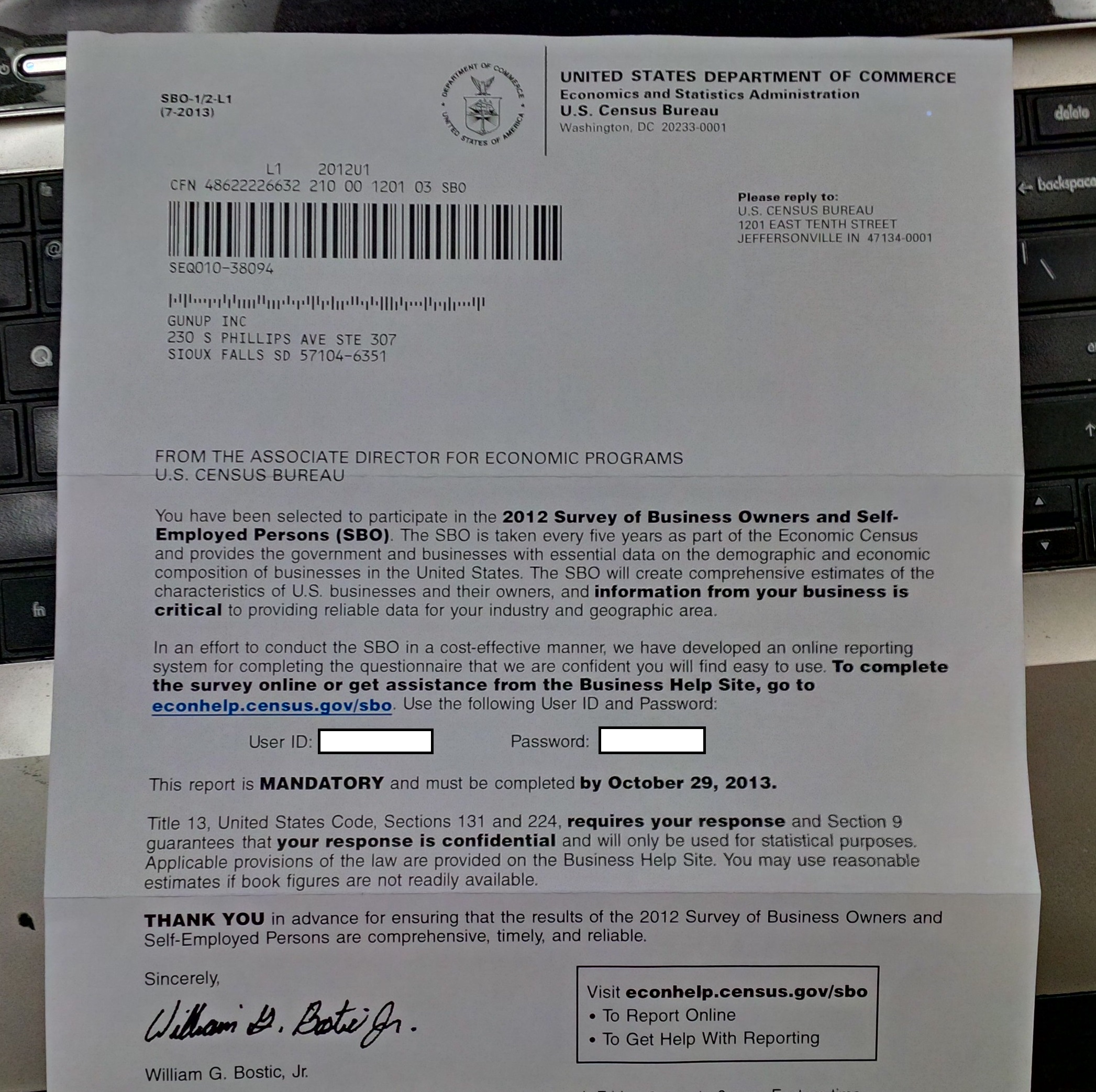
Yesterday, we received a letter at the GunUp office from the United States Department of Commerce, Economics and Statistics Administration, US Census Bureau. This letter informed us that our business had been selected (without our input) to participate in the 2012 Survey of Business Owners and Self-Employed Persons. Here’s where it gets ridiculous, and I’ll upload the entire letter so you can see it.

IMG_00000126_hdr

In case you can’t read it, I’ll reproduce the text here:

This report is MANDATORY and must be completed by October 29, 2013.

Title 13, United States Code, Sections 131 and 224, requires your respose

So, of course we go try to go to the website listed in the letter to do our civic duty and what happens? The site’s closed due to the .gov shutdown. So to recap, here’s what happened:

  1. Federal Government opts us in to a survey without our consent
  2. Tells us that the survey is mandatory and that we’re required by law to reply
  3. Shuts down the website during the mandatory reply period due to a lack of funds

Let’s assume for the moment that the shutdown lasts past the 29th of October. I can guarantee that the government would still fine us for failing to reply in the allotted time…even though it’s their fault that we can’t.

It’s things like this that make me want to invade a small island and set up my own country.

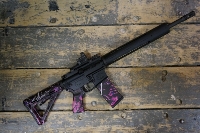
Photo of the day: FNH P-12 vs. Colt Sporting Rifle

FNH P-12 vs. Colt Sporting Rifle

The FNH P-12 is one of the best factory pump guns I’ve ever used, despite the sharp lifter. It retails for around $550, and holds 5+1 in its factory configuration. The Colt Sporting Rifle is a great AR, and retails for around $850. This rifle also has a $400 RMR as well as a Magpul MOE kit on it. 20 round magazine earns +100,000,000 style points.

Shotguns vs. rifles for home defense

In the post “Revolvers and Shotguns don’t jam” I mentioned that I would prefer to recommend a semi-automatic rifle to an inexperienced shooter for self-defense over a pump-action shotgun. There were some questions raised in the comments, so today we’re going to take a look at the various factors involved in choosing a rifle or a shotgun for home-defense.

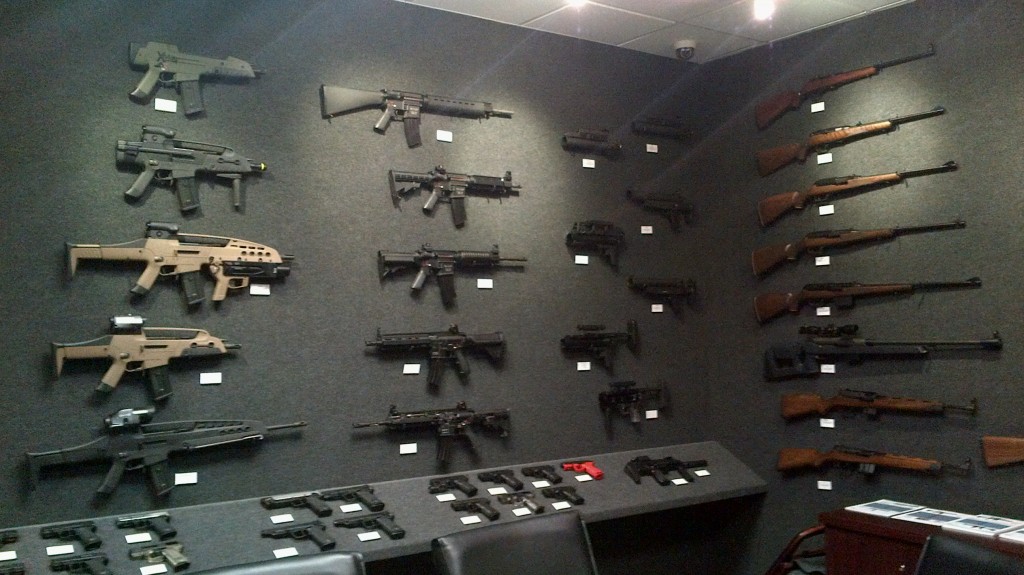
Colt Sporting Rifle - GunUp Magazine (6)

For rifles, we’ll use the ubiquitous AR15 platform, because it’s the most popular rifle in the USA right now. Pump-action shotguns are a fairly generic concept, but for the sake of this post we’ll assume we’re talking about the either Remington 870s or the Mossberg 590 series. There are plenty of other pump guns on the market, and some of them are truly excellent such as the FNH P-12, but to include every single pump would make this a 30,000 work article.

Cost
This is the first area everyone wants to talk about, and it’s a reasonable point to start. Cost absolutely figures into this equation, and it’s not exactly as disparate as you’d think. An entry level AR will probably run you about $700-800 in the current market, and with that you’ll get the vanilla features: adjustable stock, iron sights, A2 flash hider and probably a rail to mount a light on. For $400-600 you can get a similarly entry level shotgun, which will not have good sights, and will likely not have the capability to accept a light anywhere. Climbing the shotgun price ladder to $700-800 dollars will get you a top notch pump gun with good sights, a light capable forend, and higher magazine capacity (8-9 rounds). So for the price of an entry level AR, you can get the best pump shotgun on the planet.

Winner: Shotgun

Firepower
I had to think up a category that would combine both lethality and capacity, and because I like trite, cliche terms I went with firepower. Obviously, the rifle has a huge edge in capacity, since it holds 30 rounds. However, the 12 gauge pump action shotgun is the most destructive individual weapon system out there, and is the only gun that can accurately have the term “stopping power” applied to it. 00 buckshot from a 12 gauge creates massive destruction on the target and has an excellent reputation for stopping fights. .223 ammo isn’t as well regarded, however modern JHP loads like our favorite, Hornady TAP are excellent defensive rounds. However, despite the massive power of the shotgun, the edge in the firepower goes to the rifle. 30 rounds is a lot more than 9, and even more importantly it’s a lot easier to get hits with a rifle than it is a shotgun. Contrary to movies, shotguns do not spray a magical cone of death that blows badguys into a red mist.

Winner: Rifle

Shootability
This goes hand in hand with the firepower category, because having all the ammo in the world doesn’t do you any good if you can’t get hits. I won’t waste too much time on this one, because the answer is simple: rifles are easier to accurately than shotguns. They usually have better sights, better triggers, and a less complex manual of arms.

Winner: Rifle

Ease of use
A key reason people recommend a pump action shotgun is because it’s “simple”, while poo-poohing the semi-auto rifle because it’s so complex. Let’s take a quick look at the loading/firing/unloading cycle for both guns:

Shotgun:

  • Load the magazine by inserting shells into the magazine tube one at a time on the bottom of the gun.
  • Pump the action to the rear, drive it all the way forward, place the weapon on safe.
  • Take the safety off, fire the weapon by pressing the trigger, pump the action action again. Make sure you don’t short stroke the action.
  • Repeat as necessary for a maximum of 9 rounds.

Rifle

  • Load the magazine by pressing the cartridges straight down into the box.
  • Insert the box in the gun.
  • Pull the charging handle, place the weapon on safe.
  • Take the weapon off safe, fire the weapon by pressing the trigger
  • Repeat as necessary up to 30 times.

The reloading process for the rifle is also much simpler as it consists of “put another magazine in the gun”, while the shotgun requires you to manually thumb more rounds into the tube. Additionally, if either guns are carried “cruiser ready” (loaded magazine, empty chamber, safety off) the AR still gets the edge because all you have to do is yank the charging handle, which is easier than pumping a shotgun.

Winner: Rifle

The Verdict: When you break down the pros and cons of a rifle versus a pump-gun for home defense, the rifle ends up making a lot more sense. There’s also the fact that if you want to hit something with a shotgun past 50 yards, you need to do a slug changeover, whereas with a rifle you just shoot at it. I love shotguns, and I do keep several shotguns in the house for defensive use. The current state of technology and the vast proliferation of rifles means that they just make more sense as a home defense weapon than a shotgun. You can get a good rifle with a decent light and optic for ~$1000 if you shop smart (shop S-Mart), and if you really want to fully outfit your shotgun, you’ll end up spending at or near that. Yes, you can get a used shotgun that will be perfectly serviceable for $250, but this post isn’t about home defense on a budget. If you really want the best for home defense, you want a rifle.

Excellence vs. Competence

The other day I read an article on the Firearm User Network discussing an Army white-paper that contained a comparison of the error rates between snipers and upper teir High Power and Long Range competition shooters. The research found that the snipers tended to miss more than the High Power or Long Range competitors. This really shouldn’t come as a shock to anyone.

If someone invests considerable time, effort, and attention into developing a particular skillset, odds are that they will achieve a relatively advanced level of skill that will surpass those who have not made the same investment. This seems logical enough…and yet when we apply that relatively benign statement to guns suddenly people begin to exhibit completely irrational behavior.

Accurate use of a firearm requires devevlopment of a particular set of skills. As it is with most other pursuits, those who invest the most time, effort, and attention into developing these skills will usually be better than those who do not. Generally the people who invest the most time, effort, and attention into developing skills with firearms are (surprise!) firearms enthusiasts. The guy who loves to shoot and loves to compete will probably develop a much higher level of skill than the person who is issued a firearm as a part of their job that doesn’t have the same interest. The guy who dedicates a significant chunk of his free time to being on the range, drilling to improve his skills, and working towards achieving that next level will almost always be better at those skills than your average armed professional. Often they’ll even be better than your exceptionally skilled armed professional. The enthusiast who exposes himself/herself to a wider world of skill is usually better at assessing their skill level than many in armed professions who can easily become complacent by measurement against peers.

A recently retired friend of mine was one of the better shooters in his police department, and had done well at a number of law enforcement training events and qualifications, including SWAT schools and the like. In his peer group, he was pretty good. When I got him a slot in a class with some folks outside his peer group, however, his understanding of what skill with a handgun was changed dramatically. A relatively small group of enthusiasts exhibited skill that was well above anything he’d ever encountered in uniform up to that point. He told me that even the best law enforcement shooters he knew of would struggle to try and keep up with some of the poorer performers in that small group. It’s not surprising…because the enthusiasts were pursuing excellence, and most of the law enforcement world is focused on competence.

The same is true of the comparison between snipers and competition shooters. Actually taking the shot is a pretty important part of the sniper’s job, but it’s not the whole of the sniper’s job. A basic sniper school is not several weeks of shooting. It teaches a whole host of things that the sniper has to be competent at before they are useful in the field. If a 12 week school was nothing but 10 hours a day, 7 days a week of dedicated focus on developing a superior level of shooting skill it would doubtless produce some superb shooters. If, however, those shooters can’t navigate to an objective or properly camouflage themselves at the objective then they’re functionally useless. The goal of a sniper school isn’t to produce the best shooter on planet earth. It’s to crank out snipers. Training people to a level sufficient to allow them to do the job we need snipers to do.

When I see discussions about skill there seems to be little appreciation for the relevance of excellence and competence to the conversation. The enthusiasts often harumph armed professions because they don’t persue excellence in the same narrow skillset that the enthusiast thinks is important. The armed pfofessions camp often dismisses the skill and achievements of the enthusiasts because they lack competence in other important areas. There’s often more than a little ego involved in the mix as well, contributing to a whole lot of people just talking past one another.

As an example, look at the Hackathorn Standards. To most, shooting a good score on the Hackathorn Standards is a tall order. To a very select few enthusiasts, it’s a breeze. I’ve actually seen people complaining that the Hackathorn Standards are too easy…but that misses the point. The point of the Hackathorn Standards, at least according to Mr. Hackathorn, was never to crown the best pistol shooter in the world. It was designed to help a group of armed professionals judge whether or not a trainee met the level of competence needed to carry out the missions of that unit. Based on years of experience training people all over the world, Mr. Hackathorn came up with that course of fire as a way of giving a go/no go assessment of someone’s handgun skill for the sorts of things armed professionals have to do when it comes time to pull the trigger.

This is important because there’s more to being in an elite unit than shooting a handgun. There’s CQB training, escape and evasion training, communications and coordination training, field medicine and trauma response training, explosive breeching training, clandestine infiltration training, ropes and climbing training…and the list could continue for hours. There is no shortage of areas where the armed professional needs to be competent. With limited time and resources and a wide range of things they must be prepared to deal with on a mission, it would be stupid to require that every member of an elite law enforcement or military unit has to be sufficiently skilled to smoke Bob Vogel at the next championship match. If the individual armed professional wants to develop that particular skillset to the highest possible level on his own time, that’s fantastic and it will contribute to the success of his unit/agency. Excellence in one or two areas is wonderful to have, but competence in a number of areas is absolutely necessary and perfection in one or two areas cannot be pursued to the exclusion of sufficiency in other important areas.

On the flip side of the coin, I often see armed professionals who can’t bring themselves to admit that they’re competent…not excellent…at something. Like the friend I mentioned earlier, they may well be among the best of their peers at a particular skill, but once outside the universe they are accustomed to (no matter how elite it is) sooner or later they’ll come across someone who has a higher level of skill. Sometimes the reaction is learning and adaptation, incorporating new ideas and techniques to improve performance. Sometimes the reaction is deciding that good enough is really probably good enough and continuing to do things the way they’ve always done them. (A perfectly rational decision if done for the right reasons.) Every now and then, though, ego gets involved and it turns into dismissing a higher level of skill, often by pointing to areas of competence that the person with the higher level of skill doesn’t have.

Skill with a handgun/carbine/shotgun/bolt action/whatever is skill. Period. Returning to the white paper that generated this line of thought, if a sniper looks at a civilian High Power competitor who just beat him on a string of fire and sneers because that civilian doesn’t have competence in camouflage or escape and evasion, it’s pretty silly. Take the ego out of it and the sniper might ask the civilian for some pointers and might get some useful input that would help his performance.

Confusing competence and excellnce can happen as a result of totally benign ideas, but most often when I see it ego is heavily involved. The guy over there who shoots X% lower than me sucks and is incompetent, but the guy over here who shoots Y% better than me is a gamer and his stuff would never work in the real world. Or the guy over there that shoots X% worse than me is a total n00b and a “Tactical Timmy” who doesn’t know spit even if, in reality, the dude has actually won some gunfights and has an indisputable track record of preparing others to win gunfights.

It’s nonsense.

We can avoid this problem by taking the time to rationally assess our goals and to intelligently construct a path to achieving them. If my goal is self defense, I need competence in a number of different areas. Pursuing excellence in one or two of those areas would probably serve me well, but isn’t strictly necessary for my situation. If my goal is to win the next USPSA or IPSC championship, I need excellence in my shooting and manipulation skills. If I devote all my time and energy to those pursits, however, I shouldn’t allow myself to think that I have a good grasp on the dynamics of violence on the street because my reload times from my competition gear are amazing.

Don’t confuse competence and excellence, or misconstrue the significance of pursuing either one. Both have their place and dismissing one or the other doesn’t contribute anything useful to you.


Mission based gear choices

We talk about training, we talk about gear, and we talk about the decisions involved in those processes a lot. What we don’t talk frequently enough about is the concept of “mission” as it applies to the civilian gun owner. I normally don’t like to use loan words from the military to apply to civilian contexts, but mission in this case works well for our purposes, because it’s a very broad term.

As a gun owner, I believe that your mission should drive the gun and gear purchases you make, as well as the training you attend. However, and this where it’s important, everyone’s mission is probably a bit different. For example, a mom that just got her concealed carry permit is going to have a different mission than a dedicated competition shooting who’s trying to make GM. Two different missions, two different mindsets.

That’s what it’s a difficult trap to judge other people’s gear/gun/training choices based on our own criteria. There are sadly very few objective criteria to go by in this industry, so unless someone is doing something obviously dangerous (carrying a Glock at the appendix position with no holster) or using gear that is clearly sub-par (like a SERPA) using my mission parameters to critique their choices is foolish and downright arrogant.

This is different from criticizing bad technique though; because the fundamentals of marksmanship are the same regardless of your mission. If you’re training for a long-range low-heat operators unit, the actual mechanics of shooting are the same as they are for Suzy Soccormom who keeps a Taurus Judge in the glove box of her Suburban.

I bring this up because we as gun owners are often far too quick to jump on each other for their gear/training decisions because we’re operating from our own personal biases. The mindset of “I’m smart, clued in, and I carry a 1911 so obviously everyone who is smart and clued in carries 1911s” is very pervasive and applies to gun types, training and competition. I fall prey to it all the time because my mission is competition shooting, so I think about guns, gear, and training in terms of what helps me perform better on match day.

Thanks to the internet, it’s even easier to get wrapped up in whatever little clique of the shooting community you’re interested in. You can prune your FB newsfeed so it only shows you posts from tactical instructors, hang out on tactical shooting forums, and attend tactical training classes. It’s very easy to never be forced out of your comfort zone, and when you don’t expose yourself to other viewpoints with an open mind you end up running around and being a generally disagreeable person. I have to emphasize the “with an open mind” bit, because I’ve seen plenty of people who claim to be trying to learn new viewpoints, when all they really want to do is argue with people and score rhetorical points to look cool for their internet buddies.

The point of this article is simple – keep an open mind about other shooter’s decisions. Their choices are not the same as yours, because they’re not being driven by the same mission. Some gear and certain techniques may be objectively bad or dangerous, but beyond that almost everything else is a mission-driven choice. Just because it’s not the same as yours doesn’t make it wrong.

“Accidental” Shootings & Child-Martyrs for Gun-Control are Real, says NYTimes

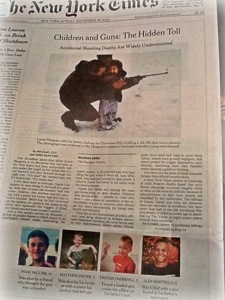
20131002-132522.jpgIt should come as no surprise that the New York Times is putting out slanted articles filled with fear inspiring statements that demonize guns. However, this weekend the Times devoted more than half of it’s cover page to making children, who were accidentally shot and killed, into little martyrs for the pro gun-control argument. The New York Times will call these deaths “accidents” because the person who caused the gun to fire was not aware that pulling the trigger would have such a consequence, but I am less willing to divert that blame.

As part of a series called, “Bearing Arms: Examining the gun industry’s influence and the availability of firearms in America”, the New York Times’ Michael Luo and Mike McIntire, produced a cover story called, “Children and Guns: The Hidden Toll” which ran on September 29th. While clear with its over all intent, I did find that the article contained a few fair statements, though due to its length I doubt any sway-able readers actually got there.

I received the above image in an email from my mother on Sunday. I knew the gun owning community’s automatic response would be, “Welp, that’s the NYTimes for you!” But I also knew how my mother would read this headline while sitting in her apartment in New York City. I felt compelled to comment on this article due to the cross communication that continues to be missing from the gun debate.

Continue reading →

Accuracy observation

I test a lot of guns for work, and that means shooting a lot of groups out of those guns. Every review I write usually involves shooting at least five 5-shot groups at 25 yards from a sandbag or rest, and I’ll usually shoot five more 5-shot groups freestyle from 15 yards.

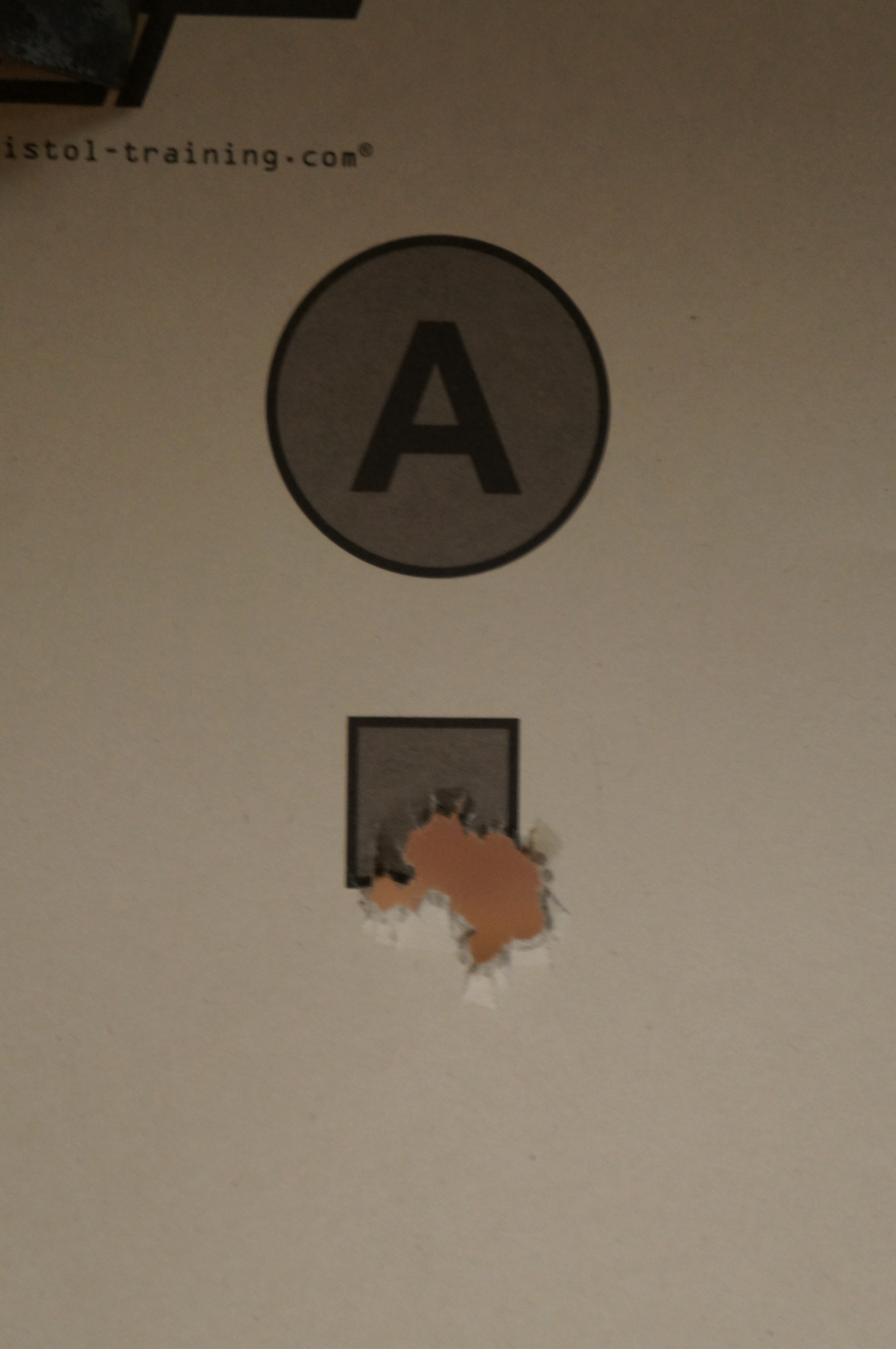
P226 25 yard group

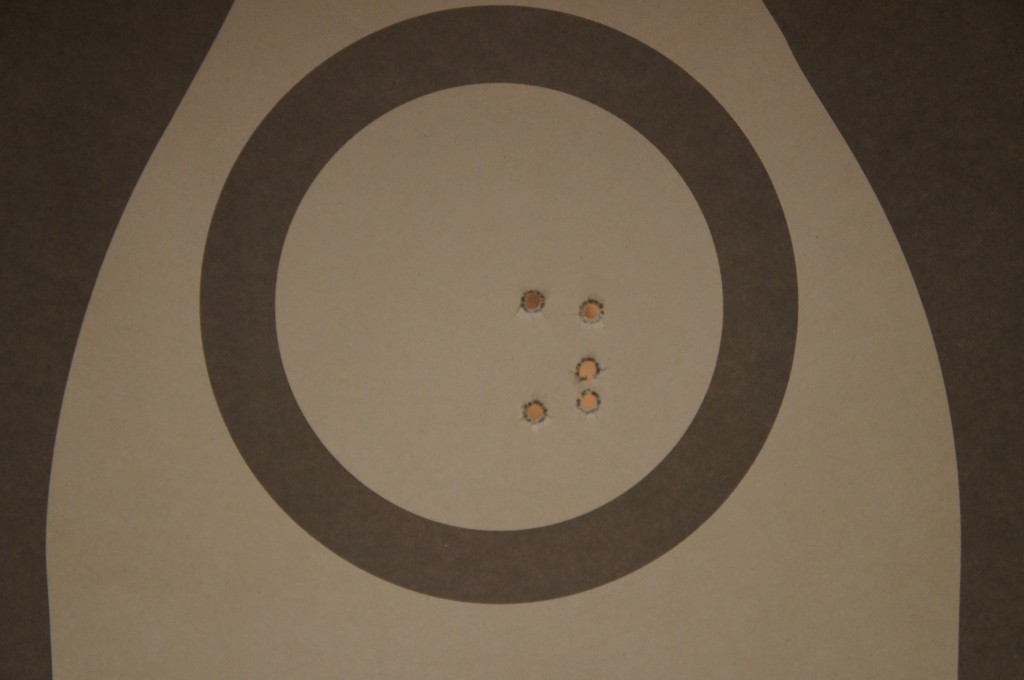
The group pictured was shot at 25 yards with a Sig P226 Elite, and measures about 1.6 inches. This particular group was fired freestyle at 25 yards, because I forgot to bring my sandbag with me to the range for testing on that day. Here’s another group, this one shot free style with the same gun and ammo at 15 yards. This group is 10 shots, and measures about 0.9 inches.

P226 15 yard group

I had previously noticed that freestyle groups shot at 15 yards are frequently so close to 25 yard rested groups in size that they’re interchangeable, so I borrowed a sandbag and shot one more 25 yard group, this time from a rested position for max accuracy. The results were interesting:

25 yard rested group

That’s another 0.9 inch group, but this time at 25 yards. By the way, I’m seriously thinking about taking this Sig to Bianchi Cup next year, because it’s obviously quite accurate. It would make a hell of a Metallic gun for the Cup. However, back to the point – this was the first time I set down to actually gather data and try to control for it a little bit. For years I’ve been noticing that my 15 yard freestyle groups were very similar to the best groups I could produce from a bag at 25 yards, and used that bit of anecdotal information to help me sight-in quickly if I was short of time. I like to know my point of aim/impact for any match gun at 10-15-25-35-50, but if I’m in a hurry, 15 yards is a perfectly acceptable mid-range zero for a competition gun with adjustable sights.

What I’m curious about now is other people’s groups. I mentioned yesterday that shooting a gun accurately is something I’m okay at, so I’m not sure if this phenomenon is something I’ve noticed, or if other people have as well? Do you shooters see correlation between freestyle 15 yard groups and benched 25 yard groups when shooting handguns?