Project Lumen

If you spend any time watching low light videos on YouTube, or reading articles by “experts”, you will notice two differing opinions on the requirements of a home defense light.  Some will say too many lumens will reflect back into your face and blind you; others say it doesn’t matter and you should go with the brightest possible.  So which is it?

I wanted to find out and decided to do some testing of my own – Project Lumen.  With this article I will lay out the goal and some ground rules.

The Goal

Can have too many lumens at night?  Will too bright a light lead to self-induced blindness?  Are the opinions of other based in fact, or just regurgitated internet tripe?

This experiment will hopefully answer those questions while also helping me to determine what the best illumination for my house is.  Keep in mind your house may be different.  You may have more, or less, shadows; your house is likely a different color and sheen on the interior walls.  I have real wood floors throughout my house.  If you have carpet the reflected light will be different.  You may have mirrors that reflect light.  In my house we have a set of French doors leading into what has become the kid’s playroom.  Will the light reflected off of those doors be problematic?
Nitecore nvg

Ground Rules

It is worth noting that while I can’t test every flashlight ever made, I have gathered a decent spread of different types and lumen outputs to evaluate.  This testing will not be done in a sleep lab or a scientific dark room; no, instead it will be performed in my home, under realistic “bump in the night” conditions.  I will get to the actual test procedure in a minute, but certain aspects will be beyond my control; things such as:

  • How much moonlight is present through the windows.
  • Is there cloud cover?
  • Are my neighbors flood lights on or off?
  • How well, or how deep, was I sleeping when the test begins?

You may not agree with the results and it is entirely possible that your results would differ from mine. Still, I hope that you take the information and processes used and decide to test your own environment, draw your own conclusions, and ensure the best for your protection.

I want to give a quick note to those that might complain about my methods.  I am open to completely redoing the test in a perfectly controlled environment.  Just tell me what lab you are paying for and provide me with airfare, per diem, the address, a rental car, lost wages, and the brace of lights you want tested… ‘nuff said.

To make things simple I will use two parameters to define the test flashlights – lumens and bulb type.  Lumens is not the “be all, end all” of lighting; but it provides a number that can be used as a reference.  Bulb type will allow me to determine if the coloration of the light effects the result (for more on light color and mood click here) on the surrounding environment.  I will neither test nor document; run time, durability, candlepower, watts, weight, size or cost.  I have also made a conscious decision not to test a weapon mounted light.  This test is to determine the effects of light reflection and overall lumens on my eye sight; thus I see no reason to increase the element of error, and danger, by introducing a weapon into the test when I can get the same results with a flashlight.

Definitions

Lumen – :  a unit of luminous flux equal to the light emitted in a unit solid angle by a uniform point source of one candle intensity.  The Wikipedia page actually has a lot of quality information about lumens for those that want to geek out.

Candlepower – illuminating power expressed in candelas or candles.

The Contestants

Before I get to the test, which is remarkably simple, I want to list the players. I will test one flashlight per night.

  • Streamlight TL-3 (incandescent xenon gas-filled pen bulb, 211 lumens)
  • Streamlight NF-2 (incandescent xenon gas-filled pen bulb, 78 lumens)
  • Streamlight ProTac (C4 LED, 180 lumens)
  • Streamlight Micro Stream (C4 LED, 45 lumens)
  • Streamlight PolyTac (C4 LED, 275 lumens)
  • Nitecore SRT3 (CREE XM-L2 T6 LED, 550 lumens)
  • INOVA XS Micro (LED, 80 lumens)
  • NEBO Classic (LED, about 100 lumens)
  • Mag Light – 3 D Cell (incandescent, around 45 lumens)
  • A borrowed Streamlight Stinger DS LED (C4 LED, 350 Lumens)
  • Maybe a Q-Beam if I can borrow one (Bright!)

The Test

For as long as this article has become, the test is actually pretty easy.  I will stage one flashlight on my bedside table at bedtime. I wake up at 5:00 AM, well before anyone else in my house; so, when my alarm goes off, I will simply proceed to “clear” my house.  I will take the same path during each test. With nine flashlights and the potential for more this will take a couple of weeks, but my goal is to update what I learn as I go and offer a final conclusion at the end.

The test begins tonight.
Trade-in Temptation

If you look at gun stuff online, you’ve probably seen them…advertisements for police trade-in guns from various online distributors like CDNN Investments, Summit Gunbroker, or Bud’s Gun Shop. The temptation is strong: Here’s the possibility of buying a good useable firearm with maybe some cosmetic blemishes for a considerable discount.

At the moment a number of police departments across the country are trading in .40 S&W sidearms as they transition to 9mm pistols and as a result those former police guns are turning up at wholesalers, local dealers, and gunshows. Selling for between $150-400 off the price of a brand new specimen it’s very attractive. So should you buy one?

Maybe. To explain I need to tell you the tale of two friends who work for two different police departments.

The first is Greg Ellifritz. Greg is an incredibly intelligent, and incredibly dedicated guy. He’s also had the benefit of working for a department with good quality leadership and a generally adequate budget. They trusted Greg enough to invest in his personal development and benefit tremendously from his input and hard work…including his service as the department’s armorer. When he was the full-time training officer for his department, Greg took the time to carefully inspect each weapon his department issued, cleaned it thoroughly, and performed essential preventative maintenance like changing springs, and checking the fit and function of small parts like extractors, ejectors, disconnectors, safeties, etc. He did this with the utmost attention to detail because he knew that weapon’s function could mean the difference between life and death for one of his officers.

The second is a friend a bit more local to me who signed on with his department in the mid 1990’s. He was issued a Glock 22 as a sidearm along with 3 magazines. He retired in late 2013. Unfortunately there was no Greg in his department. His issued sidearm received absolutely no armorer’s attention in his entire career there. Not a single spring was changed. He was still using the magazines he was issued when he joined, which were still equipped with the original springs and followers. The department had absolutely no weapons inspections. At each qualification session they experienced multiple stoppages and malfunctions, which isn’t surprising as a number of officers never really cleaned or lubricated their weapons. He convinced his department to buy an ultrasonic cleaner which he used and managed to convince a few others to use. Some wouldn’t even unload their weapon and drop it in the ultrasonic cleaner. On top of all of that, many of his department’s weapons had severe manufacturing problems. His personal sidearm was so woefully inaccurate even from a prone I could barely keep shots on an 8.5×11″ piece of paper at 25 yards.

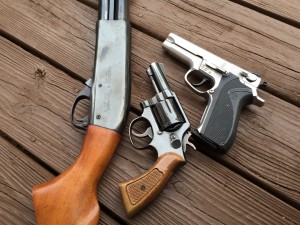
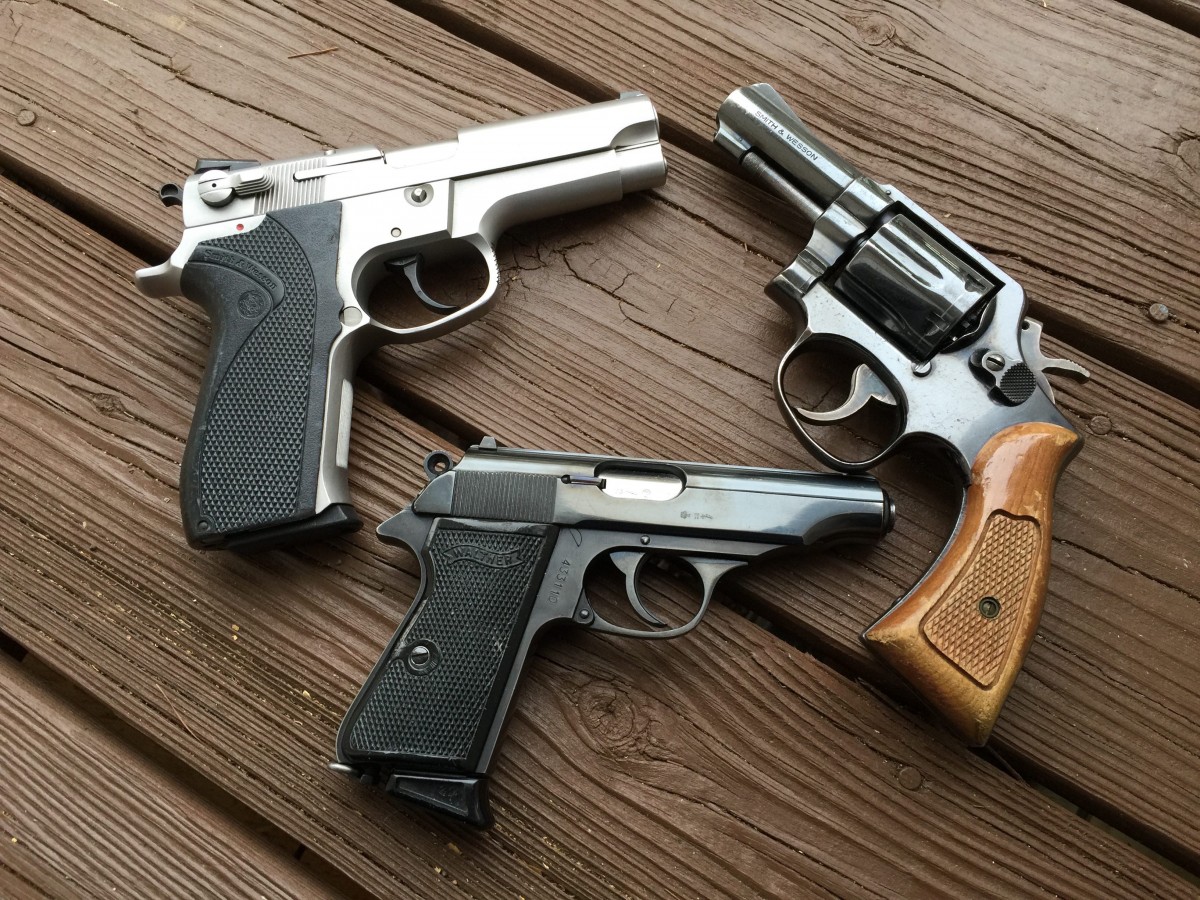
Remington 870 Wingmaster riot gun, 3" S&W model 10, S&W 5906
Remington 870 Wingmaster riot gun, 3″ S&W model 10, S&W 5906

When you are looking at a generic “police trade-in” gun, you don’t have a good way of knowing if the gun came from a department like Greg’s where it was carefully maintained or another department where it suffered almost total neglect. You don’t know if it was traded in because the department wanted to switch calibers for cost reasons, or if it’s because they experienced severe problems with a batch of guns and had to get rid of them for something else.

…and yes, that really does happen.

The key to trade-in purchase happiness, then, is to do some homework and manage expectations. For the happiest outcome you have to know a bit about how the firearm you’re thinking about was made, how it was most likely used while it was issued, and you have to be prepared to do some work on the gun to get it working.

Take the 870 Wingmaster pictured above as an example. The exterior of the gun shows wear from likely at least 2 decades of handling and storage, but I know that lots of police issue shotguns out there have not been fired very much in their service. I know the old Wingmasters are some of the best quality weapons Remington has ever made, and because it’s an 870 you can do just about anything you can conceive of to it. Knowing all of this I was reasonably certain I could buy one and get a gun that looked pretty cool (I love the old school look of the gun) and that would work. Sure enough, it looks better than Summit Gun Broker advertised and it worked splendidly when I had the chance to take her out to the range.

The Walther PP at the top of the page is a former West German police sidearm. In the era when that PP was the primary sidearm for the German police, they spent most of their lives carried in a holster (a flap holster, I believe) without being fired very much. Of course, Germans being Germans, they did actually pay attention to keeping the guns clean and in good working order…including being careful with the finish. My PP shows a bit of obvious holster wear by the muzzle, but that’s it. The rest of the gun looks as good as new. It runs beautifully with ball ammunition.

The S&W model 10 pictured is one of my absolute favorites. It is a former Australian issue police revolver that attracted my attention because of the low price (around $200 at the time…a steal) and the relatively rare 3″ barrel. K frames with a 3″ barrel might just be the best carry revolvers ever made. I looked around the web to see what some of the first buyers received and they described guns that had a bit of a rough finish, but were in excellent mechanical working order. Mine is no different. It clearly spent a lot of time in a holster being banged around and it suffered obvious neglect, but revolvers tend to be very tolerant of neglect. The bore is in excellent shape and the lockup is tight. It’s also extremely accurate with 158 grain ammunition.

I tend to have a weakness for guns that fall into the “they don’t make them like that anymore!” category, and often police trade-ins are splendid ways to collect those types of firearms inexpensively. If you have the same preferences and you’re willing to do some tinkering to get a gun that needs a little love up to snuff for the occasional range visit, trade-ins are fantastic.

If, on the other hand, you are looking for a primary defensive option I would urge more caution. If you don’t know how the gun was maintained, don’t have any insight into the service life it experienced, and don’t know if it came from a batch of guns with manufacturing problems it’s dicey to bet your life on that gun. The same would apply if you are financially strapped. If you are buying a trade-in as a more economical defensive option be sure you have the scratch necessary to fix anything that needs fixing. If you ever intend to carry a trade-in for serious social purposes make sure you test it thoroughly before depending on it.

Another sweet spot for trade-ins would be for people who already have, say, an M&P and maybe want another one they can use for range duty or experimenting with customization. A cheaper “beater” gun similar to your primary blaster that you can go Dr. Frankenstein on without worry is often very useful. Especially if you tend to learn about working on guns primarily by making mistakes. Ask me how I know…

If you understand what you are buying and you have a clear view of your intended use and what it may take to get a neglected or abused specimen back up to par, police trade-in firearms can be a tremendous value. If you don’t have a clear understanding of all of that and you’re looking for a defensive implement with a lower price tag, you should definitely try to educate yourself so you know what you are getting into.

Everyone calm down about the cell phone gun

cell phone gun

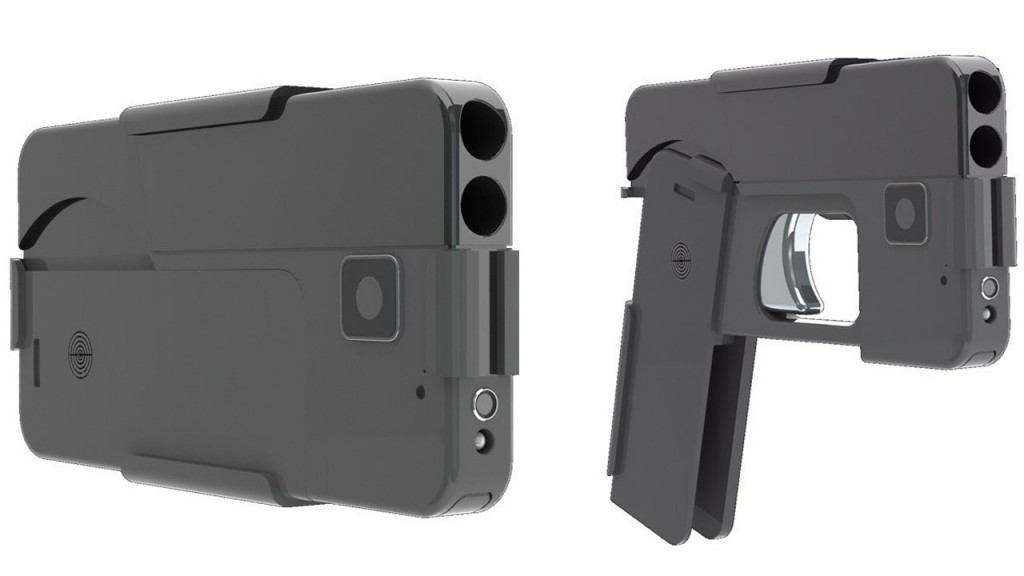
Been on the internet lately? You’ve probably seen the news reports about the company in Minnesota that has designed a gun to look like a cell phone. I’ve seen it posted across facebook with all kinds of different headings, from “Cops be on the alert” to “wouldn’t this be cool for CCW” and everything in between. It’s all incredibly hysterical, and everyone should calm down.

Continue reading →

Steamlight ProTac 1L

Let me start off with the answer you seek: Go purchase this light now!  Seriously; follow this link and order this light now.  You have two battery choices, AA or CR123, you can’t go wrong with either.

When I reviewed Nitecore SRT3 back in February I made mention that I had replaced it with a Streamlight ProTac.  That replacement took place in early January so I give you a short-term review.  Short term in this case means about 3 ½ months of daily carry and use.

IMG_5714

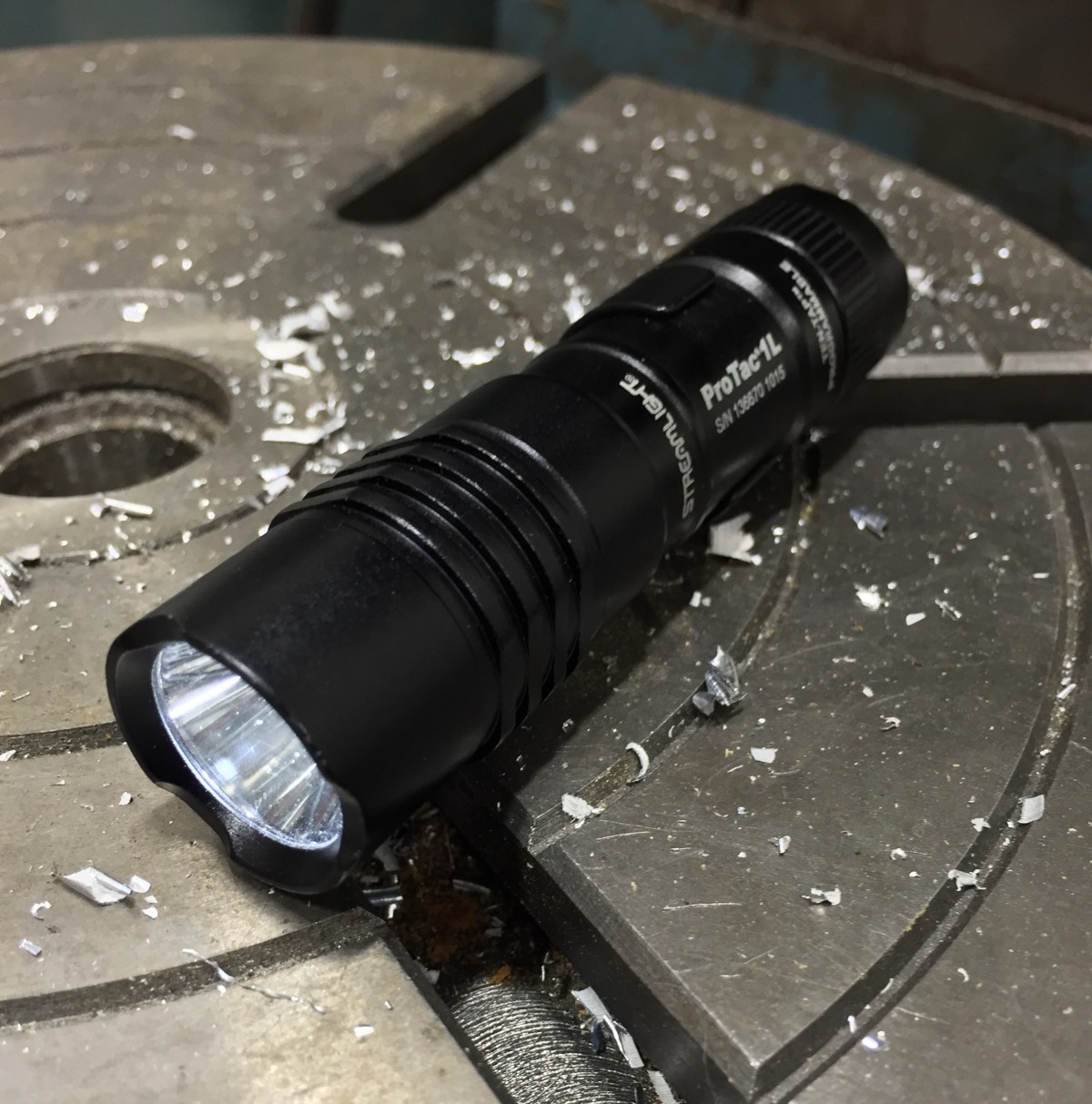
The ProTac 1L is a well-made, decent sized (as in not too bulky, but big enough to provide decent light) LED flashlight made by those purveyors of affordable lumens, Streamlight.  This is the 4th Streamlight flashlight I have purchased, and once again I am impressed.  In fact, I hope I have finally realized that Streamlight should be my go to manufacturer for flashlights.  Sure, Surefire is great, but on a cost vs. benefits scale, Streamlight holds the key – at least for me.

Here is what Streamlight says about their little flashlight and the published specs:

An ultra-compact tactical light, the ProTac® 1L is small and easy to carry, and uses a single lithium battery. The light is one of the most versatile personal carry lights available for users, from law enforcement personnel to industrial technicians.

  • Features Ten-Tap® Programming – Choose from three user selectable programs:

1.) high/strobe/low (factory default)
2.) high only
3.) low/high

  • C4® LED illumination output and run times:
    HIGH – 180 lumens; 3,800 candela peak beam intensity; runs 2 hours
    LOW – 12 lumens; 250 candela peak beam intensity;  runs 24 hours
    STROBE – runs 4 hours
  • Includes one 3V CR123A lithium battery and nylon holster
  • Solid State power regulation provides maximum light output throughout battery life
  • Rubber push-button tail switch
  • Durable, anodized aluminum construction with impact-resistant tempered glass lens
  • IPX7 waterproof to 1 meter for 30 minutes; 2 meter impact resistance tested
  • Unbreakable pocket clip
  • Anti-roll head
  • 43” (8.71 cm); 2 oz (57 grams)

Did you note the part I underlined above?  Did you notice the photos?  Industrial technicians; yup, that is the category I fall into.  I buy small  flashlights with two goals: 1) personal use, be it protection or finding the crayon my son dropped at the restaurant and, 2) ensuring airworthiness of aircraft at my day job.

I am not a LEO.  I am not a fire-fighter.  I am neither a major nor minor league door kicker.  I research and review my non-firearm related EDC gear with realistic EVERYDAY goals in mind.  I am way more likely to drop my flashlight from a ladder into a bucket of waste jet fuel (the ProTac experienced this once) than to survey a smoke-filled room for survivors, or bad guys.

So, after daily carry I can give the Streamlight ProTac 1L a solid 100% review.  I have dropped it from my pocket, kicked it, dropped it into the previously mentioned bucket of jet fuel, sprayed it down with isopropyl alcohol (to remove the jet fuel), and it even got put through the washing machine once.  It has proven itself tough.

Like Krylon of flashlight world; no drips, no runs, no errors.  That said, I can, and will, do an abbreviated Pro’s/Con’s for it.

Pros

Dependable – if a flashlight isn’t dependable, why bother.  Buy this with confidence.

Bright – It is not retina searing, but it is bright enough for every day task.  I would recommend something brighter for a bump in the night though.

Size vs Power – about perfect.  It is comfortable and lightweight.

Selectable Modes – I don’t need the strobe or the low power mode, but thankfully Streamlight gives us the option to turn them off permanently.  Bright is what I want, bright is what I get.  Circuit engineering done right.

Cons

My only complaint is with the clip.  It is stout and hasn’t lost tension, but the allowable positions leave more of the flashlight sticking out of my pocket then I would prefer.  I know; first world problems.

As I said at the beginning, go buy this light.  I have two co-workers with the 2L version, which adds a second battery.  They are equally worthy of your ownership, although I find them a little long for everyday carry.

So you are still on the fence as to whether you should purchase the Streamlight ProTac 1L or not?  I’ll let Arnie opine.

Arnie


Dan Wesson Valkyrie Commander 10-8 Performance Test

While the Rock Island 1911 test is still underway (200 rounds left) I wanted to take a break from it and run the Dan Wesson Valkyrie Commander 1911 through the 10-8 Performance Function Test. The Valkyrie Commander is new for 2016 in the Dan Wesson lineup, and is a followup to their awesome looking Valkyrie, which is a CCO-inspired carry pistol.

Continue reading →

What the hell is a Patreon and why do we have one?

You might have noticed some…uh…downtime recently here on Gun Nuts. As it turns out, we had some pretty severe server-side issues that took longer to work out than expected, although if you’re reading this they’ve since been solved. Which is awesome, and I’m glad for it. Now that we’re back up and running, I wanted to take a second and talk about something you might have noticed if you subscribe to our Youtube channel (which you totally should because it’s rad); because in the description for every video lately I’ve included a bump for people to donate to us on Patreon.

Now you’re probably thinking, “oh boy, here comes Caleb asking for money again, didn’t he already try this with that GoFundMe or whatever?” You’re right, I did try a GoFundMe, and it didn’t work the way I’d hoped; in fact I’ve contacted everyone who donated to the GoFundMe and asked if they want a refund. But that’s not the point, because the idea behind the Patreon is it allows viewers and readers to contribute however much they want, be it as small as a dollar, to support our content on a monthly basis. It’s much better than other types of crowdfunding because instead of just asking for a huge amount of money, all it asks for is small donations. If you think our content is worth a buck a month, awesome, donate that. If you don’t think it’s worth anything, don’t donate. There’s no pressure.

So here’s our Patreon. The proceeds go directly to supporting things like paying writers, hosting fees, etc. Now that we’ve moved Gun Nuts to a new server, I want to make sure I’m committing resources directly to maintaining the stability and growth of the site. Do you like our 1911 reviews? I like writing them and creating them, and would like to do more, so if you like them consider donating. The long term goal here is still to break the advertising model and focus the site entirely on creating awesome content around the firearms space. I don’t like writing “hey check out this thing on Amazon” posts any more than you like reading them, but for now they’re an awful necessity of doing this as a business. So if you want less (or none) of that, toss a buck at us. I can say for a natural fact that if everyone who reads this post kicked in two bucks, I’d never have to run another ad again, and that would be pretty damn cool.

If you want to, donate please. If you don’t, that’s cool too. We’ll keep doing Gun Nuts no matter what.

Rock Island Armory Ultra FS 1911 update: 1800 rounds and ticking

Despite the blog being down, I’ve still be working on testing the now excellent Rock Island Armory Ultra FS 9mm. It’s currently at 1,824 rounds, and here’s the fun part. Zero failures of any type. No failures to feed, no failures to extract, nothing. No parts breakages, and no issues with the build quality of the gun. It just keeps running and running. While the bulk of the ammo I’ve shot through it has been FMJ, it’s also fed 200+ rounds of premium JHP, including Golden Sabers which have an ogive so wide you can serve a martini in there.

Continue reading →

Post Incident Stress

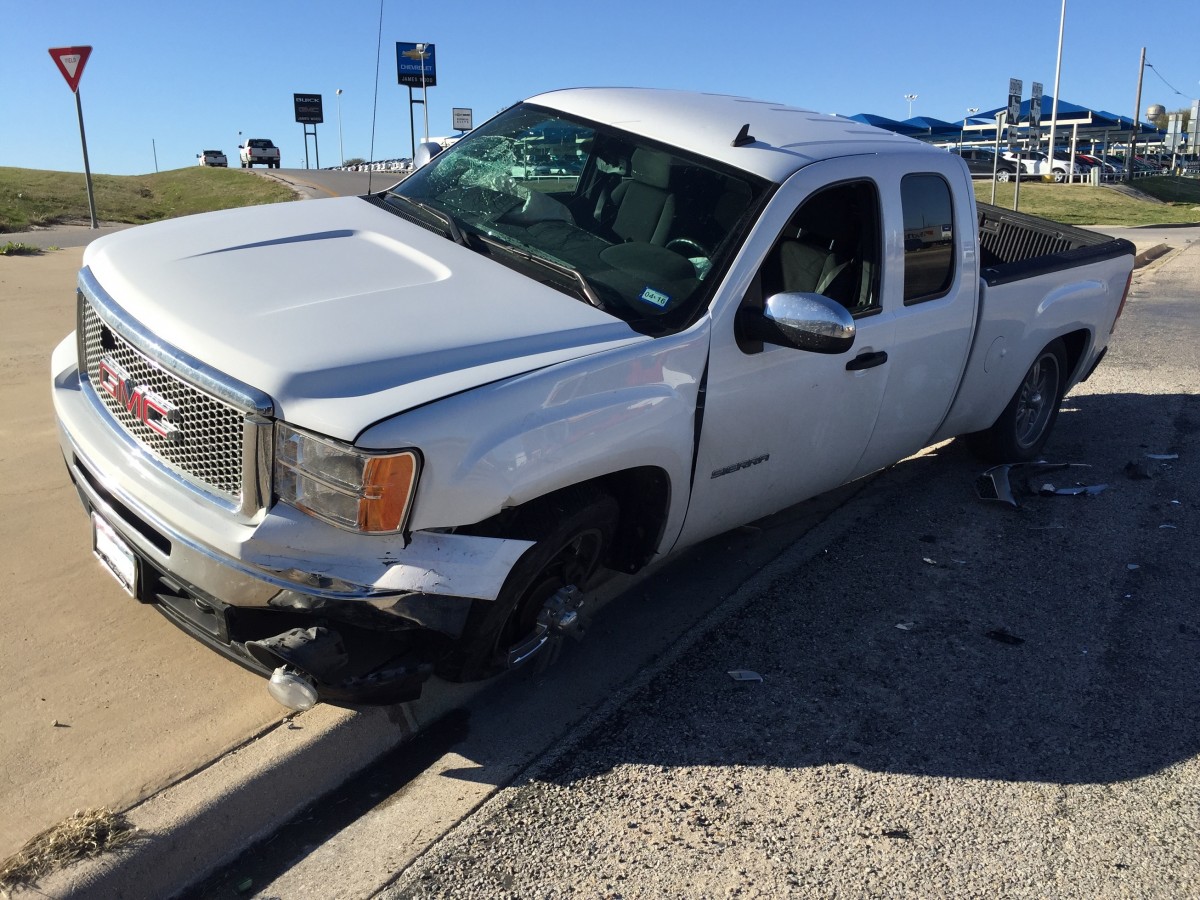
You see the truck in the lead photo?  It’s mine, and while the damage may not look all that bad, it was. So, what does my wreck have to do with guns, self-defense or shooting?  Simply put, it means nothing.  And everything.  That wreck gave me an epiphany, but I’ll get to that later.  First, I think it is important to understand my mental capacities leading up to the wreck, so we may better understand the epiphany.  Let me provide a quick background.

On March 2, 2016, my wife and I awoke our two boys for school like we do every day.  My oldest, who is nine, complained of a sore throat and had a fever – we were sure it was strep.  Neither I, nor my wife, could take off from work that day and since my wife works in the dental industry and sees patients, my oldest got to tag along with me.  Having my son at work with me was neither bad nor was it stressful.  No, my stress didn’t start its ascension until 3:44 when I received a phone call from our daycare.  They called to inform me that my youngest son, who is five, was running a fever and vomiting.  They needed me to pick him up post-haste.

No problem! I get off at 4:00 anyway.  With fears of cleaning vomit from my truck, my oldest son and I left for the daycare.  We made it three miles.  While driving down a road where we clearly had the right-of-way, a woman came down the freeway off-ramp and ran the stop sign.  The lead photo was the result.

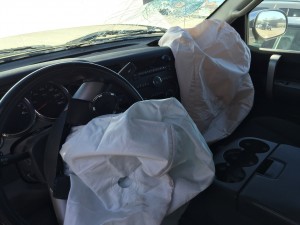
Surprisingly this isn’t an article about situational awareness.  I actually saw her coming down the off ramp and she seemed to be slowing down;  I had no reason to believe she wouldn’t stop.  My son, being a crude young male, said a funny fart joke, so I looked at him for a second.  When I looked back, she was on me.  I screamed “SHIT” and mashed the brakes just as we hit – hard.  I saw her careen off my truck from the driver side window then I looked up and noticed the airbags deflating.  It was both serene and terrifying.  I have been in bad wrecks before; but never have airbags gone off and NEVER was my child on board.

I promise, the epiphany is nigh!

I gathered my wits and composure, kicked my now wedged door open and then struggled to get my son’s door open. (Unbeknownst to me at the time, the cab was twisted due to frame damage)  Once he was out I realized we were in the middle of a busy underpass and I had no safe place for him to stand.  My mind was racing as my wife wasn’t answering her cell phone and our youngest child was likely still vomiting at the daycare.  My stress was extremely high, but I remained calm.  I am a stark realist and I am well aware that panicking is a waste of time and effort.  I can bottle up things with the best of them.

IMG_5533

I corralled my son, left a message with the receptionist at my wife’s office and checked on the other driver, a young woman who was injured.  She would ultimately leave by ambulance.  The local police arrived on the scene quickly as we were close to the police station.  I was able to put my son in a squad car for safety and I felt some relief.  As I surveyed the scene and took stock an officer pulled me aside for questioning – that is when it happened.  It was something I had never experienced before following any other car wreck.  It was an event that led to the epiphany.

Upon seeing my son’s face, panicked and teary-eyed, in the front seat of a squad car, I became a stuttering fool.  I was babbling.  I was stammering.  My speech was jumbled and I must have sounded drunk as I struggled to find my words.  I failed to remember my own phone number, my wife’s phone number, and even the name of my employer.  Granted this only lasted 3 minutes or so; but it became an almost out-of-body experience.  It was like I was watching myself; and in my mind I was giving harsh smart-ass commentary over my own incoherence.

For as calm as I had been seconds before, I was woefully unprepared for the overwhelming release of stress when I realized everything was secure, my son was indeed safe, and we were going to be OK.  I was crashing from an adrenaline rush and it was unlike any I had ever known.

I was mentally falling apart after things were calm following an auto accident.  A simple, stupid, automobile accident!  I do believe the vector for my stress filled breakdown was not the accident, but the fact I had been so worried for my son up until that point.  Immediately after the impact I was alive like never before.  Alert to everything, focusing on nothing; and now I could relax.

The epiphany came quickly, and the thought was both sickening and enlightening.

“How would I be acting or responding if I had just used my CCW to defend myself or my family nearby?” 

Like so many CCW holders I look for ways to mitigate the stress response.  I choose competition.  Some chose an endless stream of tactical classes.  Some do martial arts.  All work to mitigate the stress during the event… but what about the stress after the event is over?  Shooting a stage poorly at a USPSA match can’t invoke the kind of stress response I felt in my own body.

“Anything you say can and will be used against you in a court of law” – Miranda. 

Just because you haven’t been read your Miranda Rights doesn’t mean what you say is inadmissible.

“I didn’t want to shoot him.”

“I didn’t mean to kill him.”

“I don’t know what happened.”

What do those sayings all have in common?  They imply accidental discharge.  Negligence.  And negligence is the key ingredient to man-slaughter.  The facts are simple.  We can never know how we will truly react to a situation until we are in it; but at what cost do we risk not trying to mitigate all possible outcomes?

In my wallet I have a card from Texas Law Shield.  On the back of that card is written the following:

“The holder of this card invokes their Rights pursuant to the 4th, 5th & 6th Amendments to the U. S. Constitution, all applicable provisions of the State Constitution, and all applicable provisions of the State Codes and Statutes.  Any questioning of this individual must be immediately suspended and shall be continued only in the presence of and with the advice of legal counsel.”

Strong words, and while I have never been one to “lawyer up”; the simple fact is what you say following a self-defense situation may have ramifications that are far-reaching and costly.  This is not meant to be an advertisement Texas Law Shield, or for any other such service; it is meant to provide food for future thought.

In as little as three minutes after the wave of stress came over me I was more or less back to normal.  Three minutes where I could have said things that the best lawyer in the world might have had trouble dismissing.  Simply put, if was being interviewed by an officer following a self-defense event, I would rather hand them a card to read, then to open my mouth and increase the lawyer fees an order of magnitude.

I have been looking into some ways to mitigate the after action stress, but Mr. Benjamin Franklin was correct when he stated “surely an ounce of prevention is worth a pound of cure”.  Pay attention, avoid stupid situations, with stupid people, at stupid hours.  Finally, if the balloon goes up… keep your mouth shut until someone who is both calm and collective can prevent you from verbally hanging yourself.

Within the training community you will find a rare few that “get” the needs of a CCW.  Their teachings might not be as cool and as flashy as the 3 day AR class, but they are more important.  Entertrainment is fun, but carrying a gun is serious business and we should all look for training that supports realistic goals – at least when starting out.  For your CCW training you should seek out trainers that realize the differences between the needs of a civilian vs law enforcement vs military.  A list would include the likes of: Claude Warner, Tom Givens, Grant Cunningham, Massad Ayoob, Greg Ellifritz.  They are instructors who base their teachings on actual case study and reality.

Have I trained with any of them?  Unfortunately not yet; but you better believe they are on my short list and they are well ahead of a lot of entertrainers.  They should be on your list as well.

What happened with my son?  He was an emotional wreck for a few hours but there was no permanent damage – and I Thank God for that.

Are you curious about the truck?  The impact on the front wheel bent and twisted the frame something fierce; it was deemed a total loss.

Be safe out there, and be sure those you love know it.  I mean that, sincerely.

Goodbye, Todd

My various training travels over the years have brought me into contact with a number of outstanding and interesting people that have changed my thinking or my outlook on important matters. In some cases it was a brief intersection with someone else on the range that taught me something I wasn’t really expecting to learn. In others, I’ve made friends for life.

If I had to name the person who has had the biggest influence on my thinking and development over the years it would be easy: Todd Green.

Todd is the mind behind Pistol-Training.com, which is likely best known for the downright brutal extended torture tests he performed on a number of pistols. Before striking out on his own as an instructor, Todd worked for Sig and Beretta where he acted as a military/law enforcement rep and often as a trainer for their weapon systems. In that capacity he had incredible levels of access and insight into the training of elite law enforcement and military units on the front lines of the War On Terror that shaped his outlook on training and standards.

Before and during his tenure with Beretta and Sig, Todd sought out training with some of the best instructors in the world. Instructors like Ken Hackathorn, Tom Givens, and Ernest Langdon had a profound influence on Todd’s development. (As I understand it, Ernest Langdon actually recommended Todd for his position at Beretta) Todd was also involved with competitive shooting personally and helped run at least Beretta’s sponsored competitive team. This, too, shaped his philosophy. When you swirl all of that together with his law degree (Todd actually worked for the Washington DC US Attorney’s office Violent Crimes Unit) the end result was a very unique voice in the firearms industry.

When Todd worked at Sig and Beretta as a rep, he was often an advocate for the end users of the products. He told me that on more than one occasion he was chastised for acting more like a rep for an end user than for the company…but that’s just how he did things. Todd identified with the end users of the products betting their life and the lives of others on the function of the guns he was selling them moreso than the guys in the back office doing the accounting. He had high standards for himself and he wasn’t inclined to let others get away with mediocrity, especially when he knew lives were on the line.

Once on his own as an instructor, his experiences in the industry and in training led him to write some pretty interesting pieces. Exemplar would be his superb article, Trust No One.

Todd and I began corresponding on a firearms related web forum just shy of ten years ago. I wrote some things that apparently he thought made sense and he reached out to me and struck up a couple of conversations. That eventually led to taking his signature Aim Fast, Hit Fast program on the recommendation of Jay Cunningham of Protective Shooting Concepts. AFHF made it abundantly clear to me that I needed to completely overhaul everything I thought I knew about shooting a handgun. It was downright demoralizing. I don’t even remember what my score was the first time I shot the FASTest, but it was ugly. Really ugly.

So I forgot everything I thought I knew and started over…and Todd, often known for poking fun, was incredibly supportive and helpful. I mean, he still made fun of me, but he was incredibly helpful too. My skill with a handgun increased by leaps and bounds. I had the distinct privilege of joining with Todd and a relatively small group of other guys nearby who had been to his classes for a number of range days and with each one of them I improved dramatically. I always thought of myself as the worst guy there and I quite often had my butt kicked, but the benefits of surrounding myself with people who were smarter and more skilled than I was paid incredible dividends. Life hack time: Surround yourself with people who are better and smarter than you. It pays off.

Todd (right) on his first outing with his new bionic elbow. He couldn't shoot yet, but that didn't stop him from coaching.
Todd (right) on his first outing with his new bionic elbow. He couldn’t shoot yet, but that didn’t stop him from coaching.

The classes with Todd and the range days were so beneficial because Todd is one of the best coaches I’ve ever encountered. He was a skilled instructor who put together a superb program…and I heard no less an authority than Ken Hackathorn praise the value and benefits of Todd’s classes in person, with my own two ears…but of even more value than that was his ability to watch what you were doing and give very specific feedback that made a huge difference in performance.

It is an unfortunate truth that there is a lot of shade and shenanigans in the firearms industry…but Todd always acted with honesty and integrity. Todd was honest and up front with me when a number of others weren’t, and I’m convinced that the reason why he was on such good terms with so many people in the community is precisely because of his character.

I think the best way to show you what kind of man he was is to direct you to this post he made about what we affectionately called his bionic elbow. Todd took a lot of pride in being skilled with a handgun and because of cancer he had to re-learn everything. To go to zero from a place where your peers recognized you for your skill can be tough…but if he struggled with that he never really let on.

After a visit with him shortly after the elbow replacement I told some of the other guys that I thought he looked a tad frail, but seemed to be in good spirits and excited about getting back to it. He emailed me that day:

“Elbow or not, I can still out-shoot you any day of the week!”

To which I replied “Of course. Because I just donated all my practice ammo money to your cancer charity. So when I suck I’m going to blame it entirely on you.”

“How is that any different than your normal excuse?” he asked

“It’s not. That’s the beauty of it!”

Todd was constantly doing things for people behind the scenes. I couldn’t possibly list all the acts of kindness and favors he did for people, all the encouragement and help he gave to others because it’s too massive. I’m as good an example as any…I wouldn’t be writing if it wasn’t for Todd. When Caleb announced a writers contest a couple of years ago Todd told me that I should throw my hat in the ring. I thought he was nuts, but as was often the case he turned out to be right. He was always gently nudging people in the right direction, making connections behind the scenes, and providing input and assistance for others.

On March 15 at around 2 AM, Todd passed away. I was fortunate because I had a chance to spend some time with him in the week before, and I had the chance to say a proper goodbye.

His wife Kimberly was by his side through all of it and was so incredibly gracious…I wish I could really convey to you how wonderful she has been to those of us who cared about him. It took a lot of logistical wrangling and effort to make those final visits happen and those of us fortunate enough to be able to visit with him cannot possibly thank her enough for all she did to accommodate us and to care for our friend. Often when guys hang out together they tend to gripe about the other half. Todd never did. He always insisted that poor Kim got the worse end of the deal in their marriage.

I’m profoundly sad that I’ll never get to share the range with Todd again. That I’ll never get to go to dinner and spend 3 hours talking about training and obsessive firearms details with him again. That I’ll never get another sarcastic email from him again. That I’ll never get to listen to him try and psych me out before running me through the FAST again. That I’ll never completely freak out the waitstaff at a restaurant as we pass around knives and talk about classes and real life experiences with him again.

My skill as a shooter is better because of his instruction and coaching…but my life is better for having had him as a friend. Todd was a friend for life. I just wish so very much that his life could have been longer.

I love you, brother. And I can’t tell you how much I miss you.

If you would like to donate to Todd’s cancer charity, Rampage for the Cure (Archer reference, of course!) click here.


Why

A long time ago, a friend asked me why I carried a gun every day. Being young and intemperate, I offered up a glib answer about how I wanted to be ready or die in a pile of brass; something typical of what you’d expect a self-identified “sheepdog” to say. I’m older now, and hopefully a little wiser, but it’s still a question worth visiting. Why do I carry a gun every day?

Continue reading →