Trijicon HD Sights

The subject of pistol sights isn’t usually considered to be one of the sexier topics for shooting related discussion, but when you try to develop your ability to put a bullet on target on demand with precision, you start to realize the importance of having the right sights. The descriptor “right” in that sentence is kind of tricky as rarely will you find complete agreement between two people as to the “right” set of sights. Given that each of us is functioning with unique equipment and very different levels of skill and experience it’s really not surprising that tastes differ.
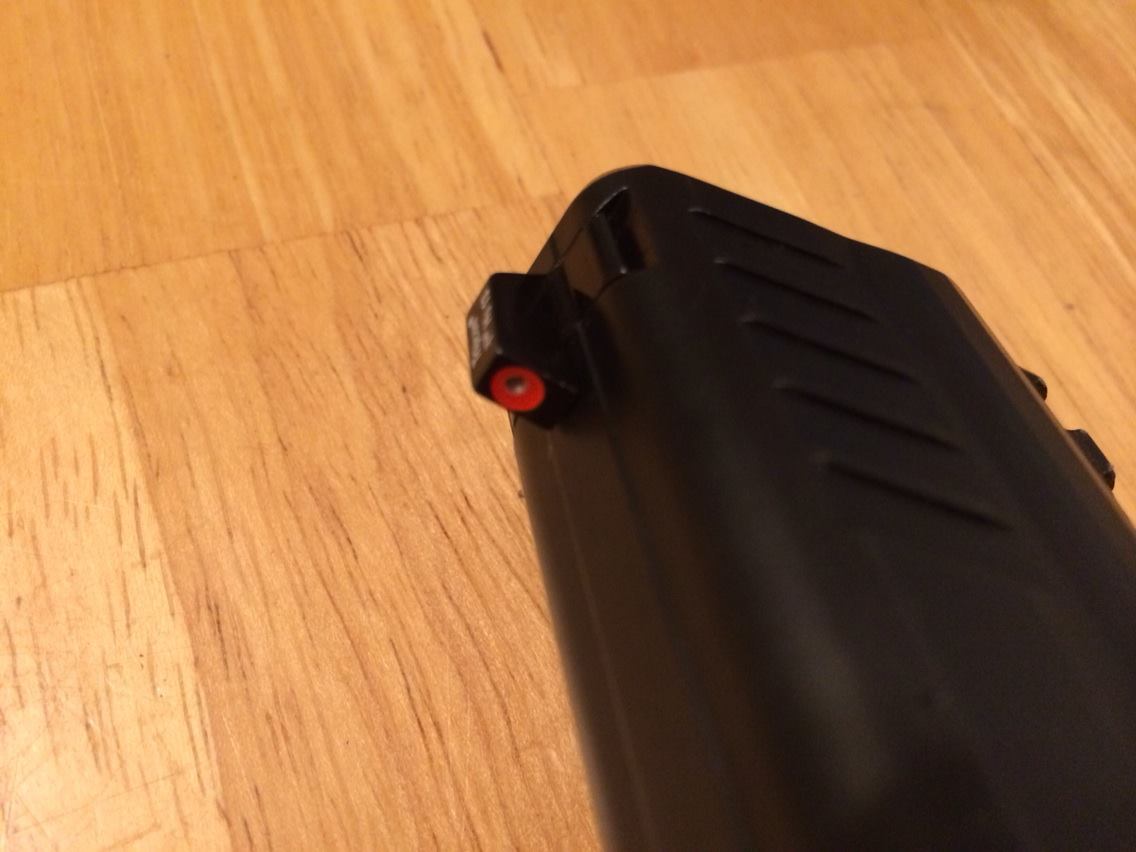
The bright orange front disc of the Trijicon HD sight is easy to pick up at speed and to use with a target-focused shooting style.
The bright orange front disc of the Trijicon HD sight is easy to pick up at speed and to use when the eyes are more focused on the target.

Personally I tend to favor sights that feature a pretty wide rear notch in combination with a relatively thin front. I find that I’m able to grab a very quick read on the orientation of the sights that way while sacrificing just a little bit of left/right precision due to slight misjudgments on how centered the front sight is. I like the rear sight to have a bit of a ledge so you can snag it on a belt should you need to perform a one-handed malfunction clear. The smoothly sloped Novak style sights look pretty but when you’re trying to rack the slide of a .45 with a 20 pound recoil spring with one hand using the belt or the holster they don’t help you at all. Fiber optic sights are very popular among competition shooters because they are highly visible especially at speed, but I find them too fragile to trust on a carry gun.
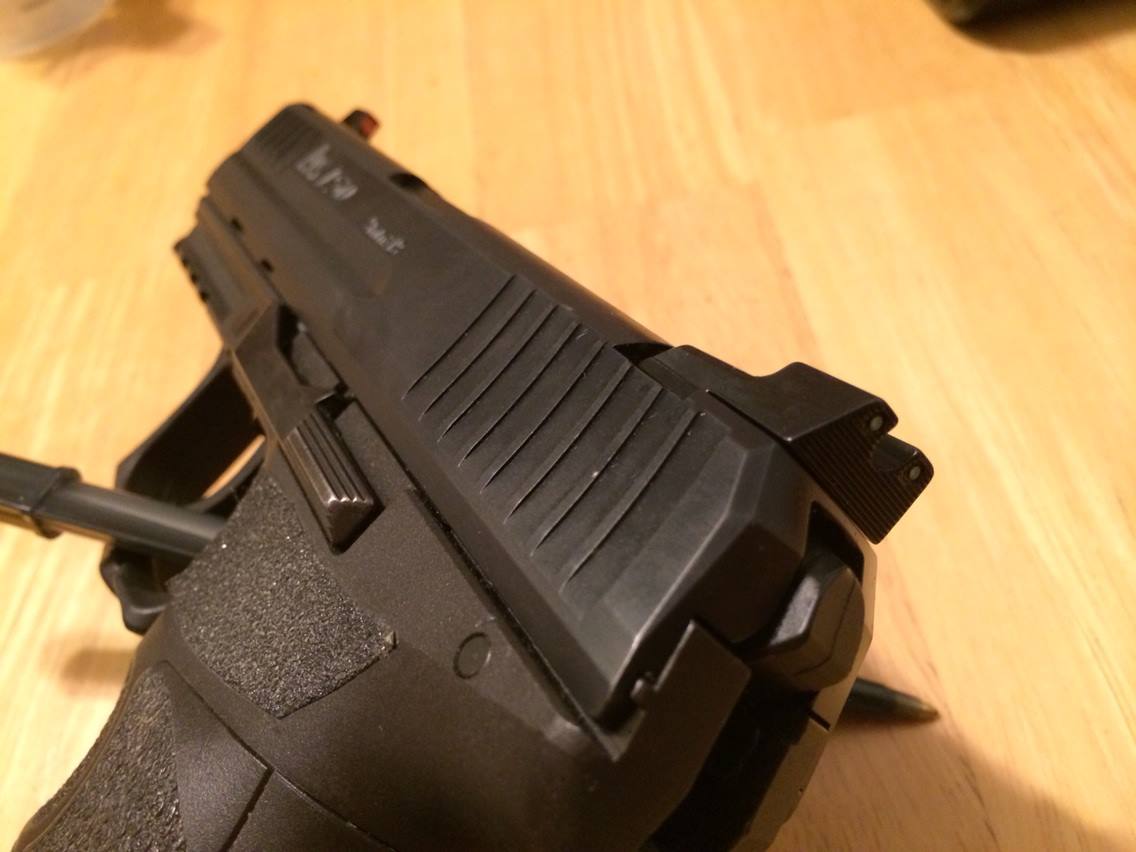
The notable step in the rear sight makes performing a one-handed malfunction clearance or reload worlds easier.

Trijicon’s HD sights try to address all of those preferences. The front sight is a bit wider than I prefer but the rear notch is still sufficiently wide to accomodate the amount of light I like to have around the front sight. The sights are made with a pronounced ledge to assist in one-handed malfunction clearance or reloads. Instead of a fiber optic rod in the front sight, Trijicon places a fairly large disc of photolumenescent paint on the area surrounding the tritium insert. The paint doesn’t quite glow in bright light like fiber optics but it does do a pretty good job of standing out. It works even better in those not-quite-dark lighting conditions where you have enough light to see what’s going on in the environment and to keep tritium vials from being very useful, but yet not enough light to clearly see plain sights or sights not equipped with a highly reflective paint.

When I purchased these sights I did so thinking that the tritium vials in them were arranged like the Warren sights that I’ve been a fan of ever since trying them out in low light. Unfortunately the “subdued” rear tritium vials refers to painting around the vials black so as not to offer visual distraction when using the sights in brighter light. The rear “dots” on the Trijicon HD’s are the same size as the front “dot” so you don’t get the idiot-proof low light sight picture of the Warren sights I was expecting. Still, the low light sight picture is good enough and a quick hit with a sharpie on the rears will make them glow more faintly so that the front sight appears bigger and brighter.

So far in my use of the sights I haven’t found any deficits over the Heinie “Qwik” sights I’ve been using on my P30 for years. I’ve been able to use the Trijicon HD sights with the same level of accuracy in slow fire and they’re easier to pick up at speed when working on most targets. I can use more of a target focus with the Trijicon HD equipped P30 since the big orange ball helps give enough visual feedback on the front sight’s orientation in the rear notch to make a relatively accurate shot even when I’m looking “through” the sights rather than being hard-focused on the front sight.

If you’re looking for something that tries to split the difference between the visibility of fiber optic sights and the durability of traditional steel sights, these may be your answer. They’re not perfect, certainly, at least not to my mind. I’d change the rear tritium vials to be smaller and if it were up to me I’d probably color the entire face of the front sight, or at least the top half of the front sight face, with the photolumenescent paint. That being said as they sit these sights do a pretty good job of doing the things that lots of folks would want their sights to do.

If you’re looking to improve the sights on your gun, they’re worth a try.
Gimmicks vs. innovation

In yesterday’s post about the Taurus Curve I talked about how the gun isn’t really serious, but is rather a gimmick designed to separate people from their money. I want to get this out of the way: there’s really nothing wrong with designing a gun with the express purpose of “sell.” Gotta make money.

"Thinking outside the box"
“Thinking outside the box”

I was taken to task in the comments by people who accused me, and those who agreed with me, of mocking innovation, because Taurus is “thinking outside the box” and “doing something different.” There are a whole bunch of issues with those statements that we’re going to unpack here, and I want to get started with the “doing something different/thinking outside the box.” It is admirable for a company to try and do something different and new. However, companies shouldn’t try thinking “outside of the box” unless they’ve reached a point that they can successfully execute the inside the box stuff. In the case of firearms manufacturing, executing inside the box is making a reliable, accurate product with a low error/rate of return. Taurus can’t currently say they do even that. It’s like someone who can’t safely operate a bicycle trying to build a jet-powered rocketbike. You can’t think outside the box until you’ve proven your ability to build a box in the first place.

Now let’s talk about “doing something different.” Product differentiation is important, especially in the current crowded CCW market. If your guns don’t look different on retailer’s shelves, there is less incentive for people to pick them up. Sig Sauer has figured out a great way to do this, by offering the same gun in a wild different variety of finishes, from Rainbow to Diamond Plate. While the different finishes may not be for everyone, the functional product itself, in this case a P238, isn’t changed. It’s still a reliable defensive firearm. You can argue that all the different finishes are a gimmick, but they don’t change the functional way the gun operates. A Rainbow Diamond P229 is still a Sig Sauer P229. What was the pitch meeting for the Curve like? “Hey uh…women have curves, right? Let’s make a f***ing curved gun! Yo dawg, I heard you like curves, so I curved your gun so you can uh…Curve on your curves?” Yes, it’s certainly different, but unlike the Sig where the difference doesn’t add or detract from the gun’s essential function, this difference actually makes the gun worse.

Finally, the topic of innovation. Curving the grip of a gun because of “women” is not an innovation. The metallic cartridge was an innovation. The self-loading firearm was an innovation. The Browning short-recoil mechanism, Glock’s use of polymer, all of that was innovative. This is just a gimmick. How you can tell a gimmick from real innovation? Real innovation makes the entire community better in the long run. Basically everything uses JMB’s short recoil system, polymer guns are de rigueur. Those innovations fundamentally changed the community because they addressed a real need.

Curving a gun doesn’t do that. But it will quite likely sell well, because it’s going to street for like tree-fiddy, and at that price point people might buy one just because it’s a curiosity. “Hey, remember that curved gun? I bought one!”

Taurus Curve .380

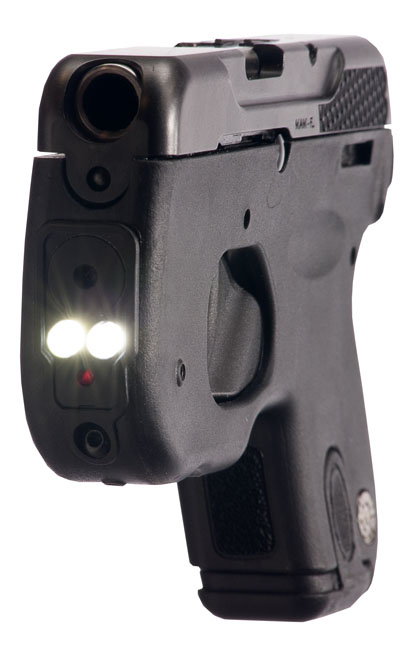
“Hey, all these small .380s like the M&P Bodyguard, Ruger LCP, Glock 42, and Sig P238 are too hard to conceal”…said no one ever. And yet despite there being literally no market demand for a .380 that’s even easier to conceal, Taurus has pressed ahead where no one wants to tread and introduced a gun with a curve in the grip to make it more carry friendly and conform to the body’s contours. Literally nothing that I said is a joke. Here’s a photo followed by Taurus’ announcement text:

Taurus-Curve-180CRV-4

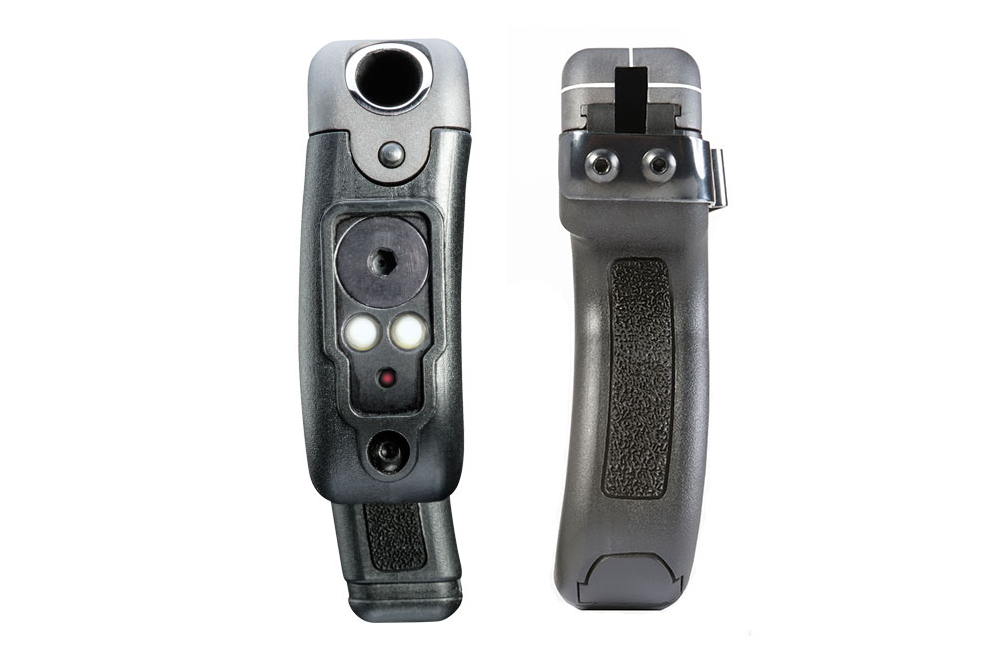
Your body has curves, so why aren’t pistols shaped to match? That’s precisely the question our engineering team challenged themselves to answer-and the results are unlike anything you’ve seen before. Introducing the Taurus Curve™, the world’s first and only curved firearm. Engineered to fit the unique contours of your body with no visible printing, the Curve is easily one of the most groundbreaking firearms ever conceived. An extreme departure from your typical compact .380, you’ll find the Curve takes form and function to an entirely unprecedented level. With its patented, snag-free design, the Curve boasts the industry’s first-ever light and laser built right into the frame. Exceptionally accurate and extremely lightweight at just 10.2 ounces, the Curve is one ultra-comfortable, ultra-reliable personal defense handgun.

We have reached the point where firearms manufacturing boilerplate officially sounds like it was written by the Onion. But hey, the gun does have some cool features. It has an integrated light and laser…that doesn’t feature instinctive activation, and it comes standard with a belt clip so you can slide a striker fired gun without a manual safety right next to your body without the benefit of anything covering the trigger guard! But hey, at least you’ll have 6+1 rounds of .380 on tap…which you could get in a Bodyguard, a Glock 42, a Ruger LCP, or a Sig P238, all of which are made by reputable manufacturers.

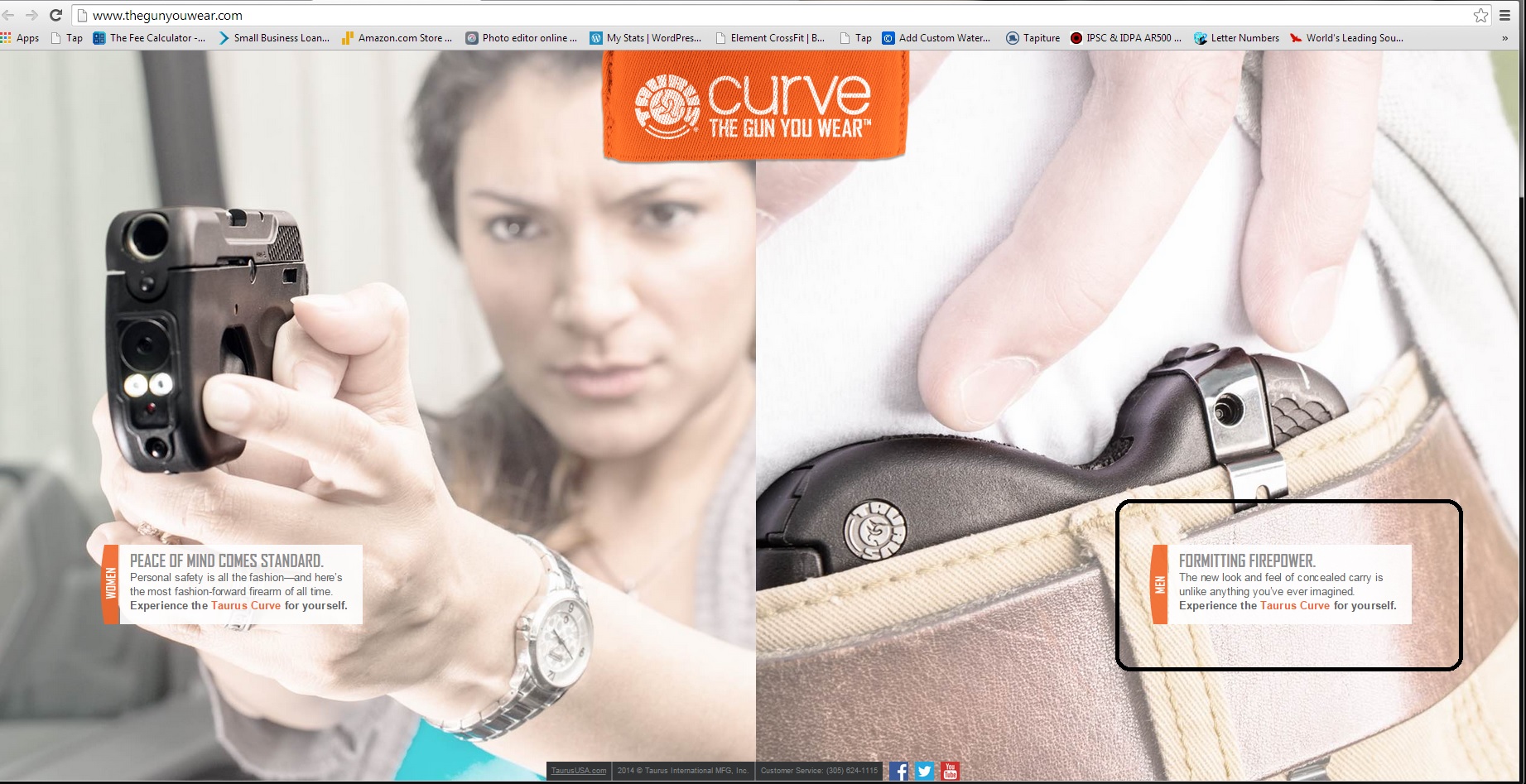
But the funniest thing about all of this was when I went to Taurus’ own promo page for the gun, TheGunYouWear.Com. On that page, right where god and everyone can see it is a typo – instead of “formfitting” firepower, it says “formitting.” It might be changed, so I screencapped it because lol. To see the image at full res you can click on it.

taurus curve typo

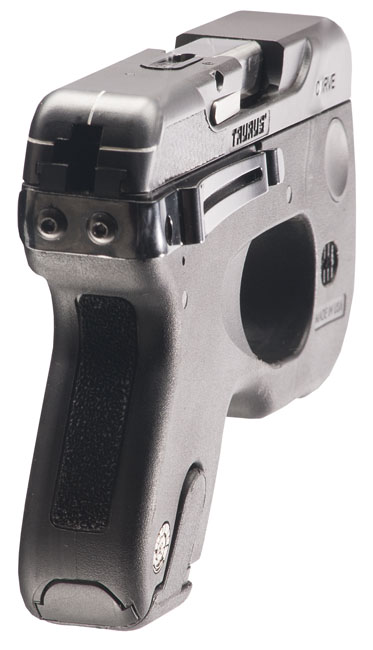
Which brings me around to my fundamental problem with this gun, is that it’s just not a serious gun. It’s a gimmick, and a poor one at that. The CCW market has not cried out to the heavens for a curved gun that conforms to our bodies, because the current crop of small .380s are easy to conceal. What’s going to happen instead is that Gun Store Cleetus is going to have a woman roll into his shop, and he’s going to recommend the little Taurus .380 for the little lady because it’s curvy like her hips and herp-derp ladies like stuff like that. Which means that a woman who was genuinely interested in personal protection will now be saddled with the worst kind of talisman pistol instead of something that would actually work, like an M&P Shield or a Glock 42.

Taurus-Curve-180CRV-6

That is really why I’m blasting this gun. Yes, it’s easy to make a few “lolTaurusSux” jokes, but what really grates at me is that instead of spending time and effort to improve their quality control on their existing lines of guns, they instead launched a gun that literally no one has asked for. It’s barely even a gun, because of the way it’s going to be marketed, it will most likely be purchased the same way one would buy a lucky cross – wave it in the general direction of evil and hope for the best.

IF the Taurus Curve is reliable, that would be an improvement. I doubt it will be. IF the laser and light are sturdy and easy to activate, that would be good. I don’t think they will be. But again, I come back to the key point of all this: this gun is nothing more than a marketing gimmick designed to separate uneducated customers from their money. In many other industries that would be fine, but here? The people that will buy this gun are buying a gun possibly to defend their lives with. They deserve better than a gimmick. They deserve quality control, and a reliable, dependable firearm. Not a gun that’s shaped to match their hips.

US Border Patrol rifle article Part II

This is a follow up to my original article.  The original article has been very popular due to the amount of times it has been read and commented upon; even if many of the comments were not public.  I will be paraphrasing the comments I received from the agents in the field and not attributing directly to anyone in order to preserve the anonymity of the agents who wrote to me.


This appears to be beginnings of a Good Thing in that the agency is attempting to identify problem rifles and also upgrade internal parts to a new standard such as replacing all buffers with Colt H2 buffers.  To clarify, these are Colt M4A1s that are being discussed in these articles.


However, the rifles are being deadlined at very high rate and sometimes for the wrong reasons.  One of these wrong reasons is diagnosis of a “bent barrel.”  A bent barrel is indeed an extremely worrisome problem but to diagnose it, one must have the barrel’s bore spotlessly clean.   I spoke at length with Greg “Sully” Sullivan of Defensive Edge Training regarding this and he confirmed that even just a bit of fouling in the bore will absolutely throw off the reading and make the armorer think the barrel is bent.  Sully was kind enough to expound upon the issues common to police and (especially) military trained armorers inspecting rifles:

  • Testing a barrel for straightness without thoroughly cleaning the barrel ahead of time
  • ofttimes armorers use the wrong or an incorrect headspace gauge as Sully has found that many of these gauges are meant for both 5.56x45mm and .223 Remington.  This is incorrect as 5.56 does indeed vary slightly from the .223 headspace specifications.  This product on Amazon is a case in point regarding the widely available yet incorrect headspace gauges.  Sully and Defensive Edge uses only Pacific Tool & Gauge headspace gauges.
  • Border Patrol  and other armorers recommending and allowing only Breakfree CLP instead of something like Slip2000 EWL  (Sully’s favorite) which breaks down the carbon.


This topic went nationwide on this story with FoxNews and Tucson TV station N4T covering the story.  The Fox story mainly repackaged the original N4T piece.  Though neither piece was very technical, the Foxnews piece brought the issue to a nationwide audience.  Claims of the Border Patrol agents being “unarmed” were made (albeit thirdhand from an Arizona firearms trainer who has questionable credentials to say the least; examples onetwo, three, four, and five).  Though, I find that claim a bit sensational, attention was paid to the issue of being issued a pool rifle with an unknown zero.  This attention is a very real concern as it is a very real issue (discussed in detail in my first article).  After reading the quotes of the “law enforcement” expert Jeff Prather, I uncovered quite a bit of sordid history (linked to in this paragraph) on Mr. Prather.  This is a bit of a tangent but after reading about Mr Prather’s martial arts businesses, I asked noted martial arts champion and firearms trainer Cecil Burch for generalized comments on on finding a credible trainer in these two oft merging fields of study:


“Any art or method where the teacher is deemed untouchable and beyond criticism should be
avoided like the plague (which is actually what it is). One of the great benefits to the popular
growth of Brazilian Jiu-jitsu (BJJ) and Mixed Martial Arts (MMA as exemplified by the Ultimate
Fighting Championship) is that they have shown that you can train full force and that even the
teachers should be on the mat training with the students on a daily basis. The recognized top
champions do it, so there is no excuse why some “master” of an esoteric art should hide behind
mystique and mannerisms better suited to a Kung Fu movie from the 70’s.
If the teacher spends his time spouting mystical proverbs and showing off techniques, but never
tests himself under authentic pressure on a regular basis on front of everyone, he is a phony.
Period.”


In an interesting public relations skirmish, the Border Patrol Union president was quoted as saying “we want our rifles back.”  The Border Patrol’s Chief Deputy Ron Vitiello was quoted as stating that a “specialist” should be doing work like replacing the firing pin and the rate of nearly 40 percent was “more than we are comfortable with.” (source, Foxnews)


Enough Border Patrol agents and other well informed professionals have made it clear to me that this is not a conspiracy to disarm the Border Patrol or to enbolden illegal immigrants and drug mules.  Rather, this seems to be a genuine though classically bureaucratic decision to finally (for the first time in the agency’s history), inspect and fix all of the agency’s rifles.  In fact, this is the first time in the agency’s history that such an effort has been made.


As well all know, the government takes a lot of time to do anything.  Obviously deadlining 40% of an agency’s rifles should be compelling evidence to any bureaucrat that the Border Patrol needs new rifles.  However, when they deadline 40% of the rifles issued to an agency that has, at best, a 2:1 rifle ratio, they are making it harder for the agents to do their job and use their rifles when they are literally confronting drug runners who are at least as well armed as the Border Patrol agents.  Couple that with a firearms training program that has been steadily hemorrhaging money and ammo for years with no agency standard on optics nor the zeroing of the optics they do have and the result is damning. Agents armed with rifles they don’t know the zero on.  Agents refusing to draw rifles, or choosing to draw shotguns over rifles, out of concerns for the reliability of their weapons, the liability of a rifle with an unknown (to the agent) zero, and their personal safety in the event they have to employ them.


From what I have been told, the Border Patrol has a decent plan for the tangible side of their rifle program.  They plan to phase out the HK UMP-40 submachine gun and replace it and gradually phase out the standard Colt M4A1 in favor of an 11.5″ barreled M4/AR15 variant manufactured by Colt.  Rumors conflict on whether or not the Border Patrol will simply buy new uppers for their M4A1 carbines or buy completely new carbines.  Below is a proposed final configuration:


The plan to replace the existing M4A1 carbines and the UMP-40 with the Colt 11.5″ carbine makes tons of sense.  What does not make sense is deadlining 1000 rifles in a sector and issuing only 100 new ones back.  What does not make sense is either going out of your way to deadline rifles (the aforementioned incorrect diagnosis of “bent barrels”) or worse yet, thinking the issued rifles are broken while lacking the knowledge to discern cosmetic issues from real issues.  Some choice quotes from agents in the field:

“Most of the rifles were deadlined due to “bent barrels” according to the inspectors.  Most of the deadlined rifles were under five years old and all of them had recently passed a qualification”

“Rifles with very dirty chambers are either being deadlined or are going to be re-barreled due to the amount of time required to clean the chamber as well as the hazmat issue (they treat lead and gunpowder residue like it is kryptonite).”

“It seems odd to me that parts are already “wearing out” at 800 rounds. They can try and blame a lack of agent maintenance/neglect, but regardless if the weapon was not cleaned at all within 800 rounds, parts should not already be worn/broken.”


So, for the Border Patrol leadership reading this; there should have been new rifles handed out, on a one a one for one basis for the deadlined rifles.  Whether you know it or not, your agents are out there on the front lines without enough weapons, without enough training, and  with weapons they are afraid to use.  A Border Patrol station not having enough training ammo in order to check zero before qualifying is a reprehensible circumstance.  Stations not having enough in their budget to spend more than $150 on their annual shooting supplies is dangerous.  Your agents are entrusted to use deadly force when necessary.  It is your job to make sure they feel confident, employing their skills and weapons in order to do their jobs and go home at night.


Going hard in the M&Paint

One of the interesting side-effects of my poor performance at the S&W BUG Nationals is it actually made me want to train hard for the shooting sports again. It also made me want to shoot a gun that’s relevant again, because as much as I love revolvers, they are definitely not what most people are buying and carrying. Because I’m a gunspaz and I love buying new guns, I started shopping around for a good 9mm carry gun that I could also compete with, because hey, who doesn’t love buying new guns? But then I realized that I didn’t need to spend money on new guns, because thanks to GunUp the Magazine editor Shelley Rae, I have a bunch of great guns literally laying around the office.

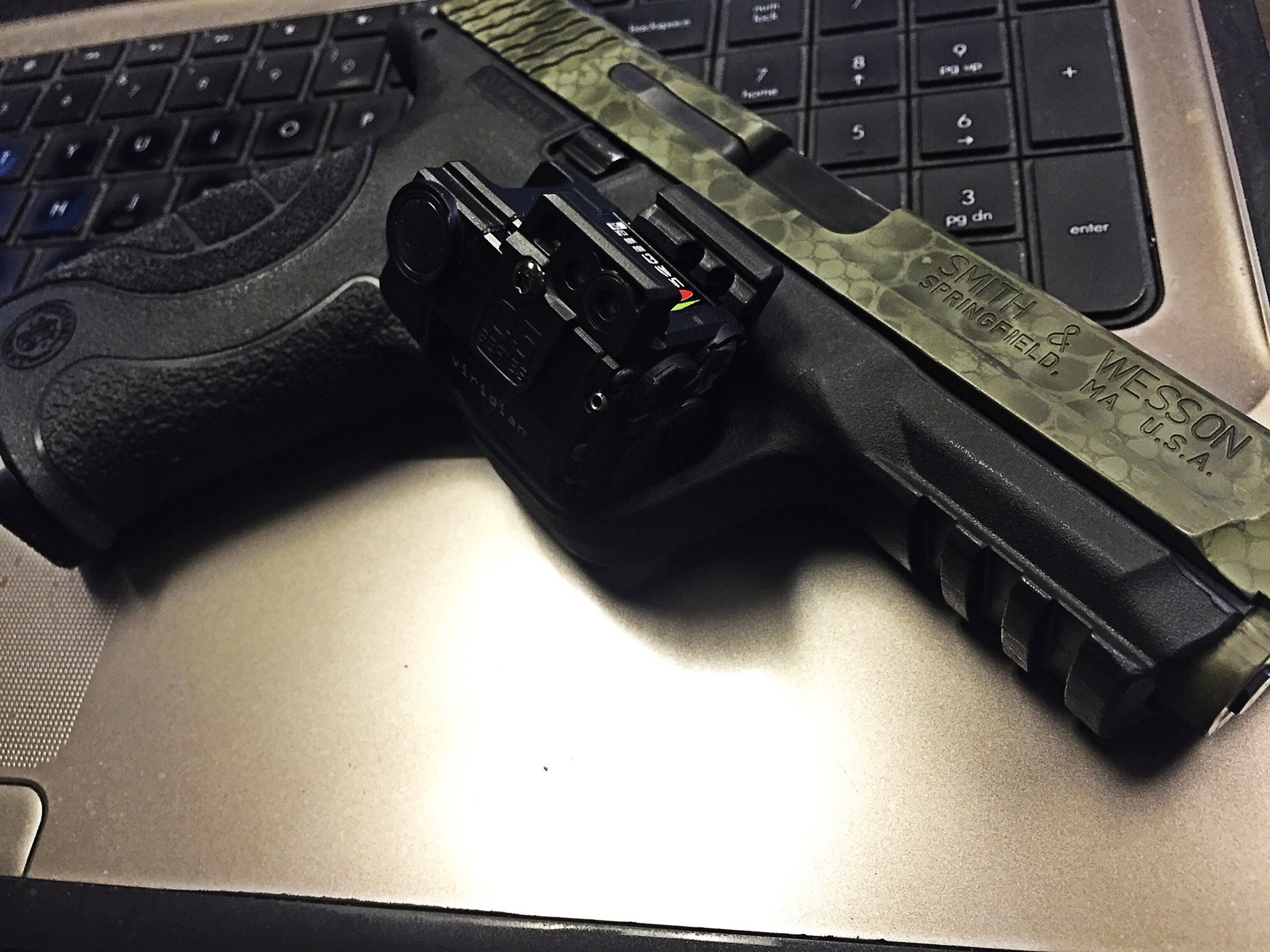
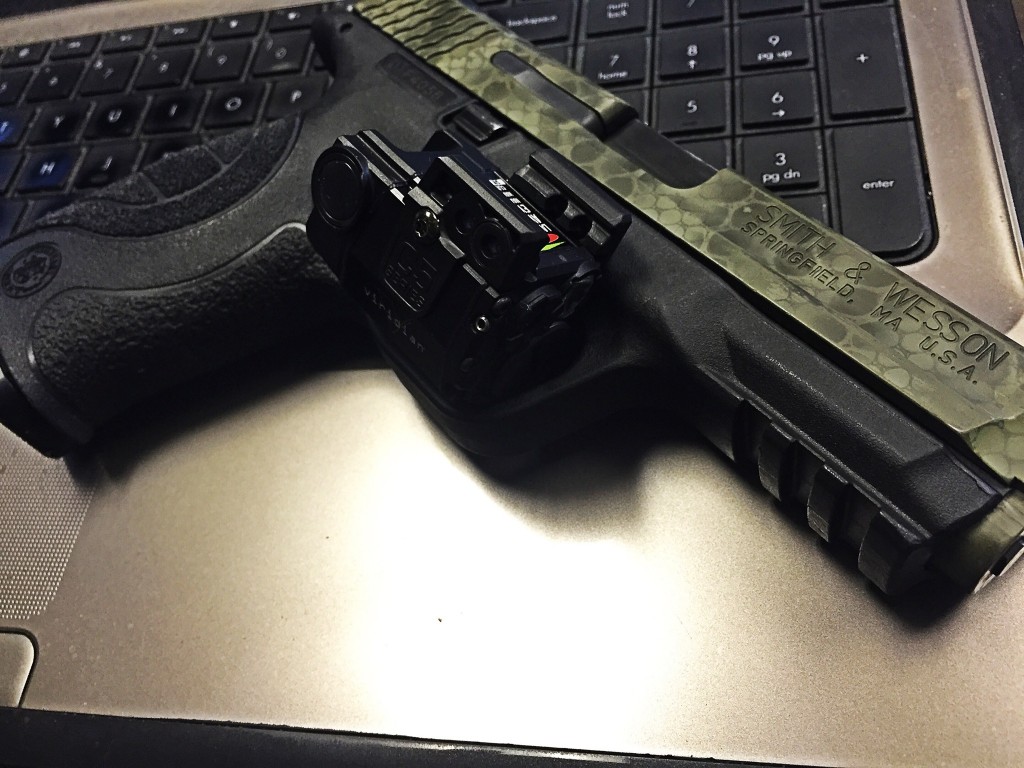
M&P9 with Viridian C5L on top

That’s right, we have M&Ps for days. In the safe there are the following M&P variants: Pro Series, CORE, JG, Compact, Shield, and .22. Pictured is the JG, which has been topped with Sevigny Performance sights, had the slide cerakoted snakeskin, and on the inside has a sooper-seekrit trigger. I also ordered a 4 inch thumb safety model, because I have a slide that’s been cut for an RMR (not a CORE slide) which had the negative side effective of disabling the striker block. So I figured an extra layer of safety for that gun would make some sense.

Going with an existing platform that’s already in the office makes way more sense than buying something new, and since I’ve never really used any of these guns it’s like having a new gun anyway. I do have some trigger time with the M&P Platform, I ran the M&P40 Pro Series in L10 for a while nearly 4 years ago in USPSA and in ESP for IDPA. In fact, I shot my ESP Master classifier with an M&P40 Pro. I like the platform, I like the fact that it’s nearly as well supported in aftermarket as Glocks, and I like the way that most of the ones I’ve handled can shoot. My plan for the guns I have right now is to take them all to the range, shoot them for groups, and pick the one that shoots the best. Then I’ll shoot, carry, and train with that until my next match, and see how we do. Should be fun. It’s nice to have a project, and it’s interesting (for me at least) to see how a terrible range performance has motivated me to start caring about my training again.

Dear gun industry

Dear gun industry,

Thanks for not being horrible. I know that may sound a little bit like a back-handed compliment, but hear me out. Lately, my political newsfeed outside the gun community has been largely overrun with conservatives offering commentary that amounts to little more than “guys rule girls drool!” Whether it’s gamergate, the feminist reaction to a very smart man wearing a very dumb shirt, Lena Dunham, or pretty much anything else; lately it seems that the conservative community’s reaction has been to come completely unglued. Regardless of whether it’s an instance of actual radical feminist craziness, or just Hollywood people being Hollywood people, for whatever reason the conservative commentator community has lost it. Just lost it. The problem is that it’s gone so far that even when they’re offering legitimate criticism of something that is actually horrible, it’s going to get lost because everything is “bitches, amirite?”

But not the gun industry. Honestly, gun industry, good job. I know it’s been hard, and sure there are holdouts in the industry that don’t like girls in the clubhouse, but for the most part? You have done a really good of not being terrible, and in fact being awesome and welcoming women into the industry. Like I said, you don’t always get it right, but you’re doing pretty well, bro. You’re doing pretty well.

Let’s keep it up, okay? Don’t get crazy, don’t lose your mind, stay focused. It’s not often that we as the firearms industry can say that we’re leading the conservative community in the fight for gender equality, but hey, let’s take this win this one time and be proud of it. While other circles of the conservative community are talking about legitimate rape and stepping on their meat, we’re actually doing a pretty good job. Keep it up.

Fanboy logic

Gun fanboys are great. They’re capable of levels of cognitive dissonance at times that hurt my brain. Here are some of my favorite examples.

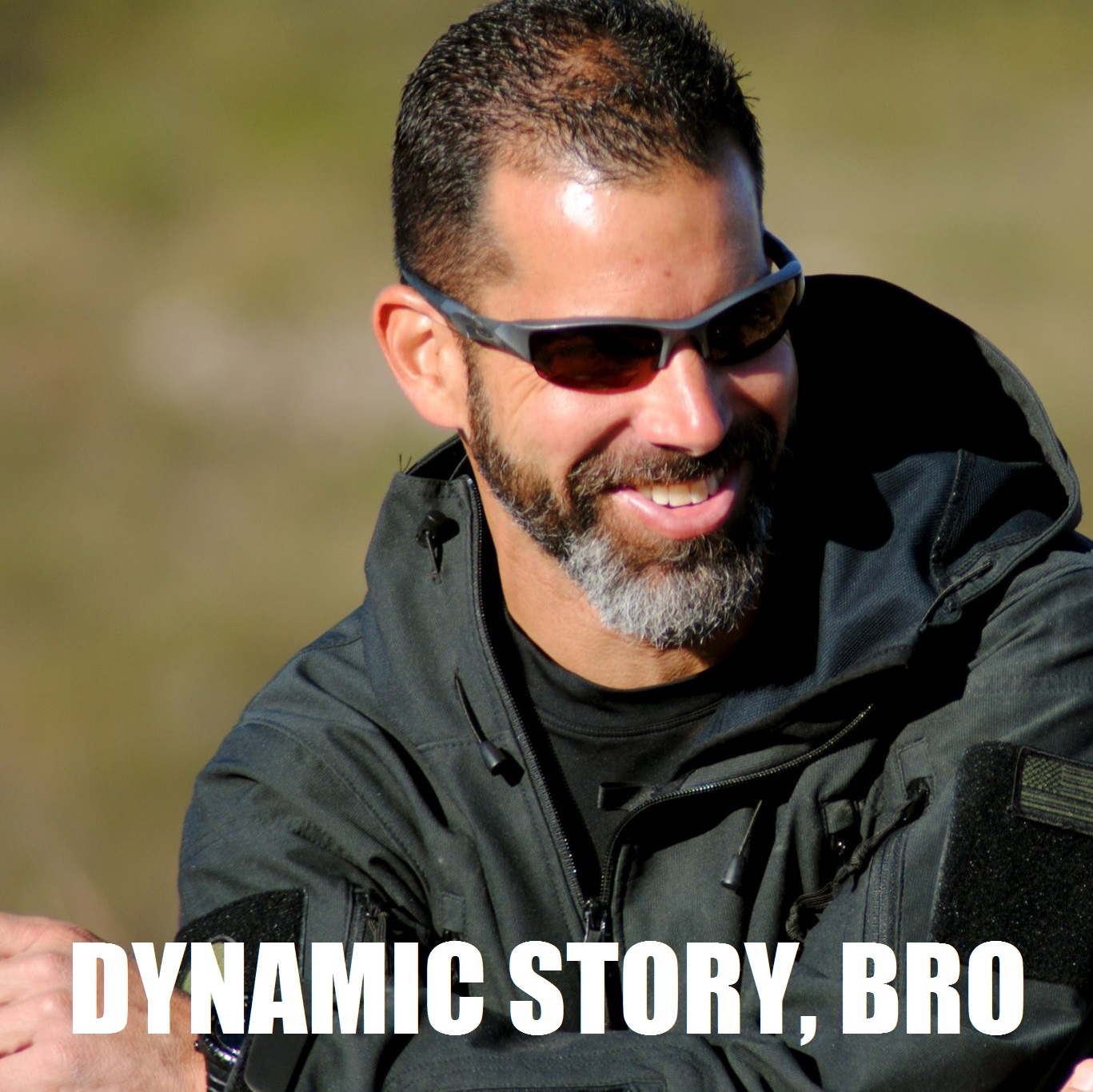
dynamic story

AK Fanboy logic
Cheap AR15 malfunctions: “All ARs are crap”

WASR-10 malfunctions: “It’s not a real AK, that’s why it didn’t work right. A real AK works even if you only lube it with pee.”

1911 Fanboy logic
Glock with aftermarket parts malfunctions: “Lol Glocks are junk.”

1911 with aftermarket parts malfunctions: “It’s because you deviated from the true design of John Moses Browning, if you hadn’t put all that extra stuff on there it’d be fine.”

Stopping power fanboy logic
On 9mm: “A puny .355 inch bullet has no stopping power and won’t drop badguys!”

On .357 Magnum: “A .357 is the king of one-shot stops!”

Glock fanboy logic
About his gun: “Glocks never malfunction! They’re Perfection! I’m just going to replace the sights, add a Lone Wolf 3.5 lb connector, fix the magwell, and cut the slide for an RMR.”

About other guns: “Your guns suck, look at all the junk you have to buy to make it work right for you!”

Tactical fanboy logic
About lights and lasers: “You shouldn’t put a light or a laser on your gun because you’ll give away your position.”

About shotguns: “Pumping the slide on a shotgun will scare any intruder out of your house!”

Post your own to comments!

Winter is here, time for coat pocket guns

One of the best things about winter is getting to break out the coat pocket gun. I am actually a huge, huge fan of this method of carry, because it allows a person to be walking down the street in a completely non-threatening manner, but with your hand on or near the grip of a defensive firearm. It’s really fantastic. Here are some criteria that I use to select a coat pocket gun.

1. It must be light
While I love all-steel revolvers for their shootability, a Ruger SP101 or S&W 640 Pro Series doesn’t make a great gun to sit in the pocket of a coat. It’s heavy, and that makes your coat hang awkwardly, which can compromise concealment. So lightness is key. For example, if we’re going with the revolver route, we’d want something like a Ruger LCR or a 638, both of which I happen to have.

2. Revolvers should have no external hammers or shrouded hammers

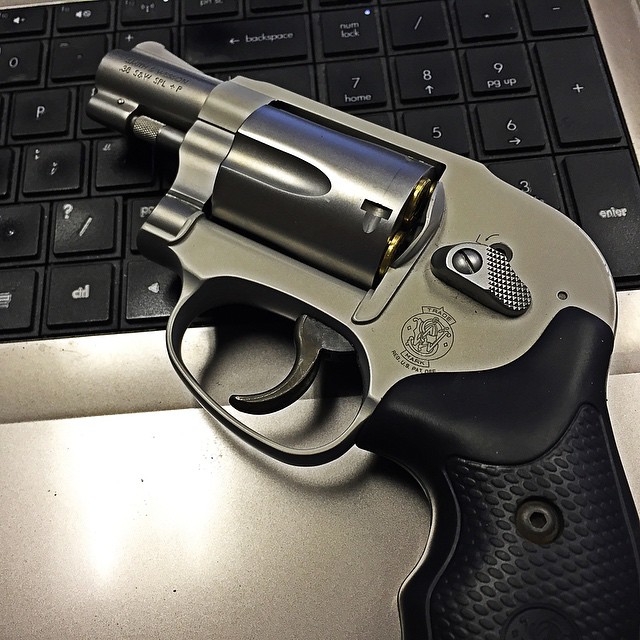
638 j-frame

The big advantage of a revolver as a coat pocket gun is that in extreme circumstances you can fire it through the coat pocket. While this isn’t generally recommended unless you want to wreck your Burberry (in the case of my readers, your Carhartt) it remains a compelling reason for revolvers as a coat pocket gun. If that’s the case, a hammerless gun or a shrouded hammer gun is the way to go, because it means there’s nothing on the gun to snag inside the pocket. If you want to have the option of retaining the hammer, a 638 with its odd little nubbin hammer would be the way to go.

3. Your gun pocket is for your gun and that’s it
If you’re carrying a gun in a coat pocket, that pocket is reserved for your gun only. No car keys, pens, chapstick, loose change, nothing. Just your gun. The same pocket gremlins that can tie your headphones into a reef knot in your pocket are also capable of slipping a dime into your gun’s trigger guard inside your pocket holster and making a loud noise at the wrong time. Gun in pocket, nothing else.

4. Semi-autos should be true DAO, hammer fired, or have a safety
I know that this is where people will disagree with me, and that’s fine. It’s okay for those people to be wrong about stuff. However, as mentioned above, when you’re dealing with pocket carry, the opportunity for an ND is something that should be recognized and mitigated. I carry a DAO revolver in a pocket because the trigger is 13 pounds, and it would take an unusual occurrence to make that go off accidentally. With semi-auto pistols, I think the same caution should be exercised. Pistols carried in the external pockets should have at least one of these features: true DA/DAO triggers, be hammer fired, or have an external manual safety. Striker fired guns with no safeties? Hard pass for pocket carry.

Whatever gun you end up choosing for winter, make sure you spend some time practicing getting it into play. Again, the advantage of a coat pocket gun is that you can have your hand discreetly on a weapon without other people knowing, which can give you the initiative advantage in a potential life threatening situation. But that won’t do you any good if you’ve never practiced drawing and shooting from that pocket. So make sure you get your trigger time in.

The consequences of cooperation

In the past few weeks a number of “news” organizations have taken to the air to offer advice to the general public on how to deal with home invaders. The suggestions in these pieces have been laughably absurd, including suggesting keeping wasp spray by the bedside to spray in an intruder’s eyes. A common suggestion in these stories, and indeed a common suggestion from the sort of people who push gun control, is to cooperate fully with the bad guy in hopes that he won’t hurt you.

If violent criminals operated on what we recognize as logic and reason, that might be somewhat useful advice…but bad guys don’t work that way. When I did a writeup on the two classes I took with Greg Ellifritz a couple of weeks ago, one of the things I neglected to mention was that Mr. Ellifritz has an exceptionally useful blog where he Hoovers up a bunch of interesting reading on a wide variety of subjects as well as giving his own worthwhile insight on some items. I want to direct you to a specific post about insults and challenges to bad guys. The whole thing is worth reading, but for our purposes today I want to focus on the following account:

“There is, however, a worthwhile learning point in the article. The robber walked into a store and fired a couple of shots from a rifle into the ceiling before demanding cash. The victim (a store manager) complied. As she was handing over the money, she was still stunned by what was going on. She made a careless comment, saying ‘you’re not going to shoot me’ to the robber. The robber took those words as a challenge and shot her in the leg before taking the money and running from the store. When asked by police if he felt any remorse, the robber replied that he did not. He blamed his actions on the victim, stating: ‘You don’t tell somebody that’s got a gun pointed at you that you’re not going to shoot them”

 This nicely describes the disconnect between the assumptions of people who urge cooperation with violent felons and the way violent felons behave in reality. There was no cause for attempted murder from the cooperative, helpless victim and yet the bad guy took offense over the slightest thing and put a bullet into her anyway. It turns out that the sort of guy who walks into a Dollar General store and fires a couple of shots into the ceiling before demanding money doesn’t have much of a mental barrier against shooting even a compliant and helpless person over nothing.

Gordon Schaffer complying with the armed robber’s commands

That’s not the only example, of course. Twenty two year old Gordon Schaffer was working the late shift at a pizza delivery joint when two men with guns entered and robbed the place. They demanded the money from the register and Mr. Schaffer complied immediately.

And then as they were leaving, one of them opened fire. Mr. Schaffer was hit in the chest and despite being airlifted to a trauma center died of his wounds.  Mr. Schaffer was perfectly compliant just like all the “experts” said he should be, and he was murdered. I’ll let the police investigating the crime sum it up for you:

“Mr. Gordon did everything he was supposed to do, he complied to everything, he gave them the money they asked for. The reason we’re saying senseless is because it didn’t have to happen,” said Sgt. Michael Kash with Columbia PD. “He was compliant and they still shot him.”

He was compliant, and they still shot him.

If you go to a lecture by William Aprill you will hear him discuss the difference between instrumental violence and expressive violence. Instrumental violence is the use of violence to achieve a particular end. This is the more “rational” (and I use that term very loosely) sort of violence, the kind of violence that the gun control experts assume is happening. Bad guy wants money, you don’t give him the money, he hits/stabs/shoots you to get the money. Ergo, if you give him the money he has what he wants and has no reason to harm you. The trouble is that they conveniently neglect to acknowledge a big chunk of human nature that’s far more sinister.


Unfortunately the sort of men Alfred is talking about there aren’t just fictional characters like the Joker. They’re all too real. Men like Mr. Broadnax or the man who murdered Mr. Schaffer are not killing because their victim was in the way of achieving their goal, they did it because they could. Some people express themselves through music, some through dance, some through poetry, some through cooking or woodworking or website design. These men express themselves with murder. They don’t run on logic or reason as you or I would recognize it. They don’t have the capacity for empathy or pity. They are remorselessly brutal and savage and will continue to be so until the day they die.

Cooperation with such an individual is not an effective survival strategy.

Never bet your life on the moral recognizance of someone who is sticking a gun in your face. Gun control proponents might reluctantly acknowledge the existence of such men but would argue that most bad guys sticking a gun in your face are just after the money, so cooperate. Trouble is that you can’t tell the difference between the guys who are after the money and the guys who will kill you until they pull the trigger…and by then it’s too late for you. So I have a radically different suggestion:

Don’t allow somebody to stick a gun in your face. Self defense is not a risk free endeavor, but even FBI statistics show that resisting with an effective weapon like a firearm tends to have the lowest risk of death or serious injury. As I’ve said before, helpless victims bring out the worst in bad men. An armed and determined opponent, on the other hand, usually brings about their flight or their end.