Kim Williams no longer with USPSA

In an announcement that would have been easy to miss, USPSA very quietly announced yesterday that Kim Williams was longer employed by their organization. The attached screenshot shows exactly how much public information they released about her no longer serving as the Executive Director of USPSA.

If you recall, Kim was the executive director of USPSA who was at the center of the recent controversy involving improper accounting procedures. Two members of the USPSA Board of Directors at the time called for her immediate resignation, which failed. It would seem that with the change in the make-up of the USPSA BOD, the new USPSA President no longer has need of Kim’s services.

I won’t speculate on the reason behind Kim no longer being employed by USPSA, although the cryptic and terse nature of the message practically begs for it. It is my hope that USPSA as an organization made this decision in the best interests of furthering the growth and expansion of the practical shooting sports.

Archangel is at it again

And this time they’re not content to shit up cheap surplus rifles like the Mosin Nagant, oh no now Archangel is coming for your beautiful, pristine Mausers.

You know, before I decided to write this post, I debated long and hard about whether or not it was worth it. You see, whenever I call out ProMag or Archangel for making crappy products, their marketing manager shows up in my comments and loses her shit. Last time she made up a whole bunch of shit that never happened, and to be honest it kind of got on my nerves. But one of the advantages of taking Gun Nuts fully independent (oh yeah, did I mention that we’re fully independent again? No strings on me) means that I can once again call a spade a spade. So let’s get on to it, because this is just awful.

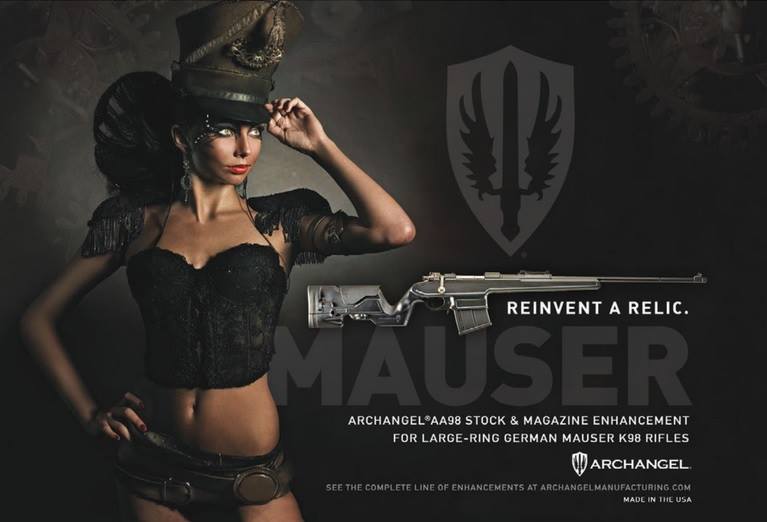
terrible ad for archangel's terrible product

I mean, first let’s start with their advertising, which while oddly reminiscent of an EAA ad, lacks the sort of barking lunacy that makes the EAA ads fun. Instead you have an attractive girl in odd makeup with a hat that doesn’t really go with the product just sort of looking confused.

And then there’s the product itself. Because when I think quality, oh yeah, I think ProMag. Or Archangel. Oh wait no, I think the exact opposite of that. And believe me, if you thought I was opposed to slapping one of their crappy stocks on a Mosin, imagine how I’m going to feel about putting it on a K98? If you imagined “horrified” you’d be correct. Yes, I know there’s no permanent modification to the rifle, but that’s not the point. Mausers are special. They occupy a unique place in history, and that wood stock you’re thinking about ditching because it’s all dinged up? It earned those dings. Every single one of them. You don’t know where those scratches came from; sure they could be from the rifle being idly tossed in a crate, or maybe they’re from a German soldier, huddling in the freezing cold at Bastogne, wondering if those crazy Americans were going to start shooting again.

Rifles like that have history, and getting rid of their stocks is like taking their history away from them. It’s like buying a beautiful ’67 Camaro and then putting neon underbody lights on it. It probably wouldn’t be so bad if the stock was a well thought out, well made piece of gear. But we all know it’s not. And we all know who’s going to buy these things, and it’s universally going to be people who don’t get a hot crap about things like “history.” That’s just too bad.

In the end, I’m less offended by existence of this product than I probably should be. Yeah, it’s going to be a piece of dogshit, and yeah it’s a terrible replacement for a real stock. But what really offends me about this is the idea that you should simply throw away history and tradition, just because it’s got a few dings in it. To me? That’s more offensive than shitty advertising and garbage products combined.

Lee Pro 1000 Reloading Press – A Review After One Year

I have owned a Lee Pro 1000 for a little over a year and in that time I have learned a lot about this press, both good and bad. After some trial and error I made some modifications to the press increase reliability. Thus I will actually have two articles on this press. The first will be the review and the second will be the mods I made.

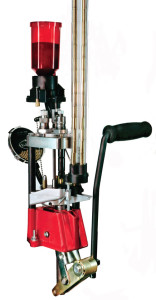
Lee Pro 1000

The Lee Pro 1000 is a Progressive Reloading Press that comes basically assembled and ready to go. It is the least costly progressive press you can purchase, from any manufacturer. In making it fit a price point some concessions had to be made and some of those concessions have serious ramifications. The best way to illustrate this is to compare it to the closest similar unit, the Dillon Square Deal B. The Dillon unit cost roughly $389 plus shipping or roughly twice what the Lee cost.  I would wager the majority of that cost is in design and materials, not just the Dillon name.  Back to the Lee…

My own experience with the Lee Pro 1000 started after I signed up for a training class that required 2500 rounds over 3 days. Prior to registering for that class I had used Freedom Munitions re-manufactured ammo and shot on average 200 rounds per month. I was faced with the prospect of purchasing 2500 rounds or loading up 2500 rounds on the single stage press I own.  The more I thought about it, the more disgust set in, so I dropped back 7 yards and punted. So began my search for an affordable progressive reloading press. I came upon the Lee Pro 1000 in a Midway USA advertisement; it was $189 plus shipping and it seemed like it would fit my needs. Some quick math proved I could buy the press and components (I had lots of brass) for the same price as purchasing loaded ammo. After researching the unit and what I would be getting  I ordered the press and the funnel collator for it.

When it arrived I wasted no time in setting it up. I had read several websites and was aware of certain idiosyncrasies and known issues but with a minimum of effort I was up and running. Now a year later I have produced a little over 5500 rounds of serviceable ammo. I say serviceable and not good because frankly, the machine is lacking in many areas and the result is inconsistency. Remember the Dillon Square Deal B I mentioned above?  You know, the press that cost over twice what the Lee cost? What do you get for that price? Accuracy, reliability and repeatability. With that said, let’s get into the Pro’s and Con’s.

Pros

Affordable – The Lee Pro 1000 is the most affordable Progressive on the market. When the press arrives you will find every die is set, with the exception of bullet seating depth.

Case Feeder – To unit comes with a “special” case feeder.  To the unexperienced the provided case feeder is a bonus.

Size – The Lee Pro 1000 is rather small in both foot print and height. This is a boon for those with limited space.

Caliber Changes – If you reload a lot of different calibers it is easy to change, especially if you invest in an extra Turret so you can keep the dies set.

Cons (hold on to your hat)

Case Feeder – I’ll start here since I also listed as a “pro”. In theory a case feeder should make the unit faster. It does not! There are two ways to load the case feeder. Use the collator, which leads to numerous cases upside down in the feed tube, or you can load each tube one at a time. I have tried both. One at a time is slower but more reliable and what I recommend IF you really must use the case feeder – more about that in the next article.

The case feeder has another time killing issue. On occasion the cases will get hung up and will not feed. This requires the operator to run the ram all the way up and use a scribe or long thin screwdriver to jiggle the cases to feed. When the machine is running the case feeder allows for a healthy feed rate. Unfortunately I don’t believe I ever loaded more than 15 rounds before some issue with the case feeder required me to stop and fix the machine. New Level Unlocked: Frustration!

Primer Feed – The primer holder is actually pretty ingenious and quick to reload; the primer feeder, not so much.  The primers slide down this chute device that looks like a playground slide and is made of two pieces of plastic. I have a mod that corrects the issues caused by its two piece design.

I don’t have a good solution for the other issue – the playground slide. The primer holder sits at a 45 degree angle behind the press and feeds the primers down the chute. The problem is the chute turns completely horizontal before reaching the actual primer setting mechanism. For the primers to feed properly there must be enough in the chute to provide “head pressure” otherwise you will have mis-feeds and a multitude of errors that will raise your blood pressure.

The last problem with the Primer Feed has to do with dirt, or more specifically powder. As you will read below there is great chance for powder to wind up on and below the shell plate. When (not if) the powder gets into the primer setting mechanism it will cause issues. A can of aerosol duster for keyboards is your best friend here!

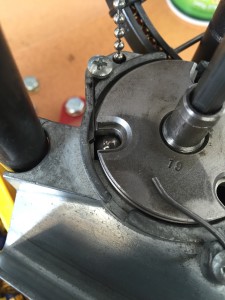
Shell Plate Stop/Locator – The “stop” or locator device for the shell plate is a spring-loaded detent ball. (See photo below) There is nothing inherently wrong with a spring-loaded detent. The problem lies in the placement of said detent. Mainly the fact it is centered below the bullet seating die. This means your case is filled with powder when the detent “pops” up and smacks the shell plate directly below the case. Anyone with a basic understanding of physics will understand the problem with smacking the case in the ass after being loaded with powder.  For those that failed High School Physics I’ll elaborate… the powder charge is violently shaken and it is normal for a flake or two to hop out of the case. Aside of the issues with powder being all over your bench you get to enjoy a variable powder charge, a dirty machine and an imminent, jammed primer setting mechanism as mentioned above.

IMG_5487

UNACCEPTABLE!

Powder Measure – The powder measure is OK. The biggest issues I had with it was elated to the powder type. Some powders measure well and others don’t measure correctly at all.  For the price of the powder measure, I can’t really fault it.

I can fault the idiocy of the Auto-Disk.  Specifically the chart that Lee provides.  This chart list common powders and shows which diameter hole in the Auto-Disk will give a specific charge weight. I recommend you take the chart and use it to start a fire pit. I don’t know what world the chart designer is living in, but I have not found it to be accurate at all. Frankly this is only a minor annoyance as you should be measuring your powder charges with a scale; but seriously, if you are going to spend the time making a chart, shouldn’t we be able to expect it to be somewhat accurate?

So there you have it. The pros and con’s you can expect with the LEE Pro 1000 Progressive Press. Note that I didn’t describe the reloading process and I won’t in my next article either. Reloading is not something to be taken lightly and if you are interested you should seek guidance from an experience reloader. I also recommend you start on a single stage or turret press.

As noted above, next time we’ll go over the mods and tricks that help make the press more reliable and user-friendly.

The best drill for concealed carry

None of carry a gun because we’re optimists, that much is a fact. However, it’s taken me years to accept the fact that most people who carry guns aren’t going to invest the time and energy into becoming a proficient shooter. I don’t like that, but there’s nothing I can do about it. Most people would rather dink around with chrome plated Mausers or carry six different guns a week than buy one gun and learn to shoot it really friggin’ well.

So what should those people practice? I’ve longed believed (and still do) that the Bill Drill from concealment is the best choice for the average joe. For the newbs, a Bill Drill is a time 6 shots from the holster at either an 8 inch circle or a USPSA A-zone. The most common distance used is 7 yards, but you can practice them at any distance. I like to shoot 25 yard Bill Drills when I’m training up for Bianchi.

Let’s break this thought process down a bit. Assuming (I know, I know) that the “average” self-defense scenario involves a single assailant surprising their target, a drill that focuses on belting a relatively large number of rounds into their thoracic cavity as fast as possible seems to make sense. 6 rounds of 9mm in the chest is going to change your plans for the rest of your life, and definitely make you rethink whatever it was that made you decide to do crimes. There’s also the shock factor in case bad guy one has friends; which we shouldn’t rely on, but still. If you and Pookie were out doing crimes together and all of a sudden some dude ninja’d a gun into his hands and dumped half a mag into your best friend in 2 seconds, maybe you’d decide you had somewhere else you needed to be, like yesterday.

The real talk though comes down to the fact that Bill Drills focus on one thing: getting a lot of lead on target as fast as possible. There’s no guarantee a badguy is going to stop after the first, second, third, or even fourth shot. That’s the other reason I like the Bill Drill so much, because it trains you out of shooting controlled pairs or double taps or whatever you want to call them all day long. You need to work the trigger to shoot a fast Bill Drill; and to shoot one under 2.00 you need to get everything right, from the draw to your sight tracking and your trigger speed.

What do you think? Is the Bill Drill the best choice for the novice CCWbro to practice?

Hey, if you like what we’re doing here at Gun Nuts and you’re tired of getting bombarded with ads and Amazon product links, why don’t you support us on Patreon? Your donation allows us to continue making sweet content like this video.

Be like Pat Mac

I don’t have trainer goggles – I’ve never really bought into the whole “cult of personality” thing that you see with a lot of “name” trainers. You know what I’m talking about: dudes getting into internet slap fights about how my sensei can beat up your sensei because they’ve decided that one trainer is the be all and end all of trainers.

That being said, if there’s one trainer I absolutely want to take a class from, it’s Pat Macnamara. That’s because while other trainers are busy getting into internet purse fights, he’s off in a corner being a BEAST.

Plus, he always seem to be having fun in his videos, which is nice. But I’ve never seen him get drawn into the silly internecine infighting that seems to be so common in “name” instructor circles. I wish he’d get back to posting more videos of his crazy shooting drill/workout combos.

You keep being awesome, Pat Mac.

The right approach to concealed carry

Last year I attended the excellent Rangemaster Tactical Conference held in the Memphis Police Department’s academy and range facility. As I wandered around the facility looking for the men’s room, I encountered the poster pictured above.

While aimed at guiding police officers in how they should approach their behavior off-duty, I think it has just as much application to the average citizen carrying a firearm for personal defense. The Washington Times published a story in July of last year reporting the results of a study that has tracked the incredible increase in concealed carry permits across the nation.

Since 2007, the number of concealed handgun permits has soared from 4.6 million to over 12.8 million, and murder rates have fallen from 5.6 killings per 100,000 people to just 4.2, about a 25 percent drop, according to the report from the Crime Prevention Research Center…And the number of permits issued is increasing faster every year. Over 1.7 million new permits were issued last year — a 15.4 percent increase over 2013, the largest such single-year jump ever

I see this trend in my own personal experience. I’ve written multiple times in this space about people who have come out of the woodwork asking me about buying a firearm and getting a permit. In the last couple of weeks in totally non gun related conversations in a professional settings three people have volunteered to me that they’ve recently obtained a permit…people I would never have expected to have one or to be remotely interested in guns. In truth they aren’t really interested in guns as much as they are self defense and there’s no better implement of personal defense than a firearm.

As concealed carry becomes more common the challenge we face is ensuring that those who want to use a firearm for personal protection have reasonable guidance and access to solid information that will hopefully keep them from having to use the weapon they are carrying, or at the very least keep them from becoming a cautionary tale if they are forced to use it. Bad acts by people with permits create bad optics for the rest of us.

Greg Ellifritz penned a very thoughtful article that I think everyone should read and digest covering a relatively new NYPD officer who accidentally killed a man and was convicted of manslaughter. Greg makes the point that one of the largest police agencies in the world certified the convicted officer as being good-to-go with a firearm and issued him one to carry every day, but clearly did not train him adequately for that responsibility. (Most police training, as Greg and countless others will readily tell you, is woefully inadequate) The fact that the state gave him the stamp of approval to carry a gun didn’t matter worth a hill of beans when he screwed up and put a bullet into the wrong person. In other words, the fact that the government says you can carry a gun doesn’t mean that the government won’t go after you with gusto if you make a mistake with that gun. If you have the gun in your hand, you have the responsibility that goes along with it whether you’ve been adequately prepared for that responsibility or not. You are well and truly on your own.

You will find that your chances of a bad outcome diminish greatly with proper training and a sensible approach to the whole problem. The MPD’s off-duty credo provides excellent guidance to that effect.

I will not seek a fight, and if at all possible I will avoid one…

Having a permit doesn’t make everything your problem. Two dudes get into a shoving match in a Burger King? Not your problem. A couple of people cursing each other out in Wal-Mart? Not your problem. A couple in a screaming match in the parking lot of the Macaroni Grill? Not your problem. Minding one’s own business and not participating in other people’s drama significantly lowers your exposure to potential violence. If for some reason you are targeted by some idiot who indicates some willingness to do you harm, finding a way to leave the situation altogether is much less risky than any form of fighting.

…but if one is forced upon me, I will do whatever it takes to survive.

I’m the world’s biggest fan of de-escalation and avoidance strategies. I’ve employed them many times and plan to use them whenever possible in the future because I would really like to go through the rest of my life without having to do any level of harm to anybody. But the other guy gets a voteThe Apostle Paul wrote to the church in Rome “If it is possible, as much as depends on you, live peaceably with all men” because ultimately we have control over only half of the equation in a conflict. I can control my reactions and behavior, but I have little say in what the other guy(s) chooses to do. They could be eminently reasonable, or they could decide that they will attack me until one of us is dead. If somebody insists on playing for keeps, if they are determined to make it him or me…well…he’s gotta go. You don’t have to be seeking a fight to have one forced upon you.  If someone does force one upon you, odds are it’s one you cannot afford to lose.

My sidearm is neither a status symbol nor an emotional crutch. I will not reach for it unless out of dire necessity…

I’m not reaching for my gun because I want to put the other guy in his place. I’m not reaching for my gun because I feel a sensation of fear, unease, or intimidation about a situation. If I’m reaching for my gun it is to prevent or stop a serious act of criminal violence against me or an innocent third party. That’s it.

…but if I must use deadly force to preserve my life or that of an innocent person, I will use it skillfully and without hesitation.

Skillfully, and without hesitation. Do you know how that happens? Training. Investing the time and effort to bring your skill set and the judgement you operate on up to the level of the responsibility you adopt when you decide to carry the gun. When you have taken the time and effort to prepare yourself, it infuses your bearing and demeanor. You can make good decisions at speed even when looking down the barrel of a gun. You’ve worked against a timer and other shooters to develop the ability to deliver accuracy at life-or-death speed. You’ve taken the time to seriously visualize multiple bad scenarios and how you can potentially handle them. You’ve done enough homework to recognize a lethal assault in its early stages and can react immediately instead of standing there wondering what is going on.

If the other guy insists on a fight, insists on playing for keeps…he’s made the worst mistake of his life.  You have spent a great deal of time preparing for the day when this joker insists on ruining your life. He, on the other hand, expects a victim. Not a trained opponent intent on doing whatever it takes to win. You have prepared to meet him, but he has never in his worst nightmares foreseen anything like you.

It’s your responsibility to ensure that you use your firearm responsibly. If you take that responsibility seriously and through training and discipline seek to bring your skill up to the level of that responsibility it has the lovely added benefit of making you much harder to injure or kill.

I’m all for the increase in concealed carry permits, and I hope that the number of people who make the choice to protect themselves continues to break records. It is on us who have been at this a while, though, to encourage a high standard of personal conduct and development of relevant skill sets to those who are making the choice…for their sake and for our own.

UPDATE – I have since learned that the credo pictured above was generated by Tom Givens. Apparently firearms instructors from Memphis PD went to Rangemaster for some training, saw posters Tom had in the place with this credo on it and liked it so much that they decided to put it up at their academy.

The Rock Ultra FS 9mm is better than a Springfield Armory

Okay, so it might be a little early in the test to say that, but last night we kicked off the test of the Rock Island Ultra FS 9mm 1911 by running it through the 10-8 Performance Function Check. Which unlike the Taurus and the Springfield, it passed. With flying colors. Watch the Rock Ultra FS in action here. The Rock Ultra FS is just like the previous two pistols we’ve tested, a fullsize 1911 in 9mm. I has adjustable sights with a fiber optic front, G10 grips, full beavertail, full length guide rod, and unlike our two previous pistols comes from the factory with a magazine funnel (thank god).

For comparison, here’s the Springfield Armory 1911 running through the 10-8 Function Test, you can see it failed on the 2nd round of the “no magazine” portion of the event. Now, that doesn’t make the RO a bad gun, and it doesn’t actually mean that the Rock is objectively better, because the Rock hasn’t completed the test protocol yet. But I do want to point out that the Rock Ultra is the first 9mm 1911 that I’ve had actually pass the 10-8 test. Tim’s Wilson Combat did, but I would expect that from a Wilson.

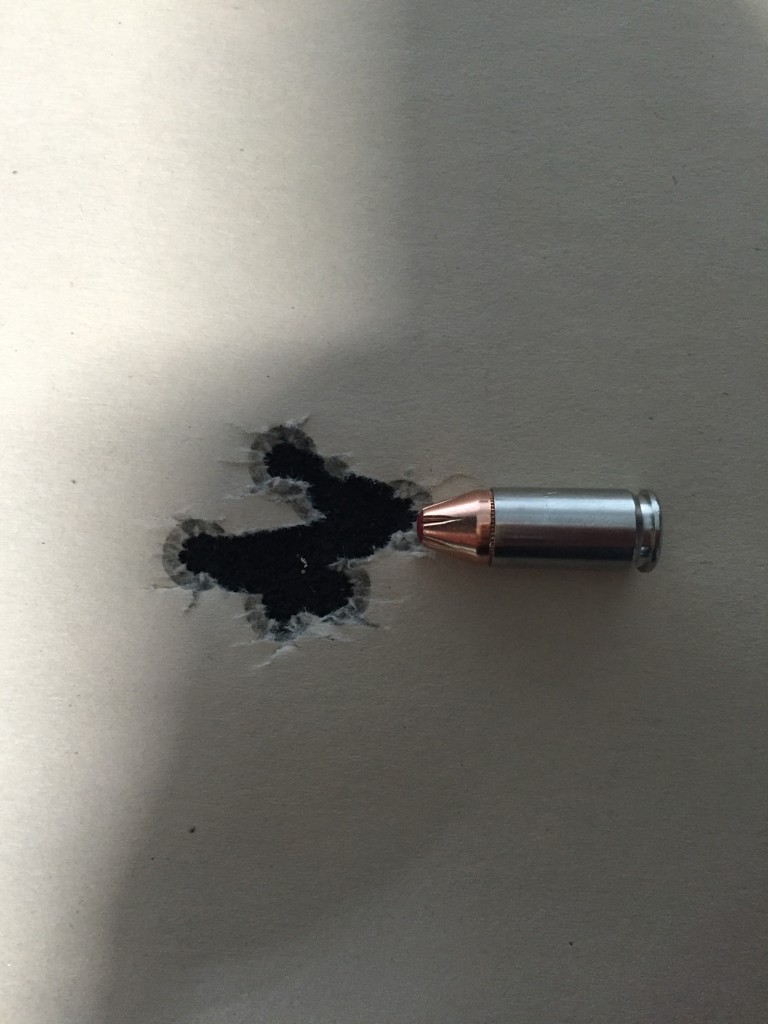
Rock Ultra FS 9mm six shot group Critical Defense

This is a six shot group from the Rock Ultra at 15 yards, standing unsupported. It’s slightly longer than the OAL of the cartridge. There’s no question that the Rock Island and Hornady Critical Defense make an extremely accurate pairing. Standard FMJ also did pretty well, turning in some strong bullseye strings like this:

Rock Ultra FS 9mm 20 shots timed fire 25 yards

20 shots, timed fire (5 shots in 20 seconds) at 25 yards? I’ll definitely take that. Only two out of the black, and both of those were called shots.

Now before we get further, I need to talk about bias here. I said during the Taurus test that I wanted the Taurus to be good, because I wanted to live in a world where a 500 dollar 1911 could get a better grade than D. I feel the same way about this gun, but even moreso because I’ve had prior positive experience with Rock Island guns; and because the Rock Island/Armscor people I know are genuinely cool people. So I want this gun to be good. I’ll admit that I was wrong in the video about the price point, I can find them only for $650 but nothing like $500. That’s my bad. However, $650 makes it more affordable than the Range Officer by $100-$200 bucks, and that’s no joke.

Initial results? Positive. I’m pretty optimistic about where this test is going to go. We’re 256 rounds in with 1744 to go, and I’m genuinely excited about seeing what happens next.

If you’re enjoying these posts, please consider supporting us on Patreon. Pledging even a buck or two helps us keep Gun Nuts running and expand the site and it’s content to serve the interests of even more readers.

Training for Match Mode – Part 2

In Part 1 I discussed the concept of building a Match Mode and a method I have been using to train. If you remember this concept of match mode comes from Steve Anderson and I believe it is a core concept to consistency.  When I left off I alluded to a couple of other benefits to the act of calculating hit factor during your live fire practice and a way I have been able to equalize and bring my best and worst runs closer together.

Practicing a match mode is really another way of saying we are working towards consistency in our shooting. During “speed mode” we try to go faster. In “accuracy mode” we try to be more accurate than ever before. But match mode is the enemy of “try”. The goal in match mode is to shoot to your level. Rushing in a match is natural while being consistent will seem slow. That is why it is so important to train and get use to a match mode. Remember from last time; consistency – it matters.

Ask yourself this – during a match would you rather have a 1.2 draw that you can achieve EVERY SINGLE TIME or would you prefer a draw that ranges between 0.8 and 1.0 but is not repeatable and you are always operating at the edge of failure?

By calculating the hit factor we can grasp other concepts that are beneficial to both our learning and understanding of this game. For starters, you will find that a lot of what we track in dry fire and specific drill training is irrelevant when viewed solely through the perspective of the match. Your draw time, reload time, and transition time are important, but not as important as consistency. The goal is to be quicker across the board. We use drills in live fire and dry fire to isolate specific skill growth; but in a match we not only compete against others, we test our overall skill. To put it another way, a 0.8 draw doesn’t mean a damn thing if you rush and blow a reload or throw a mike during the stage.

Platerack

Calculating hit factor will also illustrate how speed and accuracy combine to affect the overall score. Too many people look (and listen) to other competitors and zone in on their speed while failing to regard their accuracy as a factor. By tracking your own hit factor it becomes obvious when an extra 0.10 seconds spent aiming could have given you a better score. Equally, we can better understand how it negatively affects our score when we post up and shoot bullseye mode on 3 yard open targets.

NO TIMER

Before I wrap this up I want to discuss another method. One that I have only recently begun to use, but the results have been promising.  The method is to simply shoot your live fire drills without looking at the timer. Yes, I said shoot a drill with no regard to the end time. I use the timer for the start beep and that is all. To ensure I don’t cheat I put tape over the screen on the timer.

The goal of practice without a timer is simple – realize that rushing equals failure. The goal is not to slip into bullseye mode but to move as fast as possible, while maintaining as much accuracy as needed and finish sooner.

This is not something I believe should be done at length, but let’s say we have set aside an entire live fire session to run mini-drills and calculate hit factor. After we calculate our average, apply some masking tape over the timer screen and run the same drill once or twice without any time pressure. Feel the recoil. Watch the sights lift. Maintain a hard front sight focus when necessary. Let the sight picture drive your shooting.  Afterwards go back and run the same drill 6-7 times and calculate hit factor average. You will likely find your average run is closer to your quickest time.

Ultimately there are many different ways to get faster and more accurate, but working toward increased consistency is a worthy goal.  The next time you go to the range set aside some time to practice using hit factors and without a timer. Who knows, you might learn something about your shooting and yourself.

Buying a Holster

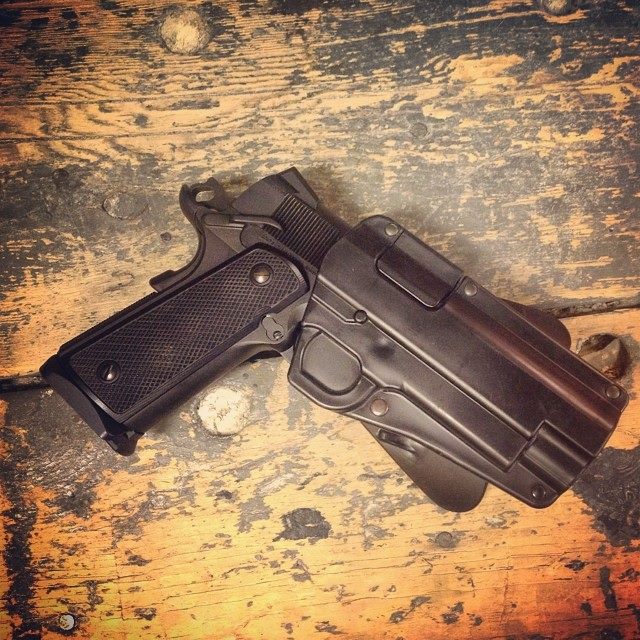
I did something this morning I haven’t done for a while: I shopped for a holster. Throughout my editorial career I’ve done a lot of carrying with what came across my desk, for better or worse. Upon exit from that career, I’ve been very content carrying my G43 in my BLACKHAWK! ARC with few exceptions.

As an experienced concealed carrier, I’m already a step ahead of where many people are in their holster shopping career: I know almost exactly what I want. (If I were to look at it objectively, I would even admit that what I want is my ARC with a slightly different clip.)

It may not make the finding of a holster any easier, but a breakdown of criteria might help newer shoppers begin to understand what to look at. We’re all going to like different things, but as we move through our carry life we can learn what we like and don’t like from different products and apply that to future purchases.

Here’s what I’ve been considering as I browse:

Material

One of the first rules I have about any holster is that it cannot, under any circumstances, collapse if the gun is not in it. This means either Kydex, or something structurally similar such as my ARC. Actually, this is one of the reasons I’m such a huge fan of the ARC holster, the polymer material is non-collapsible, but soft enough it doesn’t chafe like kydex. Which brings me to…

Location & Cant 

Wanna talk soft and non-collapsible? I wear my gun appendix under tank tops. Usually that means no undershirt and my femoral artery is down there so I’m a little squicky about how the holster goes on. In fact, my gun stays in my holster at all times and goes on and off my body holstered. Which means, another important factor is…

The Clip

I don’t always wear belts. I’m a girl, my pants are tight enough that the right clip will hold the holster in place for a draw. I need a tight, sturdy clip that will function without a belt and is low profile. Which brings me to…

Profile

Not just the clip needs to be low profile. I’m a small girl and big holsters bulk up something that is already difficult to carry. The simplicity of the ARC is one of its saving graces for me. A lot of holsters add a bunch of unnecessary leather which may make them more comfortable for some, but make them overwhelmingly large and unmanageable for me.

There are a few things you’ll notice about my approach to holster shopping that have been ironed out over the years:

First of all, I know exactly how I like to carry. I’ve screwed with a lot of different styles, but to be frank I’ve come to the conclusion that if I hit a day my regular carry rig doesn’t work it’s time to look for alternative self-defense options rather than gimmicky gun holsters. This is a very personal decision my training and my frustration with products over the years has led me to.

Next, I know what works for me and what works for other people. I’ve tried those leather/kydex hybrids everyone seems to love, and they don’t work for me. That doesn’t mean they won’t work for you. Just like there’s probably a really good chance a majority of readers don’t drive Mini Cooper JCWs, your holster is a lifestyle choice based off of your needs and no one else’s.

Finally, safety is paramount in my choice. I know the dangers of my carry choices, from what can go wrong with the draw (especially when I’m carrying without a belt) to retention and possible injury when participating in daily activities, all based around holster choice and carry location. It’s a lot to consider, and it takes time, training, and practice to realize what will and won’t work, and what is and isn’t the best for you. There are downsides to any carry style, but understanding the downsides to your choices is an important step in avoiding accidents through precautions, proper training, and proper practice.

I still haven’t found the holster I want, but hey, at least I got a blog post out of it.

Springfield Armory Range Officer 9mm 1911 Review

It’s finally here, our final review of the Springfield Armory Range Officer 9mm 1911. Let’s first start off with the scoring system, which to refresh your memory starts all guns with a maximum score of 100 points, then deducts points as various things go wrong. The Range Officer had 7 failures that were counted against the gun, lowering the score to 93. It also failed the 10-8 Performance function test, dropping the score to 83. Finally, it had one armorer level repair issue, namely that the rear sight pin would walk out of the rear sight under sustained rapid fire. That gives us a final score of 78/100, making this a solid C+ gun.

What’s interesting about the tests is that while the Springfield did out-perform the Taurus, it didn’t do it by nearly the margin I thought it would. The RO costs as near as makes no difference 250 dollars more at retail than the Taurus, but I honestly didn’t see $250 worth of performance increase. Yes, the RO was more reliable, and yes it was more accurate to shoot groups with, but the RO brand new is a $750-$800 gun, and the Taurus is a $500 gun. If the RO had finished in the mid to high 80s, which is where I expected it to finish, we wouldn’t be having this conversation, because $750 is a perfectly reasonable price for a B+ gun.

I did change the stocks out on the Range Officer during the test; obviously if you follow this blog or my Instagram you saw the issues with had with the factory stocks and the foolishness of the previous owner. I actually really like the Magpul 1911 grips, they’re grippy without being too aggressive, and they have a huge thumb relief cut to make accessing the magazine release easier. Plus, they’re affordable. $15 is a pretty good price.
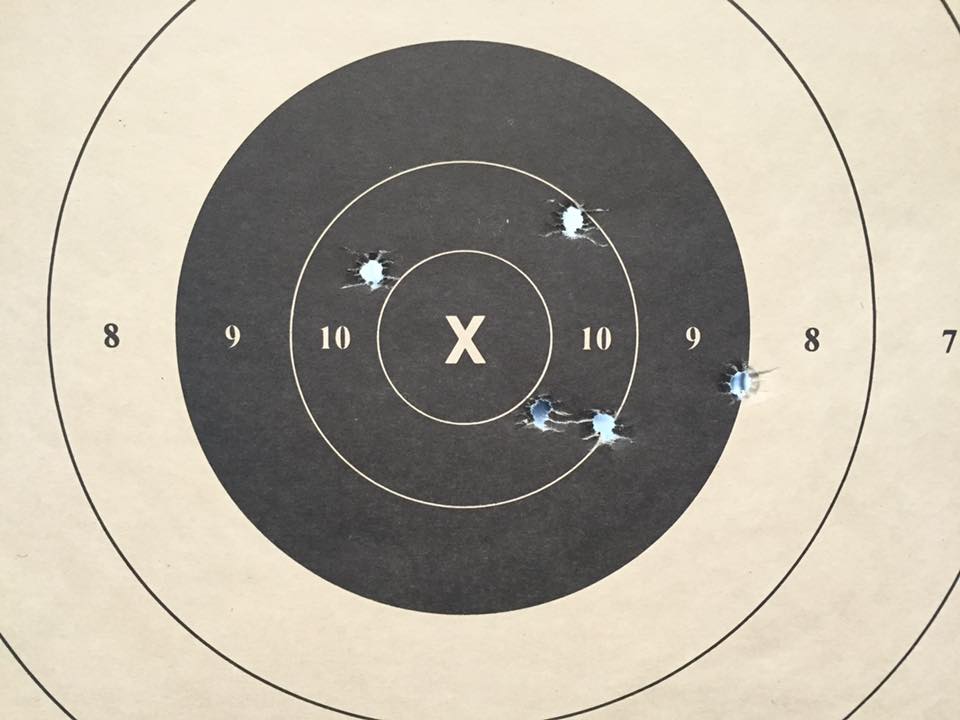
One thing I did love about the Range Officer was how accurate it is. This gun shoots.

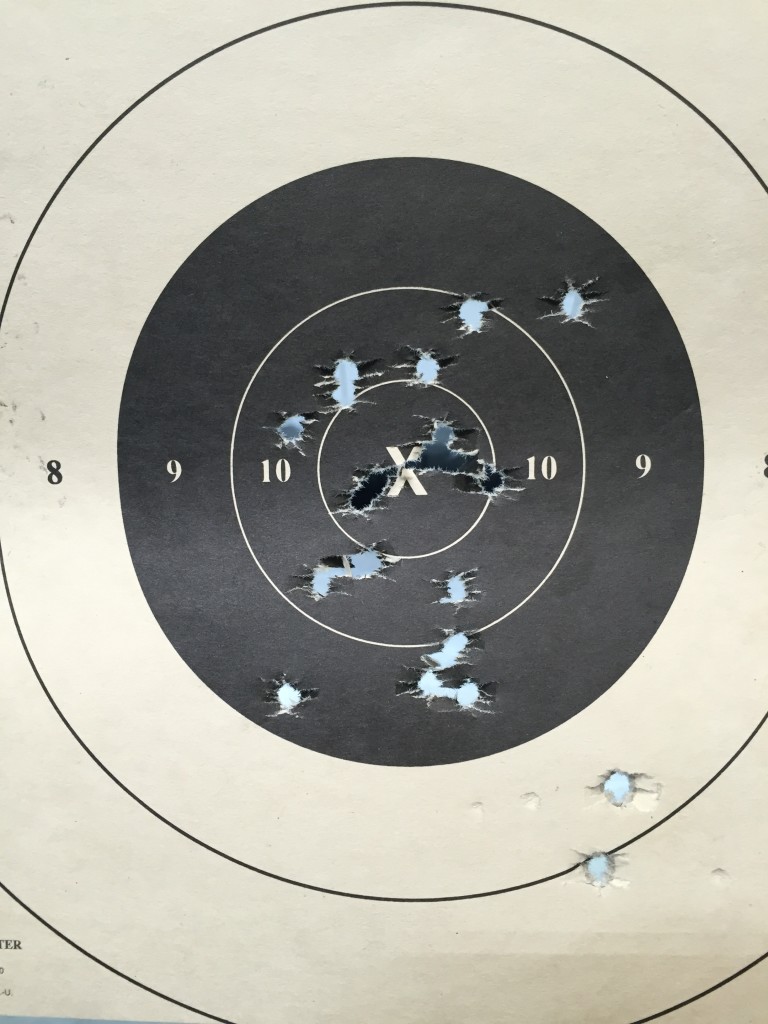
Springfield RO 25 yard timed fire group

That’s a timed fire group (5 shots in 20 seconds) from the Range Officer, shot at 25 yards a B-8 target. The “black” of a B-8 is 5.5 inches, and with the exception of that one little flier in the 9, all of those are 10s in the much smaller circle. This gun shoots well. The only real criticism I have of it is the tendency towards light primer strikes with hard-primered ammo like Tula or Fiocchi, both of which I had issues with. The easiest way to solve that of course is not use that ammo with this gun, which is exactly what I’ll do moving forward. With some minor tweaks to the recoil system, and the addition of a magazine well, this would make a pretty solid choice for USPSA Single Stack, and might even be decent if I pressed into service as a Bianchi Cup gun.

As it stands now, the Springfield Armory RO sits at a distance second place behind Tim’s Wilson Combat 9mm 1911, which scored a perfect 100/100 on our test. Up next is either the Armscor 1911 or the Dan Wesson, and to be honest I’m having trouble picking which one.