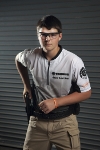
Taurus® Launches Taurus Young Guns™: Junior Shooting Team Led by Jessie Duff

Miami, FL – Taurus International Manufacturing, Inc. , the leading manufacturer of concealed carry and small frame pistols, debuts their new junior shooters’ program developed by Taurus Team Captain, Jessie Duff.
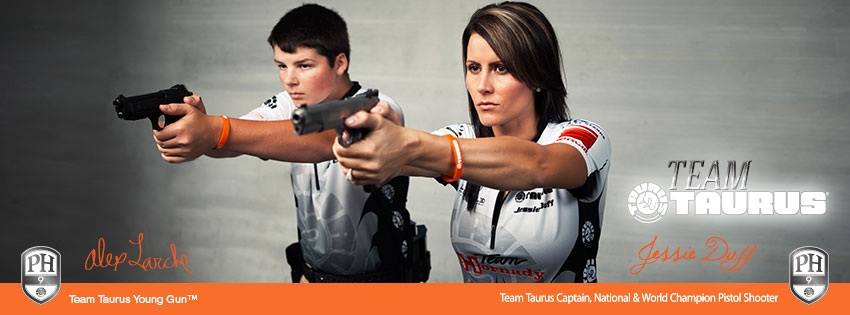
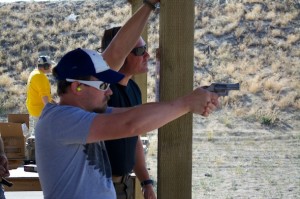
team taurus jessie-alex

When Taurus entered the world of competitive shooting, it had a goal in mind, which was to grow the sport by reaching new genres of shooters – women and youth. In 2011, Jessie Duff was recruited to take on the role of Taurus Team Captain with the vision of developing a new generation of shooting ambassadors, meeting stringent requirements both on the range and in public:

Taurus Young Guns™ must maintain a positive public image in accordance with Taurus’ corporate values regarding conduct and safety, both on and off the firing range, including but not limited to, social media sites such as Facebook and Twitter. Taurus Young Guns must also maintain at least a 3.0 grade point average or “B” average, depending on the grading scale of the high school attended by the team member.

With such stringent criteria in place, Duff was determined to find Taurus their first Young Gun team member. After several months of scouting junior shooters, Alex Larche was the one individual that caught the attention of the Taurus team captain. “I was very impressed with the level of talented, young shooters competing these days, “ comments Duff. “After an exhausting search, it was very apparent that one particular shooter met the requirements necessary to become a Taurus Young Guns member. Alex Larche is not only a talented shooter, but portrays himself in a positive manner when he is both on and off the range. He exemplifies what we are looking for in our future shooters’ program.” Alex will be competing in the Production and Single Stack classes at local, regional and national matches.

“Today, the industry is talking about the new gun owners and how we need to recruit more of these folks into the shooting sports,” states Mark Kresser, President and CEO of Taurus International Manufacturing. “We are finished talking and have implemented a program to encourage young shooters to be safe, responsible and respectful at home, in school and on the shooting range. We are very excited to have Alex as a part of our Taurus family and look forward to a very bright future!”

About Taurus®:
Taurus® is the global leader in revolver production. Taurus International Manufacturing, Inc. is proud to be the U.S. importer of all Taurus brand firearms manufactured in Brazil and to be the manufacturer of the model PT-22, PT-25 and PT-738 pistols made here in the U.S. Taurus International services all Taurus brand firearms under the LIFETIME REPAIR POLICY™ as well. For additional information about Taurus, visit www.taurususa.com. High-resolution images are available at www.taurusdownloads.com.
Firearms technology

How important are good pistol sights to you?

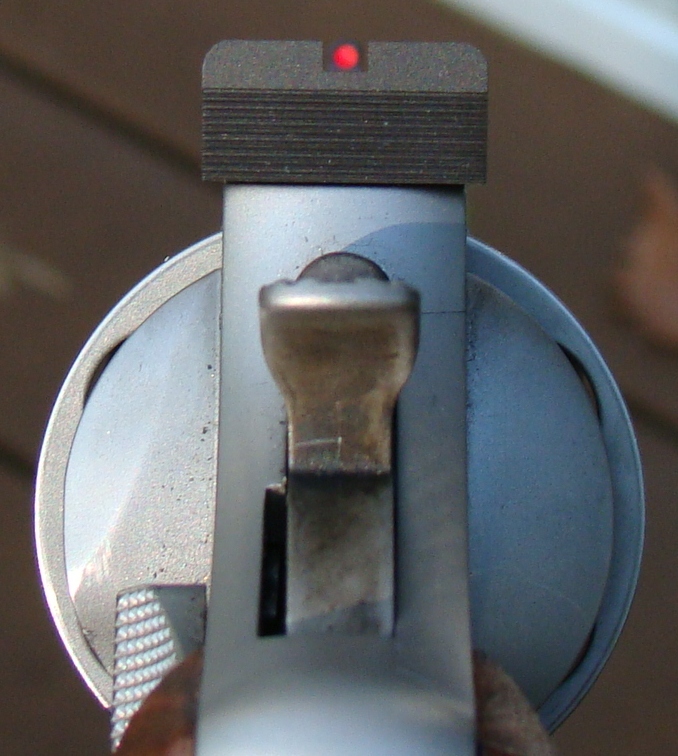
bowen-sight - caleb

The sights on our guns are the windows through which we see whatever it is that we’re shooting at; and as you track the development of the shooting sports you can see a lot of development in sights as well. Take a look at the sights on pistols and revolvers from the 30s and 40s, describing them as “puny” would be quite charitable. It was the Modern Technique and parallel development of practical shooting that really lead us to the modern pistol sights we have today.

But then, things basically stopped. Yes, we have night sights filled with tritium so we can see them in the dark, but the concept of the pistol sight hasn’t really changed significantly. The much argued about XS Big Dot sight is just an express sight, a concept that’s been on big game rifles forever. There are some ghost-ring pistol sights, which…seem like a gimmick and don’t really offer any sort of improvement over the classic notch and post sight.

So is that it? Is a notch and post system really the best mechanical way to aim a pistol? Or have we not bothered to try and come up with something better because the notch and post works well enough that there isn’t a point? Now, I do think that in the near future, electronic sights will be ubiquitous on pistols just like they are on rifles, but we’re not quite there yet. But it is interesting to think about; when you look at firearms in general, it’s a very mature technology. The 9mm Parabellum cartridge is over 100 years old, and the iron sights on a frontiersman’s flintlock rifle function exactly the same as the iron sights on a Ruger M77 Hawkeye.

If you take technological advances in machining (polymers, casting, MIM, etc) out of the equation, firearms technology hasn’t really changed a lot. We’ve had huge advancements in optical and laser sights…but not much else. Do you think that there are still advancements to be had in the areas of sighting technology? If so, what do you think they are?

J-Frame Accuracy

J-frames are not easy to shoot well, that much we all agree on. The small size, short sight radius, and heavy trigger all combine to create a pistol that is honestly an expert’s gun because of the skill it takes to wring maximum performance out of it. But with some practice, you can do pretty impressive things with these little guns.

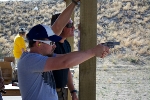
caleb and chris shooting the j-frame

At the recent Crimson Trace Midnight 3-Gun, the Crimson Trace reps had a laser equipped j-frame out on the range to shoot. The idea presumably was to shoot it at the close range targets and see the advantages of the laser on the little gun, but that was soon eclipsed by other, more…interesting goals. In the picture, courtesy Tom from My Gun Culture Chris and I are doing what we do best – competing and goofing around. On the range there was an MGM B/C steel target set out at about 70 yards, so of course we decided to see who could hit it more times double action with the j-frame. This was no mean feat, as the steel had been pretty shot up and was about the same color grey as the front sight on the little j-frame. The front sight on the j-frame was also huge, and covered the entire width of the target at 70 yards.

Undaunted by the challenges, we were able to hit the steel on command about 3 out of 5 times over multiple attempts. Shooting single action, strong hand only I was able to put together a 4 out of 5, but I’ll also readily admit that it could have just as easily been a 3/5 if I’d made the slightest error in my trigger press.

Obviously, the point of this post is to tell you how awesome Chris and I are at shooting and why it’s total bullcrap that he didn’t win Top Shot All-Stars. Just kidding. The actual point is that many people are far too willing to write off their equipment as incapable of a task, when it has nothing to do with the gear at all. Would I want to make a 70 yard shot with a j-frame under dangerous conditions? No, of course not. If I need to shoot something 70 yards away, I want a rifle.

I had a similar conversation with USPSA GM and fellow gunwriter James Tarr about why I prefer guns that will shoot around 2 inches at 25 yards. I may not ever need that level of mechanical accuracy out of a carry gun, but I like knowing it’s there. Guns with high levels of mechanical accuracy mean I can get away with a larger wobble zone or a sloppier trigger press if I’m in a hurry to get the shot off. I’m not saying that you should carry a wadcutter gun and slap the trigger, but rather that a gun that is capable will enhance your fundamentals as a shooter.

The ultimate point of all of this? Mechanically accurate guns are cool. Don’t just write off a gun as not accurate enough until you’ve spent the trigger time to really see what it can do. Shoot your j-frame at 25 yards. Push yourself to get better and push your equipment to its limits.

Mossberg MVP Patrol

Yesterday I took a look at the bolt-gun and wondered on its relevance as a self-defense tool in modern times. In that article, I mentioned that I wasn’t aware of a company that was currently producing a lightweight bolt action rifle chambered in .223 that accepted AR15 mags. To research this, I checked Savage, Remington, Ruger, and FNH’s product catalogs.

The company I neglected to check was Mossberg, and I’ll admit that’s because I have a blind spot where I tend to think of Mossberg as a shotgun maker, not a rifle company. Within about 10 minutes of the post going up, I had multiple readers comment that I needed to check out the Mossberg MVP Patrol. See, this is exactly the sort of rifle I am looking for in a bolt gun.

mvp patrol

Here are the vital stats on the Mossberg MVP Patrol:

  • Caliber: 5.56mmNATO (.223 REM.)
  • Barrel: 16.25 (threaded or un-threaded)
  • Sights: Adjustable fiber optic sights
  • Weight: 7 pounds
  • Length: 36 inchs

So, when I said I was looking for a “lightweight, handy bolt-gun” that…pretty much nails it. Things I really like about it: the fact that it comes from the factory with fixed sights and a rail for mounting an optic. You have to admit, one of these would probably be pretty cool with an Aimpoint PRO or Leupold Mark AR on it as a pig/deer gun (where legal for deer, of course). Plus, you know…30 round mags. I actually think it would be neat to take a Dynamic Defensive Carbine Operator in Operations course with one of these, because I’m interested to see if shooting a bolt gun has the same affect on my shooting as shooting a pump and wheelgun do. Namely, I slow down just a bit and my accuracy skyrockets. Knowing that I can only shoot 1 shot for every 2 or 3 that everyone else is shooting really makes me want to take the time to get my hits.

Of course, adding another gun to the long list of guns I need to review and T&E probably isn’t smart…but if I was smart, I wouldn’t do this for a living! I’ll see if we can get a gun from Mossberg to review, and then I’ll do just that – take it to a carbine course with a Leupold Mark AR. And maybe a 45 degree RMR mount for good measure.

What your IDPA Division says about you

Yesterday, I was restoring old posts that had been lost during the great and terrible hack of 2013, and I found and restored one of my all-time favorite posts, What your USPSA division says about you. This was a little tongue in cheek fun I had with the USPSA divisions, and it was quite popular back then (and seems to be popular again now). By popular request, here is the obvious follow-up piece, What your IDPA Division says about you.

Photo by Yamil Sued, courtesy IDPA

Custom Defensive Pistol
What you think it says: I am the defender of IDPA’s great tradition and history, shooting the division that the sport was originally created for. My pistol is blessed by Jeff Cooper and John Moses Browning and is the pinnacle of crastmanship and engineering.
What other people think: You know they make guns that hold more than 8 bullets, right? And firearms technology has advanced somewhat in the last hundred years.
Note on CDP: The definition above is only true if you’re shooting a 1911 in CDP, if you’re shooting a Glock/XD/M&P in CDP you’re probably doing it specifically to troll those guys.

Enhanced Service Pistol
What you think it says: Yes, I am truly the king of IDPA here in the closest thing we have to a racegun division. I will take my gear to the max, on the bleeding edge of IDPA technology while I use that technology to improve my shooting and stage times.
What other people think: That guy is shooting ESP because he’s tired of getting his s*** pushed in by Bob Vogel in SSP.

Stock Service Pistol
What you think it says: This is practical shooting at its finest. Practical guns, practical gear – a division where you can truly be competitive with your carry gun.
What other people think: “Competitive with your carry gear?” You carry an LCP in a pocket holster, but you’re shooting a Glock 34 in a Blade-Tech holster under a Woolrich vest that you literally NEVER WEAR outside of this match. Tell me another one, brah.

Enhanced Service Revolver
What you think it says: I blend old school technology and new thinking with my mastery of the art of the wheelgun. Using these moonclips, I can reload as fast as a semi-auto and compete with the “bottom-feeders.”
What other people think: Is your name Jerry? It isn’t? Okay, have fun over there with the other two guys in your division.

Stock Service Revolver
What you think it says: IDPA is the last bastion of true shooting – if a Model 19 and 158 grain LSWC was good enough for my dad on the force, then it’s good enough for me. Six for sure beats clearing malfs any day!
What other people think: Hey, there goes Sandbagger McGavin, just trying to pad his “State Championship” count by beating up on marksmen and sharpshooters in SSR again.

That’s it for IDPA! I need to shoot more 3-gun so I can do one for that, or I could just do one for all the shooting sports, like “what your shooting sport of choice says about you.” Let me know what you think in the comments.

Ancient weapons and hokey religions

Everyone in the firearms community knows the famous quote from Han Solo in the first Star Wars film about how ancient weapons and hokey religions are no match for a good blaster. In the context of the film, Han is mocking Luke’s lack of skill with the comparatively “ancient” lightsaber; Han rests comfortably in the knowledge of his own skill at arms with his pistol.

hansolo

Over my relatively short time in the firearms industry, that quote has been trotted out to jokingly show support for the following guns: revolvers, 1911s, pump-action shotguns, bolt action rifles, lever action rifles, single action revolvers, side-by-side shotguns, and archery. I’m sure you’ve probably heard it too if you’ve spent any amount of time on the internet reading about guns. Another fun Star Wars quote frequently applied to the shooting sports is Obi-Wan’s line about lightsabers being a more “elegant weapon” than blasters.

However, the Star Wars films fairly conclusively prove in the later episodes that Luke’s ancient weapon (and his hokey religion, but I’ll leave that discussion for the CaPC blog) are more than a match for good blasters and the modern technology brought to bear by the Empire. It could be argued that Luke’s training and impressive skill at arms with his lightsaber is a deciding factor in the fate of the entire galaxy. Which brings us around in a fairly roundabout way to the point of this article, which is the relevance of seemingly archaic weapon systems in this modern era, specifically bolt action rifles.

Why bolt guns? Well, when you’re looking at the relevance of modern firearms, bolt guns are the ones that for me are the hardest to justify. Pump shotguns are easy – they’re more reliable than semi-autos and can use the widest range of ammo from less-lethal all the way to magnumturboturkeyslayer rounds. Revolvers? Sure, a little slow to reload, no less relevant for civilian self-defense now than they were 100 years ago. But bolt guns perplex me, and perhaps it’s due to a lack of familiarity with the platform. I don’t have a lot of stick time behind a bolt gun, so when I look at guns like the excellent Ruger Scout Rifle, I can’t but help think “what does this do that I can’t do better with a semi-auto?” Now, I should note that we’re confining this discussion to civilian self-defense, because when you get into hunting and long range accuracy discussions, there are plenty of good reasons to get a bolt gun.

But in today’s world of 6 pound AR15s with 30 rounds of Hornady TAP on board that will shoot accurately out to 500 yards, what’s the point of the venerable bolt gun? Are they still relevant as self-defense tools in this modern age? The big problems that I see with bolt guns as self-defense tools are these:

  1. Lack of capacity
  2. Slower to operate
  3. More complex to operate

I did a little research, and there are not any major rifle manufacturers making a bolt gun in .223 that accepts standard AR mags, which would address the capacity issue pretty handily. (Editor’s note: when researching this article, we neglected to check Mossberg. Mossberg makes the MVP rifle, which is exactly what we’re looking for) For a while, Remington made their pump-action 7600 rifle in .223 for AR mags, but it didn’t sell well and was discontinued. Which actually is the crux of the issue, when you really get down to it. See, I like bolt guns, despite my general lack of trigger time on them compared to modern sporting rifles. I like the tactile sensation of operating the gun, I like the way they handle, in general they’re just nice to shoot. So if, for example Ruger took their existing M77 Tactical in .223 and changed the magazine so it would take AR mags, I’d buy one right away. I think that’s cool.

But the buying public doesn’t. Why pay $1200 for a bolt action rifle when you can pay $800 for an AR15? Honestly? I can’t think of a good reason, and that’s why I think bolt action rifles have lost their relevance as a primary civilian self-defense tool.