How can you tell if there’s a 10mm owner at the range?
Oh don’t worry, they’ll tell you.
Is concealed carry a hobby?
An interesting side discussion spun off from the “Revolvers are obsolete” post a few days ago. A couple of people noted that despite me calling revolvers obsolete, I still chose to carry one every day. Even though I know that there are other, better guns out there, I carry a J-frame.
Why then, if I state that revolvers are obsolete would I still choose to carry one? There are two reasons, and the first is directly from the title of the post. At its core, concealed carry isn’t something I need to do. I don’t know if I’d go so far as to call it a hobby, but the fact of the matter is that I don’t need to carry a gun every day. I choose to; partly because it’s my right and partly because I might need a gun. But I don’t have to carry a gun, so my personal choices become important.
I spend a lot of time talking about ideal gear, and the reason for that is because people are more likely to carry and shoot a gun that they like. Our mission here at Gun Nuts is to help people like good guns. But there is a lot of room for personal choice, because there are a lot of good guns out there. I’ll use my J-frame as an example of my point. I acquired this J-frame by trading a S&W Shield for it. The Shield is about the same size, but lighter, holds more ammo, is easier to shoot well, easier to reload, and when comparing .38 Special to 9mm fires a better round. The M&P Shield is by almost all objective measures a better gun that my 640.
But the Shield didn’t really blow my skirt up. I like carrying the 640, there is a certain je ne sais quoi about the wheelgun that the M&P Shield just doesn’t have. So I made the choice to carry the revolver because it’s still a perfectly good gun, despite not being as good as the Shield.
I can afford to do this because as noted above, concealed carry for me isn’t mandatory. I don’t have an agency telling me I must carry on and off duty, I’m simply an armed citizen making an educated choice about my personal safety and my Constitutional rights by carrying a gun. So I can afford to carry a gun that may not be optimal, because I like it more. Since I like it more, I’m more likely to actually carry it on a day to day basis than a gun that I’m just sort of “meh” about.
Carry good guns. Get good gear and good training. But don’t get too wrapped up on carrying the perfect gun. If you have a gun that’s acceptably reliable, accurate, etc, and you happen to like it more than you like the Tactiblaster 9000 that all the hotshot trainers are carrying, don’t sweat it. They don’t have to carry your gun, and you don’t have to carry theirs.
Trigger Warning
When I was first introduced to competition shooting in a class, the instructor (Todd Jarrett) taught a very specific trigger manipulation technique which we’ll call “riding the reset”. Using this technique, the shooter only allows the trigger to move as far forward as necessary to reset the gun and then proceeds to fire the next shot.
Another technique for trigger manipulation is referred to, sometimes derisively as “slapping the trigger” means that your finger comes off the trigger, even just a little bit, between shots allowing the gun to go to its full mechanical reset.
Here’s the dirty little secret: both of these techniques will work just fine. The goal of your trigger pull is simple: pull the trigger to the rear without disturbing the sights. If I’m shooting a 44 ounce Tanfoglio with light recoiling .38 Super ammo, I can get away with a lot more trigger “slap” than I can if I’m shooting a Glock in .40 S&W. It’s a bit situational. When I’m shooting Glocks I tend to ride the reset, because it has a very distinct reset point. When I’m shooting 1911s, the reset travel is fairly short, so I’ll come all the way off the trigger. Revolver shooting I get off the trigger because I can actually shoot the gun quicker that way.
This isn’t a case of right and wrong regarding trigger manipulation. Both methods work, and both are going to have situationally appropriate applications. Sometimes it depends on the gun you’re using, sometime it depends on the target you’re shooting. You don’t need fine tuned trigger control to hit a 3 yard wide open IPSC target, so you can slap that thing pretty aggressively on short range squirter targets.
The important thing to remember about this is the goal of the trigger press as stated above should be to not disturb the sights. But we have to remember that some disturbance of the Force sights is acceptable, again depending on the target. I’m going to allow a lot more sight disturbance shooting close range IDPA targets than I am shooting Bianchi Cup. I’m going to allow more sight wobble shooting a 10 yard stage at the Cup than I am a 50 yard PPC stage. Situational trigger pulls and sight pictures are important things to learn, especially for action shooters. There will be times during an IDPA stage where you’ll want to change the amount of front sight focus and trigger manipulation from target to target.
Of course, what’s really important about all of this trigger talk is that you’ll need to practice. I will say that if I had to pick one method for a beginner shooter, I’d say ride the reset. It worked well enough for me when I was starting out, and it’s something you can easily train in dry fire. It’s also more universally applicable, as you can ride the reset and get quick shots. The downside to riding the reset is that you’re more likely to get trigger freeze when you’re shooting rapid multiples on a single target. But train train train is the solution to that problem.
So whether you slap the trigger or ride the reset, the moral of the story is that you should probably spend a lot of time practicing your trigger pull. It’s one of the fundamentals of marksmanship you can never be too good at.
Photo of the day: Tower of Glocks
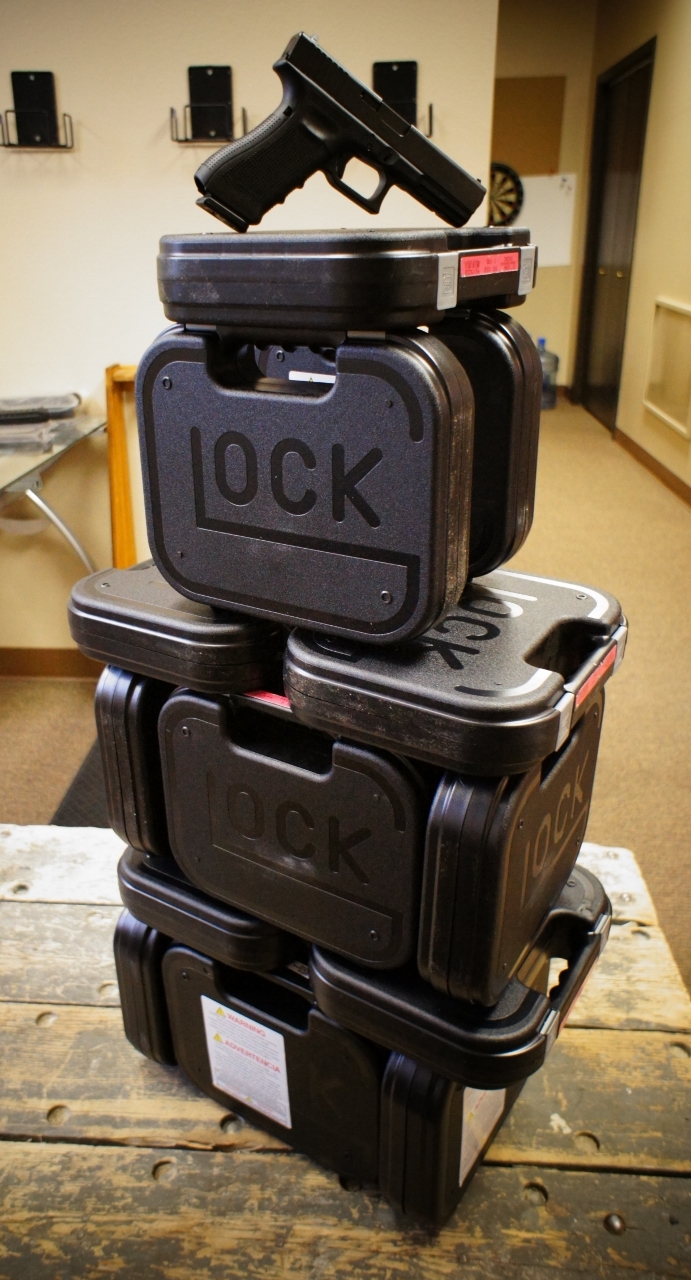
GunUp Gun Shop just became a Glock Stocking Dealer. And they’ve got the tower to prove it!
Representing gun owners
Quite a few people have taken umbrage at the 10 Steps for Successful Open Carry post I wrote last week; while many of the upset persons are the typical sort who just read enough to get offended, there are a few that have raised a point I believe is critical to address, and indeed I’ve touched on before.
In the post, I recommend that if you’re going to OC, you should “dress like a grown-up”, which is slang for dress nicely. Wear clean clothes, no flip-flops, a shirt with a collar, comb your hair and trim your beard. Ideally, you want to look like Bob from accounting. The reason for this is because whether or not you like, when you OC you are representing all gun owners. This is something that many OC advocates don’t understand, because they’re inside the movement. When you’re a part of a sub-culture, it’s very difficult to recognize how outsiders perceive you. For example, car enthusiasts. I prefer muscle cars, specifically the Dodge/Mopar line of cars, both classic and modern. There are car enthusiasts who prefer Italian super-cars, Ford muscle cars, etc etc. The variations are endless. To people not part of that sub-culture, they’re all just “car guys”.
The same is true of the gun culture – just because as an OC advocate you believe you’re only representing yourself, that’s just not true. When you’re out OC’ing, you’re representing all gun owners simply by the fact that you are very clearly a gun owner as evidenced by the gun that you’re openly carrying.
This is why we hit on attitude and appearance. You may think I’m elitist, but I don’t want a public representative of gun owners to be a sloppy-looking dude that goes around causing a scene with the cops. I just don’t.
No one is saying that OC should be illegal; in fact Open Carry should be legal in all 50 states. But until it is, if you are going to Open Carry, remember that you’re not just representing yourself out there. You’re an ambassador for all gun rights every time you OC, and it benefits us all if you’re a good ambassador. If you’re uncomfortable with that responsibility, maybe Open Carry isn’t for you.
Blackhawk CQC Leather Tuckable Holster review
The “box full of holsters” is a common meme among gun nuts; everyone who conceal carries on a regular basis seems to have filled a box full of holsters that they’ve bought that just didn’t work out for one reason or another. If you carry in the appendix position, it’s even worse. Holsters for appendix carry are very sensitive to body shape and gun location; so finding a good holster for AIWB can result in a lot of discarded kydex and leather in your closet.
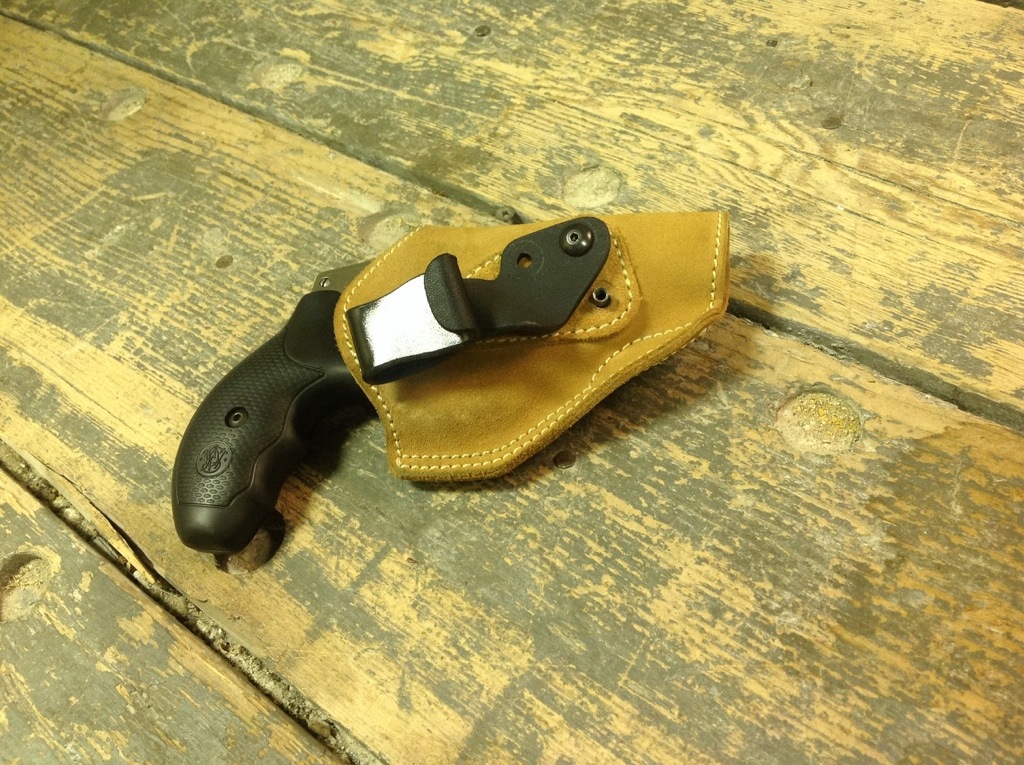
I’ve been searching for a good solution to carry my Smith & Wesson 640 Pro Series at the appendix position for a while now. I had tried several options, none of which were really satisfactory for my needs. Some options carried the gun too low, others didn’t retain the gun as well as I’d like, etc. I tried the Blackhawk CQC Leather Tuckable with the hooks that it comes with, and I had found it wanting. However, I liked the holster, I liked that the leather didn’t poke into my thigh like some kydex holsters do, so I wanted to stick with it. I tried removing the hooks entirely and relying on belt pressure to keep it in place; that worked if I wasn’t going to do anything more strenuous than walk, but wasn’t acceptable for EDC use.
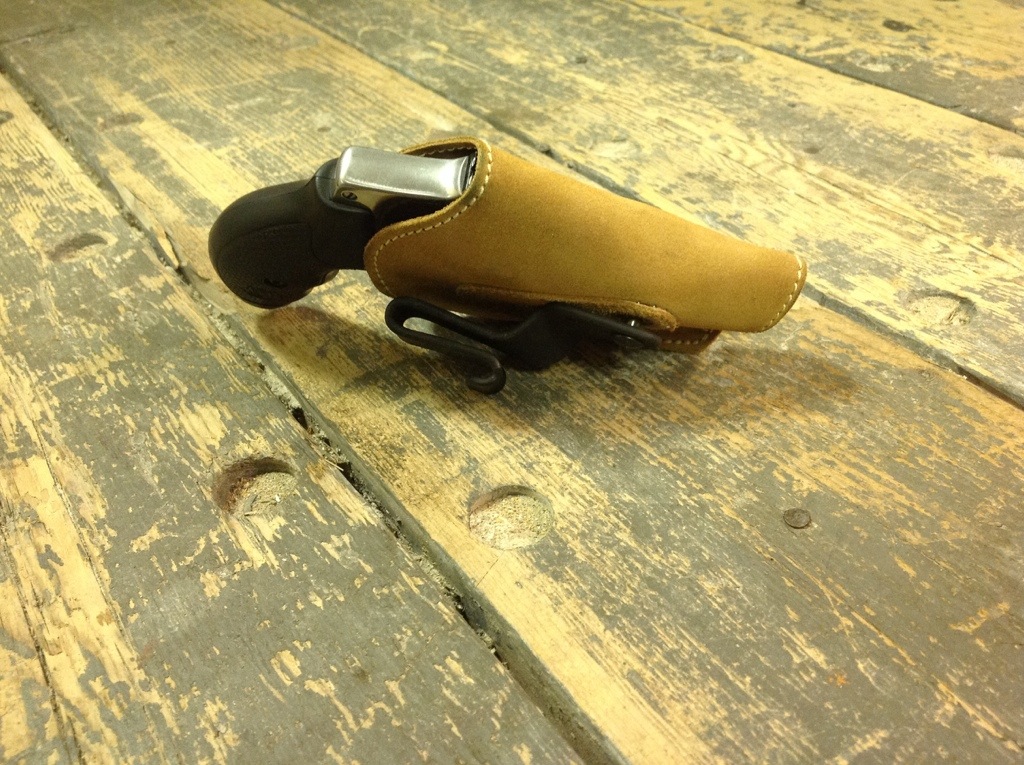
Then I had an idea. I took the j-hook off one of my Comp-Tac holsters and screwed it on to the Blackhawk using a single attachment point. It now works really well. With the j-hook attachment instead of the factory clips, the holster holds the gun high enough that I can get a full firing grip without fishing around for the gun; it’s still concealable under the most extra-smedium of t-shirts, and the leather of the holster doesn’t poke me in an uncomfortable way.
It’s not without some shortcomings, though. The mouth of the holster isn’t reinforced, so you cannot holster one handed. This isn’t a training holster, it’s much more of a deep concealment rig. I treat it similarly to how Raven Concealment recommends you use their Vanguard – remove the “holster” from your belt, put the gun back in the holster, then re-attach it to your belt. That’s probably the biggest issue I have with it as a holster, but I’m also not planning on taking this to any serious training classes.
The Blackhawk CQC Leather Tuckable holster is actually a pretty good little holster; while the factory clips left something to be desired, they’re easy enough to replace with something that works better. Once you do that, you have an excellent, comfortable, deep concealment holster.
Affordable Care is Actually Gun Control

I come from a generation of kids who see no shame in visiting a mental health professional when life gets a bit overwhelming. When I was young, and my father passed away, I went to a phsychiatrist for a while, and there’s nothing embarrassing about it. If you’re in your early 30s-late 20s and you haven’t struggled with the dilemma if whether popping an Adderall might help you get work done, or help your child do better in school (well lucky you) but, pardon me, you’ve been living under a rock!
Photo of the day: Get Low
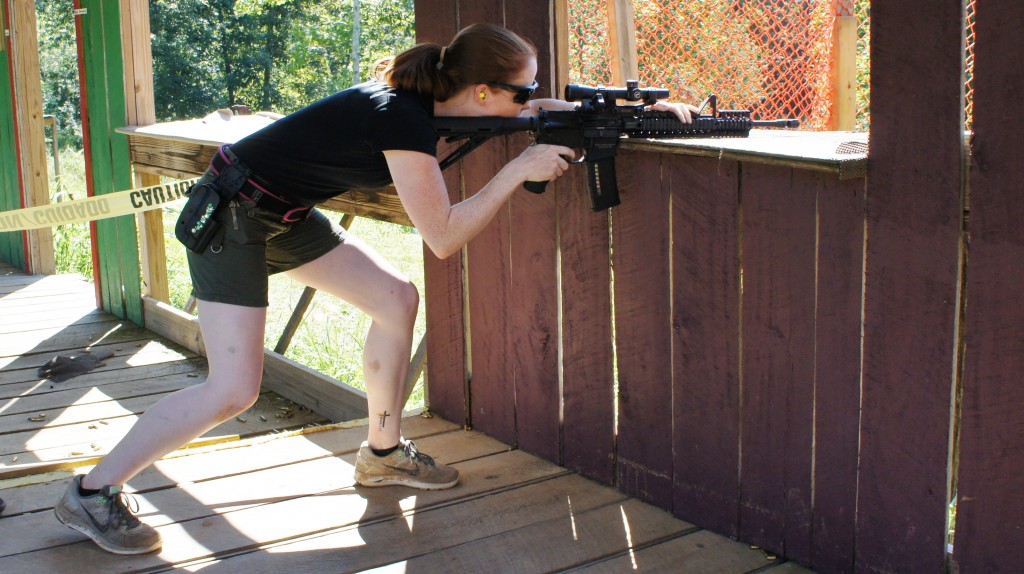
GunUp the Magazine‘s editor Shelley Rae gets low at Rockcastle and blasts some rifle targets.
Revolvers are obsolete
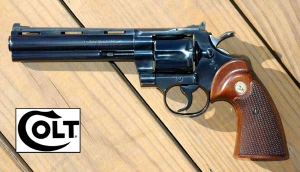
I really like revolvers. I like shooting them, I like carrying them, and I enjoy working on them. I also know that for modern self-defense, they’re obsolete. That doesn’t mean that they can’t play a role in self-defense, but there’s just nothing a wheelgun can do for general self-defense that can’t be done better with a semi-auto pistol. Please, spare me the “but what if I need to shoot a bear” comments, because you all know that’s not what I’m talking about. Wheelguns still rule the roost for hunting and backwoods use. This post is about the self-defense needs of the average person.

Strike 1: Revolvers are harder to shoot well
The trigger on my competition revolver is about 9 pounds, and it’s very smooth. It is still harder to shoot that gun well compared to a bone stock Sig P226 or Glock 34. Both of which are smaller and weigh less than a GP100 or an L-frame Smith & Wesson. “But Caleb, what about K-frames?” Fine, your average K-frame is going to have a worse trigger and be harder to shoot well than a Glock 19 or an M&P.
The most common revolver for concealed carry are Ruger LCRs and Smith & Wesson J-frames. I have a J-frame on me right now as I’m writing this. It’s an all-steel Model 640 Pro Series, which in my opinion is the best example of J-frame ever made thanks to its chamfered cylinder, good trigger, and quality sights. It weighs 1 pound 8.9 ounces fully loaded. A Glock 19 is about the same size and weighs 1 pound, 13.5 ounces fully loaded. It also has a better trigger, and holds quite literally three times the ammo that my J-frame holds.
Strike 2: They’re not actually simpler than modern handguns
To load and fire my J-frame, I have to follow these steps:
1. Insert cartridges into cylinder (either with a speedloader, a speed strip, or one at a time)
2. Close cylinder
3. Pull trigger.
To load and fire a Glock 19, I have to follow these steps:
1. Load rounds into magazine (either by hand or using a mag speedloader)
2. Insert magazine into gun
3. Close/rack slide
4. Pull trigger
There’s only one extra step, and that step is “loading the magazine”. If the mag is already loaded, learning to fire a modern striker fired pistol takes exactly three steps. Semi-autos are even easier when you have to deal with reloading. Here are the reloading processes for both types of guns:
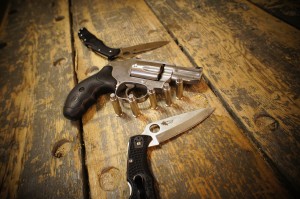
Revolver:
1. You either count five or six shots (depending on the gun) or you get a click when you’re expecting a bang to tell you the gun is empty.
2. Open the cylinder
3. Firmly push the ejector rod to clear all empty cases from the gun
4. Insert new rounds into the gun, either with a speedloader, a speed-strip, or singly by hand.
5. Close the cylinder
6. Pull the trigger.
Semi-auto
1. Slide visually locks to the rear telling you you’re out of ammo
2. Push a button to make the naughty mag go away
3. Put a happy magazine in the gun
4. Push another button to chamber a round
5. Pull the trigger.
There is less to do with a semi-auto, and I can tell you from personal experience, a lot less to go wrong during a reload with a modern semi-automatic pistol than there is with a revolver. I could describe a litany of little things that could go wrong during a revolver reload, but it would be so James May-esque in style that you’d all fall asleep.
Strike 3: They’re not actually more reliable
Ammo is the number 1 cause of failures in modern semi-auto pistols. Ammo is also the number 1 cause of failures in revolvers. And while yes, a light primer hit in a revolver can be solved by pulling the trigger again, it’s not like a tap-rack is magical sorcery that only be performed by Gun-Jedis of the highest order.
Gun Nuts Bottom Line: Revolvers are great, and I love them. I carry one every day and feel perfectly adequately armed with it. I also know that there are better, more modern choices out there for self defense. A new shooter would be much better suited with a Glock 19 or M&P than a revolver. If you think that semi-autos are “too complicated” for new shooters, than you need to re-examine your biases and stop treating people like they’re idiots. Most people can successfully operate a smartphone and drive a car, both of which are more complicated than a Glock.
Bill Wilson and Ken Hackathorn talk 1911’s
I grew up reading gun magazines, which means that my formative years were plastered with gun magazine layouts featuring 1911 pistols that, frankly, bordered on pornographic. I learned to revere the name Armand Swenson and my dreams were filled with visions of squared trigger guards and Pachmayr Combat Specials. I read about 1911’s in magazines and books, drooled over them in gunstores, and even bought video tapes about the 1911. For you dang kids who should be getting off my lawn, the term “video tape” describes a plastic cartridge that contains an actual form of tape on which video has been imprinted. They were played in devices called a “VCR” and you can probably go see an example of one in a run-down retail store security system or in the living room of a hipster who is interested in watching E.T. “ironically” while they sip their cruelty free, fair trade latte.
Anyhoo, one of the video tapes I bought many moons ago was one that featured Bill Wilson (founder of Wilson Combat) and Ken Hackathorn talking about what goes into making a good custom 1911. It was like a rosetta stone for the person who wanted to wade into the mysterious world of the 1911. My copy of that tape gave up the ghost quite some time ago, but the other day I went to youtube and lo and behold:
Yes, it’s two hours long…but if you have an interest in the 1911 pistol it’s two hours well spent. Bill and Ken are both experts on the 1911 pattern pistol and even though the video is from 1997 the information in it is as relevant today as it was then. If you want to know what exactly sets a good custom or semi-custom 1911 apart from something sitting on the shelf for $450 bucks, you’ll see it. You will see the gunsmiths at Wilson Combat (most of whom still work for WC today) actually performing various tasks like a trigger job, fitting a grip safety, beveling a mag well, and fitting a slide to a frame.
It’s unbelievably cool stuff and after watching the video I’m overcome with the urge to build a 1911 at home and maybe call up Wilson Combat and spend a ridiculous amount of money on a completely impractical gun that would make absolutely no sense but that I would doubtless love and adore with the fervor a sane person reserves only for their spouse or children. My fellow 1911 peeps get what I’m speaking, here. Few objects on earth are as satisfying to pick up and ogle as a really well done 1911, and the more you know about how they are made the more you come to revere the dark art of taking high quality steel and carefully shaping it into an object of lethal beauty.
Now that I think about it, Gun Nuts could probably use a long term review of a high-end custom 1911 pistol. You go ahead and watch the video. I’ve got to go sell Caleb on giving me a bunch of money for a 1911 send Caleb an email about an idea for a series.