Airline self-defese: what would you do?

A Florida news station reports on the possibility of terrorist practice runs on DC/Orlando flights. The particulars are kind of weird when presented out of context:

Crew members say that shortly after takeoff, a group of four “Middle Eastern” men caused a commotion.

The witnesses claim one of the men ran from his seat in coach, toward the flight deck door. He made a hard left and entered the forward bathroom “for a considerable length of time.”

While he was in there, the other three men proceeded to move about the cabin, changing seats, opening overhead bins, and “generally making a scene.” They appeared to be trying to occupy and distract the flight attendants.

So, put yourself in the scenario. You’re sitting in your seat, finally got settled in, when suddenly your Sheepdog Awareness Sensor goes off, and you see a brown dude charging toward the cockpit door. Do you A) do nothing, because the dude probably has to hit the head super bad, B) casually trip him because you’re sitting in the aisle like a good Sheepbro, C ) Let him continue but prepare yourself for a fight if things go pear shaped, or D) Go back to your book because the dude clearly needs to use the can.

Now, it’s fairly easy to construct a hypothetical situation where no matter which of the four options you pick it turns out to be wrong, but I’m not interested in creating hypothetical traps. Rather, I’d like you to think about what you can actually do on airplanes. My job means I spend a decent amount of time on commercial aircraft every year, this year I’ll bump a solid 50,000 flight miles. I actually had an incident on a recent flight overseas where a chap of Middle Eastern origin got up, starting making a ruckus and opening overhead bins to the point that the flight attendants had to sort of bump corral him back to his seat. Do I think he was a terrorist? No, I’m pretty sure he was just a rude jerk with very poor manners.

All of this travel time has let me put together a list of a few things that I do to help enhance my personal safety when I’m traveling on commercial airlines. Here are a few tips on airline self-defense that I use.

1. Sit in aisle seats.
If something bad happens, you’re going to need to move. If you’re sitting behind 400 pounds of people in the middle and aisle seats, it’s going to be hard to accomplish anything.

2. Wear pants that stay on without a belt…and wear a belt.
Belts are handy weapons. A bit of leather wrapped around your hand will allow you to deliver a full-force punch to the head and greatly reduce the risk of shattering bones in your hand. This does assume you know how to deliver a proper punch. Even then, a heavy metal belt buckle makes for a reasonable impact weapon in a pinch.

3. Keep the area around your feet clear.
I don’t put a bag under the seat in front of me; primarily because at 5’6 I don’t take up a lot of space anyway so if I keep the under-seat area in front of me clear, I can damn near recline in Economy Plus. It’s quite relaxing. It also means that if I have to get up in a hurry, I’m not going to trip over my laptop bag shoulder strap and faceplant into the lady sitting across the aisle from me.

4. Relax
You’re in a metal tube at 35,000 feet in the air flying over mountains/ocean/farmland. If something truly bad happens, there isn’t going to be much you can do about it. Be ready for what you can do, know your limitations, and enjoy the latest copy of GunUp the Magazine on your iPad.

We spend a lot of time worrying about self-defense and the potential of bad stuff happening. I think it’s just as important to relax and enjoy life as well. I know my capabilities, physically and mentally. In the situation I described above, there were FAMs on the flight that intervened and dealt with the issue. For my part, I probably would have noticed the guys moving around, thought they were jerks, and probably done nothing since they weren’t actually doing anything illegal or dangerous. The real conclusion of this post is something I’ve talked about a lot: know where your lines are. Know what behaviors you’re willing to tolerate and what you won’t; create mental plans for whatever environments you spend a lot of time in.

Make your plans now, because when the moment comes, it will be too late to plan.
Handguns vs. long-guns for home defense

We’ve talked Rifles vs. Shotguns for home defense, and now it’s time to take a look at the other end of the spectrum: handguns. Specifically, if you can only afford one gun, a long gun or a handgun for home defense, which should you chose? Well, like everything, the answer is “it depends.”

Handgun Pros
Picking a handgun for home defense makes a lot of sense. It’s easier to maneuver in close quarters than a long gun, you can effectively fire it with one hand in case you need to do something important with your other hand, like shelter a child, open a door, or use a flashlight. Most modern service handguns readily accept weapon mounted lights and lasers, which make hitting stuff in low/no light a lot easier. They’re light, and easier to secure from curious children than a rifle or shotgun. A home defense handgun can be carried on the body all day and then put in a quick access safe at night.

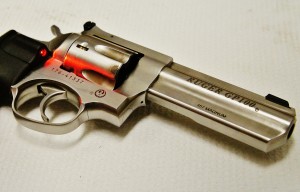
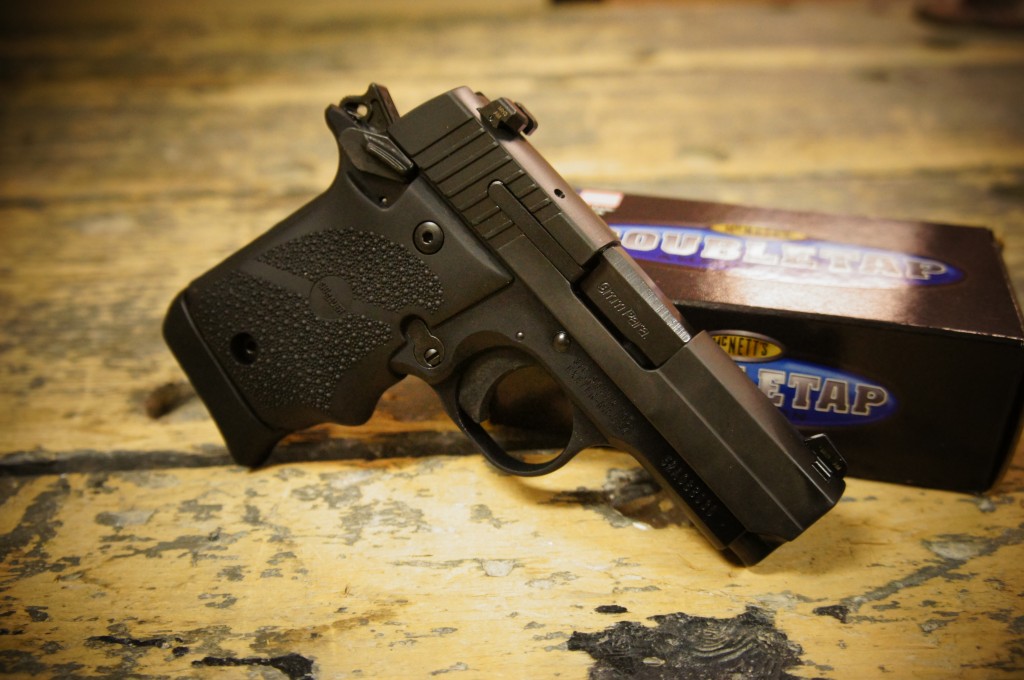
Ruger GP100 Lasergrip

Handgun cons
The cons of a handgun are that all handgun rounds suck at stopping fights. Rifles and shotguns are much more effective at ending people who are intent on doing bad stuff. If you live on a farm or a ranch, a handgun might not have the reach or puissance necessary to effectively solve the problem, especially if you’re more likely to deal with four-legged intruders. Pistols are harder to shoot well than rifles and shotguns, requiring more skill and practice to master. An AR15 with an Aimpoint on it is about as simple a shooting tool as you can imagine.

A lot of this is going to depend on your personal situation. For example, if you’re a single adult living alone, your home defense strategy could quite reasonably be “shelter in place while calling 911”, for which a rifle or shotgun makes perfect sense. Hunker down, call the po-po, and shoot anything that comes through the bedroom door that isn’t a good guy.

shoot-it-double-action-cover-200x200

However, if your HD plan involves getting family members and moving them to a safe room, it makes a lot of sense to use a handgun. The big reason for this is the freedom to use that other hand to do stuff. I like weapon mounted lights on long guns, but on handguns there is frequently the temptation to use the gun as a flashlight, which is not a good idea. Doing that and you end up pointing the gun at lots of stuff that you don’t want to point a gun at. Using a handgun means you can use a flashlight with your free hand giving you flexible illumination, and you can still open doors and grab stuff with your light hand.

Again, every person’s home defense situation is going to be very situational. What works for me may not be your best solution, which is why I encourage everyone to take a realistic look at your needs. Perhaps your best bet is a handgun for moving through your house to secure family in a safe room, and then a long gun once you’re at the safe room. However, the Gun Nuts Bottom line is this: whatever your home defense plan is, practice it. If you have fire drills with your kids, you should have “badguy emergencies” or whatever you want to call it. If you live by yourself or with another adult, make sure everyone knows their role if the balloon goes up at 2am.

Competence vs. Excellence – Round 2

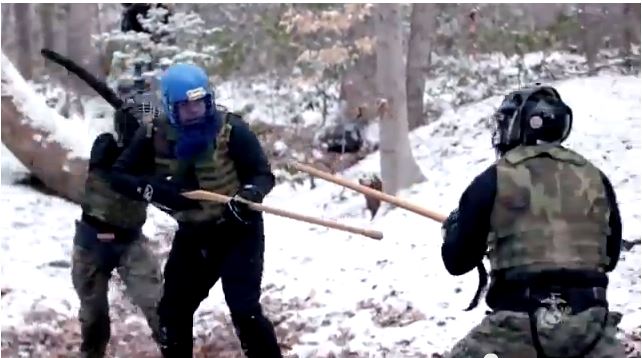
I threw out a lot of words trying to quantify the concepts of competence and excellence in last week’s post, but this week thanks to the joys of the internet I stumbled across a very visual representation of what I was trying to capture. At some point in the relatively recent past the UFC took a few of their fighters to Quantico so they could get a taste of the Marine Corps Martial Arts program. Most fighters at the UFC level are skilled in Greco-Roman wrestling, Mui Thai, and Brazilian Ju-Jitsu and have invested a great deal of time and effort training in techniques and working against training partners to ingrain skill under stress. They also have experience fighting in professional bouts, which is a pretty stressful endeavor.

The average person might think they’d handle the USMC’s Martial Arts program easily…but as the video shows, it’s not quite that simple.

As I mentioned last week, for someone to be useful in the field they have to be competent in a number of different areas. Even if we confine the conversation to just close quarters combat, there are a number of different competencies that the individual is likely to need. A professional MMA fighter is very skilled in some areas that would be useful in close quarters combat, but training to be an MMA champion does not factor in multiple opponents or the involvement of weapons. As good as some MMA/BJJ programs are, and as useful as the skills they teach may be in an actual fight, they don’t often really deal with multiple, armed, opponents or the use of whatever weapons you may be carrying to successfully defend yourself.

This is one reason why the Shivworks Extreme Close Quarters Concepts course is regarded so highly by just about anyone worth listening to, and why so many who have been through the ECQC program come back to the course over and over again. It’s heavily influenced by MMA skills, but those skills are put into a realistic self defense context that involves weapons and multiple opponents. The Marine Corps Martial Arts program does the same, dealing with the combat environment rather than the competition environment.

The context you train in, and the end state you are training for, matters. Even though every one of the UFC fighters in that video is probably more skilled than most you will meet in any gym or dojo in the country, when handed a weapon they’ve never used before and told to deal with multiple skilled attackers they were kind of at a loss on what to do.

A very skilled fighter positions himself poorly and is about to get taken out of the fight before he's landed a single blow.
A very skilled fighter positions himself poorly and is about to get taken out of the fight before he’s landed a single blow.

Lacking any other plan or preparation for this sort of confrontation, a legit black-belt in Brazilian Ju-Jitsu who has knocked out some big names in the MMA world picked one guy and went after him. In doing so he stepped directly in the middle of two armed threats, turning his back completely to one and was basically taken out before he even makes an offensive move. I can sympathize because in a moment of stupidity during ECQC I put myself in between two hostiles and ended up taken down, having my gun taken away, and then getting shot in the groin for the umpteenth time that weekend. If you’re going to take on multiple attackers at close range, it turns out your footwork and positioning matters. A lot. That’s a lesson you generally don’t learn until you find yourself on the wrong end of a beating…preferably in training.

On an individual level without the involvement of weapons, I have absolutely no doubt that Mr. Gonzaga would have probably defeated most/all the Marine instructors…but outside that context, in the environment where the Marine instructor cadre lives and works every day using the wide range of competencies they’ve forged over many hours of training, Mr. Gonzaga’s excellence in striking and grappling couldn’t really come into play. If you watch the video closely you’ll notice that some of the instructors are sporting cauliflower ear, showing that they’re probably enthusiasts who spend their personal time working on the stuff that Mr. Gonzaga is an expert at.I don’t encourage picking fights with anybody, but it would be an especially bad idea against big Marines with cauliflower ear and a red tab on their belt.


When I look around at the gun world, I notice that we are tempted to imagine the problem we’re going to face favors us…that it will fall in line with the things we’re good at. This is especially true if we invest considerable time and effort developing a narrow set of skills to the level of excellence. Having a fast draw time or reload time or being able to shoot one hole groups at 40 yards with a pistol are not bad things in and of themselves, and all those skills would certainly come in real handy if it came down to needing to pull the trigger to save your life or the life of a loved one. But if you get taken out because you made a gross error in tactics at the beginning…


The other half of the competence vs. excellence conversation is defining those things at which we need to be competent versus those things at which we want to be excellent. In military or law enforcement units there’s no guess work because you’re told what you will be competent at. For the individual who has never been or is no longer attached to such a unit there’s a good bit of figuring to do all based on your lifestyle and circumstances. Doing a bit of familiarization in a number of different areas would be a good first move. Take a first aid class. Go shoot your first competition or try a set of standards to do a hard assessment of your pistol skills. Take ECQC or go to the local gym and see where your unarmed skills are at. You don’t have to become an expert at everything, but maybe adding a few competencies to your toolbox could come in handy.

10 Steps for Successful Open Carry Activism

With Open Carry still making headlines, it’s time to take a look at how Open Carry can be successfully used as a tool to further gun rights. There are definitely right ways and wrong ways to Open Carry, and unfortunately too many people do it the wrong way. Here is the Gun Nuts Guide to Successful Open Carry.

1. Don’t be a dick
Honestly, if you can accomplish step 1, you’re way ahead of the power curve. We lost Starbucks specifically because people were being dicks. If you have to ask yourself “is action X being a dick?” then the answer is probably yes and you should not do it. Don’t provoke confrontations, don’t get up in people’s faces, and don’t give the cops a reason to think you’re a clown.

2. Have a goal beyond “just open carrying”
Open Carry worked in Virginia because the VCDL used it as a tool to illustrate the silliness of Virginia’s restaurant carry laws. Open carry in this case was a means to an end, not an end in itself. Open carry will probably work in Florida because Florida Carry is using OC as a tool to illustrate the silliness of Florida’s carry law. They have a goal beyond “just open carrying.” OC didn’t work in California because there was no legitimate political goal that could be achieved by the use of open carry.

3. Don’t go looking for trouble
This goes hand in hand with number 1, but is a category all by itself because of the number of people who saddle up and OC guns specifically so they can record themselves getting in confrontations with the police. Then they post on their OC message board about how they got hassled by The Man. Seriously, don’t be that guy. Just don’t.

4. Dress like a grown-up
If you are going to OC, people are going to see your gun and by default you will be considered representative of the gun culture.

Glock 21 Open Carry Wal-Mart (600x800)

The photo, sourced from USA Carry via a simple google search is a perfect example of everything that’s wrong with OC appearance. I don’t know this guy from Adam, and I’m sure here’s a really nice dude in real life, but if you’re going to OC, don’t wear a ratty tank-top.

5. Get some gun retention training
Cops open carry every day. Cops are also trained to defend themselves from gun grabs. Be prudent. Get training.

6. Use a retention holster
Cops also use retention holsters. The Safariland ALS is $40 and is one of the best retention holsters on the planet. Its retention mechanism is a huge step up over a thumb-break of the push button on a SERPA, but even the SERPA is preferable to carrying in a non-retention holster openly.

7. Don’t proselytize people.
The goal of smart OC shouldn’t be the act of OC’ing itself. It should be part of a greater goal, as mentioned above. With that in mind, don’t be the 2nd Amendment equivalent of an annoying street preacher who goes around bible-thumbing people. That guy is annoying, and no one likes him. The best memory that Joe and Jane average can have of you when you’re open carrying is “what a nice and reasonable person”; people don’t get that memory when you’re trying to “educate them about the 2nd Amendment.”

8. Just go about your business
I have to give some props here to the guy pictured in the photo. Other than his attire, he’s doing an excellent job at OC, because according to the thread he’s simply carrying his gun as a part of his normal activities. He’s not carrying a long gun into Starbucks to make a point, he’s not parading around in public parks yelling “LOOK AT MY GLOCK” to the local LEOs, he’s just grocery shopping. That’s awesome. But seriously, buy a shirt with sleeves and a collar.

9. Be polite to the police
In general, the average rank and file beat cop is neutral or even friendly to the gun issue. So when the police get called on you, don’t be that guy who refuses to show ID and only ask “am I being detained?” That guy is a jerk. Those cops have a lot better things to do than deal with some obstinate OC clown, so when the police come, be nice. 99% of the time that will result in a positive encounter. The 1% of the time where it doesn’t, you were the nice guy and didn’t cause problems, so you’ll be okay in the long run.

And finally we come to 10. Don’t be a dick
This is so important it needs to be said twice. Many of the points here are directly related to not being a dick. Remember, when you OC you’re not just representing yourself and other OC advocates, but to the general public you’re representing gun owners as a whole. Be a good representative.

Handgun over-penetration

Stop me if you’ve heard this one: “You shouldn’t use projectile XYZ because it will punch through the badguy and kill a bystander behind him.” It’s a common saw of gunshop logic, and yet you’d be hard pressed to find a verified report of it actually happening. Even in cases where projectiles exit the target human entirely, good luck finding an instance where a handgun bullet passed through a person and killed a bystander behind them outside of Indiana Jones. So is this all Hollywood myth, or is there a kernel of truth to old gunshop saying?

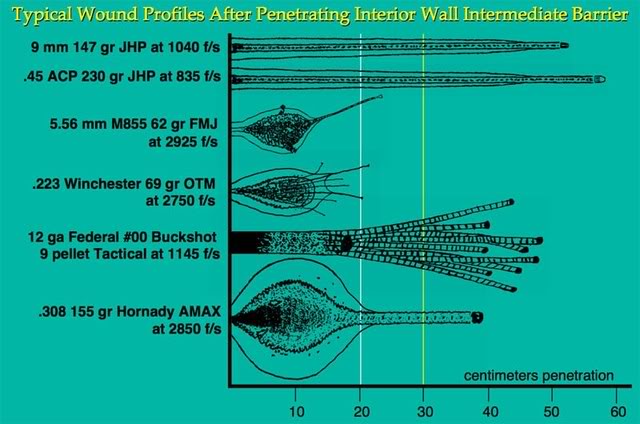
wound patterns after defeating a wall

Well, as it turns out there have been documented incidents in the late 80s and early 90s of people getting killed by bullets that had passed through another person. When reporting on these incidents, you have to bear in mind that the bullet technology of the time wasn’t nearly as advanced as it is today, and a JHP round of that era could be easily plugged by heavy clothing. This would result in it acting like an FMJ round, which means more penetration.

Yet even then, incidents of fatalities caused by over-penetrating bullets are extremely rare. It’s just not something that happens a lot, and there are two good reasons for that. The first reason is that shootings are statistically rare, despite what the anti-gun lobby would have you believe. People just aren’t getting lit up all the time, and when gunfire is exchanged it is frequently done in places without a lot of “other people” standing around gawking. There’s a low probability of getting into a shooting, and an even lower probability of getting into a shooting in a really crowded place. The math just isn’t in favor of overpenetration injuries.

The second reason is also important – the human body is an amazingly resilient structure. Combine that with the relative lack of power that handgun bullets deliver to their target, and “shoot-throughs” that have enough energy left to hurt another person become even more rare. Perhaps if you’re talking about rounds through extremities that don’t contact bone, sure. But good hits in the upper thoracic area? Those would have to penetrate the sternum, a bunch of internal organs, and then come out back through the ribs or spinal column, all while maintaining enough energy to wound another person. That’s…highly unlikely.

The Gun Nuts Bottom Line: While there is some concern of overpenetration with a handgun cartridge, your primary concern should be that your defensive round of choice will have sufficient penetration to reach vital organs and cause incapacitating blood loss in an attacker.