The Indiana 2nd Amendment March is tomorrow!
Additionally, if you want to really upset a hippy, come to Atlanta Conservation Club in the morning and shoot our monthly Steel Challenge match – shooting and protesting, can it get more American?
The Indiana 2nd Amendment March is tomorrow!
Additionally, if you want to really upset a hippy, come to Atlanta Conservation Club in the morning and shoot our monthly Steel Challenge match – shooting and protesting, can it get more American?
Yesterday evening I had the opportunity to take a trip back in time to a marvel of Victorian era engineering. Yes, I took the side plate off not one, but two of my Smith & Wesson revolvers.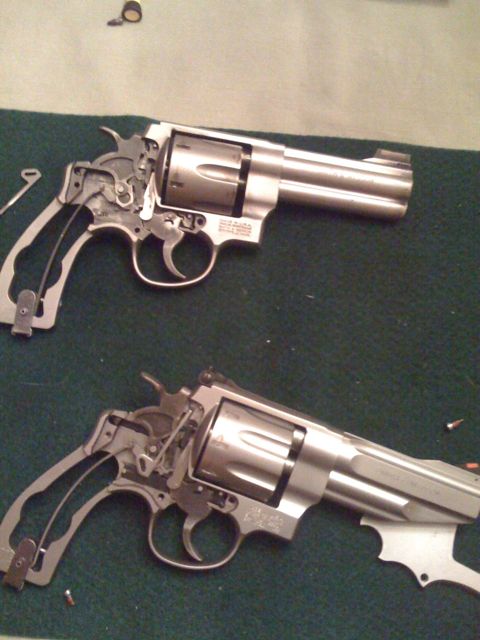
I had ordered a Power Rib spring kit from Brownells and to install it the side plate has to come off the gun. So off I went with my screwdrivers, YouTube instructional videos, and a bottle of Wild Turkey. The first thing I noticed was that the side plate was actually kind of difficult to get off the gun – I removed all the screws with no problem, but then I was sitting there and the side plate just didn’t pop off in my hand like I expected it to. The internet said “tap” the frame of the gun and the vibration will get the side plate out. It was more like “vigorously whack the crap” out of the grip frame, but that’s the internet for you.
In my fascination with the Victorian engineering, I turned the gun towards me, causing the hammer block to fall out – you can see it installed in the 627 on the right, and the one from my 625 just sitting there on the gun rug, mocking me. Once I figured out exactly what it was and how it worked, getting it back to where it was supposed to be wasn’t a problem, until I had to put the side plate back on.
But that’s getting ahead of myself. The goal of the mission was to install a Brownells Reduced Power Mainspring to take some of the weight off the double action trigger pull. That was actually shockingly easy. Loosen the strain screw and the mainspring will basically fall right out of the gun. Swap in the Brownells spring, tighten up the strain screw, and you’re done – assuming that you don’t want to replace the rebound slide spring. I opted to leave the factory rebound spring, as I want the gun to reset as fast as possible when I’m shooting for speed – the worst thing you can do to a DA revolver in a match is short stroke the trigger.
With the new mainspring successfully installed, I then had the fun and entertaining task of putting the side plate BACK on the gun. The 625 was a lot easier than the 627, which incurred much cursing, tapping, and eventually beating the frame like it owed me money. Clearly, I’m not destined to work as a gunsmith.
All that being said, the instructional videos from Brownells and MidwayUSA were surprisingly helpful. I’m leery of “lurn 2 gunsmif online!” videos, but for something as simple as a spring swap it seems I can muster up the necessary skills to get the side plate off and then eventually back on my gun.
Prior to installing the reduced power mainspring, the double action trigger pull on my 625 was too high for me to measure on my simple spring loaded trigger pull gauge, I’d estimate it around 12 pounds. After the new spring was installed, the new trigger pull weight breaks consistently around 7.5 pounds. The difference is incredible in the speed with with I can manipulate the trigger – when compared to my un-modified 686SSR, the trigger on the 625 feels silky smooth and absurdly fast. I can’t wait to get this out to the range!
Some people race cars for fun. Some people ski. Others jump out of perfectly good airplanes. And some people, people like me, race with guns. The common element that ties all these together is speed – in racing, action shooting, and many other pursuits you’ll find the purest pursuit of speed – in these sports the goal is to simply go faster than the other guy. There is no more pure a contest of athleticism than to stand next to another person and see who is faster; our fascination with speed is such that we extend that machinery, racing everything we can get our hands on, and it’s truly glorious.
Some people don’t get speed. They don’t see a stretch of open road behind the wheel of a fast car and think “I wonder how fast I can get this up to”; looking down a huge hill on a bicycle doesn’t fill them with anticipation; the words “shooter ready” don’t make their stomach twist with adrenaline. That’s okay, because speed isn’t everyone’s thing. But for the people that get it, that understand – going fast for no other reason than you can is a pure sort of joy rarely experienced.
Things I do not get: people shooting small revolvers such as Smith & Wesson J-frames or the Taurus CIA in single action mode. If you’re shooting a large hunting revolver in serious caliber that’s one thing, but the whole point of small framed revolvers is that they’re a fighting weapon. Honestly, I feel like shooting your J-frame single action is doing nothing but teaching bad habits – if you need to use that gun in a fight and all you’ve done at the range is shoot average groups in single action mode then when the time comes you’re not going to have the range time to properly manage the DA trigger under stress.
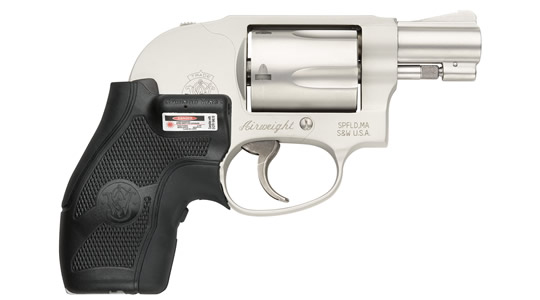 That’s why I’m a proponent of double action only revolvers for personal defense, like the Smith & Wesson 638CT model pictured. If you buy a revolver that is double action only, there is no temptation to shoot it in single action mode at the range for practice time. We’ve talked before about how no one likes to practice things that they’re not good at, and that’s true for any shooter. That’s why when you’re at the range and struggling with the double action trigger on a small frame wheelgun, it’s easy to give in to the dark side and pull that hammer back; believe me I know because I’ve done it myself. But the problem is that when you pull that hammer back, you’re not training yourself for how you would use your gun in a defensive situation…which is why for some people the double action only gun is the best choice.
The 638CT pictured above does the shooter another favor by coming from the factory with Crimson Trace Lasergrips. Just like the Crimson Trace equipped Ruger LCR,  the laser grips give you an excellent defensive backup sight as well as a great training aid. The best way to learn to shoot a double action revolver isn’t actually range practice. It’s dry fire, lots and lots of dry fire. Using the Crimson Trace, put the dot on a spot on the wall, such as a screw in a light switch or another small target. Then dry fire slowly – the goal is to keep the dot from bouncing off the target. As you get stronger, go faster. You can do that same drill without a laser – just get close to the wall and use the screw or the divot as your aiming point, and dry fire until the sight picture starts bouncing off the target too much.
You don’t even need to do it excessively – try 5 “cylinders” of dry trigger pulls, do 3 reps with two hands, 1 rep strong hand only, and one rep weak hand only. Do this regularly and the next time you go to the range with your double action revolver, you won’t be tempted to pull that hammer back to single action mode!
But the speed was power, and the speed was joy, and the speed was pure beauty.
– Richard Bach
The holy grail of practical shooting is when you get to shoot OPA, or “other people’s ammo”. Now you have a chance to do just that, except without having to practice or wear a silly colored shirt. HPR Ammo is a new ammo manufacturing company out of Arizona that is spooling up for production.
They’re having a raffle to give away ammo to 100 lucky customers that will get their pick of .223, .40 SW, 9mm, or .45 ACP! Nothing beats shooting other people’s ammo, so get to their website at HPR Ammo to sign up.
Press release from Bushmaster:
Windham, ME – As of April 1st, firearms dealers began receiving the much anticipated Bushmaster ACR, redefining the term “modular” with the extraordinary ability to change calibers, barrel lengths and stock configurations in less than two minutes – without the use of tools. Truly the most versatile and adaptive rifle ever conceived, the ACR is a result of a collaborative effort between Bushmaster, Magpul® and Remington®. The Bushmaster ACR for the commercial market is available now in the Basic configuration and the Enhanced configuration is slated for initial shipments on May 1, 2010.
Read the whole press release here at the Tactical Wire. I am basically uninterested in the ACR other than “oh hey, a rifle I can’t afford”. I think it’s a cool idea, and I wish Bushmaster and Co. the best of luck in selling them, but until I can build one to my exact specifications for less than $2000 (which I can do with an AR) then I’ll pass.
Smith & Wesson has expanded their M&P15-22 line to include a .22 LR pistol based on the popular AR15 clone rifle.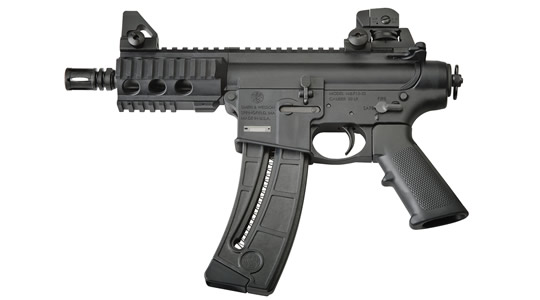 That’s a cute little gun, and I’m not going to lie – the temptation to slap a stock on that and create an SBR is already really, really strong just looking at the picture of the pistol. The M&P15-22 line of rifles has been selling like hotcakes, and has already earned a pretty loyal following in the .22 community. I’m planning on running one in the rimfire rifle division at the Indiana State Steel Challenge match this year for giggles. If you’re looking for a cool .22 LR pistol to make Sarah Brady cry, you might want to check out the M&P15-22 Pistol.
MSRP is $585, however just like the rifle it will probably street for lower than that. Smith & Wesson has not provided me with any consideration for this post, FTC.
While perusing the internet for .38 Special and .357 Magnum loads to meet a specific need, I happened upon two interesting loads, one from Winchester and one from Remington. Winchester catalogs a 110 grain .357 Magnum load with a stated muzzle velocity of 1295 feet per second, which gives a power factor of 142. Remington also has a 110 grain load in their Express line of cartridges (note – I’d link to Remington’s website, but it’s a flash based monster) with the same stated muzzle velocity as the Winchester load. That means that both loads have enough “oomph” to make minor power factor in USPSA and IDPA, as well as clear the power floor in ICORE and Bianchi Cup. Additionally, a load around 140 power factor generally will whack pepper poppers hard enough to make them fall down a bit quicker than the usual 130 power factor 9mm bunny fart loads so many people use.
A quick trip around the internet reveals some disdain for the 110 grain .357 for personal defense, but from a pure “game playing” standpoint, it may have some interesting potential for revolver shooters. Of course, you run into the problem that .357 rounds are longer than .38 Specials and can be difficult to shoehorn into the cylinder in a hurry, so it’s likely that the benefits of making a decent power factor are outweighed by the negatives, however I am intrigued by the concept here for a “playing games” standpoint.
On the other end of the spectrum, CCI Blazer has a 158 grain load that only claims 1150 feet per second of muzzle velocity, which puts the power factor around 180, enough to make USPSA Major or be eligible for Enhanced Service Revolver in IDPA. I would imagine that in an 8-shot 627, this would be a relatively easy shooting load. That is the great thing about shooting revolvers; even if you don’t reload there are a lot of different options to meet the various requirements for ammo in the shooting sports. Need a light, fast load for Steel? Got it. Need a heavier bullet with lower velocity for making Major in USPSA? Got that too.
I’m a huge fan of CCI Blazer, by the way. It’s cheap and relatively accurate, which makes it almost the perfect practice ammo for a competition shooter that doesn’t reload, especially in a revolver. The only downside is that I don’t get any brass to re-sell.