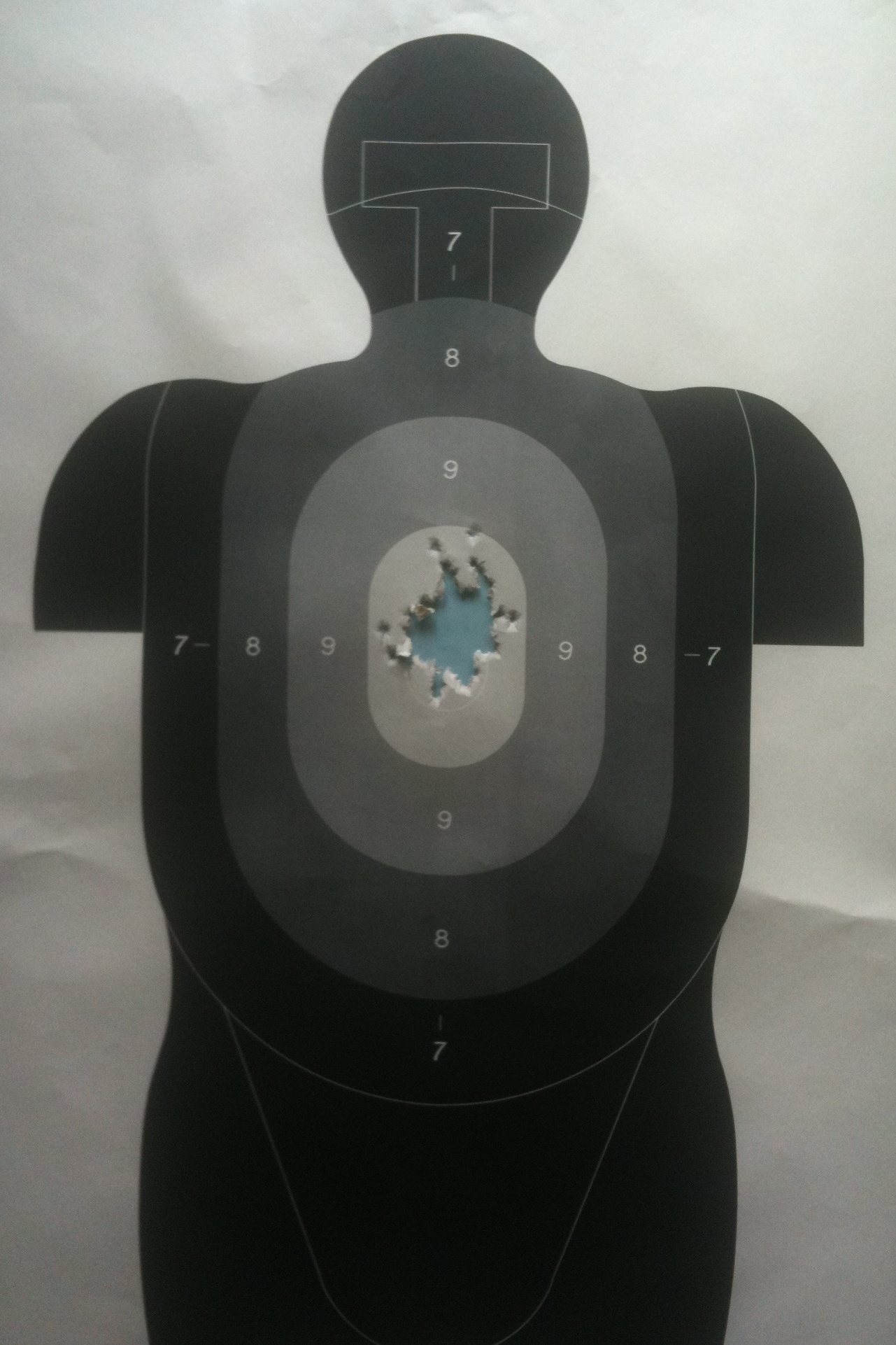
One of the questions I get a lot is “how accurate is the Ruger SR9c?” My usual answer is “accurate enough to hit a 5’6 150 lb mugger in the chest”, because realistically that’s all you’re going to need to do with this particular gun. Last night however I had the opportunity at the excellent Bellevue Gun Club in Bellevue, WA to do some shooting at a the standard qualification target for the Spokane Police Department. It occurred to me that people wanted to know how accurate the SR9c is, and I’d never actually sat there and shot it for accuracy, so I ran the target down to 10 yards and fired 124 rounds at the target.
 I let one get away from me high that almost broke out of the 10 ring, but for the most part all the holes are touching. Near the end of the 124 rounds, my finger was starting to get tired from pulling the trigger so slowly, so I got a little sloppy and opened up the group. Of course, this really isn’t a training exercise. While I’m not quite shooting bullseye slow, I’m definitely shooting slower than I would in a match or a self defense situation. There is some training benefit to this however, and that’s building patience. It takes time to develop the ability to break a clean shot, and to be able to back off the trigger when you know you’re about to take a bad shot. That flier at the top of the 10 ring? I knew that was going to happen, and should have backed off the shot. I didn’t, because I was in a hurry and wanted the accuracy test to be over with.
The Ruger SR9c has a pretty good trigger for a polymer carry gun. I imagine removing the mag disconnect would probably improve the trigger by taking a couple of pounds off the pull weight, and I actually believe that the gun itself is capable of far greater mechanical accuracy than I can wring out of it. So if you’re on the fence about the Ruger for a carry gun because you’re worried about the accuracy from a 3.5 inch barrel? Don’t be. It will get the job done.
Speaking of accuracy, the conversations about accuracy are always great to me, because it means different things to different people. I’ve even talked about it before, in a post with this same title. I remember a time when gun magazines would only test guns at 25 yards from a bench rest or ransom rest to see how accurate they were. While that’s an excellent display of mechanical accuracy, I don’t need the gun that I’m going to be carrying to be able to shoot a 4 inch group at 25 yards. “Accuracy” is subjective to the needs of the shooter and the needs of the situation. A gun for Bianchi Cup should shoot 1.5 to 2 inch groups at 25 yards, but an IDPA gun doesn’t need to be that accurate. In my estimation, what is farm more important than mechanical accuracy is my favorite made up word: “shootability”. What is shootability? It is the features of a gun that make it easy for you to do your desired task with the gun. For me, 1911s are very shootable. The Beretta 92FS has high shootability marks for me. The Ruger SR9c excels at shootability. Some don’t score well for me in shootability, because their controls are odd, or their ergonomics are weird, or whatever. But if you pick a gun, and you can get hits on target comfortably and rapidly? That’s a good score for shootability. I’m a big fan of the SR9c because it’s very shootable – the grip is small enough to conceal, but not so small that I can’t get a good hold of it for rapid fire.
Bottom line? The gun is mechanically accurate and physically easy to shoot. Not a bad deal in a carry package.
Like this:
Like Loading...