Winchester SX3 Flanigun

Why, I do believe I’ve found my shotgun for if I get back in to 3-Gun competition.  Meet the Winchester SX3 Flanigun, the production version of the SX3 shotgun used by exhibition shooter Patrick Flanigan to break 11 hand thrown clay birds before they hit the ground.

It’s even red.  Winchester makes a shotgun that matches my signature red Comp-Tac holsters, and that’s just too awesome for words.  Plus, extended capacity competition magazine tubes are available for the gun, which bring the capacity up to 11+1.  While I believe I’m only allowed 8+1 in 3-Gun, it’s nice to know that I can build a 3-Gun ready shotgun for the cost of the gun and a magazine extension.  After that all I need is shell carriers, and I know where I can get some of those.

The Winchester SX3 Flanigun has an MSRP of $1400, but can be found for around $1000 in stores or online.  I’m not really a “shotgun” guy, but come one – a fire engine red shotgun that’s also basically good to go for 3-Gun?  It’s love at first sight.

New Quest for Master Class is up at DRtv!

The latest installment in the Quest for Master Class is now available at Downrange.TV.  This week we’re taking a look at what you can do if you only have an indoor range available for your practice sessions and can’t necessarily set up the IDPA classifier whenever and wherever you like.  The big focus of this week is your press out, which is actually one of the best ways to improve your draw time without actually needing to draw from your holster.  Also, you get another look at the Cougar Magnum that I’ll be using at Bianchi Cup in 2011; so check out the latest episode of The Quest for Master Class: Take it Inside!

I can be taught

Earlier this week I had a post up about IDPA adding a Grandmaster classification.  In the post, I was indifferent about it; I didn’t see how it would change IDPA or make any difference to the average competitor.

I was wrong.  After reading and considering the arguments presented in the comments, I’m in favor of an IDPA Grandmaster division.  It makes sense to take the top 5 or 10 competitors and take them out of the running and put them in their own division, so that the high level non-professional Master Class shooters can take a run at 1st Master, etc.

Of course, with that consensus the real question is how do you go about putting the IDPA GM class in place?  I tend to agree with the idea that it can only be based on Nationals (Indoor and Outdoor) performance, because that would prevent the “paper GM” issue that you see in USPSA.  In the initial bump, take all past National Champions and bump them to GM; then from there on out the only way to get the IDPA GM tag would be to finish within 95% of the total score of the National Champion in your division.  I like the suggestion that the GMs only compete for Division Champion as well – leaving the other trophies such as High LE, 1st Master, etc for the non-professional shooters.

More thoughts from our readers, of course!

The 4 rules, redux

Folks are talking about the 4 Rules.  I was going to write a post about it, but then I realized that I already did that a year ago.

The short version is that the 4 Rules are elegant, but when you become dogmatic about them, they lose their meaning.  An example of “good” use of Rule 1 is that you simply verify the condition of any gun that hasn’t been in your immediate control.  If I set a competition gun down and walk away for 2 minutes, a week, whatever, I’m going to clear it before I dry fire again, just in case the bullet gremlins snuck a round in the chamber.  The 4 Rules: They’re more like guidelines, anyway.

You're hot and you're cold

An interesting discussion cropped up on my Facebook page this weekend about the merits of hot vs. cold ranges; I personally am of two minds on this issue as I can see the merits of both arguments.  The key arguments behind advocates of hot and cold ranges are summed up thus:

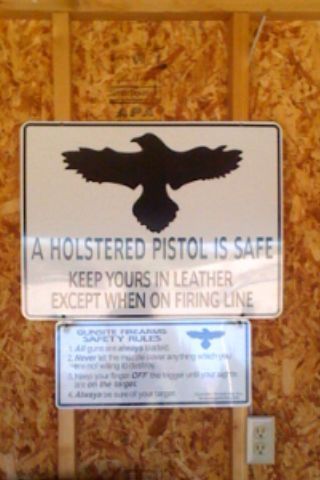
  • Hot: A holstered gun is a safe gun, who cares if it has ammo in it just don’t touch it when you’re not on the line.
  • Cold: Manually unloading each shooter guarantees there are no loaded guns behind the line in someone’s hands.

Both have merit, and both in my opinion have their place.  For example, in a Gunsite class, it would simply take too much time to have each shooter unload and show clear every time they came off the line.  It makes much more sense for them to top off their gun and holster up with a hot gun.  The “hot range” theory operates off two key principles – 1) it assumes that all shooters in attendance are actually going to leave their guns in the holster, and 2) that everyone has a sufficient level of competence with admin gun handling to keep their guns topped off in between strings of fire.

On the flip side, you have the cold range school of thought.  Having been around a lot of matches and seen a lot of novice shooters, I am in favor of cold ranges for matches.  As a certified IDPA Safety Officer and competitor, I like the peace of mind knowing that no one is handling a loaded gun behind my back while I’m on the line.  The reason I like cold ranges for matches is because matches, unlike classes such as Aim Fast, Hit Fast or Gunsite often attract a wide variety of skill levels and competencies which means that not every shooter in attendance is going to be as well versed in gunhandling as the advanced shooters.  So in that environment of unverified competency, it makes sense for the safety officers to manually inspect everyone’s guns.

Personally, I’d love to live in a world where I never had to worry about whether a range was hot or cold – but I’ve also been muzzled quite a few times at indoor ranges and outdoor ranges with “empty” and loaded guns to know that there is a time and place for both hot ranges and cold ranges.

Pax on training

A professional firearms trainer, Kathy Jackson who runs the Cornered Cat as well as working at FAS and editing US Concealed Carry Magazine (and is also my boss in that capacity) really hits the crux of the training argument as far as I’m concerned.

A single guy who has no family and no intent to protect anyone else in the world can be quite content to learn how to hit a target at bad breath distances, and not much else. It’s his life, see? If he’s too slow out of the holster, it’s his life. If he’s fumble prone and likely to shoot himself in the knee or left hand because he never learned how to draw, it’s his problem. If he’s too stupid and unaware to avoid trouble, that’s his burden to bear. His life, his choice. If he wants to wander on in happy ignorance, let him.

But someone with a family might want to give a little thought to working with a great deal more competence and confidence even at farther distances. What if someone across the room grabs his baby daughter and threatens to leave with her? Can he hit a kidnapper at that distance? Can he avoid hitting his baby at that distance? Has he given any thought at all to the types of tactics that might enable him to most safely protect his family in these or other circumstances? That’s going to take more training and more thinking. It’s going to require more skill and more knowledge. So he owes it to himself and his family to learn more. Again, if he chooses not to, it’s his life and he’s the one who ends up mourning the consequences if he gets it wrong.

Read her entire post and the ensuing discussion at TFL.

Comp-Tac Speed Red

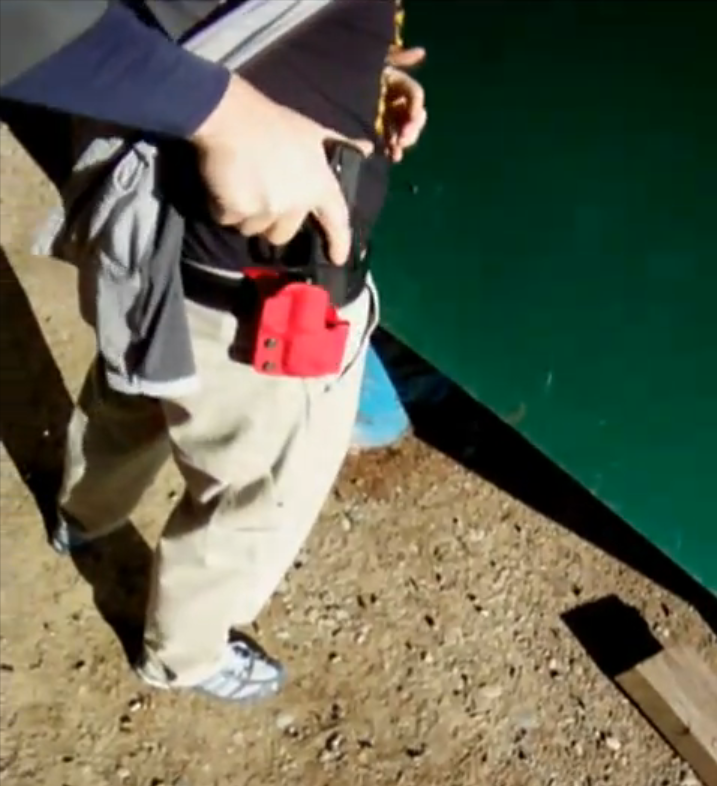
I honestly can’t think of a good name for my now “signature” red holster from Comp-Tac; but I did get a request from someone to see it in action.  So I grabbed a screencap from this video for a shot of the holster in action.  A couple of features of the holster that you can really see well in that image are how wide open the thing is – there’s no hunting around for the opening of the holster when you’re putting the gun back in, which makes it much easier to holster up without having to look down at your holster.  You can also see how deep the sight channel is – this is great for competition shooters who will frequently replace the factory sights on their guns with sights that have a different profile; in fact I’ll probably end up replacing the front sight on the SR9c with a fiber optic eventually.

The other thing that I really like about the Comp-Tac paddle is that the paddle is part of the holster’s body.  Unlike other paddle holsters such as the Fobus, the “paddle” and the back piece of the holster are all one piece, with the paddle folded over and tucked under my trousers , held securely by my belt.  I cannot recommend this holster strongly enough for IDPA or USPSA competition, and you can buy your own from Comp-Tac’s website.