Just not the same

One book, two different reading styles.

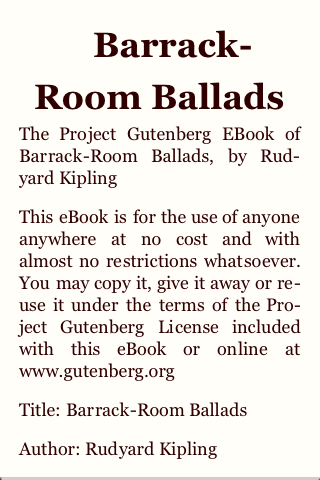
This is Barrack-Room Ballads, by Rudyard Kipling.  It’s one of my favorite books, and that’s what it looks like on my iPhone.  It’s a handy format, it goes with me wherever I am.  My iPhone carries a library on it that I could never carry with me, over 100 books stored in my pocket.
But it doesn’t have any soul.

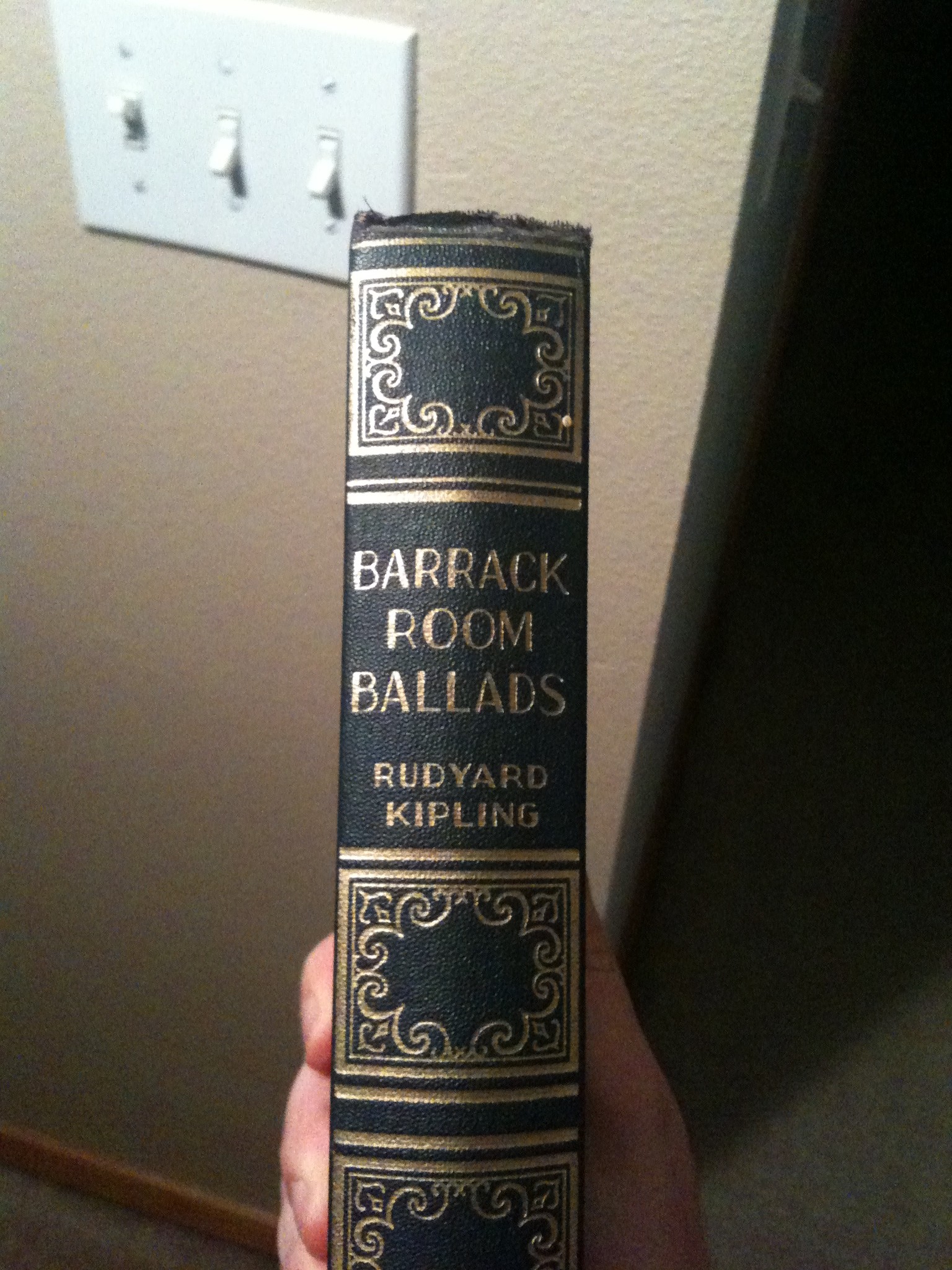
Because this is also a copy of Barrack-Room Ballads by Rudyard Kipling.

The only indicator of when this particular version of the book came in to being is the name “Atwood” in the front cover, under which is written “Feb, 1944”.  I had to stop and think about that for a minute.  66 years ago, this book changed hands; and it kept traveling until it ended up here, in my hands.

So while I dearly love technology, and the ability to read great works of fiction, carry hundreds of books with me wherever I go, I think that when I’m reading Kipling I’ll keep it in the traditional format.

That's what I was looking for!

Back in August, I had a chance to shoot the HK45 being used for the Pistol-Training.Com endurance test.  I liked it, although it was a little large for my tiny hands, there was something about the trigger that I just couldn’t put my finger on (ha).  Tam shot the same gun this past weekend a bit, and in one sentence was able to sum up what I was feeling about the trigger:

A (for the lack of a better term) “two-stage” long travel trigger is just not something I have a lot of time with, and so it always feels unusual to me, like my revolver just broke or something.

In the words of Charlie Brown: “THAT’S IT!”  Now, there is absolutely nothing wrong with the HK45 trigger.  In fact, it’s a really good trigger, and I’d probably recommend it over a Glock 21 (the HK45 has better ergonomics as well), but coming from shooting revolvers for a year it just felt weird.  Now it makes sense, and I finally feel so much better.

I asked you a question

So I could ask you another one.  Yesterday, I asked how many of the gun nuts out there that legally carry would intervene using their firearms in three different hypothetical situations.  The point of that question wasn’t actually to get people thinking about tactics, but rather to ask a second question – to those that said “yes I would”, I would then pose this next question: If you are willing to use your firearm in public with innocent bystanders present, are you confident enough in your ability with your carry gun to say that you would be an asset in that situation that you said you’d intervene?  Or would you be a liability because you’ve never fired your gun under pressure?

This will likely be my last post on the issue of professional firearms training for a bit, because I feel like after this, this particular dead horse been flagellated enough.  But this is actually one of the most important issues to me in terms of getting training, and that’s the moral/ethical issue behind the use of deadly force.  For example, let’s revisit the restaurant gunfight from yesterday’s blog post – shooters come in, I have a shot, and I take it.  I miss, and kill a 32 year old new mother in front of her husband and children.  I missed because I’d never fired my gun under pressure, and it turns out that plinking mediocre groups at 25 feet isn’t actually going to help me in a gunfight.  Depending on what state I live in, I may not be legally responsible for that woman’s dead body.  However, that’s not going to help me sleep better at night knowing that I took her life, and I took it because I was incompetent.

This isn’t about whether you need training, or want training, or anything like that.  This is nothing but my personal morals, and yours may be different.  I carry a gun in a public place.  There are other people around, quite often, and muggings don’t happen only in deserted alleys with hard brick walls to serve as backstops.  Crime happens on street corners, in fast food restaurants, convenience stores, and even insurance agency parking lots.

You may not believe this way, and that’s fine – but I believe that I have an ethical obligation to any innocent bystander to not put their lives at undue risk.  This applies to more than just carrying a gun.  I don’t drive recklessly for the same reason: I do not have a right to endanger your life through my lack of skill behind a wheel or a trigger.  “My right to swing my fist ends at your nose”, and my right to be untrained ends when it endangers someone else’s life.

I don’t think that there should be a training requirement to carry concealed, because I don’t believe the state is capable of actually training people to be safe, competent shooters.  If you’d only use your defensive firearm in a one on one encounter with no possibility of shooting a bystander, then don’t get training.  But if you have a family, if you believe that CCW holders are “sheepdogs” and would intervene in a public situation, if you would use your weapon in self defense in a crowded street or public parking lot or any situation where the possibility exists of injuring or killing a bystander, then please seek training.  If the time ever comes where you have to pull the trigger, I want everyone that reads us here at Gun Nuts to say “I did everything I could to be ready for this moment, and I was able to win the fight because of that”.

A question

Many of the readers here at Gun Nuts have permits to carry a concealed firearm.  So I’d like to ask those of you that do carry the following question.  Would you intervene, as a private citizen (active duty LEO is excluded, sorry) in any of the following situations:

  • You’re eating at a restaurant with your family and a group of shooters burst in to the restaurant and light it up, Mumbai-style.
  • You see a 3rd party being violently attacked and in clear threat of death or grievous bodily harm.
  • You see a young mother having her child forcibly ripped away from her by an obvious bad man.

Assume for the sake of argument that in all the above situations the bad guys are clear, the good guys are obvious, you’re carrying your regular carry gun, and lethal force is clearly justified.  We assume that to remove any pedantry from the discussion, since the thrust of the question is more “would you assist a bystander in need if violent force was justified”.

Grip tape

More questions today, but this one gets a cool poll:

I’m curious about your responses. The more I shoot, the more I don’t want anything to “force” my hand in to a certain spot on the gun. I don’t like rubber grips, finger grooves, or anything like on revolvers. My line of thinking is that I want my hand to hit the gun and slide in to position if necessary, not hit the gun and stick to the grip tape or whatever I have on it. As I return to semi-auto guns, I really don’t like any kind of aggressive texturing on those guns. Especially for any gun I’m going to shoot for 1000 rounds at a stretch. So vote in the poll, and share your comments below.

Data!

I recently found my old IDPA notebook that used to use to log my training back before I went to the all digital format that I currently use.  I thought it would be interesting to share some of the data I’ve collected over almost 3 years of competition.  It’s interesting to me because it shows the actual value of training and practice in terms of demonstrable improvement.  It’s easy to say “if you get training and practice you’ll get better” but it’s another thing entirely to be able to point to numbers and say “see, I told you so”.  Here’s a brief trip, first by division then in chronological order:

Custom Defensive Pistol

  • Official Classification: 3/28/2009 – 125.38, Sharpshooter
  • No Practice runs (I just haven’t shot enough CDP to make it worth my time, although that may change soon)

Enhanced Service Pistol

  • Official Classification: 9/6/2008 – 126.46, Sharpshooter
  • Best Practice Run: 7/11/2010 – 84.66, Master

Stock Service Pistol

  • Official Classification: 8/22/2010 – 104.27, Expert
  • Best Practice Run: 7/11/2010 – 87.41, Master

Enhanced Service Revolver

  • Official Classification: 6/29/2010 – 97.61, Master
  • Previous Classification: 9/16/2009 – 116.34, Expert
  • Best Practice Run: 9/2/2010 – 90.22, Master

Stock Service Revolver

  • No official classification
  • Best Practice Run: 3/7/2010 – 114.22, Expert

Now, if you look at those as just a scattering of data points it doesn’t necessarily make sense until you look at all the data that I’ve accumulated.  For example, I’ve only shot the classifier in CDP 1 time, and that was fairly new in my shooting career.  On the flip side, I have a ton of data from when I was trying to make Master in ESR and my current Quest for Master Class.  So now let’s take a look at that data chronologically, and also include the numbers from my practice sessions with the guns.  We’ll primarily look at Enhanced Service Pistol – It’s the division I’ve spent the most time competing in with various guns, from my Springfield XD(m), various 1911s, and finally up to and including the Ruger SR9c.  Remember, all classifiers here are fired strictly for Enhanced Service Pistol.  My official classification of record will be in bold, everything else is practice and strictly unofficial.

9/6/2008 – 126.46
4/16/2009 – 122.87
6/14/2009 – 124.12
8/3/2009 – 121.63
8/7/2009 – 110.58

After August of ’09, I switched to revolvers exclusively until I started the Quest for Master Class in July of 2010.  If you track the data from shooting revolvers, my classifier scores start with the mid 110s and continue to track downward.  After shooting revolvers for a year, the Quest for Master Class began and I once again started shooting a semi-auto that was eligible for Enhanced Service Pistol.

7/2/2010 – 99.81
7/11/2010 – 84.66
8/11/2010 – 87.12
9/1/2010 – 90.70

I’ve not fired the classifier since then; however you can actually see a true downward trend in my scores over time. What’s happened since that very first classifier? I’ve had training, and practice time. A class with Todd Jarrett, a class at Gunsite, shooting major matches and picking the brains of the GMs there, and lots and lots of practice. Right now I’m hovering around low master scores for Enhanced Service Pistol, and I truly believe that a little bit more practice and range time will have me shrinking those times down to the mid to high 70-second range.

Like I said, you don’t have have to get training.  But if you want to do more than shoot mediocre groups at 25 feet and want to be able to point to actual data points and say “I am objectively better as a shooter than I was 3 years ago” then training is for you!