Vulnerability and hostile behavior

Last week auto journalist Jack Baruth wrote a piece for Road & Track that has made a bit of a splash in the online world. In it he describes a number of occasions where he has encountered hostile behavior from other motorists up to and including challenging him to a fight…only to see them back down when he takes off his flower-covered helmet and reveals the bearded face of a male.

I suppose it is inevitable these days for that kind of article to spawn a bunch of social-justice-warrioring nonsense, but I think that all of that politically correct conversation happening elsewhere misses what’s really going on…and I believe that the core reality of what Mr. Baruth wrote about has great implications for everyone interested in self defense. It’s not about misogyny, it’s about monkeys.

In the second article I wrote on the superb Unthinkable class put on by William Aprill and Greg Ellifritz, I mentioned William’s explanation of the data we stream into the world about ourselves and the way that criminal actors use that data to make a go/no-go assessment for attempting an attack. In this study researchers found that higher order criminals were able to use someone’s gait to effectively judge their vulnerability to attack. Here’s the catch, though: What we think of as hard core criminals are not unique in their ability to perceive vulnerability in other human beings. Nor are they unique in their willingness to attempt to exploit that perceived vulnerability. Have you ever seen a shady salesman in action? Or maybe you have a coworker who is a complete suckup to anyone he thinks can better his career but treats anyone not perceived as useful like dirt? In my experience, a sizable chunk of the human population will attempt anything they think they can get away with when they perceive vulnerability.

Mr. Baruth’s theory is that the road ragers he encountered saw his flowered helmet and long hair and assumed that he was a female, and therefore vulnerable. The typical male of the human species has a considerable strength and size advantage over the female of the human species. Even if a male and female are roughly the same size, the average female is not going to be as strong or as able to take hits without serious damage as a male of the same size. The female, ceteris paribus, is more vulnerable…so when they mistook Mr. Baruth for a female they exhibited much more aggressive behavior. Not, I would argue, primarily out of some sort of gender motivation, but out of an assessment of the relative weakness of the other person.

I would take it even further than that and posit that a significant chunk of the insult they took from Mr. Baruth’s behavior was a direct result of that perceived vulnerability. In other words, had the person splitting the lanes in traffic been a 6’6″ 350 pound, ‘roided up biker with a big knife on his hip and a swastika tattooed on his forehead, I doubt that the people who raged on Mr. Baruth would have been offended by the behavior. They may not have appreciated it, but the seething anger Mr. Baruth witnessed was unlikely to be present because the big biker I described does not look vulnerable. Quite the opposite: Anyone confronted with that sort of individual is likely feeling their own vulnerability exposed. This is basic level primate stuff you could expect to see in any zoo. The weakest member of the troupe has to walk on egg shells lest he/she be immediately savaged for challenging the established pecking order.

Greg Ellifritz wrote an extremely useful article about Insults and Challenges in the context of a criminal assault that I would encourage you to read very carefully. Of particular interest is this passage:

The researcher David Luckenbill studied all of the murderers in a California county over a 10-year period and asked them why they killed their victims. You would expect to see a variety of responses. You would be wrong. Every death row inmate interviewed listed one of only two reasons for killing….

34% said they killed because the victim challenged the killer’s authority

66% said they killed because the victim insulted them in some way.” 

The quote above is presented in an article covering a Dollar General clerk who was shot in the course of a robbery. In a bewildered state, she said “you’re not going to shoot me” to the robber, who promptly shot her. He took her statement as a challenge to his status in the situation. He, after all, had the gun. He had all the power. She was as vulnerable as any human being could be. I’m certain that the Dollar General clerk had no intention to insult the guy pointing a gun at her, but the power difference between them made just about anything she attempted to say an insult.

You can watch this dynamic in action:

The puncher felt insulted and challenged by the victim’s statement. The victim is older and weaker…vulnerable. There’s plenty of video of similar attacks out there being perpetrated against male victims that are also typically older and weaker. Similarly vulnerable.

What I’m getting at is that perceived vulnerability is at the core of what Mr. Baruth experienced…and what any of us could experience if the conditions are right. When you are perceived as vulnerable it invites attack. If someone perceives you as being vulnerable the perceived power difference between you can make even the most innocuous statement or behavior into a deliberate insult in the mind of the other party that actually justifies an act of criminal aggression against you. 

It’s not always possible to verbally deescalate a situation. In fact, the more vulnerable you are the more likely it is that anything you say or do is going to be interpreted as a challenge or an insult that justifies a violent response in the mind of your attacker. What could have started out as a simply dominance display (I believe what Mr. Baruth experienced were attempts at dominance display) could rapidly deteriorate into an act of violence if the perception of vulnerability is not immediately changed.

Since we can see that perceived vulnerability manufactures attack, it would be worth our while to do what we can to limit the possible perception of vulnerability about us. This is where deselection really comes into play. How we carry ourselves, how we pay attention to the world around us, and as Mr. Baruth demonstrates even seemingly insignificant fashion choices can be used to make us look less vulnerable…which, in turn, discourages attack.


Springfield Armory Range Officer 1911 9mm: Halfway there

Last night I ran the Springfield Armory RO through another 350 rounds of ammo, bringing the running total to an even 1,000. As usual, I shot Dot Torture at 5 yards to open up, and because I was feeling speedy I tried to shoot it fast; ended up dropping 3 shots for a 47/50. What I’ve established with Dot Torture is that when I take my time and shoot it for max accuracy with this gun I can clean it on command. When I speed up and try to shoot it quick…things start to fall apart. It’s always in the same place, on the strings with transitions.

In order to work on my transitions, I spent the end of my practice time working on the iHack. This drill is hard, you’re shooting at tiny-ass little targets with a relatively tight par time. Even when you delete the timer and just try to self-pace yourself for a balance of speed and accuracy, it’s easy to mess this drill up. As you can see in the video, on three consecutive runs from the Safariland 1911 ALS I’m using I went 6/9, 8/9, and ohmygodwhy/9 on the final run. The best way to work up through this drill is to start aimed in on the targets, and if you can hit the par time from there, go to whatever ready position you use, and if you can hit the par time from there, go to the holster. Right now my skill level is in between low-ready and holster; I can pass the drill routinely from the low ready, and I’m about 50-60% from the holster. My issue is I’m slow on the first shot, so I then tend to rush the transitions to make up for lost time, and things kind of fall apart when you do that.
The gun itself had another malfunction on round 800something. This was a failure to return to battery during a SHO string of fire I was doing. Ammo was PMC 115 grain 9mm, corrective action was to spank the magwell like it was naughty. One of the things I’ve noticed about the RO is that it’s very sensitive to running without adequate amounts of lubrication, and for whatever reason this gun likes to have a lot of lubrication on it. Everything about this gun is, for lack of a better phrase, tight. It seems like this gun is the kind of 1911 that I’ll need to establish a regular lubrication cycle for. No points off for that, but -1 one point for the failure to RTB. Currently the gun’s at 85/100 with 1000 rounds left to go.

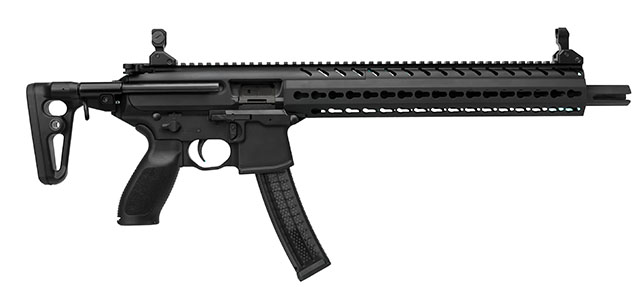
Sig Sauer MPX 9mm sub-machine gun review

While 9mm SMGs aren’t as tactically relevant as they used to be, there is still a market and a place for them. I’m a huge fan of the Sig MPX, and now that they’re offering it in a carbine version makes me genuinely happy. 9mm rifles/subguns are awesome fun, and while they may not be as practical as a rifle, you can do a lot worse for a defensive firearm.

Training doesn’t always equal skill

Here at Gun Nuts we’re big advocates of getting professional training. One of the big reasons I push that people get training is because it’s difficult for self-taught practitioners of anything to identify places where they’re making mistakes. Video taping yourself practicing can help, but it’s always useful to have a second set of eyes watching what you do and making corrections or offering tips.

However, just taking a class doesn’t necessarily mean you’re going to get any better at what you do. This can be for a number of reasons: the instructor isn’t very talented, the class is way below your current skill level, etc. However, assume for the sake of argument that the class is appropriate for your level of skill and that the instructor is talented enough to actually provide useful feedback to you as a shooter. It still doesn’t guarantee you’ll get better.

2015Hornady3Gun054440229May1054

The reason it doesn’t guarantee improvement is because improvement is self-motivated. You can take 5-10 training classes and if you don’t take any of that learning and practice it in your own time, you’ll never improve. The cycle of improvement looks like this:

  1. Learn new skills (class)
  2. Practice skills on your own (range, dry fire, etc)
  3. Pressure test skills (match, other venues)
  4. Identify weak spots, and refine

You can repeat steps 2-4 as many times as necessary to continue to refine your skills; but at least for me I’ll eventually run into a point where I then need to go back to step one as well. Classes are incredibly useful for breaking through plateaus, because again of that value of the second set of eyes that are on you. But just taking classes won’t make you better, because it’s way too easy to brain dump everything you learned in the class and not bring it into your training regimen.

Don’t fool yourself into thinking that just because you took 6 classes last year you’re better as a shooter. I’d rather see someone take 2 classes and spend that extra time and money on refining their skills on the range, shoot a few matches, and continue to work. My ideal class/training schedule would look like this:

  • Season start: take a class to knock any rust off/tune up. For me, this should be a relatively high intensity class, for example the Automatic Accuracy class I took a few years back.
  • Early-Mid-season (March-May): Dry fire, range work, refine skills. Shoot club matches, maybe some state level stuff to start getting back in to match rhythm.
  • Main season: (May-Sep) focus on major matches, keep shooting club matches and keep doing range work, but focus is on main matches. Somewhere in here, work in another class to tighten up any weak spots identified with pressure testing.
  • End of season (Oct-Jan): Do season review, identify success/failures, and do a final skill assessment to identify any weaknesses that can be addressed during the off season. Off-season is he best time to work on holes, since (at least on Hoth) matches basically stop after October. So get in the indoor range and get in your house and dry fire.

Bottom line? As it turns out, the shooting sports are like any other sport. You won’t reach your maximum potential just practicing in your basement or going to the batting cage, but you also won’t reach it if you don’t practice at all. Today’s post has been brought to you by Captain Obvious needs content.

Lessons from a Robbery

NOTE: Turn your volume off when watching the video.  The version originally posted had no audio, but the YouTube version has some pointless noise.

This video was recently shared on Facebook by the American Warrior Society.  For those who do not know, the American Warrior Society is a website and podcast created by Mike Seeklander.  If you don’t know who Mike Seeklander is you owe it to yourself to look him up.

But Mike is not the subject today.  The video is.  It is very enlightening and a in-depth review can offer some insight into areas of training often overlooked.

What we start with is a man, standing in what appears to be a Subway Restaurant, with either his wallet or phone in his weak hand.  At approximately 8 seconds everyone we can see turns and focuses on something out of the view of the camera.  They seem to be in shock as two men enter with the clear intent to rob the establishment.  The events unfold from there.

The first thing you will notice is a person (we’ll call him suspect #1) walking up to the man at the counter (we’ll call him CCW holder) and blatantly grabbing the item(s) from his weak hand.  As this is happening the CCW holder moves his strong hand back to his weapon.  For the next few seconds of video we see the CCW holder continue to work towards a draw stroke – RIGHT IN FRONT OF THE SUSPECT!  He is blatantly telegraphing his movements, but the suspect is ignoring them.

Lesson 1: With his strong hand empty the CCW holders strong was able to quickly move to a draw position.

Lesson 2: Both suspects (suspect #2 is out of camera view) were seemingly oblivious to the  motions of the CCW holder.  Without interviewing the suspects we can only speculate on their thoughts.  Perhaps the suspects had a strong personal narrative of how the robbery would unfold and it blinded their judgement or, perhaps the thought of someone with a CCW intervening never crossed their mind.  Either way it is something we should be cognizant of, as a better criminal might be more aware of his victims actions and movements.

As we continue watching the footage we see the first suspect head behind the counter, at the same time we see suspect #2 walk over to the CCW holder and physically push him back.  The CCW holder appears to be extremely compliant as the suspect doesn’t seem to exert much force while controlling the situation.  Inexplicably suspect #2 does not notice the telegraphed, imminent draw stroke either!

Lesson 3: Compliance, even if momentary, can give the criminal a false sense of security.  It leads them to believe they have chosen their victim wisely.

The CCW holder draws his weapon and makes a point-blank range shot into the chest of suspect #2.  As suspect #2 is falling to the left (hopefully reflecting on his choices in life) the CCW holder drives the gun forward, toward suspect #1, who is now behind the counter.  Note the CCW holder is doing this strong hand only.  Suspect #1 immediately throws his hands up, surrenders and cowers in the corner – like the pathetic human being he is.  It is here we see the CCW holder grab a gun off the floor and disable it.   I have watched the video several times and I can’t tell if the gun came from suspect #2 when shot or suspect #1 when he withdrew.  Either way he takes his eyes off suspect #1 while retrieving the gun from the floor.  Thankfully suspect #1 didn’t try anything stupid while the CCW holder diverted his attention.

Lesson 4: STRONG HAND ONLY.  When did you last train strong hand only?  This video provides as good a reason as any.  Get out there and shoot strong hand only at the range!  While you’re there, practice some weak hand.  It is better to suck at the range than to fail miserably in a defensive situation.

Lesson 5: Be prepared for anything.  Suspect #1 immediately surrendered and was seemingly no longer a threat.  Have you ever thought of practicing the retrieval and disabling a suspects weapon?  Do you practice ways to keep awareness on all of the suspects as the situation unfolds?  The best situational awareness is easily defeated by auditory occlusion and tunnel vision.

Finally the CCW holder takes command of the environment and orders suspect #1 out from behind the counter and onto the ground, where he has better vision and control over him.   It is my hope I would have the awareness to direct the suspect away from the gun I just disabled, but it is easy to pass judgement from a computer screen.

As the events wind down we can see suspect #2 still withering in pain (good) on the floor.  We have no idea if he is quiet, moaning or even screaming.  The entire area might be rather loud if suspect #2 is screaming in pain while the store personnel are overcome with panic and terror.  If you ever have to draw and shoot someone you should be  prepared for extreme confusion and noise.

If we look at the video in detail it is easy to pick it apart and find errors.  In reality it is only 17 seconds between the actual drawing of the CCW holders weapon until he is standing on suspect #1.  While we can find some mistakes made by the CCW holder the fact is he excelled.  He only fired when necessary to stop the threat.  He remained relatively calm.  He found the solution to the problem as his world fell apart in 17 seconds.  Think about that.  In 17 seconds the CCW holder shot a suspect and apprehended a second.  That isn’t much time to think things through and I am sure that it was far from his mind while deciding between a cold cut combo and a meatball sub.  We must react quickly and properly.  We must be aware.  Full awareness of your surroundings 100% of the time is impossible, but partial awareness all of the time is more than the normal person has.  Even partial awareness can buy you time to react and change the outcome.  You must be aware of your surroundings and you must be ready to act.

Those serious about carrying a weapon and defending themselves should train themselves wisely.  I would also suggest you check out the American Warrior Society; Mike’s podcast is full of useful information.

Review: Badlands Gun Range

If you follow the Gun Nuts Media YouTube channel you’ve probably noticed that all my recent videos have been filmed at a new location here in Sioux Falls, specifically Badlands Gun Range. Up until recently, there was only one indoor range in Sioux Falls, a place called Gary’s. While the staff at Gary’s were always nice to me, the facility itself left something to be desired. One of the big problems that Gary’s had was that the air system didn’t work very well, to the point that after an hour of shooting when I would leave the range, I’d have grey/black mucus in my nose for a while. That’s not ideal.

Other options would be to travel ~1 hour north to the Outdoor Adventure Center in Brookings, SD. The OAC is a great facility, five star rated by NSSF, is nice and clean, well lit, and quite lovely. I teach classes up there and heartily recommend it. However, it is an hour north, and in winter in SoDak that can be problematic. As a brief aside, it’s interesting how living in SD has changed my perception on what’s a long drive; when I lived in Seattle I’d routinely drive 45+ minutes from Redmond to Puyallup for USPSA matches. But I digress. I love the OAC and maintain a membership there, however due to its distance I have to plan when I want to make a trip up there to train.

That’s why when Badlands Gun Range opened up in Sioux Falls, five minutes from my house, I was extremely happy.

(Full disclosure: Badlands did not ask me to write this review even though my wife works there and I’m friends with a bunch of the staff)

Facilities
To understand the Badlands Gun Range, you have to look at the facility as a whole. It’s not just a gun range, it’s a gun shop, a pawn shop, a deli, a radio station, a music shop, and a concert venue. It’s…kind of like a little slice of Las Vegas got dropped right down into Sioux Falls, and to be honest it’s pretty awesome. Not a single dollar was spared on amenities, which means the parts we care about (the gun shop and gun range) are clean, well lit, well laid out, and generally a nice place to pull some triggers.

Photo courtesy Badlands Gun Range

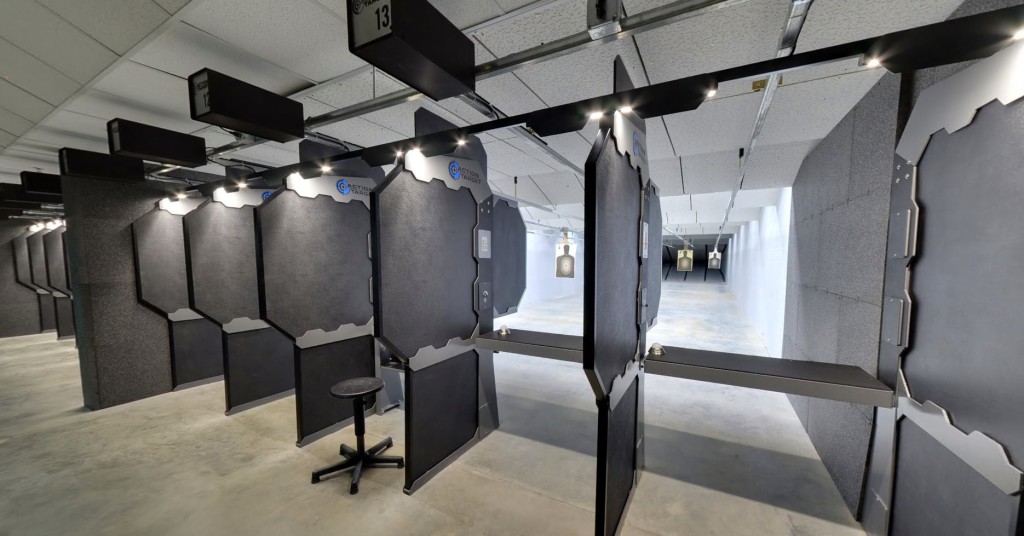
The actual shooting range is an Action Target set up with 10 standard lanes and 4 VIP lanes. The VIP lanes get a private shooting area, a waiting lounge with pinball and non-alcoholic drinks, and upgraded computerized target carriers. The standard lanes are fed from a large waiting area with high top chairs and tables, and a huge glass window for viewing shooters on the range. There are also electronic combination wall lockers to store jackets or other items in. The standard lanes have simple “forward/back” target carriers, which unless you’re interested in turning targets on par times, will absolutely suffice for your training needs. I just bring a shot timer.

All the shooting lanes are rated for up to a .30-06, and one lane in the VIP side is rated for up to .50 BMG. You can hammer away with your .223 all day without causing any issues.

Rentals
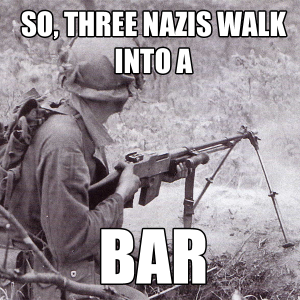
I’m a big believer that a good gun range should have a good rental selection, and Badlands does. They have the expected assortment of handguns for shooters to try out, but where their rentals really shine are the full-auto guns. 9mm AR buzz guns, MP5s, MP40, but the real crown jewel of the rentals? A BAR. Yes, a full auto Browning Automatic Rifle. Because .30-06 squad automatic weapons are AWESOME, and shooting a BAR is an even better way to reenact WW2 than shooting a Garand.

3 nazis walk into a BAR

Gun shop
The range also has a gun shop, which…is a gun shop. It’s very nice and clean, and the customer service is solid, which is really what makes or breaks a shop. I price shopped their new guns vs. what I know about MSRP and dealer markup, and they’re solidly in the ballpark. Used gun prices trend a little higher than I’d like to see, but let’s be honest, used guns are where most people make their money anyway. If you’re interested in gunsmithing services, make sure to talk to Chase.

Customer Service
Honestly, I’ve not had a bad customer service experience at Badlands, but to be honest it’s also not fair for me to really rate the service there. Everyone knows me, and they all know my wife who is an employee of the range, so impartial judgement is pretty much out the window on that count. However, everyone I’ve interacted with on the shop or range side has been unfailingly polite.

Pricing
This is a bit of a multi-faceted equation, because “pricing” covers a lot of different areas. I’ll try to hit them all:

  • Retail sales pricing: New guns are right in the ballpark, used guns seem a little high, however there are also some downright steals in the shop if you know what you’re looking at. And no, I’m not going to tell you what they are.
  • Hourly range use: perfectly reasonable. Standard Lane for half an hour is $20 bucks, and a full hour is $30. VIP lane is $40 for a half hour and $60 for a full hour. I recommend the full hour on the standard lane to get the most bang for your buck.
  • Membership pricing: This is where I have issues, because the membership prices are totally out of whack for the value received. The standard membership is $250 a year, and you get 1/2 off lane fees and 1/2 off rentals. I’m actually going to go into more detail on membership pricing below.

I do want to kind of park on membership pricing here for a second. The only membership that really makes sense is the $250 basic membership. The half off lane fees does justify the cost of the membership in 17 visits, which is a lot for a casual shooter (more than once a month is a lot, trust me), but it’s still a number that you can reach. The family version of this membership is $400, which unless the other people on your membership are going to shoot by themselves a lot, doesn’t make a lot of sense.

VIP memberships are $500 for a solo membership and $800 for a family membership. That’s nuts. Here are the benefits you get with the VIP membership:

  • 1/2 price on standard range fees
  • 1/2 price on standard rental guns*
  • 1/2 Price on specialty packages
  • FREE tickets to any Badlands Motor Speedway Event**
  • FREE eye & ear protection rental
  • 1/2 price Simulator use
  • One Limited Edition Badlands Gun Range t-shirt or hat
  • FREE standard targets
  • One Complementary Badlands Gun Range training class
  • Invites to all “Members Only” special events
  • Complementary soft drinks
  • Occasional priority opportunity to take advantage of free ticket offers to Concerts and Events at Badlands Pawn and Badlands Motor Speedway!

The only perks on that list that aren’t available to standard members are guaranteed access to the VIP range, the free tickets to Badlands Motor Speedway events, and the free sodas. Which…isn’t really worth an extra $250 bucks to me. If you’re going to get a membership, I’d stick to the $250 basic membership and make sure to hit the rang up twice a month to get my money’s worth!

Overall score
Honestly, it’s a great facility. The air exchangers are great, the range is clean and well lit, the staff is friendly, you can do holster draws if you get certified, rent machine guns, and when it’s all done you can go to the deli and get a legit sandwich. That’s pretty awesome if you ask me. If you want to buy a membership, get the standard $250 membership and go twice a month, and you’ll be in good shape. Oh, and if you do go? Make sure you tell the range staff that you’re there because Caleb from Gun Nuts told you it was awesome.

I’m glad that the Badlands Gun Range has opened up in Sioux Falls. Having a place to train that’s convenient and is a great facility makes it a lot easier to hit my training goals. I was doing the best shooting of my career when I was training weekly at WCA in Bellevue, and I can already feel my groove coming back.

Springfield Range Officer 9mm 1911 Update

No video this week, as I was in Des Moines attending a defensive pistol class taught by Melody Lauer (more on that later this week). I did have one malfunction during the class, a classic stovepipe failure to eject during a weak-hand only string. It might be because I was limp-wristing the gun, but it also didn’t happen again during class, so I’m going to go ahead and count it against the pistol. The malf happened with PMC 115 grain FMJ, which I generally really like for practice ammo. It seems to be loaded light, which makes shooting it a lot of fun.

Here’s a quick breakdown on the gear I’ve been using with the Springfield. Unlike the Taurus, I’m carrying the Range Officer, so for EDC I’m using a Shaggy by Custom Carry Concepts. I do like to carry a reload when I run a single stack. When I do carry a reload, I sacrifice a little concealability to get the spare mag in quicker, so right now I’m carrying my spare mag in a simple Blackhawk single stack magazine pouch. While it doesn’t hold the magazine as tight to the body as some other pouches, it does make for a slightly faster reload. It works very well under an open front concealment garment.
One of my shooting goals this year is to take an Ernie Langdon class and take another run at getting a FAST coin. My last attempt for the record was almost four years ago now, and I finished with a 6 and change, which I know I can do better on. To that end, I’m doing most of my training with a retention holster, because if you game out the FAST, an open top retention holster is probably the way to go. Because I like to use the best possible gear, I’m rocking a Safariland ALS.

Right now the Springfield sits at 650 rounds, with a running score on our 1911 scale of 86/100. One thing I have noticed is that it’s much more sensitive to lubrication than the Taurus was. During the class I noticed that slide operation was getting really sluggish, despite having only digested 500ish rounds at that point. So, I lubed it up, and everything was hunky dory again. It’s an interesting data point. Without using actual tools, I can tell you that the SA subjectively feels like it’s tighter than the Taurus was. More shooting this week!

Virginia will again recognize other state’s carry permits

Last weekend, Gov. Terry McAuliffe of Virginia announced a bipartisan deal that would restore CCW reciprocity to the state of Virginia. The new bill will grant reciprocity to more states than were covered under Virginia’s previous agreements. The bill is still working it’s way through Virginia’s General Assembly, so there is a chance that it could get derailed.

In exchange for expanding VA’s reciprocity, VA House Republicans agreed to provisions that would take guns away from anyone subject to a domestic restraining order, and would also have the VA State Police attend gun shows to provide background checks for private sellers if so requested.

Overall, this looks like a pretty solid deal for gun rights in Virginia. If the crybaby reaction of the Coalition to Stop Gun Violence’s reaction is any indicator, it’s actually an excellent deal for gun rights.

Mr. Governor, you have been a good friend and led the way on this issue for many months. But if you think we are going to let you drive this bill home without a fight, you’ve got another thing coming (sic). It is terrible.

Good luck to Virginia getting this billed passed. I’ll be watching its progress through the VA General Assembly as it would be nice to be able to carry in VA again.