HK VP9 shooting USPSA Limited Minor

Matches and good classes are really the best place to test out your gun. Once you’ve established that a pistol is reliable enough for a match or a class, take it to an actual event and shoot it at speed. You’ll learn stuff about the gun that can’t be revealed in dry fire or single lane training. As an example, in this USPSA video featuring the VP9 is that at speed, even with a solid grip, the gun tends to have a lot of muzzle flip. It’s nothing that can’t be controlled, but at the same time it was a lot more bounce than I expected from a 9mm. It actually flips the muzzle more than my .45 ACP 1911, which is odd.

So take your guns to a class or a match. You might be surprised what it tells you.

Operator starter kit

Hey! You! Are you interested in taking tactical shooting classes but want to make sure you look the part? Luckily, the team here at Gun Nuts has invested entire minutes into creating this humorous post that is nothing more than thinly veiled Amazon product placement! However, if you follow our handy guide to looking like an operator, you’ll be ready to take your first Tactical Response class and look like you know what you’re doing, even if you don’t!

Step 1: Get yourself a hat. Not just any hat, but it has to be a subdued color like black or brown with an American flag on it.

Now you’ll be able to keep the sun out of your eyes while also looking like you’re getting ready to deploy on a contract to Afghanistan.

Step 2: Shirts! Shirts are super important. Your choices here are simple: skin tight Under Armour or tactical polos. That’s it.

The trick is to buy several of the exact same color so it looks like you’re wearing the same shirt every single day. That’s the best way to blend it to the background and be the ultimate gray man. Bonus points if you buy the UA compression shirt and you’re the sort of body type that has no business wearing that.

Step 3: PANTS. Tactical. Cargo. Pants. More pockets is more better. You should definitely avoid things like the 5.11 Ridgeline pants because those aren’t tactical enough and just look like regular khakis. No son, you need to go FULL TACTICAL.

Once you get the pants, you need to stuff the pockets with every piece of crap imaginable, like flashlights, tourniquets, pressure bandages, .308 magazines (even if you don’t own a .308), spare pistol magazines, and more pockets inside your pockets. POCKETCEPTION

Step 4: BELT! Now you’re got all that stuff in your pockets, but your damn pants are falling off. You need a belt that’s strong enough to suspend a pickup from, in case it needs to pull double duty as an emergency rappelling line!

If you’re not rigging, you’re wrong.

Step 5: Boots! Remember, this is for a tactical class, so none of those Salmon or whatever special shoes that those dirty, dirty gamers wear. Just because they give you excellent traction in variable footing conditions doesn’t mean they’re TACTICAL enough for us! You need boots! WARRIOR BOOTS!

And nothing says “warrior” better than boots by Nike, a company with a storied tradition of making athletic shoes using child labor in the same 3rd World Countries you could have invaded if you’d actually enlisted!

Step 6: BUY ALL THE TACTICAL THINGS. At the minimum you’re going to need a plate carrier, a drop leg holster, a shemagh, and some hard knuckle gloves.


That should cover it. You might need some other stuff like ammo, ear protection, or eye protection, but that can wait until after you’ve got all the gucci gear so you can look cool. Sure, you’re going to have to eat nothing but ramen and cheap hot dogs for the next month because you blew all your money on tactical stuff, and you can’t actually afford to attend the class now, but who cares? Your new YouTube channel is going to be badass!

Photo of the day: Dan Wesson Valkyrie Commander 9mm

Just got this in today for a 1911 test, and oh my goodness is it a pretty gun. The finish is nice and dark, the Hi-Power style slide cuts have me weak in the knees, and just the general spartan appearance of it makes me happy. It has night sights, nice frontstrap checkering that isn’t too aggressive, and JUST LOOK AT IT.

Have your 1911 Commander range-ready with the Shooter’s Value Pack from Blade-Tech! Less than $50 gets you an injection molded holster and a twin mag pouch, all you need for a day at the range or an IDPA match.

Thinking Critically About Safety: AK Edition

This week a video of Travis Haley (probably best known from the Mag-Pul DVD series that were all the rage a while back) having an unintentional discharge with an AK pattern rifle made the rounds on forums and social media. The video generated some intelligent discussion, but largely it devolved into another Safety Sin goat rodeo. Here’s the claimed uncut footage from the producer of the video:

Let’s review the four primary rules of firearms safety:

  1. Never point a firearm at anyone or anything you are unwilling to destroy
  2. Keep your finger off the trigger until you have consciously made the decision to fire the weapon
  3. Treat all firearms as if they are loaded until you have personally verified that the weapon has been properly cleared…and even then, see rules 1 and 2.
  4. Be sure of the target you intend to shoot, and beyond it

Travis was demonstrating some sub-optimal trigger finger habits taught and used around the world in this video, probably intending to demonstrate why they aren’t a good idea. Mission accomplished on that front.

Doing this kind of demonstration with a loaded weapon is not really a good idea. It’s relatively easy to lose track of your weapon’s status if you are alternating between shooting and handling the gun, as one might be if they were setting up for various video shots. It is also a fairly common thing to see in classes when people are cycling from a break period back to class, and that’s one of the reasons why most sane instructors will have a rule forbidding handling a weapon if there is anyone between you and a decent berm.

It’s not uncommon for me to check the status of a gun I’m handling multiple times, even if I’m the only person around. Sure, I think that pistol I just put down a minute ago so I could go find my sight pusher is unloaded and I’m reasonably certain that nobody snuck in and loaded the gun while I had my back turned…but it costs me nothing to check the gun again before I resume the process of trying to swap the sights.

Note that even though Travis broke a couple of rules, he was observing rule 1. The over-the-shoulder angle of the camera shows that his rifle was pointed at a berm. The rules layer on top of one another so that even if one or, as in this case, two are broken tragedy is avoided.

Rule 1 violations really annoy me. It is an act of supreme douche-atude to point a firearm at another human being, and yet whenever I’m on a range or often even in a store I see it happen over and over and over again. This past week I took a brand new gun owner on her first trip to the range and before I could even get inside two separate idiots pointed rifles at me. Two. In a mostly empty parking lot somehow these **CENSORED** idiots managed to find a way to point loaded rifles directly at my face. I know they were pointed directly at my face because I was looking down the barrel of both of them before taking evasive action.

I’ve decided that Tom Givens has probably the best possible solution to rule 1 violations and I think I’m going to adopt it for myself. At the beginning of the Intensive Pistol Skills class Tom told us in a very matter of fact way that his rule was simple: If you point a gun at him, he’s going to point his gun at you right back. It wasn’t a joke. Pointing a firearm at another human being threatens them with death or grievous injury. Putting somebody in a casket, in a coma, or in a wheelchair is not a trivial faux pas.

Take a minute and read this, the account of a friend of mine who was injured when someone was negligently handling a gun. That injury has cost him a boat load of money, pain, and on a couple of occasions it almost cost him his life…because some dumbass couldn’t follow rule 1.

So, yeah…I’m down with Tom’s rule. I’ve tried being nice and being polite a whole bunch of times in the past and usually all I get is the person who pointed the friggin’ gun at me acting like somehow I have wronged them by asking them to please not point a lethal weapon at my face. I’ve had it with that. I’m sick to death of dudes running their suck about how super “sheep dog” they are who act like a spanked 6 year old when you tell them to stop pointing their gun at people who don’t deserve to die. Everybody wants “big boy rules” until it’s time for big boy accountability, and then they want to act like whiny little bitches.

Do not point a gun at me. You don’t get to threaten my life or the quality of it because you cannot be bothered to handle a gun properly. If you insist on being a colossal asshole and you point your gun at me, I’m going to point mine right back at you and then we can see how much you like staring down the barrel of a gun.

A lot of people online have been quick to make fun of Travis because of his mistakes in that video. Travis is a big boy and he’s making a good living as an instructor, so he doesn’t need anyone to white knight for him and I’m certainly not going to do it. He messed up, and he did it on video. People are going to make fun of it and meme it. C’est la vie.

It would be bloody wonderful if the same level of effort was applied to correct the douchebag in the next range bay when he waves a gun around like kid playing with a flashlight, or the drooling idiot at the gun store who insists on pointing guns at the employees or customers.


Gun nuts and sports

One of the odd trends that I’ve noticed among online gun enthusiasts is a frequent and vocal disdain for organized sports, which I’ve never really understood. I like sports; I follow college and professional football, baseball, several different types of racing, and MMA all with relatively avid interest. What’s interesting to me is that when gun people are disdaining sports, combat sports such as MMA and boxing almost always get a pass, and their dislike is usually reserved for team sports like hockey or football.

It always struck me as an odd kind of virtue signaling: “I’m so tactical I don’t have time to care about foosball” or something along those lines. As if your disdain for a popular thing that the “sheeple” like makes you cool or something. Like I said, I’ve never really gotten it, but then again I like sports. I have since I was a little kid. I’ve always wondered what it was that motivated people to be so vocal about that.

I’m not talking about people who just aren’t interested; those people usually just don’t post about sports. I’m talking about the people who are so uninterested in sports that they have to post about how uninterested they are in sports on Facebook or YouTube or wherever so that everyone knows how uninterested they are in sports. Like the vegan who has to tell you about their dietary choices, or the crossfitter who…well, you get the idea.

Mostly, I just don’t get it. But, like I said, I enjoy sports. I don’t see why people need to get riled up over someone else’s harmless diversion. Maybe someone can explain it to me in the comments.

Pistol Drills – 3 to 7 Yards

As a follow on to my last article,  Setting (and Tracking) Realistic, Attainable Goals, I wanted to give some drills that will improve your pistol shooting with a target distance of 3 to 7 yards. Some of these will work at a stodgy square “bowling alley” range and others require a more permissive environment.

Bullseye Mode

This is the simplest and works at any range. The goal is to shoot the smallest group possible at any distance. For this drill I recommend cardboard because paper will have a tendency to tear out and make the group appear larger than it actually is. Start close and work your way back. I normally do a run of 6 rounds. You will not get fast with this drill; you need not draw from a holster. The goal is sight alignment, trigger press and breathing.

3 yards

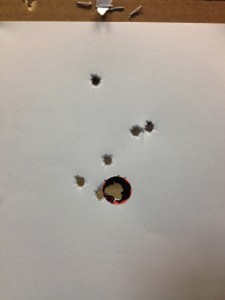
If your target looks like this at 3 yards, you need more practice!

This is the number 1 static range drill and everyone reading has probably done it, but I would suggest you try it again, but set a minimum time between shots. Say 10 seconds. That is enough time to bring the gun down, take a few breaths and aim again. You might find you are capable of better accuracy than you thought!

Dot-Torture Drill

This drill was created by David Blinder at personaldefensetraining.com and can be found here. The instructions are printed on the target, so I won’t waste our time repeating them here. With no time limit required this drill is good for a static range that doesn’t allow rapid fire. If you can’t draw from a holster, use low ready. Once you can clear it at 3 yards, move back to 5. This drill requires a decent understanding of sight alignment and trigger press fundamentals.

Garcia Dots (or The Dots)

This drill was created by Frank Garcia and is recommended by many USPSA shooters and trainers. It is often confused with Dot-Torture but the only similarity is the size of the dot. This drill uses six 2 inch dots arranged in two rows of three. You need a shot timer and you must set the par time to 5 seconds. Upon the beep you draw and shoot 6 rounds into a single dot. You then continue with each remaining dot using the same par-time. Your actual time is irrelevant as long as you can beat the par beep. The goal is all six shots either within or touching the 2 inch circle. The drill is a total of 36 shots and it is scored as misses/shots fired, or 30/36, if you had 6 misses.

The drill is designed for 7 yards, but you should start at 3 yards and work back. Consistently cleaning the drill at 7 yards is difficult for the best shooters, so don’t get discouraged.

You can mix it up and shoot some dots strong hand only, some weak hand only, etc. When modifying the drill I shoot it a few times and see what my average time is, and then I set the par for 0.5 seconds less.

In all honesty I shoot this drill virtually every time I go to the range as a means of warm up. I feel it is a much better training aid than the Dot-Torture, but with its draw and rapid fire requirements it is not useable at most static ranges and it is not for beginners.

Doubles

This is simple drill that helps build speed. It can be done at any distance, but for maximum speed training I use 3 yards. The drill is simple; you draw from concealment and put two shots into the target as quick as you can identify two sight pictures. This is NOT A DOUBLE TAP! A double tap is two shots with one sight picture and normally leads to one shot in the center of the target and the other in the upper region of the target.

It is worth mentioning that some people like to perform a similar drill but only shoot a single round. I have done that and found you can cheat your sight picture and get lucky. Shooting two shots requires you identify the sight picture with each trigger pull.

With this drill you see a flash of a sight picture, fire and the moment the sights are aligned you pull the trigger again. For a target I use a USPSA Metric target or a 6” x 10” box on a piece of printer paper.

My first attempt at this drill was in Ben Stoeger’s Fundamentals class and he made a joke about using a sun dial. Now, using my USPSA Production gear I can average a 1.05 on the drill with good center A-zone hits. From concealment my speed drops to around 1.5 or so, but that is a function of a concealed IWB draw. I promise I didn’t start off that quick – this drill works!

If your range won’t let you draw from a holster you can start at low ready and practice the draw in dry fire. You don’t get the full effect of grip and draw, but you still get the training on sight alignment at speed.

Bill Drill

What type of 7 yard drill list wouldn’t include the quintessential drill? The original Bill Drill, as told by Rob Leatham (go to 1:32 on this video to hear Rob talk about the creation of the drill) was to draw and fire 6 shots into a IPSC A zone as quick as you can get the hits. This drill works on the draw stroke, sight alignment, recoil control and trigger press. You must have all of the fundamentals squared away to accomplish this drill in less than 2.5 seconds.

Personally, from concealment using my S&W Shield, I generally turn in a 2.2 – 2.3  second run. With my USPSA rig I get 2.00 flat. I have gone faster, but that is not the average.

This drill is really fun but there are some downsides; you must have a rather liberal ran to do this drill for one and this drill will eat ammo. 10 runs, which is my minimum for this drill, will eat 60 rounds. But what a way to burn ammo!

For more information here is Caleb explaining and shooting the Bill Drill.

Four Aces

This is the final drill I consider a close range skill builder. It tests your draw, sight alignment, recoil control, ability to quickly change a magazine and then get back on target.   This drill is performed at 7 yards and consists of drawing and firing two rounds into an IPSC A zone or similar sized target, performing a mag change and then firing two more rounds at the target. As designed the gun does not go to slide lock during the mag change, but it is entirely acceptable to do so, just ensure you are consistent each time.

So there you have it, six drills that I have found work wonders within the 3-7 yard range. This list is not comprehensive and a quick search on the internet will reveal an overwhelming amount of drills. Frankly a great many of those drills are crap! The goal of this article was to give the new shooter, or any shooter looking to improve, a solid set of drills to start with. In the next article I’ll give some drills that build your skills at what I consider medium and long-range.

Deal of the day: Burris FastFire with Picatinny mount

Looking for an affordable mini-red dot sight to mount on a rifle or a .22 LR pistol? We have extensive experience with the Burris FastFire series of dots, and I’m a strong believer that they’re an excellent choice for recreational use, which still delivering excellent quality and durability. Get the a Burris FastFire with picatinny mount for only $200 with free Prime shipping.

Pistol Drills – 3 to 7 Yards

As a follow on to my last article, Setting (and Tracking) Realistic Attainable Goals, I wanted to give some drills that will improve your pistol shooting with a target distance of 3 to 7 yards. Some of these will work at a stodgy square “bowling alley” range and others require a more permissive environment.

Bullseye Mode

This is the simplest and works at any range. The goal is to shoot the smallest group possible at any distance. For this drill I recommend cardboard because paper will have a tendency to tear out and make the group appear larger than it actually is. Start close and work your way back. I normally do a run of 6 rounds. You will not get fast with this drill; you need not draw from a holster. The goal is sight alignment, trigger press and breathing.

3 yards

If this is what your 3 yard group looks like, you need more practice!

This is the number 1 static range drill and everyone reading has probably done it, but I would suggest you try it again, but set a minimum time between shots. Say 10 seconds. That is enough time to bring the gun down, take a few breaths and aim again. You might find you are capable of better accuracy than you thought!

Dot-Torture Drill

This drill was created by David Blinder at personaldefensetraining.com and can be found here. The instructions are printed on the target, so I won’t waste our time repeating them here. With no time limit required this drill is good for a static range that doesn’t allow rapid fire. If you can’t draw from a holster, use low ready. Once you can clear it at 3 yards, move back to 5. This drill requires a decent understanding of sight alignment and trigger press fundamentals.

Garcia Dots (or The Dots)

This drill was created by Frank Garcia and is recommended by many USPSA shooters and trainers. It is often confused with Dot-Torture but the only similarity is the size of the dot. This drill uses six 2 inch dots arranged in two rows of three. You need a shot timer and you must set the par time to 5 seconds. Upon the beep you draw and shoot 6 rounds into a single dot. You then continue with each remaining dot using the same par-time. Your actual time is irrelevant as long as you can beat the par beep. The goal is all six shots either within or touching the 2 inch circle. The drill is a total of 36 shots and it is scored as misses/shots fired, or 30/36, if you had 6 misses.

The drill is designed for 7 yards, but you should start at 3 yards and work back. Consistently cleaning the drill at 7 yards is difficult for the best shooters, so don’t get discouraged.

You can mix it up and shoot some dots strong hand only, some weak hand only, etc. When modifying the drill I shoot it a few times and see what my average time is, and then I set the par for 0.5 seconds less.

In all honesty I shoot this drill virtually every time I go to the range as a means of warm up. I feel it is a much better training aid than the Dot-Torture, but with its draw and rapid fire requirements it is not usable at most static ranges and it is not for beginners.

Doubles

This is simple drill that helps build speed. It can be done at any distance, but for maximum speed training I use 3 yards. The drill is simple; you draw from concealment and put two shots into the target as quick as you can identify two sight pictures. This is NOT A DOUBLE TAP! A double tap is two shots with one sight picture and normally leads to one shot in the center of the target and the other in the upper region of the target.

It is worth mentioning that some people like to perform a similar drill but only shoot a single round. I have done that and found you can cheat your sight picture and get lucky. Shooting two shots requires you identify the sight picture with each trigger pull.

With this drill you see a flash of a sight picture, fire and the moment the sights are aligned you pull the trigger again. For a target I use a USPSA Metric target or a 6” x 10” box on a piece of printer paper.

My first attempt at this drill was in Ben Stoeger’s Fundamentals class and he made a joke about using a sun dial. Now, using my USPSA Production gear I can average a 1.05 on the drill with good center A-zone hits. From concealment my speed drops to around 1.5 or so, but that is a function of a concealed IWB draw. I promise I didn’t start off that quick – this drill works!

If your range won’t let you draw from a holster you can start at low ready and practice the draw in dry fire. You don’t get the full effect of grip and draw, but you still get the training on sight alignment at speed.

Bill Drill

What type of 7 yard drill list wouldn’t include the quintessential drill? The original Bill Drill, as told by Rob Leatham (go to 1:32 on this video to hear Rob talk about the creation of the drill) was to draw and fire 6 shots into a IPSC A zone as quick as you can get the hits. This drill works on the draw stroke, sight alignment, recoil control and trigger press. You must have all of the fundamentals squared away to accomplish this drill in less than 2.5 seconds. From concealment, using my S&W Shield, I generally run a 2.2 – 2.3. With my USPSA rig I get 2.00 flat. I have gone faster, but that is not the average.

This drill is really fun but there are some downsides; you must have a rather liberal ran to do this drill for one and this drill will eat ammo. 10 runs, which is my minimum for this drill, will eat 60 rounds. But what a way to burn ammo!

For more information here is Caleb explaining and shooting the Bill Drill.

Four Aces

This is the final drill I consider a close range skill builder. It tests your draw, sight alignment, recoil control, ability to quickly change a magazine and then get back on target.   This drill is performed at 7 yards and consists of drawing and firing two rounds into an IPSC A zone or similar sized target, performing a mag change and then firing two more rounds at the target. As designed the gun does not go to slide lock during the mag change, but it is entirely acceptable to do so, just ensure you are consistent each time.

So there you have it, six drills that I have found work wonders within the 3-7 yard range. This list is not comprehensive and a quick search on the internet will reveal an overwhelming amount of drills. Frankly a great many of those drills are crap! The goal of this article was to give the new shooter, or any shooter looking to improve, a solid set of drills to start with. In the next article I’ll give some drills that build your skills at what I consider medium and long-range.

Post-ignition recoil control vs. pre-ignition flinch

I guarantee one of the first comments on this video will be “nice flinch” – which was the entire reason why I posted it. This post is targeted more at new shooters than our experienced readers, so please feel free to share it with the filthy casuals new shooters in your life.

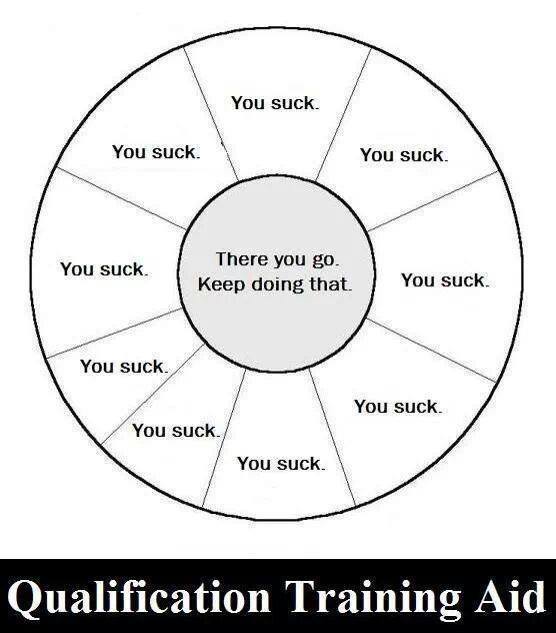
First, let’s take a look at both terms. What is flinch? To put it simply, flinch is when a shooter, for various reasons, attempts to compensate for the gun’s recoil before the gun goes off. The most common reason for this is fear of recoil/muzzle blast, and the result is usually to drive the shot low and to the left (for right handed shooters).

qualification target - you suck

Post-ignition recoil control is exactly what it sounds like. The gun has gone bang and you’re now using your body to control the recoil to bring the gun on target for the next shot. What creates confusion is that to an untrained shooter who is just learning the fundamentals of marksmanship, what I do in the video looks exactly like the flinch that they’ve been told is bad.

To put it simply:

Flinch: trying to control recoil before the gun goes off, bad.
Recoil control: controlling the recoil after the gun goes off, good.

In the video I posted, what happened was I was working on running the gun at speed from the holster. My brain tells my index finger to pull the trigger, and then tells the rest of my body to prepare for the loud noise that is supposed to follow. When the loud noise doesn’t follow, there isn’t enough time for my brain to say “don’t worry about it” so I act to control the recoil, causing the muzzle of the gun to dip. Doing this correctly is an essential skill for running a gun fast. If you spend time watching youtube videos of top pros, you’ll see that in the rare cases when they have a malfunction, their muzzle does the exact same thing.

With new shooters, what you’ll see is the opposite. As they’re pressing the trigger, they preemptively drive the gun down in recoil which causes the aforementioned missed shots. The best way to train this out is to train in dry fire, to get used to pressing the trigger and keeping the gun flat. Then as you get used to shooting, it’s time to start working on speed. Hopefully this post has helped you understand the difference between flinching (bad!) and controlling recoil after the trigger pull (good).