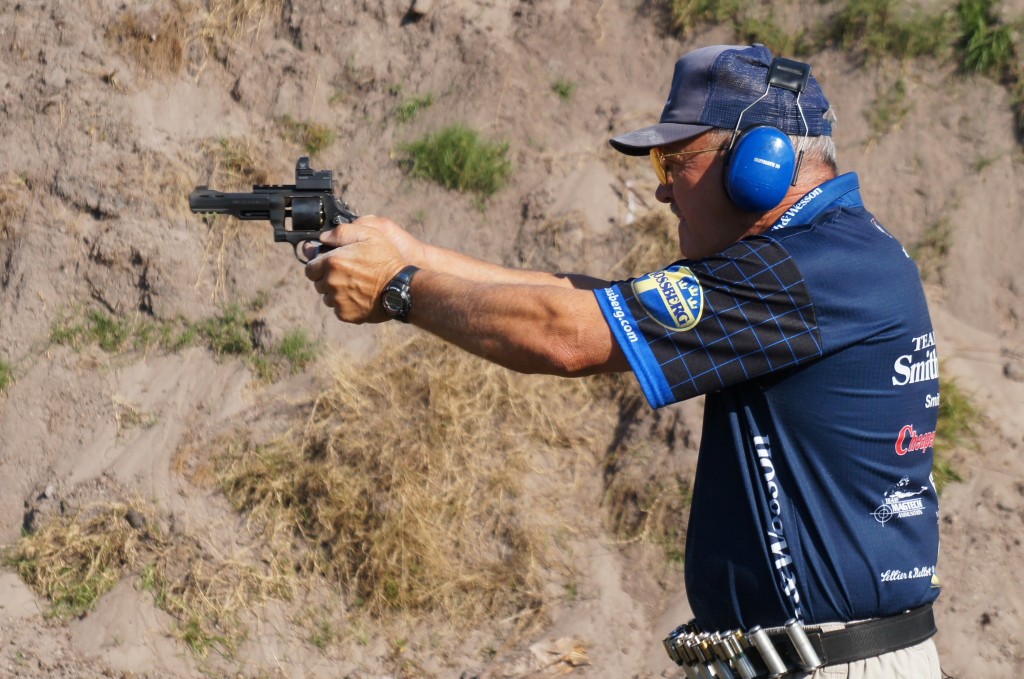
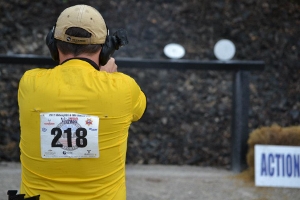
From the 2012 Steel Challenge, Jerry is shooting a S&W 327 that’s been ported and carries an optic in Open/Optical Revolver.
From the 2012 Steel Challenge, Jerry is shooting a S&W 327 that’s been ported and carries an optic in Open/Optical Revolver.
In the comments on the Super Security Six post, a couple of people have asked why I’d convert the gun to a true DAO wheelgun. For the purposes of this post I’m only going to talk about revolvers used for self-defense and competition; large caliber magnum revolvers used for hunting are excluded.
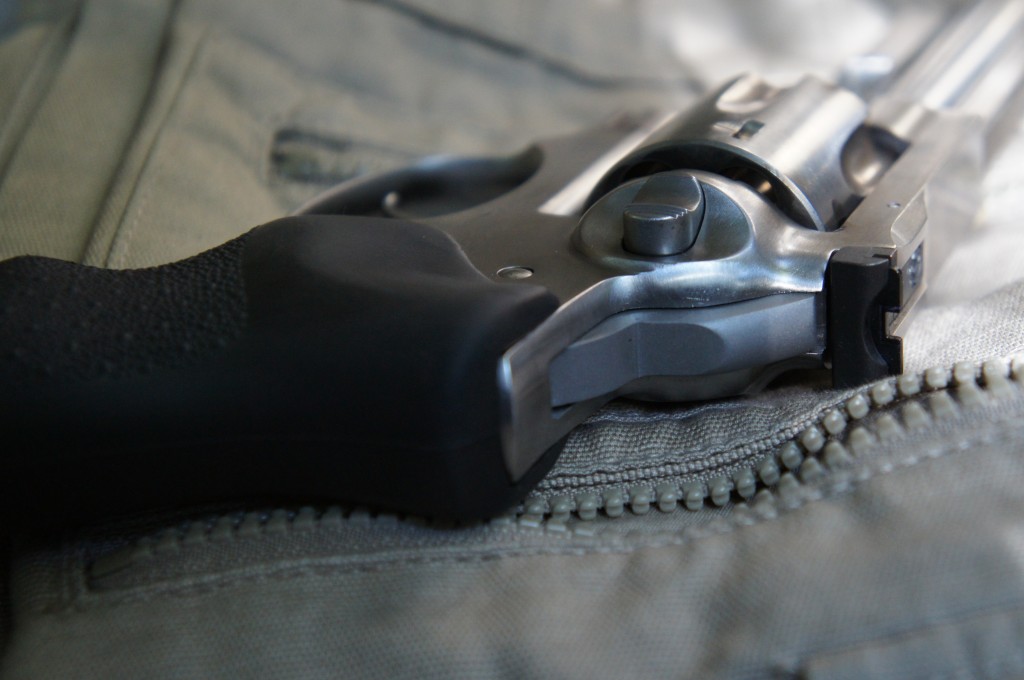
For a competition/defensive revolver there are number of considerable benefits to having the hammer bobbed and the gun converted to DAO. The first thing to note is that single action is basically worthless in competition, and is also pretty worthless in a defensive gun. You absolutely need to be able to shoot your revolver in DA if you’re going to fight with it, or if you’re going to compete with it. So since you’ll never use the SA function on your gun, you can simply delete it.
There are a couple of sound reasons for deleting the SA function of a competition/defensive gun. The first advantage is eliminating hammer bite. I have large hands, so when I’m gripping a revo I get as high as possible on the backstrap. With the hammer on a gun, I can actually bite my hand during DA shooting. Eliminating the spur eliminates that problem entirely. Once you’ve bobbed the hammer, you can then eliminate the SA notch on the gun entirely. This actually smooths out the DA pull a little bit more. It’s not a huge difference, but once the hammer spur is deleted, it makes sense to convert the gun the rest of the way to gain the incremental benefit.
Another benefit of removing the DA function of the gun is an alleged increase in reliability of ignition. The theory is based on maths which I don’t completely understand, but has to do with the force imparted to the firing pin by the hammer. As I understand it, if you take two springs of equal weight (10 pounds) they’re using that energy to accelerate the hammer. A hammer of lighter weight will accelerate faster and to a higher speed than a heavier hammer if being driven by springs of equal weight. More hammer speed = more force hitting the firing pin. Science!
Ultimately the best reason to remove the SA function from a competition gun is to remove the temptation. Shooting your guns in single action for defense and competition is bad and creates poor habits, so just get rid of it entirely.
The capacity question is not defined entirely by the speed with which you can pull the trigger when you believe someone is trying to kill you. There are other concerns, and just as we did last week let’s look at more footage from a real shooting to illuminate the discussion, this week focusing on the idea of managing your on-board supply of ammunition:
The lapel camera is a relatively recent technological innovation that many police officers around the nation are readily adopting as a self defense measure. The footage here gives us the closest thing we’re likely to get to seeing a shooting through the officer’s eyes, and provides us with some invaluable insight into how even a trained person reacts under extreme stress.
First, note how many shots the officer fired. As I stated last week, you do not need a roving gang of bikers or a zombie apocalypse to motivate you into emptying the magazine of a typical double-stack semi-automatic pistol. Just one dude out to kill you is plenty of motivation to work that trigger as fast as you can until you’re reasonably certain that he is unable to continue fighting. The officer in the video fired 16 shots in self defense. The careful viewer might have noted that it took the officer about 4 seconds to fire those 16 shots, falling directly in line with the 1/4 second rule noted in last weeks post. Faced with what he believed was a threat to his life, he drew his weapon (an excruciating 3 seconds after the bad guy pulled his) and fired his sidearm as fast as he could make it work. Note that this tends to be a pattern when you look at footage of actual shootings.
The 16 shots without slide-lock tells us that the officer’s Glock is probably a G17, which most police agencies typically mandate to be carried with a full 17 rounds in the magazine plus another in the chamber. After the officer fires his 16 shot volley (while backing away from the threat) he radios the shooting in and attempts, from a distance, to try and assess the status of the threat he just shot at 16 times. Take a second to ponder the significance of that. We can see from how he interacts with the officers rolling to back him up that he’s not sure what, exactly, the bad guy is up to. Note also that he does not perform a reload. Most likely this is because the officer has absolutely no idea how many shots he’s just fired. It is extremely common under stress to be unable to recall how many rounds you fired in self defense, to the point where many self defense experts who have experience in the legal system advise strongly against ever attempting to make a definite statement about how many shots you fired.
I once trained with an instructor who told the tale of one of his on-duty shootings. Serving a warrant he ended up face to face with a bad man armed with a gun. My instructor was a little bit faster to get his weapon, an MP5, on target than the bad guy and he opened fire first. In the aftermath he said that he told investigators that he thought he had fired 5 or 6 shots, but couldn’t be sure because he was too busy trying not to die to count his shots. In reality he fired 18 shots into the bad guy.
So why does this matter? Let’s return to the situation in the video: The officer has just engaged someone he believes was out to kill him. There’s no backup yet. He’s utterly alone, facing a threat he’s not sure of, and he’s got a maximum of two more shots in his weapon before he runs dry. I hear people talk a lot about how they’ll manage ammunition in a gunfight, but you know what? I don’t believe a word of it. I don’t think the average person is capable of executing a sophisticated ammunition management plan when they believe somebody is out to end them. There’s a significant body of evidence out there to show that the first clue someone is going to have that they’re low on bullets is when the gun stops going bang. This officer’s weapon didn’t stop making loud noises, and with the stress-induced distortion of perception he has no idea how many rounds he’s fired. On top of that, he’s got a lot on his mind.
Note the officer’s breathing after the shooting stops. He’s feeling the full effect of adrenaline. He didn’t move very far or do any physically strenuous activity, and yet he’s breathing like he just busted out a 5th set of squats with a new personal record. Note the officer’s statement after he calls for help…”Son of a bitch!” The average mind will not be in a state of zen in these circumstances. The average mind will be racing with all sorts of questions, emotions, and concerns. “Oh, god! What the hell just happened? How much trouble am I in? Am I going to get sued? Am I hit? Where the hell is backup?”
On top of that, there will be a constant worry about the guy they just tried to stop getting out of the car and trying to finish what he started. The mind with superior training will still be racing, but will be sufficiently innoculated to stress that it is focused on things that increase the chances of survival. Useful actions like seeking cover or checking the status of one’s weapon do not come automatically to the untrained person. Proper training does not eliminate stress, it simply acclimates the trained individual to the presence of stress so they can learn the mental discipline to accomplish useful things while feeling the effect of it. This is why enduring a number of crash simulations is a prerequisite for flying fighter jets or commercial airliners. It’s why advanced emergency medical training sometimes involves slicing a pig’s femoral artery open and requiring the trainee to stop the bleed. It’s why advanced skydiving certifications require simulating a parachute failure.
On the internet I often see people arguing about the “lull” in a fight that’s supposed to allow for a tactical reload. In the video here we’re presented with a pretty sizeable “lull” in hostilities…but here’s the thing about “lulls”: It’s really easy to identify a lull using video footage from the safety of a keyboard. It’s a very different matter when you’re standing a few feet away from someone who just tried to kill you, heart pounding through your chest, mind racing, and breathing like you just tried to backpack a Buick up Everest. Unless you have irrefutable visual proof that the bad guy you just tried to shoot is unable to continue, (like seeing the contents of his cranium on the pavement) you’re going to be pretty darn worried about him resuming hostilities.
With all of this going on, and all of these factors in play, I’m very skeptical that most people are going to be anywhere near as good at managing their ammo supply as they think. Most people toting a firearm for self defense are not as well trained as the officer in the video. It’s absurd to believe that they’ll somehow exhibit the behaviors of the exceptionally experienced and well trained without the actual experience or training that makes those behaviors possible.
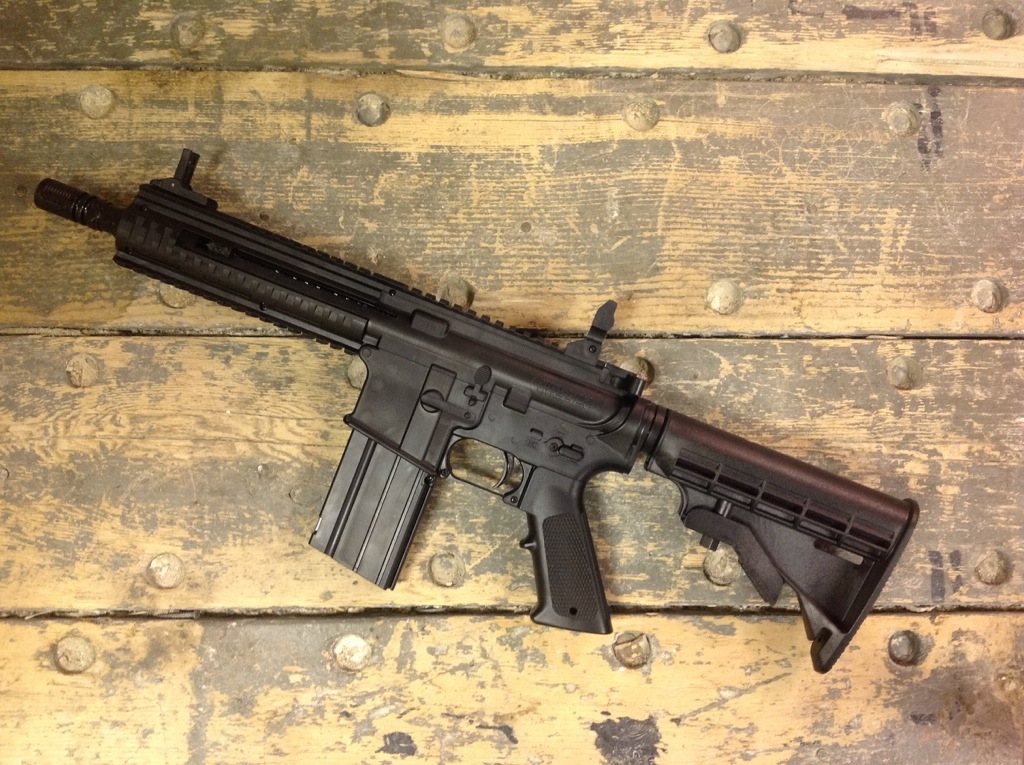
Want to shoot a full auto BB gun? The Umarex Steel Force is less than a $150 bucks and is a hoot.
There is no magical Goldilocks Zone of shooting speed. Being faster is never a bad thing. If someone makes an error while he’s going so fast then the issue is the mistake, not the speed.
From this post at Pistol-Training which also addresses one of the issues with the current state of pistol instruction, namely that “people other than me are wrong.”
I’d like to focus in on the one statement about shooting speed – because it also applies to accuracy. There is no such thing as too fast, and no such thing as too accurate. There are times when it’s important to sacrifice accuracy for speed, and times where it’s important to sacrifice speed for accuracy. It’s a very poor instructor who insists that the speed they shoot at is the “best” speed. Similarly, it’s a poor instructor that teaches only their level of “combat accuracy” as necessary.
But here’s the rub, and it’s something we’ve touched on here before. Time. It takes time and dedication to get faster and more accurate, and the level of speed and precision required to win IDPA Nationals is probably a lot higher than the level required to be competent enough to defend yourself. The reverse of that statement though is that if you’re preparing at a very high level, you’ll be even better equipped to defend yourself. This leads to the inevitable discussion on how you should allocate your training time, which is a really fun discussion of risk acceptance; but is also beyond the scope of today’s post.
The bottom line for today’s post is simple: there’s no such thing as too fast or too accurate. Unless you’re going so fast you can’t get situationally accurate hits; or if you’re being so accurate you’re going too slow. Examples: you’re shooting 0.18 splits but can’t keep all your shots in the 0/-1 zone of an IDPA target, that might be too fast. Or if you’re shooting one hole groups on an IDPA target at 7 yards, but taking 1.00 second splits. The key here is that you have to be able to analyze and understand the situation you’re in, whether it’s a match or self-defense. We see a lot of first time match shooters pick one speed on a stage and shoot every target at that speed, whether or not it’s an appropriate speed. If you watch top shooters navigate a stage, you’ll be able to hear their splits change depending on the target engagement.
The shooting sports are a great trainer about thinking with a gun in your hand; yes you get a walk through and time to mentally prepare for the stage, but that doesn’t negate the value in learning to change your speed while you’re actually shooting. I encourage everyone to not rely on gun store wisdom like “a slow hit beats a fast miss” or the equally overused “slow is smooth and smooth is fast.” Instead, get out there and actually shoot. Do drills that require you to transition from hard to easy targets and back and forth. Learn your own speeds, then push those speeds.
The US Supreme Court has agreed to hear the case of Abramski v. United States. The meat of the case is that Abramski, a former police officer legally purchased a Glock handgun, which he then sold to his uncle, a resident of PA. Both transactions were conducted through FFLs, and both parties were legally entitled to own guns.
SCOTUS could clarify and review two important areas in this case; the first being what clearly defines a straw purchase, and the second could also be what defines “engaged in the business” of selling firearms. Right now, the only clear definition of a straw purchase comes from the 4473 form itself, which states:
For the purposes of this form, you are the actual transferee/buyer if you are purchasing the firearm for yourself (e.g., redeeming the firearm from pawn/retrieving it from consignment, firearm raffle winner). You are also the actual transferree/buyer if you are legitimately purchasing the firearm as a gift for a third party.
That actually leaves a lot of room for interpretation, unfortunately. In the case of Abramski, there is some interesting back story as well. Abramski was originally arrested for bank robbery, which the authorities were unable to get sufficient evidence to prosecute for; the records relating to the transfers were found during searches of his house. Apparently the .gov decided to go after him for the straw purchase after failing to prosecute for the alleged bank robbery.
Gun Nuts will continue to follow this case, because rulings on the definition of a straw purchase will have an immediate affect on gun owners across the nation. There is a lot of gray area in the law that could be impacted by this ruling.
Everyone should have a laser on their defensive handgun. Rifles too, because a rifle with a laser on it is super quick in CQB situations. But rifle lasers are another post entirely, and have to deal with other issues that are beyond the scope of this post. Here we want to deal strictly with handgun lasers.
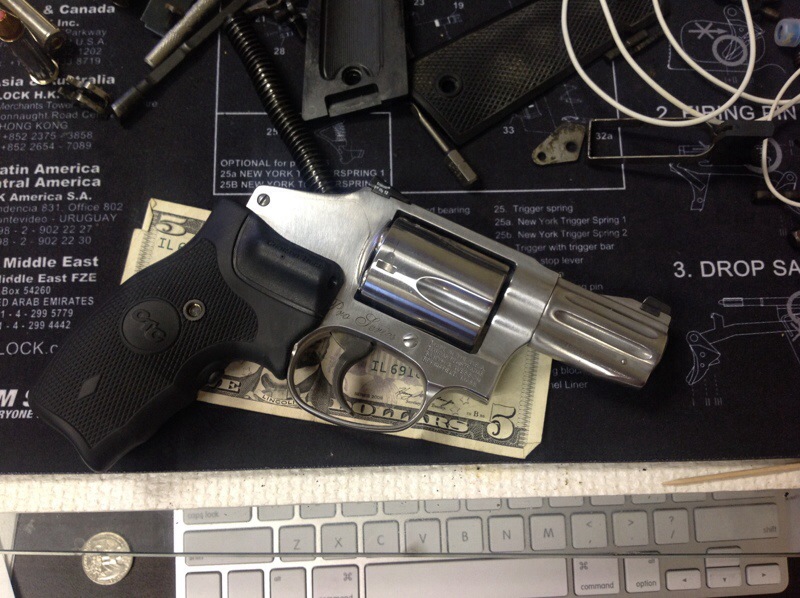
The king of the camp of handgun lasers are the Crimson Trace Lasergrips. They provide the most important aspect of a defensive handgun laser, which is instinctive activation. When you naturally grip the gun, the laser activates. Simple as that. If you’re worried about light discipline, on many models you can block the beam emitter with your index finger (if you’re right handed). A great advantage of the Lasergrip design in addition to the instinctive activation is that you don’t need to buy a new holster to fit your gun. The factory holster will continue to work just fine.
Second on the list are the Laser Guard products from Crimson Trace. These also allow for instant activation, but mount on a pistol’s rail system. They require a new holster for your gun, but because the body of the device is a bit larger than with a Lasergrip, the ‘Guard models can accommodate both red and green lasers, as well as weapon lights. A pretty slick set-up for a defensive M&P is a Lasergrip on the back, and a Lightguard on the front.
Recently, Crimson Trace came out with the Rail Master series of lights and lasers. These don’t have instinctive activation, and mount on your pistol’s rail. They’re available in red and green lasers, and also as a weapon mounted light. I actually like the Rail Master series a lot better on rifles than I do on a pistol, because they’re incredibly light and compact, but somehow are quite rugged as well. CTC also launched the Defender Series recently, which I know nothing about and have no recommendations one way or the other.
There are other companies that make laser products on the market. I have never used any products from LaserLyte, and have only used one product from LaserMax. I don’t recommend them, not because I don’t think they’d work acceptably, but mostly because why not just go for the best out of the gate? You’d be hard pressed to find a reputable industry expert that doesn’t recommend having a laser on a defensive firearm, and most of them recommend Crimson Trace.
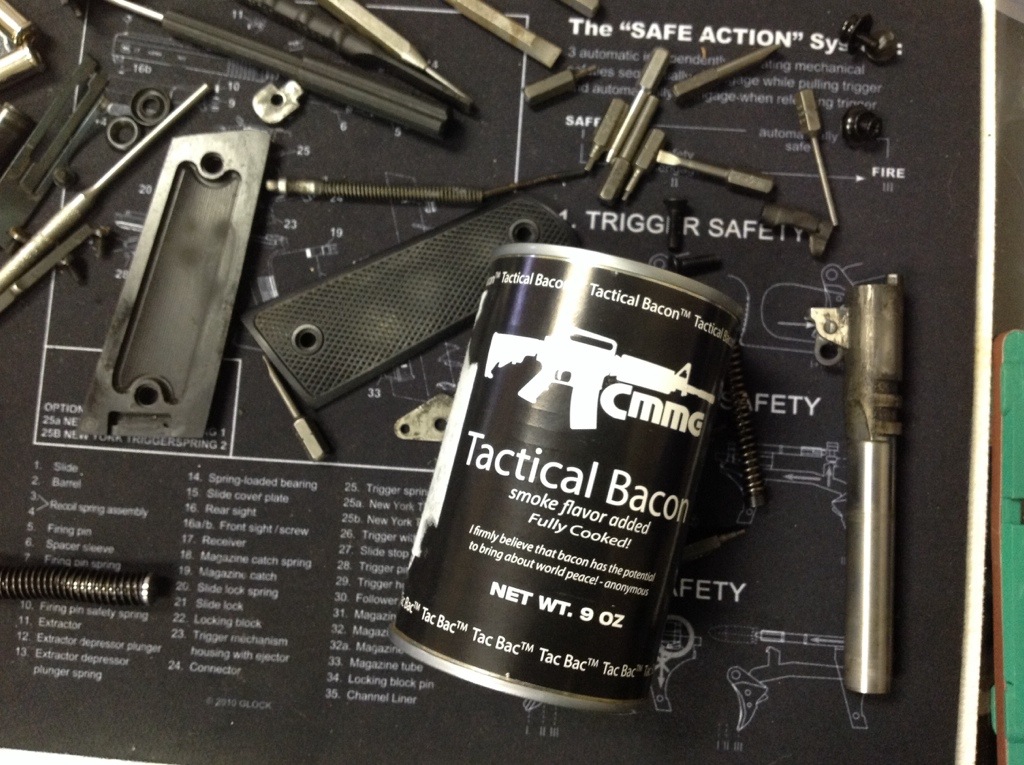
I received this as a gag gift years ago. I still have it. I don’t want to open it, because I’m afraid. Also, a 1911 exploded on my desk.
Right now, my stainless Security Six is at Clark Custom Gunsmiths getting turned into the Super Security Six.
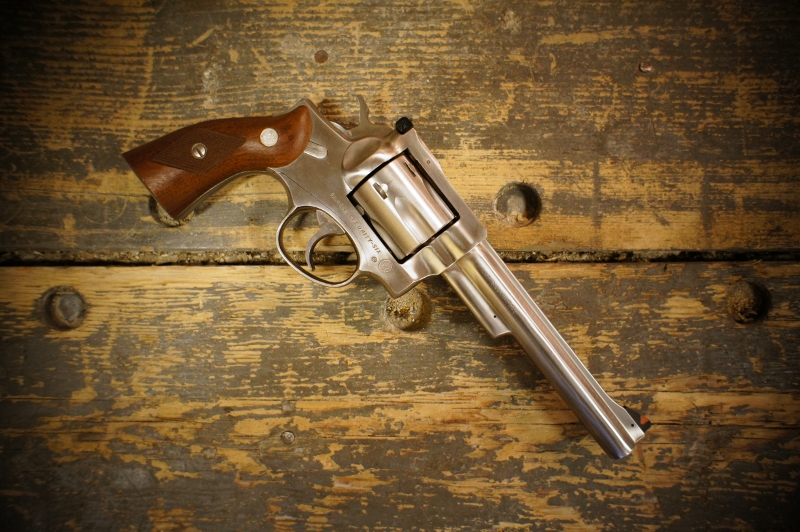
Remember, this is the stainless 1982 gun, not the blued 1970s gun. The stainless gun is getting turned into an action shooting machine by Clark. The first mod is an action job, which I’ve specified must be left heavy enough to crack factory primers. Because my ammo situation is frequently catch-as-catch-can, I don’t have the luxury of having the action tuned so light that it will only crack crush-fit Federal primers.
The next important modifications are the removal of the hammer spur, and the removal of the SA notch on the hammer itself. This will convert the gun to a true DA gun, which is what I prefer for Bianchi Cup. The final mod will be cutting the gun for moonclips. I like moonclipped guns for a number of reasons, not the least of which is that I never lose my brass. I’ve struck a deal with an ammo company to provide brass for them to load, and keeping Starline .38 brass around is always a good thing. Plus, if I want to shoot USPSA revolver, moonclips are a must.
I’m looking forward to seeing the finished product from Clark, it should be a great gun. To complete the retro competition gun, I’ve ordered a Tyler T-Grip to give me a little bit more gripping area.

Your votes are in, and now the brackets for the Gun Movie Throwdown are set. Here are the four final brackets. The individual throwdowns will commence on Thursday, with the 1 seeds taking on the 8 seeds in each bracket. The way winners will be decided is simple: of the two movies, I’ll present my opinion for the strengths/weaknesses of each one, then we’ll let the commenters decide which they think should move forward. Here are the final brackets.
War/Military
Western/Period
Action/Sci-Fi
Note: Lethal Weapon was moved from the Drama/Thriller category into the action category. We’ve selected three films to fill out the Drama bracket as a result.
Thriller/Drama
There are your brackets for the 2013 Gun Nuts Movie Throwdown! And here are your matchups for Thursday, so prepare your arguing helmets: