Space gun showdown: FN PS90 vs. Beretta Cx4 Storm

In the mid 2000s, the Sci-Fi channel was full of space-age guns as props in television shows. Two of the most prominent were the FN PS90 in Stargate SG-1 and the Beretta Cx4 Storm in Battlestar Galactica. But in the real world, which of these two lightweight carbines stands on top of the sci-fi gun heap?

FN PS90
The PS90 showed up in Stargate SG-1 as the primary weapon of the Space Assault Guys, or whatever they were called. Of course, it was in its full rock-and-roll P90 version with the stubby barrel. Its primary roll in the show was full auto magazine dumps in the general direction of badguys, A-Team style. Still, it looked cool, and that’s important. In fact, it looked so cool that it was originally used in Battlestar Galactica. The prop department of BG eventually dumped it specifically because it was all over SG-1, and they didn’t want their cool gun to be the same as the other show’s cool gun.
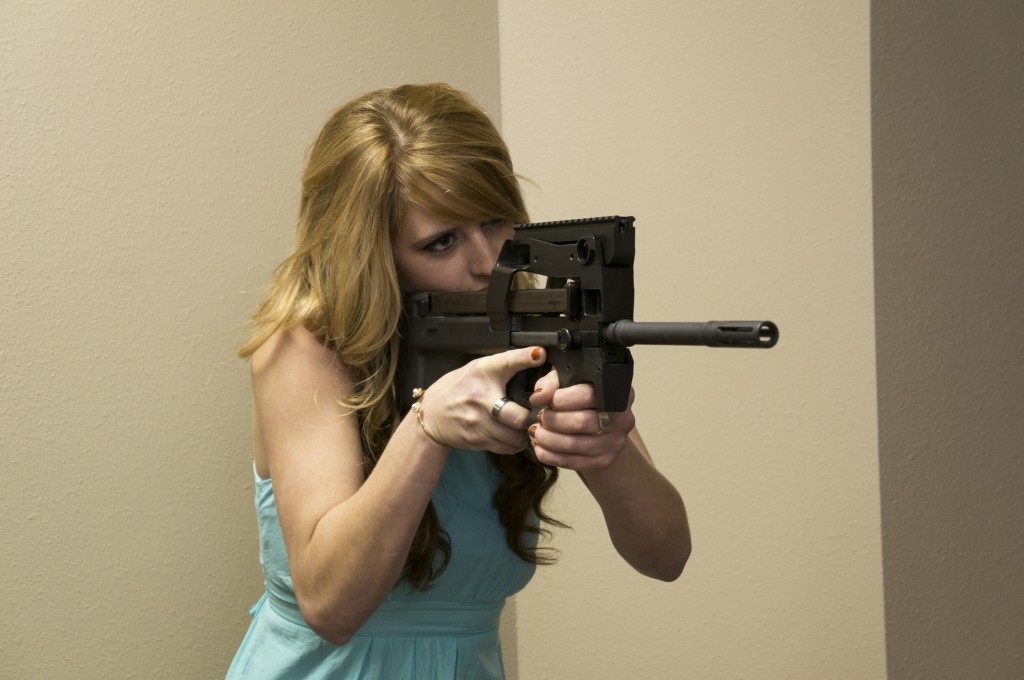
JoJo_close

In the real world, the PS90 is chambered for the unique 5.7×28 cartridge. It is generally only available to civilians with a 16 inch barrel, which remains quite compact thanks to its bullpup configuration. Like most bullpups, the trigger is spongy and soft, and the support hand is positioned very close to firing hand when gripping the weapon. However, it’s easy to forgive the PS90 for the general ergonomic awfulness of bullpups, because of its 50 round magazine, which loads from the top of the gun. It’s actually easier to reload than a conventional bullpup, because at no juncture do you need to stick a magazine in your armpit. Plus, it’s 50 rounds of fun.

Beretta Cx4 Storm
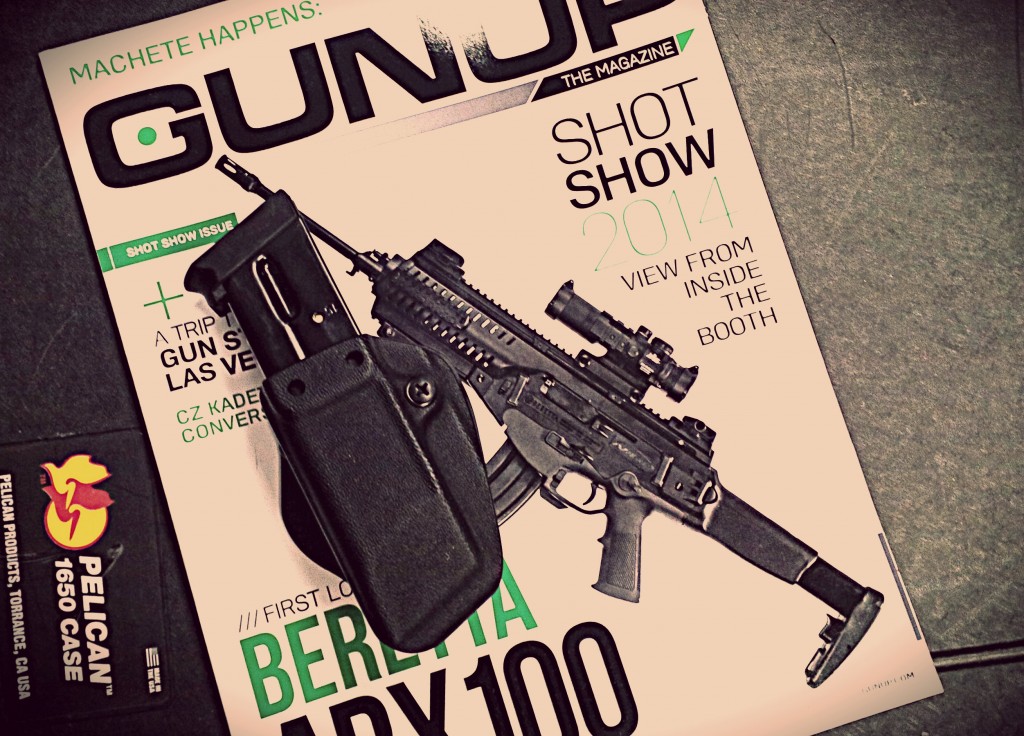
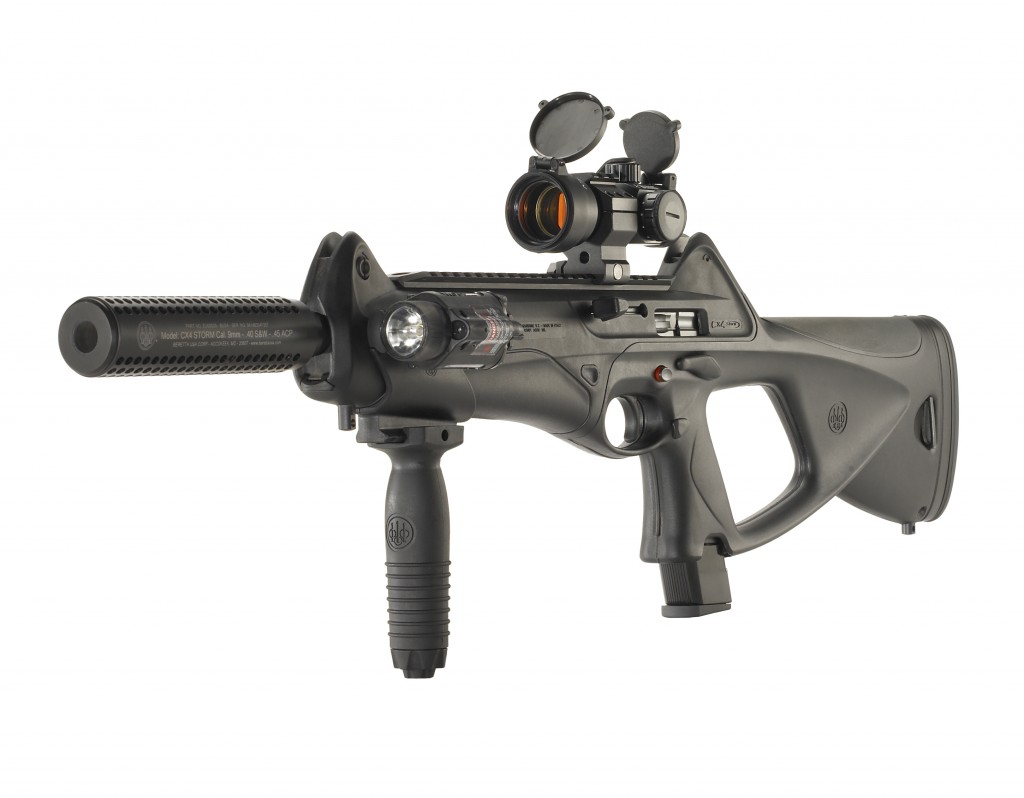
The Cx4 Storm made its Sci-Fi debut in Season 2 of Battlestar Galactica, as the primary long gun of the Colonial Fleet Marines. Knowing that the Storm carbine is generally chambered in 9mm, it requires a bit of a stretch of the imagination to see it taking down armored Cylon warriors, but hey, it’s called science fiction for a reason.
CX4_3-4

In later seasons of BSG, the Storm would be supplemented by the even smaller caliber HK MP7, but for most of the show’s run it was the primary long gun featured. In real life, the Storm is a neat design – a straight blowback carbine available in 9mm, .40 S&W, and even .45 ACP. It’s designed to share magazines with Beretta’s 92 series and Storm line of pistols. Back in the late 90s, there was a push in law enforcement communities to issue officers pistol-caliber carbines that shared magazines with their duty guns, giving them the ability to make longer range shots than a pistol or shotgun offered. Obviously, the current trend is to simply issue a proper rifle to officers, but still to this day the pistol caliber carbine offers some advantages and fun for the budget/recoil sensitive shooter.

The Winner
First, it’s important to note that Battlestar Galactica was a much better TV show than Stargate SG-1. That in itself is import. What’s even more important is how these guns would be used by the average shooter. The PS90 is cool, no doubt about that. But it’s designed around a boutique cartridge that’s really best when used full auto. Ammo is expensive and not always easy to find in 5.7×28. The gun is also expensive, with retail well north of $1,000.

On the flip side, the Cx4 Storm is available in 9mm, which is (generally) readily available and extremely versatile. It would make an excellent home defense carbine, or a fun rifle to shoot out at the range. Ammo is cheaper, easier to find, and the gun itself is much cheaper, usually retailing for around $600.

The PS90 would be the choice if all I wanted was to look cool. The Cx4 Storm however is the overall winner – it looks cool, and it’s just a bit more practical for every day life.

“Gotcha” Force on Force training

I am frequently skeptical of force on force training as a way to pressure test self-defense skills. Because most Force on Force (FoF) is scenario based, it’s very easy to construct contrived “gotcha” scenarios that leave the student without a better understanding of their own skills, or the application of deadly force. This post was spurred by a thread on Pistol-Forum, an AAR about a FoF class. Here’s the relevant scenario:

Scenario is, you’re going to pick up your teenage child from the mall. As you’re approaching the entrance, several distraught individuals pour out of the doors, panicked, screaming that some guys are fighting, one of them has a knife. You go inside and find that it’s your kid that’s got the knife, and is stabbing someone on the ground. As I was yelling at “my son” to stop, another person with a gun steps out from behind a corner, also screaming for him to drop the knife. Kid doesn’t drop the knife,I yell at the other guy to drop his gun, other guy shoots “my son” and I, of course, light him up. This one actually turned into a running (waddling in my case) gun fight. I got hit once in the left shin, but put most of two magazines (loaded with 5 rounds each) into the other shooter. Once again, even while trying not to get shot, I didn’t fumble my reload, I was VERY proud of myself on that one.
Story on this one was, “my son” got jumped by a group of guys that he’d been having problems with at school. He was defending himself. The other guy was a CCW holder that came onto the scene after the main group of BGs had run off, saw one guy stab another guy, told him to drop the knife and the guy didn’t, his shot was justified. I just saw some guy shoot “my son”, I was completely justified in dropping him. This scenario was designed so that it wasn’t really possible to have a happy ending, but rather, it made you think about EVERY single detail in the discussion afterwards.

new edc knife (800x449)

This is not a knock on the class, the student, or the instructors; from reading the AAR the other two scenarios were pretty reasonably constructed to simulate real life situations. But that third scenario really is a perfect example of the Kobayashi Maru scenario, because there’s no way to win. There was a video that went around a while back of a FoF event where the instructor, playing the badguy climbed up over the doorframe of the classroom to shoot the assaulters when they entered, because they hadn’t thought to scan directly above the doorway.

The point isn’t to knock FoF training. There are plenty of good FoF classes and events out there; our own Tim has attended Southnarc’s excellent EQCC class, and the same Southnarc also teaches the highly recommended Armed Movement in Structures (AMIS) class. Force on Force training can be extremely valuable for people interested in self-defense, so long as it’s conducted intelligently. That’s the most important part. It’s very easy for instructors to construct scenarios where the student can’t win, which doesn’t really accomplish anything. To return to the scenario written out; let’s just briefly examine that. What do you think the odds are of one of your kids getting involved in a knife fight at the mall, and you encountering another CCW holder who shoots your son. It’s so far outside the realm of what you’re likely to encounter that it’s damn near ludicrous.

Get training! If you’re serious about improvement as a shooter or self-defense, training is essential. But it’s important to be able to sort out good scenarios from fantasy-land. Some FoF scenarios are realistic and worthwhile. Others are just IDPA stages with simmunitions. And if you’re going to shoot an IDPA stage, it’s a lot more fun with a real gun.

GCode single magazine pouch review

The Lionheart LH9 I’ve been testing came with some additional pieces of gear: a GCode OWB holster and a double magazine pouch. The double magazine pouch was…not good. However, in the spirit of the test, I went ahead and ordered a pair of the GCode single magazine pouches to continue the test with. Generally speaking, I prefer single pouches to doubles anyway. Double magazine pouches tend to be harder to adjust the retention correctly. Usually what happens is you’ll have one of the pouches adjusted just so, but the other pouch will either be Kardashian-loose or tighter than…a very tight thing.

gcode magazine carrier

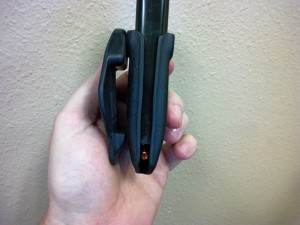
The GCode single magazine pouch is a single piece of injection molded plastic that uses a single screw for retention at the top of the carrier body. The belt attachment is an easy-on/easy-off clip which appears to be sized for a 1.75 inch wide belt. The retention level was set so tightly when I took the pouch out of the bag that after I had successfully removed the test magazine, I half expected to be crowned king of England. However, the single phillips head screw is easy to adjust, and setting the pouch to a more reasonable retention was a piece of cake.

IMG_00000709_edit

Once retention was set, pulling a magazine from the carrier was very fast, thanks in part to the front opening of the pouch. It feels like there’s less drag on the front of the magazine when you’re pulling it from the carrier than there is with similar high-bodied carriers. That brings us back to the design of the carrier – it holds the magazine very deep, much deeper than I’d like, actually. However, I understand that this magazine carrier wasn’t designed with competition in mind. Unlike my low cut Comp-Tac or Blade-Tech pouches, which were engineered with the gun games in mind, this is obviously designed more for concealed carry.

As a CCW pouch, it works just fine. While it won’t conceal under an untucked extra-smedium polo from Baby Gap, it works just fine under an open shirt (preferably red and Hawaiian) or under a vest. The paddle attachment makes it a little to large in profile to be a great magazine carrier for CCW, though. I’d prefer belt loops like the Blade-Tech Eclipse pouch.

To sum up the CGode pouch, I’ll have to borrow a phrase from Jeremy Clarkson. He said, when describing a Toyota Corolla hatchback “that is some car” – meaning “yes, that is a car, and it will do various car things, but none of them spectacularly.” The GCode single magazine pouch then is “some magazine pouch.” It’s $22, so it’s not cheap, but it’s not crazy expensive. It’s not great for competition, and it’s not great for concealed carry, but it will do either reasonable well if asked to.

Run it ’till the wheels come off

Here’s a video of me shooting the IDPA classifier with a raw time of 50 seconds. The purpose of doing this was to shoot it so fast that I was basically out of control; I dropped a spectacular amount of points and finished terribly. But, the value in this is that I learned a max speed. After this run, I shot it again and pulled the speed back just a little bit – my raw time increased to about 65-70 seconds, but my points down dropped dramatically. Sometimes, you have to go out of control to realize how fast you’re capable of shooting.

4 Reasons I’ll never go to Front Sight

There are a lot of great training schools and instructors out there. Long time readers of the blog know that I’ve never included Front Sight in that list, and there are good reasons for a lot of that. If Front Sight was just a training school using obsolete techniques, that would be one thing. But there are many, many problems with Front Sight that extend beyond just their training.

front_sight

1. Doctrinal Weaver
Let us be honest for a moment: Weaver is obsolete. Modern Isosceles, as used by every top tier shooter on the planet, is better. Yes, you can absolutely prevail in a self-defense situation using Weaver, and a well trained Weaver shooter is very capable. However, Front Sight teaches Weaver as The Only Way, and still teaches it as close to the original Modern Technique as possible. Even Gunsite, the fountain of Weaver has adapted their stance over the years. That’s why I always tell people, if you want to learn how to shoot Weaver properly, go to Gunsite. They started it.

2. Their prices are insane
Front Sight’s 2 Day Handgun Course is $1,000.00. You read that correctly, that’s one thousand American dollars. Which doesn’t include lodging or travel. Their four day pistol class is two grand. $2,000 is a lot of money, and again it doesn’t cover travel. By contrast, InSights Training Center’s 2 Day General Defensive Handgun class is $450 per student, and is located in Bellevue, WA surrounded by decent hotels and restaurants instead of BFE, NV. Or if you want to take Gunsite’s 5-Day 250 Pistol course, it’s $1585. Which is cheaper than Front Sight’s two thousand dollar four day course.

3. Their instruction is mediocre at best
I’ve had students in my classes that are Front Sight graduates, and I’ve know shooters who were Front Sight instructors. The the students had to nearly be re-taught how to shoot, as their time at Front Sight had left them with dismal skills, to say the least. The instructor I knew was no better – the only thing he was actually good at shooting off was his mouth. This also matches up the AAR’s I’ve read from skilled shooters that have attended Front Sight.

4. Dr. Ignatius Piazza
The most important reason I’ll never go to Front Sight is their founder. I could ignore the six-sandwich condiment master certification, and I could ignore the terrible, spammy marketing that come out Front Sight. But I can’t ignore the Scientology and the fraud. I’ll have no truck with cultists or fraudsters. Going to Front Sight would directly put money in his pockets, and I’ll have no part of that.

We live in a golden age of training. You can’t swing a dead cat without hitting a firearms instructor these days, and that’s a good thing. So why, in this glorious land of opportunity would you ever spend money supporting Scientology going to Front Sight? For less money you could go to Gunsite or InSights, you could take a class from Chris Costa for less. Hell, for two grand you could fly me out to your range and I’d teach you 1 on 1 for three days.

My love/hate relationship with the 1911 – The Hate

Did you ever go out with someone that you were absolutely crazy about, only to find out somewhat later that she was actually crazy? You manage to get clear of the meltdown without getting burned too badly, but even though you know that moving into a little flat in Chernobyl would be safer than getting her back into your life there’s still this completely irrational attraction you can’t shake off. Every now and then you go to a party or an event and she’s there, and heavens does she look amazing. In the moment you see the smile and the cute way she brushes her hair back behind her ear when she’s flirting…and things start to happen. Your olfactory receptors are catching the subtle scent of her perfume, triggering all sorts of memories to the point where you can practically feel the dopamine hitting your brain like a warm summer breeze. She is beautiful, isn’t she? Didn’t you two have some amazing times together? The few neurons in your head that aren’t bathing in all the feel-good chemicals swirling around up there remind you that she’s actually quite mad. She may be blushing slightly and smiling innocently now, but you know from hard experience that she’s capable of pulling your still-beating heart from your chest, taking a great big bite out of it, and then spitting it in your face…all while wearing the exact same smile. Yet there you are, still talking to her. Agreeing that yes, you really should get together and catch up sometime…

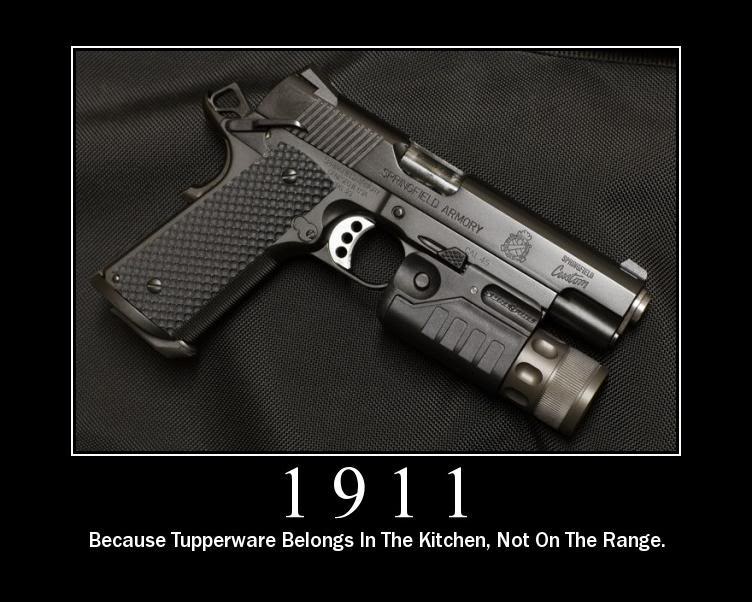
Oh, right. This is a gun column. Well, that perhaps slightly too biographical description works pretty well to sum up my feelings on the 1911. I spent my formative years in the closing era of gun magazines as an authority on firearms, which means I was routinely exposed to centerfold quality pictures of finely crafted 1911 pistols. I developed a particularly strong attraction to Colt Gold Cup and Delta Elite pistols that had been customized. Sometimes when I’m sitting in a meeting I’ll Google image search “Gold Cup custom” (I have such a window open right now…yes, I have a problem) and gawk at the results until I’m as glassy-eyed as all the other people in the room…only I’m thinking about 1911’s while they’re just feeling the life force being sucked out of them into the gaping maw of pointlessness caused by listening to the most boring human being on planet earth give a mandatory lecture on information nobody in the room really cares about. motivational1911

I also happened to be doing a lot of shopping as the 1911 was seeing a renewed popularity in the market due to a liberalization of concealed carry laws and the ridiculous Clinton assault weapons ban limitation on magazine capacity. If you’re stuck with 10 rounds in your pistol suddenly the appeal of the wonder-nine guns was somewhat diminished. Kimber and Springfield Armory started producing 1911’s with desirable custom features like extended thumb safeties, beavertail grip safeties, and Novak sights for less than the cost of what you’d pay for a plain-Jane Colt 1911 that would need to have all that work done at a custom shop.

Armed with all the quality knowledge about the 1911 you could get by drooling over gun magazine centerfolds, drawn by the allure of the custom 1911 praised to high heaven by gun writers, and now with the added consumer idea that everything you could ever need in a 1911 was available on the cheap, I plunked down the (still quite large) amount of money for one and absolutely loved it. Right up until the moment I tried to shoot it. When it couldn’t cycle through a magazine without a stoppage and the rear sight flew off, I started to wonder if perhaps there’s a reason why this was cheaper than a Colt customized in a competent shop. I fettled and futzed and sent the gun back to the manufacturer and they returned it to me saying it was working. Fantastic! Except it still didn’t feed harball reliably on the next range trip. Worse, somehow the plunger tube had been dented enough to freeze the safety plunger in place, allowing the poorly made/fitted safety to flop around like a fish you just pulled in the boat. Turns out that the plunger tube was made of metal so soft it bent like the silver wrapper on Wrigley’s chewing gum.

That pistol was replaced by a couple of others…and, predictably, they didn’t work right either. I learned the hard way that while there were certainly a lot of 1911 pattern pistols on the market, there weren’t a whole lot of people out there building them properly. At first I thought it was just me, that maybe there was some ancient 1911 ritual wherein you anointed the pistol and the Wilson magazines you bought for it with the blood of a virgin conceived during a full moon that I wasn’t doing right. Research and talking to people much smarter than me led me to the conclusion that if you want a reliable 1911 with no problems, you had to go custom. So I did…and I finally got a 1911 that worked! It cost more than 3 times what a Glock was selling for, but by gum I finally had my 1911 and I now knew the key to the 1911 universe. Just go custom and it’ll work!

At least that’s what I thought until I started attending training and saw other guys packing custom 1911 pistols that cost even more than mine did who couldn’t get them to work. One individual showed me a gun he paid over three thousand dollars for that had been back to the smith he bought it from six times without positive result. Worse, the smith had basically told him to go pound sand and that he wasn’t going to do anything else on the gun. I found this very disturbing and asked around and it wasn’t long until I’d compiled a list of people who had somewhat similar experiences with custom 1911 pistols. Buying custom, then, wasn’t quite the magic bullet I originally thought.

I started to see the 1911 as the kind of gun that would take a giant bite out of your wallet and then spit it in your face. The very idea that you can spend north of 2 grand on a pistol that doesn’t work properly just about makes me break out in hives…but that’s the reality of the 1911 market as a whole. You don’t have to know Glocks terribly well to get one that works, but if you want to get a 1911 you’d better hit the books (Kuhnhausen would be a good start) and learn the important stuff so you don’t end up sinking a bunch of money into a lemon.

Yes, some people talk absolute nonsense about the 1911…but the fact remains that there’s still a lot to hate about the 1911 as it exists in the market today. To paraphrase The Animals…it’s been the ruin of many a poor boy, and God, I know I’m one…