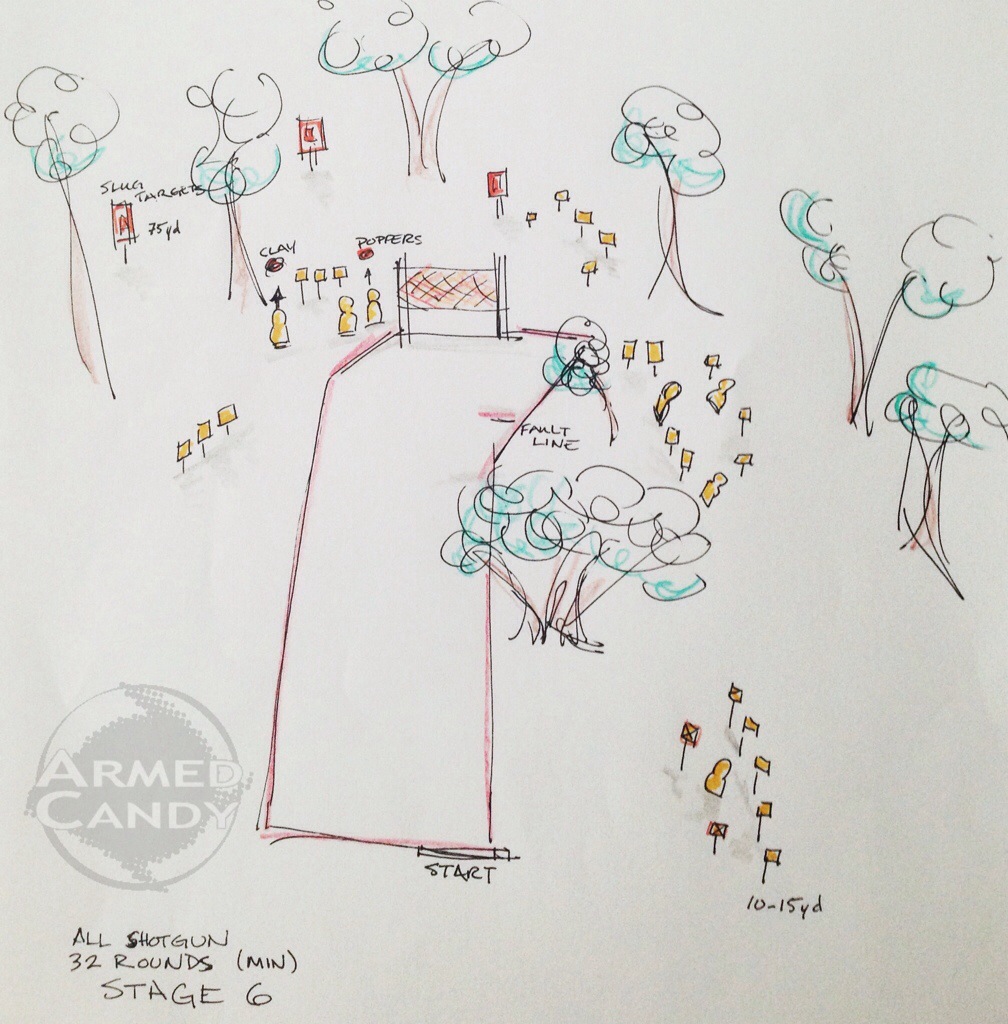
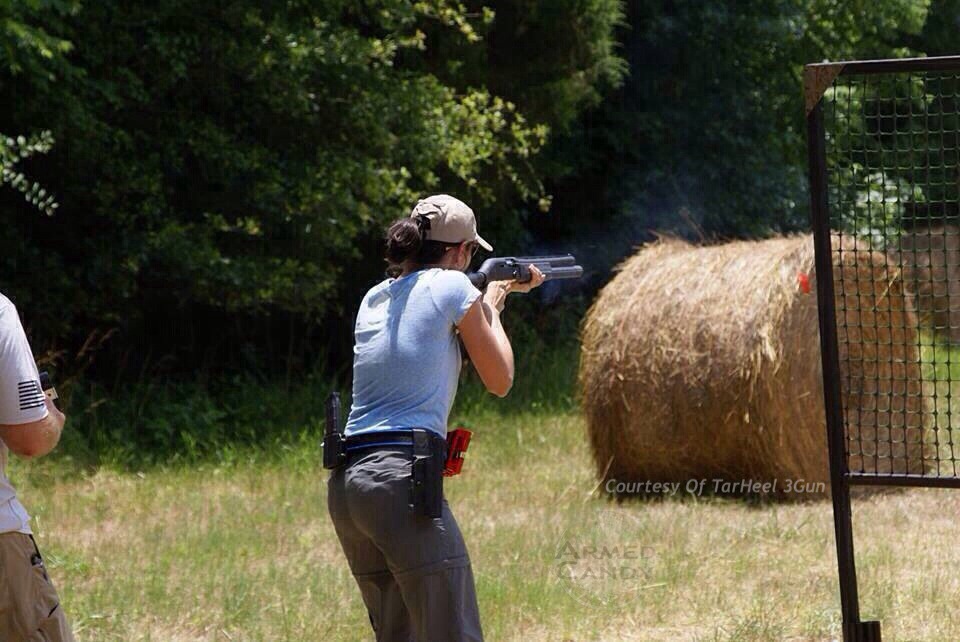
For the past few months I have been amazed at how much I am enjoying the shotgun portion of my 3gun training. While it’s easier to hit a target it’s takes more brute force to control than a pistol or rifle. Yet even with my pathetic excuse for upper body strength, I really like this new challenge. This was the mindset I had as I approached a 32 round shotgun stage at the Freedom Munitions Memorial Match in Clinton, South Carolina.
Get GunUp the Magazine on your iPad
Get GunUp the Magazine today for your iPad or iPhone in the App Store. Subscriptions start at $0.99 a month!
Glock Magazine Disassembly tool
Disassembling Glock magazines sucks. The new LW Glock mag tool makes it not suck. Buy one today.
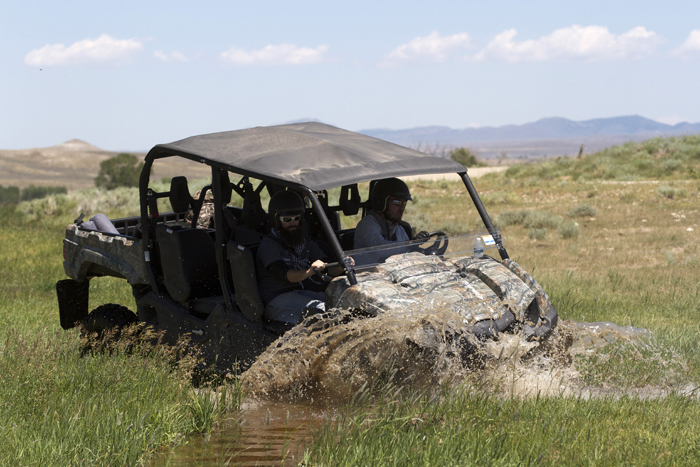
Photo of the day: I promise this is work

I’m not saying we drove through that puddle at speed just to see if we could…and then did it again faster, but we may have done just that. Photo credit again to Brad Howe of ATV Rider Magazine.
#flashbackfriday: Testing the Colt 1911 XSE Railgun
Have a look at the gun review of the Colt 1911 XSE Rail Gun from 2011.
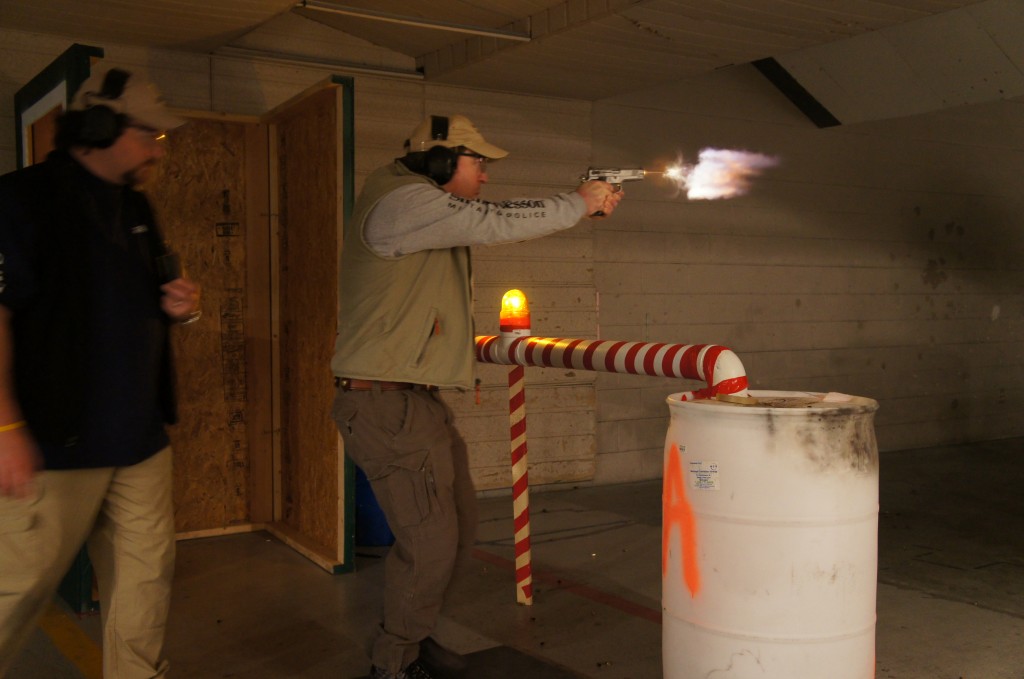
#muzzleflashfriday – show us your fire!

Do you have a great photo of guns in action with muzzleflash? Send it to us at [email protected] for next week’s MuzzleFlash Friday or post the link in the comments!
USPSA’s finances part 4: Program Service expenses
Program service expenses are the most important ways that USPSA spends their money. These are things like putting on USPSA Nationals, running RO seminars, producing Front Sight, and my favorite catch-all category, “member services.” Again staying with the 2013 tax return for the time being, you can find these listed on page 2 of the Form 990, under “Statement of Program Service Accomplishments.” If you skip down to box 4a-c, you’ll get a picture of how the money is allocated and how much revenue is directly generated from that event/line item. Here’s how it looks on 2013’s return:
- National Championship Matches – Expenses $576,114 – Revenue $357,440
- National Range Officer Institute – Expenses $141,981 – Revenue $394,473
- Membership Services – Expenses $257,108 – Revenue $770,844
You’ll notice that the Membership Services revenue exactly matches the line item on page 9, 2a for revenue generated from Membership Dues. If you add up the numbers from Nationals and NROI you get a number that exactly matches the one listed under 2b for Entry Fees. So it’s safe to assume that $394k is how much USPSA made from classifier fees in 2013.
This examination gets interesting when you move back to 2012’s return. The numbers are largely the same – Nationals loses money, the balance is made up by NROI/classifier fees, Membership Services makes money. However, on the 2012 return the production cost for Front Sight is listed as $353,109 and the revenue is listed as $37,911. But the same return lists $256,947 dollars in “Advertising” revenue. Now, I don’t know a lot, but one thing I do know a lot about is producing a print magazine. My question here is what does USPSA classify as “advertising” revenue? Because flipping through Front Sight, it is FULL of ads. Lots and lots of ads. They only do six issues a year, but I’m still having a hard time believing that six issues with that kind of ad count only results in $37k in revenue.
2011’s return doesn’t help answer the question either. It doesn’t even bother to list revenue generated by Front Sight, only marking that it cost $325,308 to produce six issues of the magazine. 2010’s return lists Front Sight as costing $300,106 to produce, and again no revenue is listed. So we have to do a little more work. I pulled a random sample of Front Sight from 2013. There are at least 17 full page ad blocks (either full page ads for a single advertiser, or two half page ads stacked on top of each other) and three full page cover ads. Assuming a 1:1 circulation ratio for Front Sight and USPSA membership, we can place their distribution around ~20,000. It’s a bi-monthly magazine, so six issues a year. We can pull their rates directly from the USPSA Front Sight Rate Card posted online and do some quick and dirty math: 17 full page ads at $1265 a pop, two inside covers at $1460, and one back cover at $1500. This does actually low ball it a little bit, because some of those “full page” ads we’re counting are actually two half-pages stacked, which are $700 each, but for quick and dirty analysis it’s fine. Add all of these numbers up and you get $26,000 in revenue just from full page ads. That doesn’t include the 1/3, 1/4, and various other tiny ads they litter all over the magazine. What I can gather from this is that the statement that Front Sight only generating $37,000 in revenue is completely wrong.
We’re left with two possible conclusions: 1) Front Sight has been horribly mismanaged and is a huge money sink, 2) Front Sight loses a little bit of money but not in a bad way. We can fairly conclusively state that the advertising revenue reported on the form includes other streams than just Front Sight.
I didn’t intend for this post to turn into an examination of Front Sight, but it has. On Monday, we’ll look at Nationals, and attempt to answer the questions: can USPSA run a profitable Nationals, and more importantly, should they?
Photo of the day: On Target

Gun Review: T/C Encore Pro Hunter .223
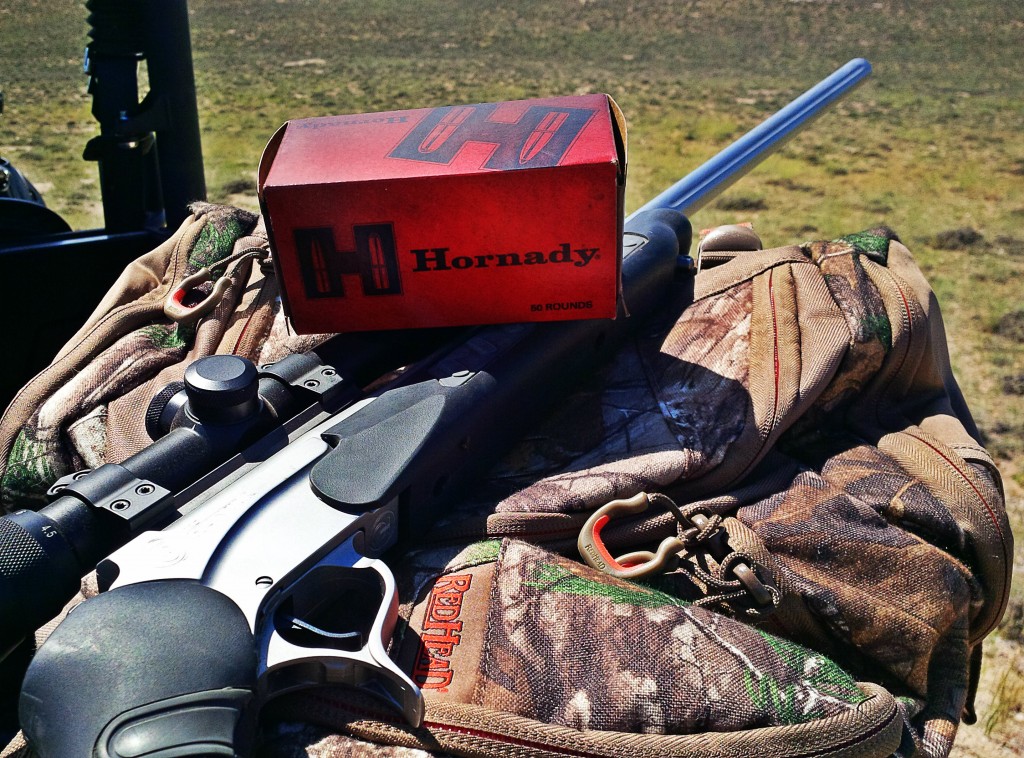
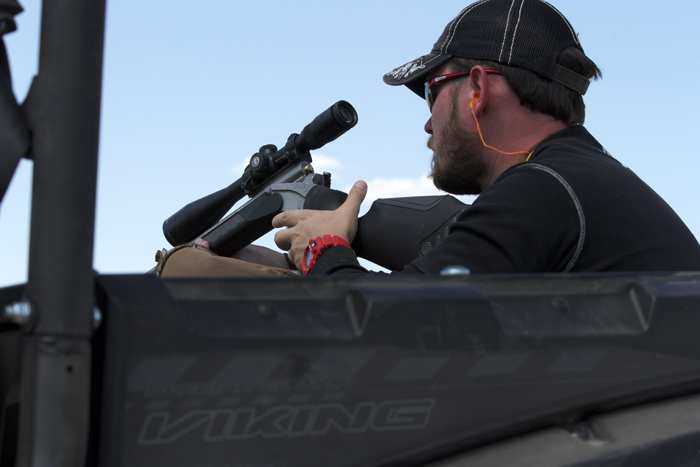
Sometimes simple is the best solution. It doesn’t get much simpler than the T/C Encore Pro Hunter platform; a single shot, single action, receiver which can be mated to any number of different rifle barrels in various calibers to produce anything from a modern muzzleloader to a close range brush gun in .500 Magnum. The version I spent a day with in Wyoming was chambered in .223 with a 26 inch fluted, stainless steel barrel. The rifle’s mission was simple: shoot as many prairie dogs as possible.

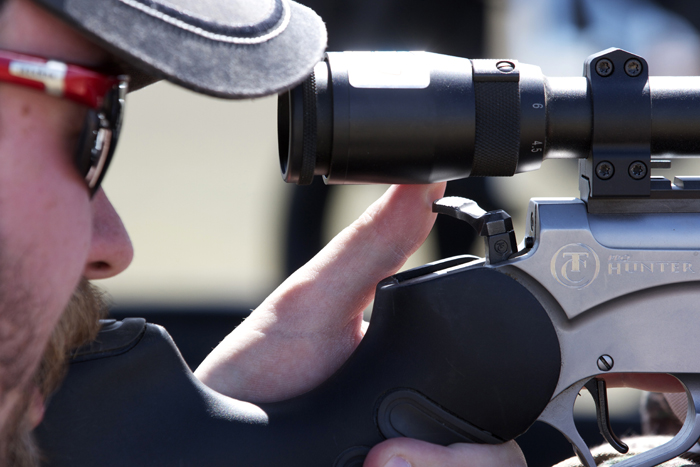
Riding on top of this rifle was a Bushnell ELITE LONG RANGE HUNTER scope, the LRHS 3-12x 44mm. Again, I was very impressed by the quality and clarity of the Bushnell optics I used, I could easily hit prairie dogs at 200 yards with these scopes and could see them all the way out to 400 yards.
The Vitals
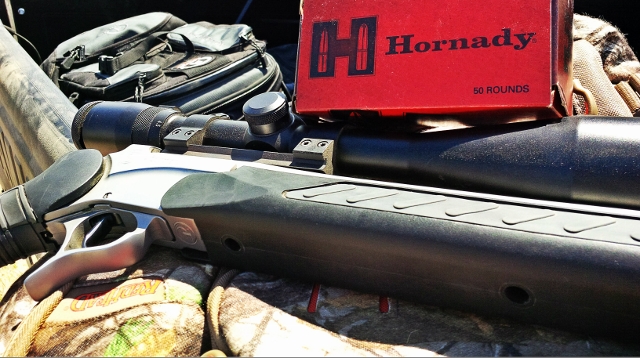
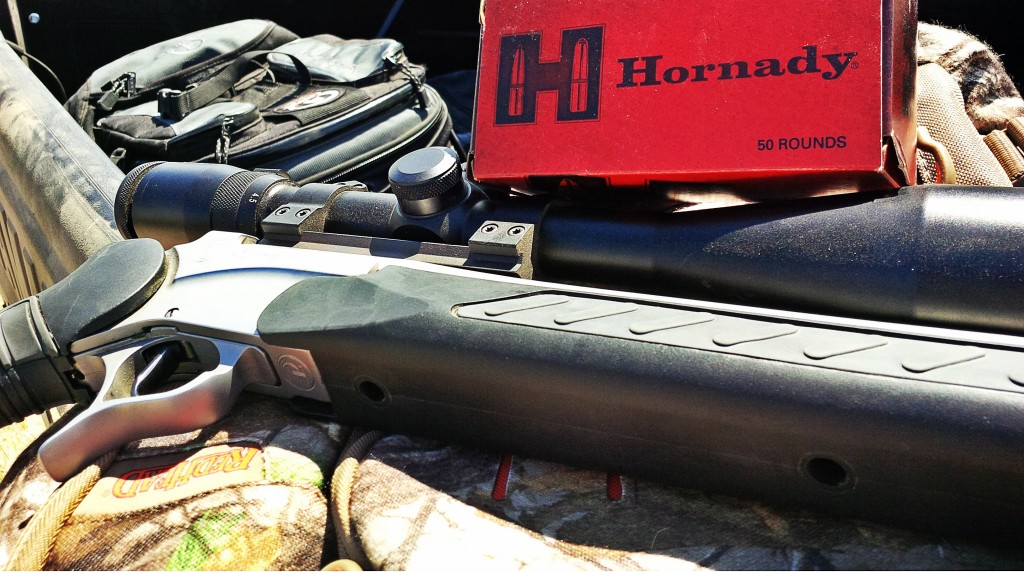
The T/C Encore Pro Hunter starts life as a stock and frame combination. It’s important for NFA purposes to only ever put rifle length barrels on the rifle stocks, and never to put a short, pistol length barrel on the rifle actions. As mentioned above, my sample was a rifle chambered in .223 Remington with a 26 inch barrel. Every Encore features an ambidextrous, single action mechanism; the hammer is rather clever in that it can pivoted either to the left or the right to make cocking the gun easier and to avoid striking any scopes that may be mounted on the gun. The action is released by pulling the lever that protrudes from and forms part of the trigger guard, which can be clearly seen in the below photo.

Lacking a trigger pull gage, I wasn’t able to get an accurate assessment of the weight, however it was a very clean and relatively light trigger. I’d guess based on my Mark 1 Model 00 Index Lever Puller that it’s around 3 pounds. There are no ejectors on the gun, so each fired cartridge must be manually extracted by hand. Doing this while wearing gloves combined with the small diameter of a .223 cartridge was mildly annoying, and I found myself wishing for automatic ejectors when confronted by en masse charges of zombie prairie dogs.
The Shooting
Actually shooting the T/C Encore is a blast. There is a certain zen quality about running a single shot rifle on distant targets, it forces you to take your time and take good shots. When running an AR15 on the plains rat hunt, I frequently found myself taking a “good enough” shot, knowing that I had 29 more shots to back it up if I wanted to purse the “accuracy by volume” approach. With the Encore Pro Hunter, every shot I attempted was the best shot I could take in that moment. Plus, because the gun was a .223 with a relatively long and heavy barrel and a large, comfortable cushioned stock, felt recoil was negligible. I could easily spot the fall of rounds through the scope; and when using the T/C Encore I was treated to frequent prairie dog explosions.

Even when the rifle didn’t make contact, there is something satisfying about the manual process of reloading. It’s hard to describe, but cracking the action open, pulling out the spent casing, and inserting a new round had a primitive, retro feel to it. While I know it’s not the same as reloading a Trapdoor Springfield in the face of a charging Indian horde, the act of a manual reload on the Wyoming plains just felt right.
The Verdict
I didn’t really want a T/C Encore before July 6th. Now, not only am I planning on ordering one, I understand why people buy them in such large numbers. Aside from the modular nature of the gun, which lets you play LEGO for grownups to your heart’s content, the T/C Encore just feels good to shoot. It’s everything I love in a rifle: lightweight, functional, accurate, and perfectly customizable to your mission. Would I recommend one for a tactical home defense gun? No, of course not. But a T/C Encore Pro Hunter rifle action can be successfully used for everything from a bone simple rimfire trainer all the way to a bear thumping .500 Magnum; a .223 varmint gun, or an Indiana woods deer-blaster. That’s pretty neat in my book, and now that I’ve finally spent some serious trigger time on one, I get what everyone else is saying. The T/C Encore Pro Hunter is a great platform, and in its varmint configuration was nearly perfect for eradicating prairie dogs.
USPSA’s finances part 3: where your money went in 2013
Because USPSA is largely funded by membership dues and entry/classifier fees paid by the shooters, the most important part of our examination of USPSA’s finances is how they’re spending that money. Yesterday’s post covered USPSA’s revenue streams, so today we should look at where it’s all going.

Expenses are reported on the form 990 in two places – the first is a section that has the organization (in this case USPSA) list their four largest program service expenses, the revenue generated by those expenses, and a brief description of them. For example, on the 2013 return it lists National Championship Matches as costing $576,114 to put on, and generating $357,440 in revenue. From this we can deduce a couple of things: first that the “Entry Fees” revenue item definitely includes classifier fees, and secondly that USPSA loses money on the Nationals.
Unfortunately, the expenses reporting is fractured, because if you scroll further down the report, there’s no line item on page 10, Statement of Function Expenses for “Nationals.” Statement of Function expenses is where traditional expenses are reported, things like compensation of key employees, comp of all other employees, office expenses, travel expenses, etc. For example, in 2013 USPSA spend $210,000 on compensation for Directors and key employees, and $287,000 on salaries for all other employees. That makes a total of $497,825 on employees, not including payroll taxes, 401k contributions, and “other employee benefits.” Sticking with 2013, USPSA also spent over $300,000 on office expenses, and another $300,000 on travel.
Looking at key salaries for the moment, everyone knows that the Area Directors are not paid employees of USPSA. They serve on a volunteer basis. The Key Employees/Directors that do receive compensation are the President of USPSA (currently Phil Strader), the Executive Director (Kim Williams), and the Vice President (John Amidon). Their salaries on the 2013 return are reported as $55,000 for the President, $56,844 for John, and $98,760 for Kim Williams. I don’t think anyone would begrudge Phil and John their relatively small salaries, considering the amount of work that goes into both of those positions. I do wonder about the ED’s salary – in his last year as Executive Director, Dave Thomas was making basically the same amount as Kim Williams is in her first year as ED. I’m not saying that the salary is too high, but that does strike me as odd that a new employee would be hired at basically the same rate as the long-tenured outgoing employee.
Now, here’s where things get confusing – as I mentioned above, there’s no line item for “nationals” on page 10 of the report. So we have to assume that the $500k spend on Nationals is a combination of all these factors; and I’d be willing to further assume that a decent sized chunk of that is travel. But this raises the question: why can’t USPSA run a profitable Nationals? Every single other return shows USPSA losing money on the National championships as well. But here’s the further interesting part – sponsorships aren’t recorded on this form separately, so there’s no way to tell if USPSA isn’t reporting the cash donations given to Nationals by various companies to sponsor the match. It’s feasible that because of the way those are set up, it’s not considered reportable revenue; which would mean that it’s impossible for shooters and members to get a true picture of 1) How much Nationals costs to put on and 2) whether or not USPSA loses money on it.
In order to keep this posts short, I’m going to break the examination of expenses down into a couple more parts. Tomorrow we’ll look at “Program Service” expenses; which are listed on page 2 of the report, and on Monday we’ll take a deep dive into salaries, office expenses, etc.