In the discussion about the possibility of the military purchasing new sidearms to replace the Beretta M9 there has been much nonsense. Most of the discussions of the virtues of a new pistol has centered around the irrelevant, trivial, or even the completely untrue. Despite this, there are some perfectly sane reasons to look at acquiring a new sidearm.
1. It’s now possible to buy an auto pistol that will fit almost anyone.
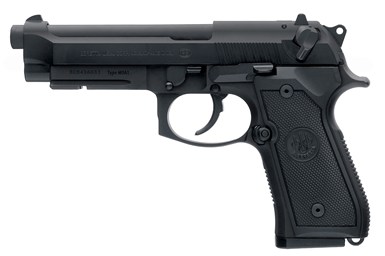
In the early 1980’s when the military went shopping for a double-stack 9mm pistol the world was considerably different. The Glock had not yet had the impact on the market that would make polymer frames an expected design feature in a handgun. Polymer isn’t simply cheaper, proper use of it also allows for more efficient packaging. This gives you the ability to make the grip of the pistol smaller overall and as we’ve seen with the Smith & Wesson M&P, H&K P30 or VP9 (and a host of other pistols) it also makes it easy to have an adjustable grip to fit a wider array of hands. The M9 is a good sidearm, but the size of the grip and reach to the double-action trigger are a struggle for many smaller-statured shooters. Beretta could modify the M9 to make it better in that respect with different grip profiles such as the one found on the Vertec or Elite pistols (or even the Beretta 90-two) and it would help enormously…but it would require revisiting the contract. People often don’t understand that a contract is frozen in time. Once you contract to deliver a pistol with certain specifications you have to deliver to exactly those specifications even if you’ve come up with a better idea since.
Police and military agencies need a handgun that’s going to work with the physiology of very different individuals. During a range trip a while back I ran into a police officer from a few miles away who had just been hired on to a police force while she finished her master’s degree. She was an exceptionally bright, and exceptionally small human being. She was issued a S&W M&P chambered in .40 S&W, which was a good thing because she was able to use the smallest grip panel so she had a shot at reaching the trigger. With a little work on how she approached gripping the pistol she was hitting bull’s-eyes on small targets in no time. Getting a new sidearm to better accommodate the physical differences in the personnel who need sidearms would be a perfectly rational motive for at least revisiting the current M9 contract.
2. It’s now possible to buy sidearms that require much lower levels of maintenance.
Maintenance and upkeep for issued weapons is often cited as one of the strikes against the current Beretta M9. While much of that is overblown, there are some annoying maintenance issues like the trigger return spring on the M9 that are a pain to keep up with. Thanks to revolutions in manufacturing and design, there are now options on the market that are much easier to work on or that require maintenance far less frequently than in the past. The H&K P30 is an excellent example. The pistol was designed to need armorer level attention only after 25,000 rounds…which is a hell of a lot of shooting. Granted there are some units in the military who can put that many rounds through a sidearm in a couple of weeks, but with the shooting schedule of most of the sidearms the military would be replacing the armorers working on the guns more frequently than the armorers would be replacing parts in the guns. Given the neglect that military sidearms often see, buying a new sidearm that thrives despite neglect would be perfectly reasonable.
3. A new sidearm would make new training programs necessary…which might be an opportunity to fix the training problem.
This, I admit, is an exceptionally unlikely outcome. The lack of solid training with handguns is an institutional problem and even though a new weapon would require a new training program to go along with it, but I don’t expect buying something new and shiny to fix the institutional culture that doesn’t take handgun training seriously now. Still, if the argument is going to be made a new pistol and training program is when the organization is most vulnerable to new thinking about it.
So, Mr. Smarty Pants, what would you do?
Good question. Since the power to completely overhaul how the military approaches training with sidearms likely will not come along with the power to select a new sidearm, I think we’re doodling around the margins. Given the expense and logistical headache involved in buying an entirely new sidearm, I’d seek to make improvements to the current M9. The USMC’s M9A1 program is a good example of how that could work. I would add on top of that a revised grip such as the one found on the Vertec pistols or the 90-Two, dovetailed sights instead of the integral front sight on the current M9, and perhaps moving all the pistols to the “G” configuration which makes the levers on the slide function as a de-cocker only. This could probably be accomplished with the lowest overall cost when you figure in logistics, training, support equipment, etc. Perhaps even a low enough cost to allow the purchase of some additional equipment (like visible lasers) that would make putting bullets where they need to go easier under stress.
I have no idea what the military will eventually decide on. I honestly expect this latest lust for a new pistol to die in the cutthroat budget process within the DOD…but stranger things have happened. The military has a bureaucracy and whenever reason and circumstance seem to make a particular decision to be exceptionally unlikely bureaucracies have a tendency to make precisely that decision. So I wouldn’t count it out, either…