Green Ammo

So, someone asked me to blog about “green” ammunition, so here goes. A little research has turned up all sorts of different kind of ammo that is being labeled as “non-toxic”, “lead-free”, “saves the whales”, and all manner of other labels. Since I haven’t shot all this ammo, I’ll only address the types of “non-toxic” and “lead-free” ammo that I’ve used.

First up is the Winchester “WinClean” line of ammunition. WinClean is not lead free – instead the lead core of the bullet is fully encased in the brass jacket. I have used this stuff in revolvers, and as far as quality goes, it’s really not any different than Winchester White Box, except for the fact that it’s more expensive. Since it costs more for the same performance, WinClean gets a thumbs down from Ahab.

The only “lead free” ammo that I’ve used with any regularity is the MagTech First Defense round. Instead of a traditional copper jacket around a lead bullet, it uses a 100% copper bullet, which it claims provides “maximum weight retention”. They make a .38 Special +P load which pushes a 95 grain solid copper bullet around 1000 fps from my Ruger GP100. This ammo burned cleaned, grouped well, and did not overpower with recoil. I stopped using it in my carry guns when I came to the mathematically realization that I was basically pushing a souped up .380 downrage, when I could be pushing a 158 grain slug at 1100 fps with magnum loads. However, if you’re interested in top-shelf, lead free ammo, I would recommend MagTech First Defense.

There you go, that’s pretty much the sum total of my knowledge about lead-free/non-toxic ammo. Ya’ll feel free to add your two cents in the comments.

Home Defense, part 2

This is the second part in the Home Defense series, (part 1 is here) where we take a look at different home security devices, tactics, and methods.

In Part 1 we examined home security measures that didn’t involve firearms or other weapons; things like alarm systems, trimming hedges back, getting a dog, etc. Today we’re going to look at weapons, including non-firearm weapons. In part 3, we’ll take a very, very brief look at the tactics involved.

Weapons can be broken down into two broad categories, less-lethal and lethal. Obviously, your less-lethal weapons are going to be your various sprays, tasers, and cudgels. Your lethal weapons include all firearms; as well as swords, knives, etc.

Less-Lethal weapons
Some people don’t like guns, or for whatever reason they’re just adamantly opposed to keeping a firearm for home defense. While I disagree with that choice, choosing to not have a firearm in no way disqualifies you from your right to defend your life and property. It does complicate the issue, but it’s workable.

Less-Lethal weapons fall into three broad categories, as I mentioned above.

  • Sprays – these are your garden variety anti-personnel sprays, such as OC spray, Mace (which is becoming increasingly difficult to find), etc. The most common is probably OC spray, which is more commonly referred to as pepper spray. For home defense, it is a less than ideal solution. Apply a little critical thinking – you’re going to spray an airborne irritant into an enclosed space at an intruder. Generally, airborne irritants and closed spaces aren’t a good mix for you. Give pepper spray a pass for inside the home. It is best used in external areas.
  • Tasers/Stun guns – Again, two types of tasers and stun guns. The former (Tasers) are a specific device which launches two electrified darts into the target, and then runs a charge from the device through the wires into the target. The advantage of this is that it allows you to maintain some distance from a potential intruder. The disadvantage is that it also might not work that well. The other type of stun gun requires you to actually make physical contact with the target. Quite frankly, you’re better off with a baseball bat than a contact stun gun.
  • Clubs, cudgels, and bats – Ah, blunt force weapons. Into this category falls the trusty Louisville Slugger secured under the bed, as well as all manner of collapsible (or otherwise) batons. Right off the bat, I would recommend tossing out collapsible batons as home defense weapons. The point of a collapsible baton is that it takes up less space on an officer’s belt – space is not really a concern here. My two recommendations for a home defense club would either be a baseball bat (preferably wood) or a side handle baton (tonfa). The advantage in the baseball bat is that it requires very little training to use effectively, and provides the user with a decent amount of reach. However, it is worthwhile to note that in close quarters it looses a lot of its effectiveness. It’s best used when you have the ability to take large swings at an intruder; you may not have the room to do that in your bedroom. In my opinion, the single best cudgel/blunt force weapon for home defense is the venerable side-handle baton, or tonfa. The tonfa provides an extension of your reach so that you don’t have to get as close to an intruder as you would with a stun gun, etc. It’s also extremely versatile, being quite effective at intermediate distance and extremely close quarters. The major disadvantage to a tonfa is that it requires a relatively significant amount of training to be utilized to its maximum potential.

When dealing with less-lethal weapons, my standard advice is to avoid anything that forces you to close to very short range with an intruder. If you can avoid hand to hand combat, doing so is a tactically sound decision. As such, I advocate weapons that have a high possibility of incapacitating an intruder while maximizing your ability to stay away from said intruder. My recommendation for a non-lethal alternative would be 1) Tonfa, 2) Louisville Slugger, 3) Taser. The contact stun guns and pepper sprays are just a bad idea.

Lethal Weapons (Edged)
Because of the variety of firearms, I’m going to break lethal weapons into two categories, edged and projectile. When it comes to using an edged weapon for home defense, I’m less than enthusiastic. Most knives do not give you the ability to maintain distance from an assailant, and have an even higher learning curve than the tonfa to use effectively.

  • Knives – All knives, from pocket knives to machetes and everything in between fall into this category. Like I said, I don’t like knives for home defense. They’re less likely to cause an incapacitating blow than a good club, and are harder to use effectively. If you must choose a knife for home defense, my personal recommendation would be a machete, or similar long bladed knife. It maximizes distance and minimizes the learning curve necessary.
  • Swords – Well, why not? Swords are better choices than knives in my mind, again allowing you to keep some distance from an intruder. The problem of course is that to be truly effective with a sword, you have to train a lot. Additionally, anything the size of a baseball bat is going to have the same complications as a bat, namely it will be difficult to effectively manipulate in close quarters. If you forced me to pick a sword for home defense, I would most likely choose a well made replica of a Roman Gladius. It would not be difficult to wield in close quarters, and is designed to stab and penetrate deeply; deep stab wounds are generally more likely to incapacitate an intruder than a slash wound. However, I wouldn’t pick a sword for home defense.
  • Polearms – Spears? Really? Uh…don’t. Too long, unwieldy, and just bloody impractical. Despite the fact that charging an intruder with a spear seems like fun, there are just too many better options.

My general thoughts on edged weapons for home defense – don’t. They are harder to use well than a club or a gun, and less effective than a firearm.

Lethal Weapons (projectile)
Ah, the meat of the matter. Firearms sport several advantages over the other categories: they’re generally easier to learn how to use effectively than knives, they allow you to maintain distance from an intruder, and are more effective at producing incapacitation than non-lethal weapons or edged weapons. That is not to say that firearms are not without their disadvantages – namely among those is the possibility of a miss striking an innocent person, or a round that overpenetrates and strikes an innocent person. If you’re shooting indoors, you must be 100% sure of your target, and sure of what is behind and around your target.

  • Handguns – Lots and lots of people keep a handgun for home security purposes. While a handgun is limited in stopping power (the ability to rapidly induce an end to hostilities) when compared to a rifle or shotgun, what it lacks in power it makes up for in maneuverability. Be it a revolver or semi-auto, the handgun’s greatest advantage is its compact size. The disadvantages are (again) the relative lack of power, and the fact that it is harder to aim and hit with a handgun under stress conditions than a rifle or shotgun. However, a handgun is very capable of penetrating several interior walls if you miss a target – again be 100% sure of your target and what’s beyond your target.
  • Rifles – In the rifles category, you have rifle calibe
    rs
    (.223, 7.62×39, .30-30, etc) and then pistol caliber carbines, rifles which are chambered for pistol calibers. The rifle has significantly more power than most handguns, and thus is more likely to end hostilities in a rapid fashion. Additionally, rifles are easier to aim and hit with under stress firing situations. The major drawback of rifles is that they’re not nearly as compact as a pistol, which can create difficulty if you need to maneuver in a tight space. Again, over penetration is a concern.
  • Shotguns – possible the most recommended long arm for home defense is the pump-action 12 gauge shotgun. It has achieved this lofty status via its proven reputation of being devastatingly effective at short range. I strongly recommend shotguns, as they share the advantages of rifles; and also reduce the possibility of over penetration, albeit not by much. If the recoil of a 12 gauge pump with buck/slugs is too stout, consider a semi-automatic 12 gauge, or a 20 gauge. There are several excellent 20 gauge slugs, as well as more than a couple of good buck loads. Also, don’t leave out your traditional side-by-side shotguns – they’re quite often very compact and easy to tote around. Their greatest disadvantage is their limited ammo capacity.

When it comes to firearms, I’m personally leery about recommending a major centerfire rifle for home defense. I generally steer people towards shotguns or handguns for defending hearth and home. If you do choose a firearm, one of the most important things you can do is practice with it. All trigger time is good time, but if you get to a self-defense or home defense class, that’s even better.

In summary, my recommendations for a home defense weapon would be 1) Shotgun, 2) Handgun, 3) Rifle, 4) Tonfa, 5) Baseball bat. In part 3, we’ll address the most important part of home security, which is mindset/tactics.

Diary of a hoplophobe

I’m honestly not sure what the purpose of this “editorial” is, other than to take potshots at gun owners while at the same doing the literary equivalent of hanging curveballs over the plate for pro-2A blogs to hit out of the park.

I can’t really think of anyway to describe this sort of meaningless drivel in civil terms; were I a professional writer instead of someone who is just doing this for fun, I’d be ashamed to turn in a column that contained sentences such as those below.

Every few seconds I violently twitch as another gun is fired; even with ear protection the noise is deafening. I’ll be glad to get out of here without soiling my undergarments.

I squeeze off shot after shot, jumping at the sound of each one. Some people feel powerful with a pistol in their hand; I feel terror. I reload rapidly, hoping I run out of rounds before I run out of luck and end up with nine fingers.

I mean, really? He actually wrote that? I love the subtle implication that gun owners only have all their fingers and toes by sheer blind luck. Clearly, the training and safety precautions that responsible gun owners take have absolutely nothing to do with the fact that we have all our fingers and toes. Of course, no editorial would be complete without implying that the only reason we own guns is to feel “powerful”, as though gun owners are all compensating for some sort of physical or social inadequacy.

I guess on the flipside though, you have to laugh. I mean, look at the paragraph above. The guy actually admits to being on the literal verge of pants shitting hysterics.

Help

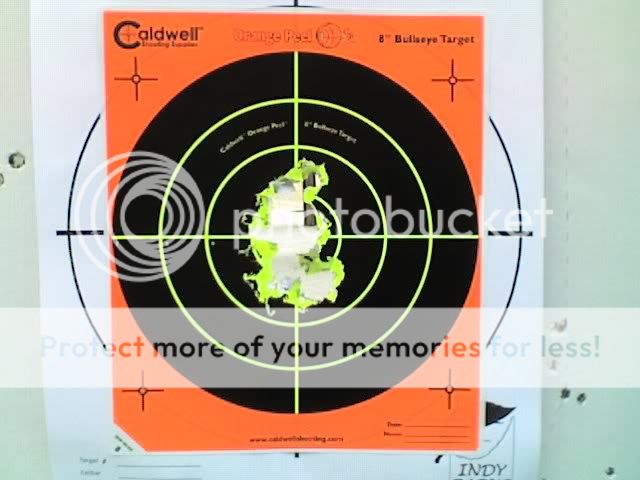
So, my “new” (if you can call a 70 year old gun new) ’37 Brazilian Contract S&W shoots like there is no tomorrow. Target picture here, 18 shots at 25 feet.

However, there’s a small hitch in her giddyup. After about 40-45 rounds, the cylinder became very difficult to open and close. It turns that this is because the ejection rod (for some weird reason) is now stick out further than it did before I started firing the gun. Now, instead of sliding neatly into place and locking up, the knob on the end of the ejection rod is making contact with the lug on the underside of the barrel, preventing the revolver from going into battery.

Countertop suggested that this is likely the result of crud inside the cylinder set up that has “frozen” the revolver, and that a good bath in mineral spirits followed with a thorough cleaning should solve the problem. At the very least, I’m going to try that before I ship this off to a gunsmith and actually pay for work to be done.

However, the title of the blog today is “help”. Since I am no expert on S&W revolvers by far, I have two requests for assistance. 1) How do I get the cylinder off this thing (it’s a 1937 Brazilian Contract, which is just an M1917, which I believe is just a big M&P), and 2) can someone get the attention of Tam on this? Since she’s sort of the guru of old S&W revolvers, I’d love to have her input on this, if she’s encountered this sort of problem before and if there’s anything I can do to fix it short of sending it off to the gunsmith.

While asking for help on a gun related issue is sort of a blow to my pride, I’d rather be humbled and have a working gun than keep my pride and have a broken gun. I mean, come on. Look at that target. This gun can flat SHOOT.

Update: Thanks to Tam and my dad who both correctly pointed out thta my ejection rod was backing out under recoil, and a few turns fix everything right up. I can’t wait to shoot this in this month’s e-postal.

E-Postal Match, Point Shooting

Carnaby Fudge has the E-Postal match for August up! It’s called Point Shooting, and I’ll give you a hint what the central theme is. If you guessed “point shooting” then you win an E-Cookie. Of course, I don’t have any cookies, so don’t worry about it.

I, for one, am going to suck at this match. I don’t really shoot “without” the sights, so forcing myself to not acquire even a flash sight picture while blazing away at the target is going to prove to be a challenge.

I’m relatively excited about this match, as it looks like another month of forcing myself to shoot outside of my comfort zone.

Home Defense, part 1

Congratulations, new homeowner! You’ve just purchased your first home, you’re all moved in and unpacked, but now you’re concerned about security. Good for you. You, and you alone, are responsible for the safety and security of your home and family, and it is important to take steps to ensure their safety.

Today I want to focus on home-security measures that don’t involve firearms/other weapons. We’ll cover weapons on Monday. For the record, there is no “one perfect” home-security solution. You can use all the methods below, or just cherry pick the ones that work for you. The advice below is for people with or without guns.

The Outside
Before anyone can enter your house, they have to be on your property first. While you could lay claymores and tripwires to prevent people from trespassing on your lawn, I’m pretty sure the homeowners association would frown on that activity. It’s unfortunate, but there isn’t a whole lot you can do to prevent people from walking up to your house; but there are some decent measures.

Take a walk around the outside of your house. One of the things that you don’t want is for someone to be able to approach your house and have concealment the entire way. If you have large bushes that obstruct ground level windows, consider trimming those back to allow a clear view from the inside out. Another good idea is to install motion sensitive floodlights to illuminate poorly lit areas. It is possible to have these calibrated so that small animals won’t set them off; however you should check your local ordinances on the legality of said floodlights. The usual logic about having a good fence applies as well; like I said, it’s good to put obstacles in the path of an intruder.

One more thing to watch out for on the outside of your house applies if you’re the owner of a two story house. Generally, try to avoid having trees or other climbable objects that could give an intruder access to second floor windows – too many people secure everything on the ground level, but have a giant old tree that leads right up to a 2nd floor window.

Doors & Windows
These are the most obvious points of entry to your house, and special care should be taken to ensure that they’re secure. All ground level doors and windows should be alarmed; I recommend also alarming 2nd floor windows as well. Additionally, if you have a sliding glass door to your backyard, a glassbreak sensor tied into the alarm system is a must as well.

Lock your doors. Don’t just lock the handle, make sure you have a good deadbolt and a solid frame, and USE THEM. Having a bank vault door doesn’t do you any good if you don’t use it. Also, if you have the aforementioned sliding door; it doesn’t hurt to drop a 2×4 into the track to make sure it can’t be forced open. Doing so forces them to break the glass, which sets off the glassbreak sensor.

Alarm system
I recommend that every homeowner have an alarm system. I have it for the same reason that I have a gun in my house – having it and never needing it sure beats needing it and hot having it. An alarm is both an active and passive deterrent to a home invasion. Smash my window, kick my door in, and that sucker starts whooping up to raise the dead. That’s the active deterrence. The passive deterrence is that I have that little sign that says “brinks” in my front yard – while I don’t bet my life on it, a potential home invader could see it and think “I’ll go somewhere else”.

If you do decide to get an alarm, here are some guidelines. At the minimum, you’ll want all the ground level doors and windows to be alarmed. In addition to that, I recommend glassbreak sensors for glass doors/windows, as well as an internal motion detector. On the off-chance that someone gets into your house and doesn’t set off any of the alarms, the motion sensor is your “last line of defense”, unless you’ve mined the stairway or something.

Finally, it’s worth looking into the extra cost to have your alarm system run on a dedicated phone line. Have your primary line for voice calls, but set up your alarm on its own dedicated line.

Kingdom Animalia
According to my homeowners association, I can’t have trained attack leopards, or a moat that is filled with sharks with laser beams on their heads. However, I can have a dog. The trouble with a guard dog is that it has to be exceptionally well trained – I am not an expert on dogs, nor do I purport to be. If you’re thinking about getting a dog, there are plenty of excellent resources out there to help with your choice.

Fire
Burglars aren’t the only threat to home security. You’re statistically much more likely to have to deal with a home fire than a burglar. At the minimum, and I mean bare minimum, you should have smoke detectors in every room, and check them regularly. It’s also worthwhile to have at least two fire extinguishers. You should put one in the kitchen, and then place the other one where you see fit. The master bedroom isn’t a bad idea. For the kitchen fire extinguisher, ensure that it’s the type that can be used safely on oil/grease fires.

Little Things
Sometimes, it’s the little things that make a difference. Have a cell phone and a flashlight in your bedroom; if your phones are out you still need to call the police.

Make sure you have a plan – whether or not you have kids, you and any other occupants of your home need to know what to do in the event of an emergency. On Monday, when we discuss weapons, we’ll also take a look at tactics and different types of emergency plans.

It’s important to remember that you’re the only person responsible for the security of your home. Floodlights, a big dog, and an alarm don’t guarantee that the police will arrive in time to do you any good – when it really comes to do it; you are the first and best line of defense against an intruder.

Airguns are not toys

Just ask Jesse Joseph DeJesus Perez. Wait, you can’t ask him, because he’s dead. Okay, maybe you could ask Andrew McGowan, although he might have a bit of trouble talking around his his missing tooth.

Relax, I haven’t turned into some gun grabber demanding that BB guns be banned and regulated, I wouldn’t do that to you. What I am saying is that I see a lot of stories from people who don’t treat BB guns, be them airsoft or otherwise, with the same respect for the four rules. Yes, I am aware that “playing” airsoft is quite popular pursuit, and I even agree that airsoft has some practical application in force on force training.

The difference is that in those airsoft games (which I think are silly, but that’s another story), paintball, and force on force training, the appropriate safety precautions are being observed. They’re not be observed when some idiot parent gives his kid an airsoft gun because “it just shoots little plastic balls” or something idiotic like that.

Stupid accidents are the favorite gateway for gun grabbers, we all know that. Whenever they can muster up righteous indignation about “innocent lives” and “doing it for the children”, it is really easy for us to lose that battle. Suzy Soccermom wants her children to be safe, and if that means taking away those “nasty” airguns, well then so be it.

But if we lose airguns, we lose the greatest entry into the shooting sports. There are probably thousands of other gun owners who got their start with a BB gun, plinking at cans and dirt clods. I for one don’t really want to lose that.

So, here I am again, beating the drum of personal responsibility. So, if you’re younger and reading here; I need you to listen up. Don’t shoot each other with airsoft guns. Or BB guns. Or pellet guns. Just because it’s not a real gun doesn’t mean it can’t main, or even kill. And then sure as shooting, you won’t have your BB gun anymore. If you’re a parent, and you want to give your kid a BB gun or something like that, for the love of god, teach them some damn responsibility. It’s not a toy. When it’s used safely, a BB gun will provide years of fun and valuable practice – but for crying out loud make sure they don’t go around shooting at people.