.38 Super for self defense?

The short answer is “absolutely”, and the longer answer is “yes, think of it as a hot 9mm.”  Cor-Bon manufactures several different loads for the .38 Super as a defensive round, from standard jacketed hollow points in 115 and 125 grain weights all the way to a 100 grain Pow’RBall load.  DoubleTap also makes a 115 hollow point load for personal defense.  The thing to bear in mind is that the .38 Super projectile is the same as the projectile fired from the 9mm, it’s a .355 inch bullet, so any load that you could conceivably handload for the 9mm you could also work up for the .38 Super.

However, there are drawbacks.  Ammo isn’t nearly as widely available for the .38 Super as it is for 9mm, and it’s often more expensive in factory loadings.  Magazines and spare parts for guns are also more difficult to find, as the caliber has fallen from popularity in recent years.  I wouldn’t recommend to anyone who is specifically looking for a defensive firearm, because the ballistics are easily duplicated with 9mm loads.  The one caveat to that is for people married to the 1911 platform but not wanting a .45 ACP.  The .38 Super tends to be more reliable, as stubby cartridges such as the 9mm tend to be more prone to feed issues in 1911 style pistols; plus they make John Moses Browning weep.

I wouldn’t tell you to go out and buy a gun in .38 Super for concealed carry for the reasons mentioned above.  However, if you’ve got one sitting around and want to carry it, then it’s most certainly a viable choice.  But don’t think you’re getting anything better than a hotish 9mm, because that’s exactly what you’re getting.

FTC Disclaimer: I have not received any payment or compensation from any of the companies listed.

I should not have done that

Namely, spend about 45 minutes browsing the USFA website.  Because when I did, I found their “Lend-Lease” Colt SAA reproduction, which is a Colt SAA style revolver chambered in .45 ACP.  This is a historically accurate revolver, as well – it seems at the start of WWII, the Brits were off in a bad way for small arms, and pretty much took whatever they could in terms of pistols.  Among those pistols sold to them in the US Lend Lease program were 161 single action Colt revolvers that had been chambered in .45 ACP.

The guns that USFA makes don’t really fill a niche for me – I don’t shoot CAS much these days, and I don’t have $1800 to drop on a gorgeous hand fitted revolver.  However, like many things in the world, they are worth that price to certain people, in which case you’re probably not going to find a more attractive single action revolver.

Send in the hounds!

Let me tell you a story, shall I?  So, some cub reporter for a paper that no one reads decides he’s going to write a story about people in Indiana that have pink cards, aka carry permits.  So he contacts the State 5-Oh and gets a copy of the list, because if you’re an Indiana carry permit holder, your information is a matter of public record.

Then said cub reporter posts that he wants gun owners to contact him to talk about the articles he’s going to write.  Then the internet happens.  Hilarity ensues, as the 11 page thread on the Hoosier gun forum is a pretty sporty read.  Piles and piles of misinformation fly around, no one knows what’s going on, and dogs and cats are lying down together in unholy congress.

But there are some valuable pieces of information for Indiana gun owners, of which I know there quite a few that read us at Gun Nuts.  So for the record, yes, while some reporter is probably going to run a hit piece on permit holders that’s not what I want you guys to get out of this post.  This is: your information is a matter of public record.  If you’ve got a pink card, regardless of whether it’s a lifetime card, a 4 year, or whatever, your personal info is out there and part of the public record.

Don’t bother calling the State Police about it, by the way.  It’s not their call – so don’t go blaming them.  You want to call someone, write a letter or an email?  Contact your State Legislators.  If you don’t know who your legislator is, you can use this handy form provided by in.gov.

A matter of millimeters

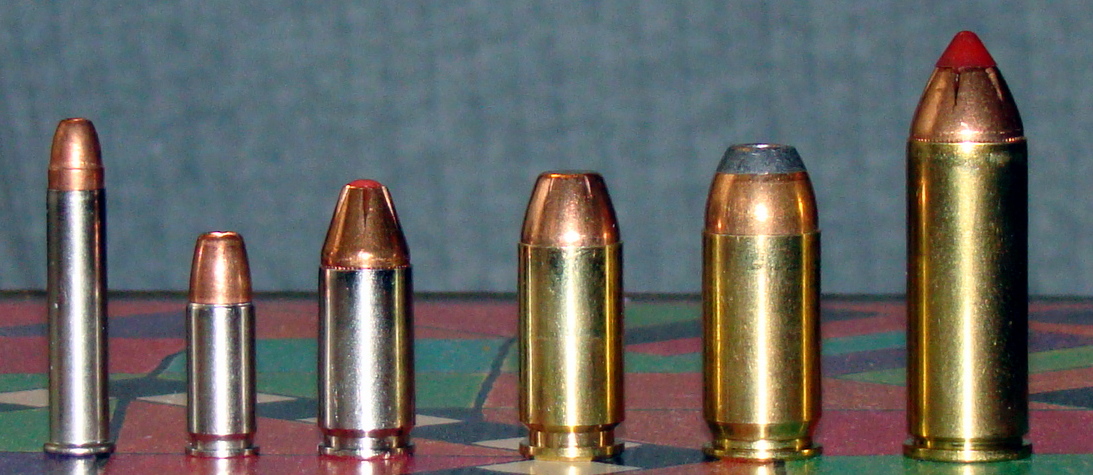
On last night’s Gun Nuts Radio, Breda asked me what type of ammo I had in my carry guns. In this case, a picture is worth 1000 words though.

ooohhh shiny

From left to right:

  • CCI 40 grain JHP, .22 WMR
  • Speer Gold Dot 35 grain JHP, .25 ACP
  • Hornady Critical Defense 115 grain Flex tip 9mm
  • Winchester Ranger 140 grain JSP frangible, .40 S&W
  • Wolf Gold 185 grain JHP, .45 ACP
  • Hornady LEVERevolution 225 FTX, .45 Colt

It really is a matter of millimeters, though. When you look at a 9mm, a .40, and a .45 ACP all right next to one another like that, the size difference is almost laughable. It’s almost funny to think about the countless hours spent debating which of these has more “stopping power.”

The myth of the double-tap

ToddG at Pistol-Training.Com takes a look at the false idol that is the double-tap.

Most people don’t measure or worry about the speed of the first shot in a double-tap. Taking three seconds to align the gun, stabilize your grip, and carefully aim before hammering the trigger twice is counterproductive.

If you watch, you’ll frequently see this on public ranges.  A shooter will start from the low ready position, get the gun up on target, and then take forever prepping the trigger for the first shot…and then slamming the trigger for the second shot, regardless of where the gun is.  That’s how indoor ranges end up with bullet holes in the roof, and target carriers that don’t work so well.

It’s extremely important to differentiate the “Amateur Hour Double-Tap (AHDT)” from controlled pairs and hammers.  A controlled pair is two precise shots with two flash sight pictures, and a hammer is a pair of controlled shots with one sight picture.  The difference is that you’re never out of control of the gun; unlike the AHDT where the shooter really isn’t controlling the gun after the first round leaves the muzzle.

I also agree that training to shoot two rounds and then stop on a target is folly for a defensive shooter – as discussed in the Stopping Power post, you have no idea how those two rounds are going to affect the target.  That’s why places like Gunsite teach the “non-standard response” drill, where you shoot the target until it goes away.  In all honesty, the only people that have any business practicing double taps/controlled pairs/hammers for any significant amount of time are competition shooters, where the “two shots on a target” is doctrine.  In fact, it’s so deeply ingrained in my head that I’ll find myself doing every kind of pistol practice in groups of two.

Stopping Power

Last night’s Gun Nuts Radio, after the ancillary discussions on news items and other sundries was supposed to focus on stopping power and specifically handgun wounding mechanics.  If you’d like to download and listen to last night’s Gun Nuts Radio, just click here.  Of course, you can also always get an .mp3 copy of the show, or for iPod/iPhone users, subscribe to the show on Gun Nuts Host - Gun Nuts Radio: The Next Generation of Shooting | Blog Talk Radio Feed - Gun Nuts Radio: The Next Generation of Shooting | Blog Talk Radio Feed.

Unfortunately, we didn’t really have the time to get into the meat and potatoes of stopping power and handgun wounding ballistics, and that’s partly my fault – it’s is a fairly technical and dry (read: boring) topic that unfortunately doesn’t translate well to radio. The source document for much of what I’m about to talk about can be found here, it’s the FBI’s document that explains the rational behind their standards for defensive pistol ammo. It’s only 19 pages, and while it’s kind of technical in some places, it’s also a very good read for anyone who wants to really understand terminal wounding ballistics. Projectiles wound in one of four ways, or which only a couple apply to handguns:

  1. Penetration – the tissue destroyed by the passage of the projectile
  2. Permanent cavity – the volume of tissue destroyed by the passage of the projectile
  3. Temporary cavity – Expansion of permanent cavity by stretching due to kinetic energy.  While this type of wounding is seen with handguns, it’s effectiveness at stopping a fight is often grossly overstated.
  4. Fragmentation – secondary projectiles, bone fragments, etc which create their own wound channels.  Not often seen with handguns unless specialized ammo is used.

The reason why the “temporary cavity” honestly doesn’t matter with pistol bullets is due to the elasticity of most human tissue – the temporary cavity caused by pistol rounds doesn’t significantly stretch the tissue enough to do damage.  As such, the permanent cavity is the only wounding mechanism in pistol bullets that can be reliably measured as an indicator of “stopping power”.

Of course, the problem that most people fail to realize in this is stated in the FBI document: “…the concept of reliable and reproducible immediate incapacitation of the human target by gunshot wounds to the torso is a myth.”  Even if you were to destroy the heart of a hypothetical attacker with your first shot, the brain contains enough oxygen to support 10-15 seconds of voluntary activity after that; this also does not take into account attackers that may be chemically enhanced by various drugs.  Ultimately, a gunfight is tremendously dynamic experience, because those of us that carry guns for self defense cannot in any way control for the various mental factors that contribute to a projectile’s effectiveness.  This is what lead to the FBI’s rational that a bullet must be able to penetrate 12 inches of soft tissue regardless of expansion to be an acceptable projectile for law enforcement use – which became the basis for the FBI Protocols for bullet testing.

Again, I encourage everyone to check out last night’s Gun Nuts Radio for more information on stopping power and terminal ballistics.  For further reading, please refer to the FBI’s source document on handgun wounding.