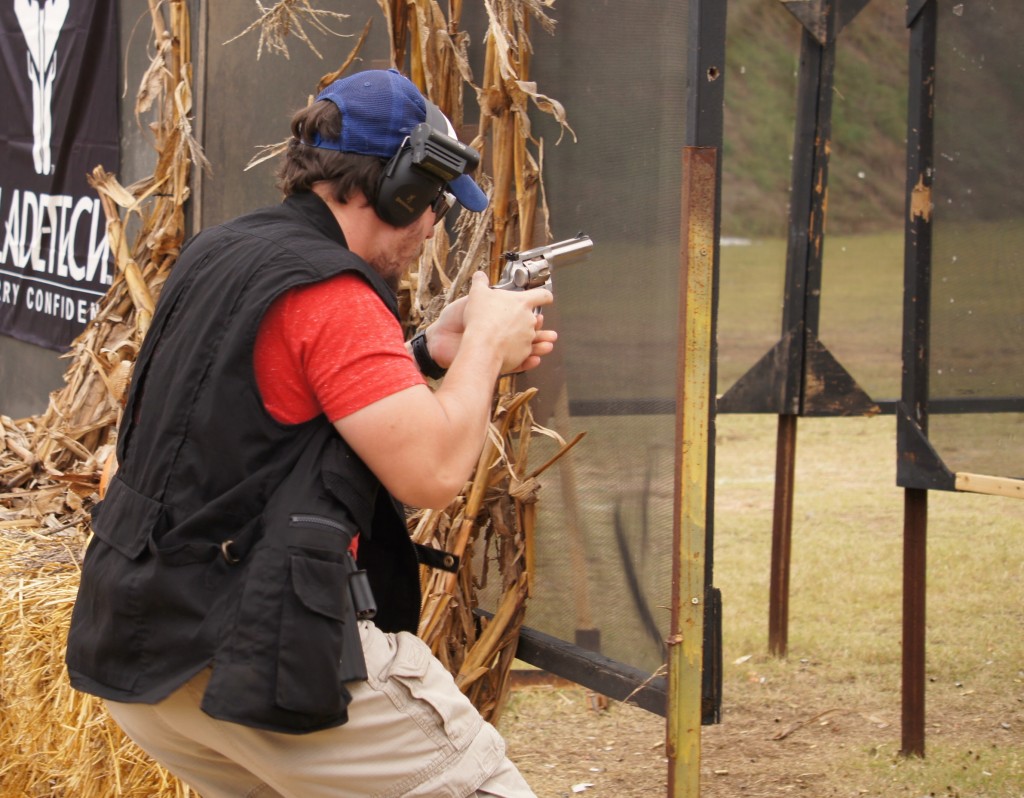
This is Stage 7 from the IDPA Nationals, Children in the Corn. This was what most people think of when they think “IDPA stage”. Traditional set-up with shoot, move, shoot, move through the various positions. I actually really liked this stage, and not just because I shot it very well.
Gabby is off to Shoot a Bear
Have I told you about my bear hunt?
First, you should know that I’ve never pointed a firearm at anything with a heartbeat, let alone a cute furry animal.
Second, I’ll admit that this was no “hunt” and it was technically over before it began, but it was an exciting moment in my gun-wielding life and I hope you enjoy it.
Kilted to Kick Cancer
It’s a little late in the month for me to start a Kilted to Kick Cancer campaign…which is why I’m not. Instead, I’m imploring you to support JayG, because he’s a rad dude. Here’s a link to his donation page, which I encourage you to pound into dust with your hot, massive donations.
IDPA Nationals Performance Analysis Part 2
Yesterday we did stages 1-4, today we’ll do 5-9. This will follow the same format as part 1, with time, raw time, and overall place followed by analysis and self-tips for improvement.
Stage 5
Score: 30.30, down 6
Raw time: 27.30
Place: 8th
Analysis: This was probably my worst stage from a mental standpoint in the match. The first array was a total of 7 shots, and I nailed that pretty well. However, shooting on the move I should have fired 3 shots into a target instead of just two. When I got to the final position I lost track of my round count for what should have been a simple, six shot array. I ended up pulling the trigger on a dead chamber, and double clutched a not-reload right before that.
Tips for improvement: Work visualization back into my daily training regime. Having a solid plan like I do for USPSA stages would have prevented the stage meltdown and saved me a mike and several seconds.
Stage 6
Score: 32.76 down 2
Raw time: 31.76
Place: 6th
Analysis: This was the toughest stage at the match. The majority of the targets were partial targets behind a wall with hardcover. Your shots had to pass through the gaps in steel bars to hit the targets. Here’s what it looked like:
Pretty tough. The winning time for SSR on this stage was 29.16, down 11. I quite likely could have shot it faster, but at what cost to my points? Down 2 in about 30 seconds was solid, and I was very deliberate on the trigger. I took make-ups where I needed them, and avoided them when I didn’t.
Tips for improvement: Work on shooting partials at speed at longer ranges. I should be able to shoot the same kind of points down on this stage about 4 seconds faster.
Stage 7
Score: 18.14, down 3
Raw time: 16.64
Place: 4th
Analysis: I was pretty happy with this stage. The only big issue is I cost myself about a second because I went too hard into the last position and had to hop around on one foot before getting my shots off.
Tips for improvement: Movement drills with more start/stops.
Stage 8
Score: 27.20, down 2
Raw time: 26.20
Place: 4th
Analysis: This was a solid stage. I took one extra shot at the end. The awkward shooting position made some transitions a little more difficult, but I didn’t pull down any PEs and shot a fairly accurate stage. This was an empty gun start stage.
Tips for improvement: Work on empty gun starts more.
Stage 9
Score: 30.44 down 7
Raw time: 25.94
Place 9th
Analysis: This should have been an easy stage with a time in the mid 20s. However, I threw a bunch of points away because I didn’t focus on the front sight during three strong hand only shots, choosing instead to point shoot them and in one case almost look away from the target before I was done shooting it. My movement here wasn’t excellent either. I did however smoke the charging target with all three rounds in the down zero.
Tips for improvement: more gear changing drills. And probably more Strong Hand practice.
Tomorrow we’ll do stages 10-13!
Sweep the leg!
I’m definitely adding this drill to all my training classes.
Photo of the Day: VZ-58 Project part 2
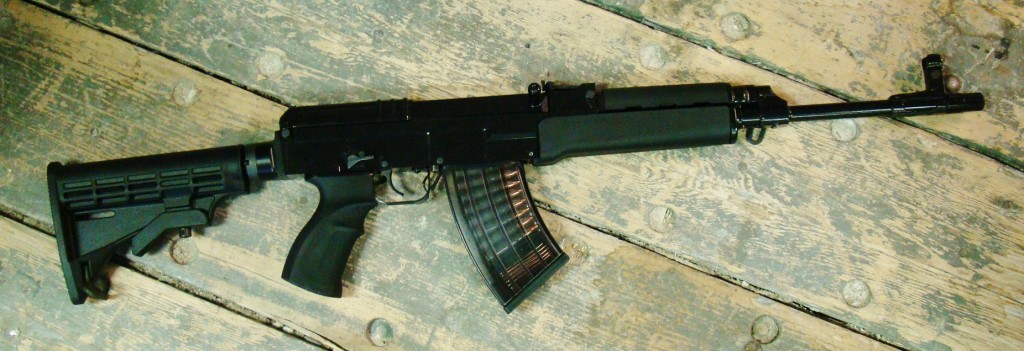
The horrid thumbhole skeleton stock is gone, replaced with a pistol grip of dubious origin and a M4 style collapsible stock. After I refinish it, the aforementioned Magpul MOE stock will find a permanent place on this gun.
IDPA Nationals – stage performance analysis Part 1
Thanks to IDPA’s new online scoring system, I can go back and take a look at all the stages from the 2013 Nationals and see where I finished in my division regardless of classification. For various reasons, IDPA’s SSR division is actually pretty tough, this year there were a total of 9 DMs or MA class shooters in the division, plus 5 Experts and 9 combined Sharpshooters and Marksmen. This post serves as a match recap, where I’ll look at each stage, my score/points down, and what I could have done better. All “places” in this post are overall, classifications have been eliminated for the purpose of this discussion. You can see the full match results here.
Stage 1
Score: 23.29, 8 points down
Raw time: 19.29
Place: 11th
Analysis: Stage 1 did not go well for me. With a fairly slow raw time at 19.29, a miss on the far target just added insult to injury. To close the stage out, I also took an extra un-needed make-up shot, adding another half second easily to my time. This was my 2nd to last stage on the 2nd day of shooting.
Tips for improvement: Trust my front sight and trigger pull. For whatever reason, I was very slow with my trigger pull on this stage, despite having made tighter shots earlier in the match with a much quicker trigger pull.
Stage 2
Score: 22.95, 1 point down, 1 no-shoot
Raw time: 17.45
Place: 12th
Analysis: I actually turned in a fairly competitive raw time on this stage, and if I hadn’t winged that no-shoot, I’d have finished 6th overall.
Tips for improvement: Don’t shoot no-shoots. This one I can just chalk up to “stuff happens sometimes” and move on.
Stage 3
Score: 16.46, down 4
Raw time: 14.46
Place: 4th
Analysis: My last stage of the match, and after a pretty poor day of shooting on day 2, I finally pulled it all together when it was too late to do me any good. You can actually see video of my solid run here.
Tips for improvement: I gave away probably a 1.0-1.5 seconds in two areas, my draw and coming up to the first target after the reload. My draw was very slow because I was trying to avoid sweeping my leg, and the target acquisition after the reload is a little slow as well.
Stage 4
Score: 28.99, down 9
Raw time: 24.49
Place: 8th
Analysis: my first stage of the match, and I was pretty cautious and slow. My raw time would have been reasonable, but one target I was score with a down zero and a miss, which I still believe was two down zero shots. Oh well. I always struggle on the first stage, and I usually shoot it in “survival” mode, trying to not lose the match.
Tips for improvement: I really need to work on attacking stages right out of the gate. Shooting in survival mode is fine if I don’t want to win anything, so I need to work on mental conditioning to help get me ready to be more aggressive on the initial stages.
Tomorrow I’ll look at stages 5-9, and I’ll have video as well.
Hornady Critical Defense .38 Special +P Review
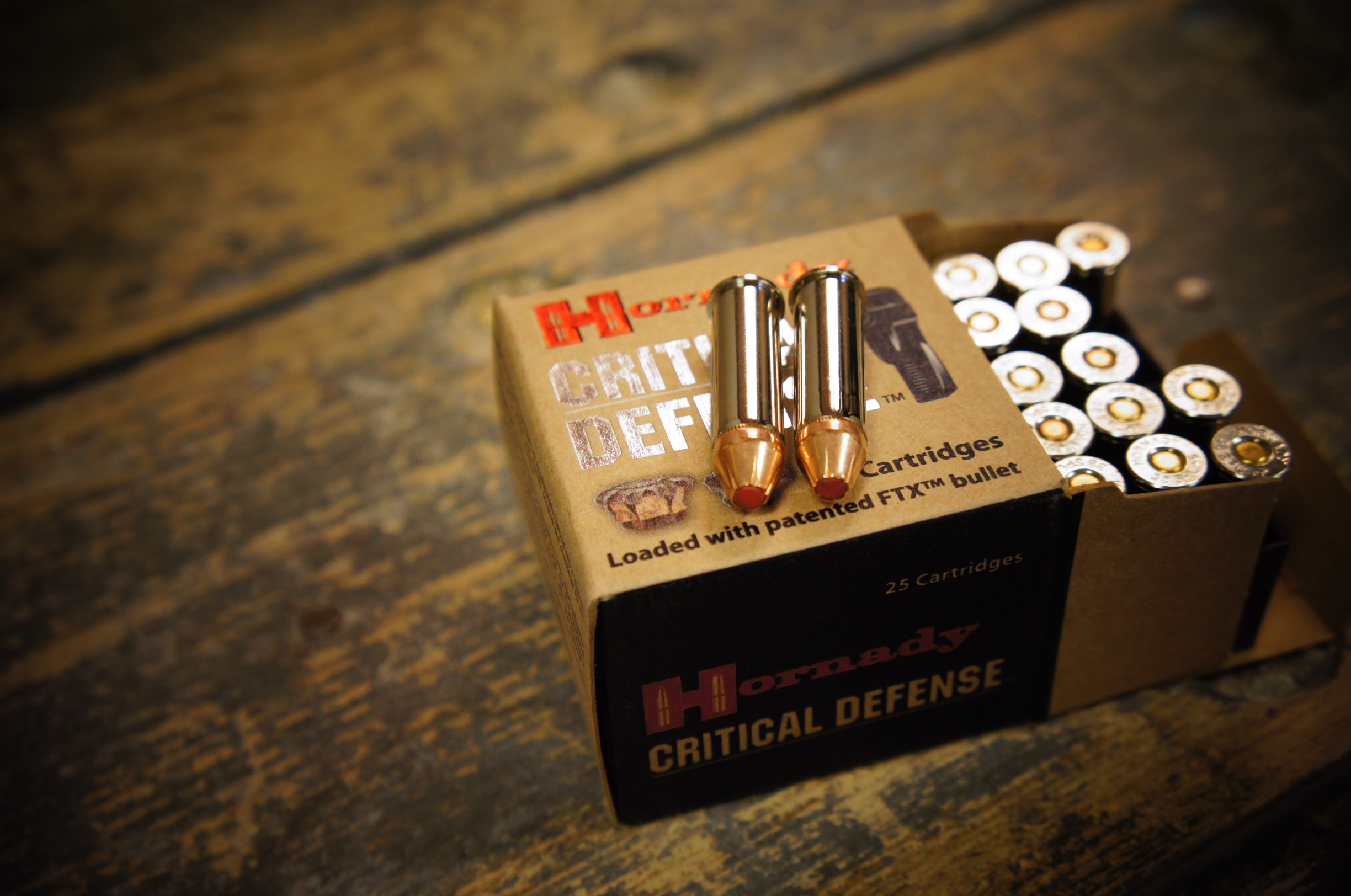
The last few weeks I’ve had the opportunity to do a considerable amount of shooting with the excellent Hornady Critical Defense .38 Special +P which uses Hornady’s FTX bullet. The Critical Defense line of rounds is designed to always expand regardless of whatever clothing it must first penetrate. Here’s Hornady’s boilerplate:
Since their inception, conventional hollow point pistol bullets have performed well, but have never delivered 100% reliability especially in self-defense situations. The patented Flex Tip® technology used in Critical Defense® ammunition eliminates the clogging and inconsistency that often plagues hollow point bullets. Hornady® achieved this by using the same tip material as used in LEVERevolution® ammunition.

Reviewing ammo is tricky, because there are a lot of qualities that are subjective interpretations on the part of the shooter. To hopefully avoid as much subjective information as possible, I’ll look first at the objective qualities of the Hornady Critical Defense .38 Special: Accuracy, reliability, consistency, and penetration.
Accuracy
The Hornady FTX bullet is based on the XTP bullet, which in addition to being a top notch self-defense round is also legendary for its accuracy. XTPs are popular with competition shooters looking for maximum accuracy. It’s no surprise then that the FTX bullet used in the Critical Defense ammo would also provide excellent accuracy. For accuracy testing, two test platforms were used: a Ruger GP100 with a four inch barrel and a Smith & Wesson 640 Pro Series. The guns were shot for groups off a rest at 25 yards for maximum accuracy, and freestyle at 15 yards as well. An interesting side note – I’ve found that freestyle slowfire groups at 15 yards produce mathematically similar results to sandbagged groups at 25 yards. This is obviously not the case for all shooters, and has much more to do with the individual marksman than the gun itself.
Out of the GP100, the average group at 25 yards was 2.15 inches. Owing to its shorter sight radius, the average group from the 640 opened up considerably to 3.44 inches at 25 yards. Five 5-shot groups were fired from each gun at each distance (15 and 25 yards), with the exception that the last group from the 640 was four shots because I was out of ammo. Best group of the day was a 1.22 inch group from the GP100 at 15 yards freestyle. Out of either gun, the accuracy from the Hornady Critical Defense rounds was excellent. I have held back a few rounds for testing out of a 6 inch revolver as well.
Reliability
Revolver ammo is subject to reliability issues just like semi-auto ammo. A “feed” issue with a revolver occurs when a cartridge doesn’t fully seat in the cylinder during a speed reload, or if it sticks and doesn’t eject. This problem can be exacerbated by dirty cylinders as well, or by rough/dirty cases. The nickel plated cases of the Hornady Critical Defense fed without issue in the test platform GP100 during the recent IDPA Nationals. Fired cases extracted easily with a positive strike on the ejector rod, and new rounds were quick and easy to reload using the Comp-III speedloaders. In fact, the pointed shape of the FTX bullet makes the Critical Defense easier to reload in a hurry than other defensive pistol rounds. The large, flat ogive on other JHP bullets can make aligning the rounds with the charge holes difficult; Critical Defense doesn’t have this issue.
Consistency
As mentioned, the Hornady Critical Defense was very reliable and very accurate. It was also very consistent, meaning that shot to shot there were no obvious variations in powder charge. Hornady states a muzzle velocity from a test gun of 1090 FPS with a 4 inch barrel, the rounds were able to provide at least 954 fps in all tests, and were sufficient to meet the IDPA power floor of 105 for Stock Service Revolver. Performance on steel was excellent, all the steel targets that needed to be engaged at IDPA Nationals went down with single hits from the Critical Defense.
Penetration
My friend and colleague Richard Man did extensive penetration testing with the Critical Defense for Shooting Illustrated, which you can read here. Richard tested the Critical Defense using a 2 inch barreled revolver in 10% ordnance gel, where it achieved 10 inches of penetration at a fairly low muzzle velocity of 955 FPS. Other tests have shown similar penetration, ranging between 10-14 inches depending on the gun and consistency of ballistic medium.
The FBI standard for penetration is 12 inches after defeating 4 layers of denim, in many tests the Critical Defense .38 Special round failed that test…and in other tests it passed. This illustrates the problem with internet ballistics tests, namely that it’s impossible to know if proper testing methods were used, if the gel is calibrated correctly, etc. Richard’s test for Shooting Illustrated are the best of the lot, since Richard is a known entity and a professional.
Another note on the Critical Defense round – it is not a bonded round like Winchester Ranger or Federal HST. If you’re looking for a bonded round using similar technology, check out Hornady’s Critical Duty line of ammo.
The Verdict
Hornady’s Critical Defense .38 Special +P load is a solid choice for your carry guns. While it doesn’t consistently reach 12 inches of penetration in testing, it will provide reliable expansion after defeating most common types of clothing. It’s well made, fast to reload, and has Hornady’s excellent levels of quality control. This is my summertime carry load for my j-frame, and my match load for IDPA competition. In fact, I like it better as an IDPA competition load than I do a carry load, because of it’s excellent accuracy and easy reloading. I’d rate this 4 stars out of 5. If I hit 12+ inches of penetration reliably, it would be a lock for five stars.
Quick photo: The ugliest stock in the world

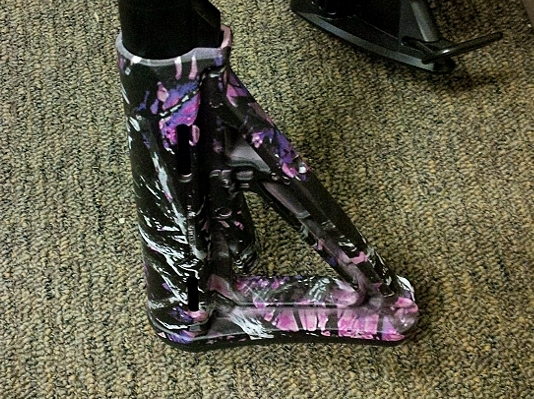
This is a Magpul MOE stock for AR15 pattern rifles. It is finished in what’s referred to as “Muddy Girl Camouflage” (I am not making that up) and is quite likely the ugliest thing I have ever seen. It is also currently attached to my VZ-58 project, and all it needs now is a little rattle-can re-finish.
2013 IDPA Nationals Stage 3: Flip the table!
You can’t tell me you’ve never wanted to flip a table over and shoot stuff.