At American Rifleman, I have a review of the Sig Sauer P226 Elite SAO.
Why we criticize open carry
I’ve gotten some flak recently (and in the past) for my criticism of the obnoxious behavior I see from Open Carry “Activists.” Usually it’s people saying that criticizing OC presents a divided front to the anti-gun activists. The problem with that assertion is quite eloquently summed up by Tam in a comment:
[F]rom the outside? That douchebag doesn’t just represent Robb [Allen]; he represents you and me and Todd, too.
Non gun-owners don’t grok any OC/CC schisms; they just see “gun owners acting like toolbags”.
This is the sad truth.
See, to the middle class, to non-gun owners, and people neutral on the issue there are no schisms in our community. They see us as the media represents us, a giant blob of gun owners marching in lock-step to the tune of the NRA’s piper. While we know that couldn’t be farther from the truth, that is in fact how the very people we need to keep being neutral to our cause see us.
This is why it’s important for us to call out bad behavior when we see it. That dude with the rifle in Starbucks? That becomes you, that becomes me in the minds of non-aligned/neutral voters. Yes, there are 80 million gun owners in America, but how many of those people actively vote on the gun issue as a core issue? I’ll tell that it’s not enough should we ever get in a situation where the neutral votes turn against us.
We have as a movement made great strides in just the time that I’ve been around. But getting those advances in protecting rights haven’t come by shoving rifles into people’s faces and shouting “LOOK AT MY GLOCK” like a needy child. They’ve come through the hard work of dedicated volunteers and activists, from people calling, faxing, and writing their representatives. Alan Gura didn’t win Heller by slamming an AR15 onto the desk of the Supreme Court and yelling “SHALL NOT BE INFRINGED OC4EVA”, and we as a community won’t continue to move the ball forward if we think that being the Westboro Baptist Church of Gun Rights is a good, or laudable idea.
No one is saying OC should be banned. In fact, Open and Concealed Carry should be legal in every single state in the union. But that path to that legalization doesn’t visit Jerkville, and we certainly won’t reach that laudable goal of 50-state carry by acting like tools.
IDPA Nationals Performance Analysis Part 4
Click here for Part 3
Stage 15: The Standards
Score: 49.98, down 22
Raw time: 38.98
Place: 12th
Analysis: Of all the stages I shot, this was the one where I was most disappointed with my performance. A standards stage based on accuracy? I should have made this stage my bitch. I didn’t. Instead, I rushed the strong hand headshots and dropped two, and then I thought it would be cool to slap a couple of down-3s while I was at it. If I had slowed down, I could have shot the stage in a 40 or so raw time and dropped about 14 fewer points.
Tips for improvement: Honestly? Suck less. This stage was all about patience with the trigger and sights, and I rushed it.
Stage 16
Score: 7.36, down 2
Raw time: 6.36
Place: 11th
Analysis: Another fast and furious stage, this one had you start with your gun grounded on a dummy, which you had to retrieve and then engage three targets from the awkward position of kneeling between airliner seats. I chose to shoot one of the targets strong hand only and then instead of staying SHO and using my support hand to get leverage, I went back to a two handed grip on the gun. That cost me about a second of raw time and -2 points on the last target.
Tips for improvement: Better stage planning, honestly. One of the things that I struggle with when I shoot IDPA is that for some reason, I turn my “stage planning” brain off. Perhaps it’s the lack of individual walk-throughs, but that shouldn’t be an impediment to coming up with a good plan and executing it.
Stage 17
Score: 13.12 down 1
Raw time: 12.62
Place: 16th
Analysis: By far my worst stage of the match. On T2, I didn’t step deep enough into the position to get a clear shot, so I had to shuffle step around a little to get to the target, that was probably 1 extra second right there. Then disaster struck, on the reload one of the rounds didn’t seat cleanly in the cylinder, so instead of a sweet 2.75 second reload, I had a 5+ second reload into the last target. Take those two issues away I’m looking at a raw time around 10, which would have been competitive.
Tips for improvement: Brush the cylinders more, and see above about stage planning.
Overall, you can see that by going through this stage by stage, I’m able to give myself a more honest performance assessment. On some stages, I shot very well and would say I executed the stages to the best of my ability. Obviously on other stages I didn’t do that. Unlike a USPSA match where you can battle back from a bad stage by placing well on the next stage, in IDPA (like Steel Challenge) your extra seconds will haunt you from stage to stage. At IDPA Nats, I finished Day 1 within 5 seconds of the pace I wanted to shoot. By the end of day 2, thanks to some poor shooting, I was 30+ seconds off that pace.
The moral of the story: SSR ain’t no joke. If I’m going to shoot one of those silly spinny-roundy guns, I need to spend more than one week and 200 rounds prepping for a major match.
2013 IDPA Nationals Stage 7
This was one of my favorite stages at Nationals. When you think about IDPA outside one particular region, this pretty much defines a “classic” IDPA course.
Bonus photo: Concealment
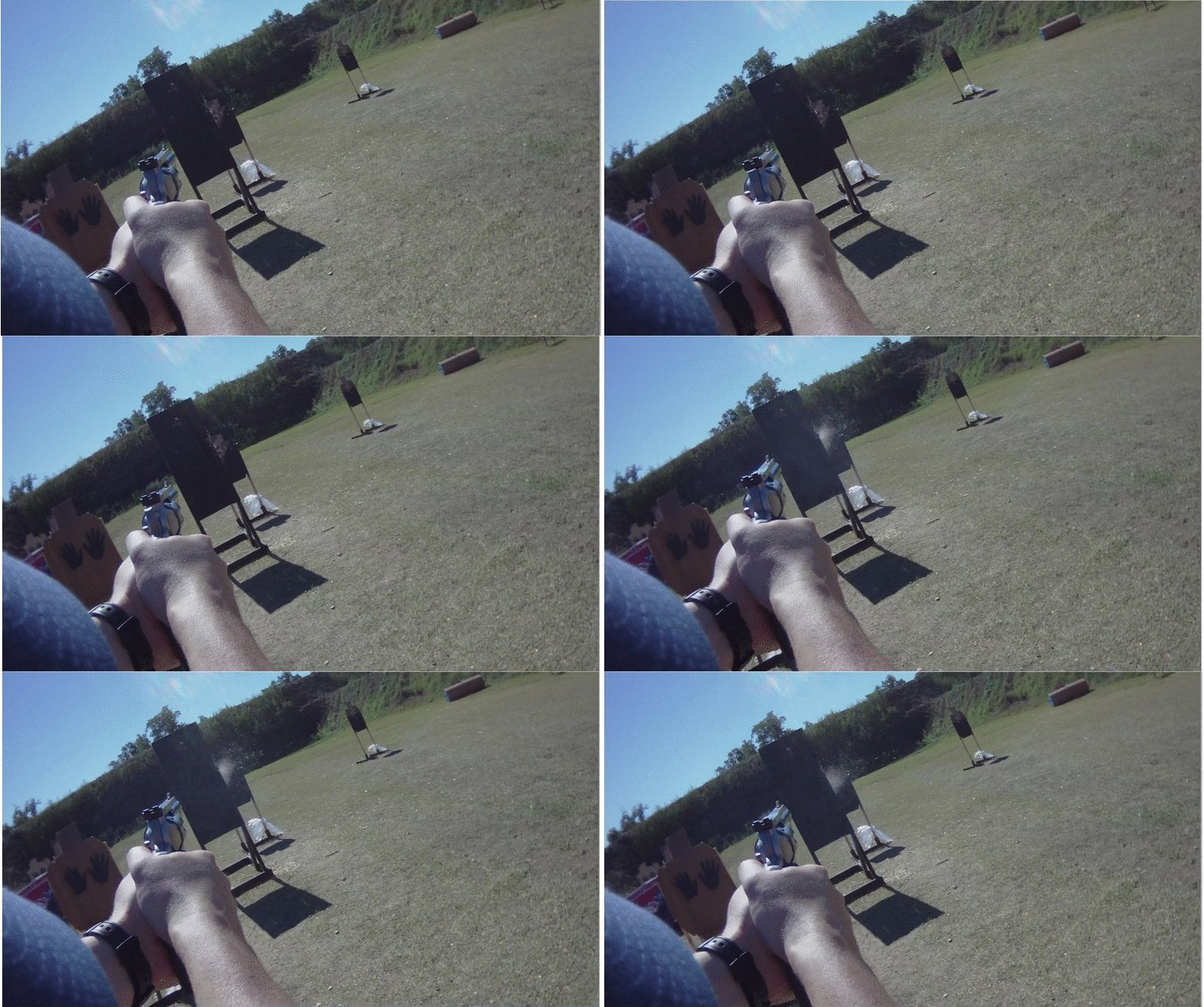
After smashing through the wood, the 110 grain bullet still had enough energy to strike the target and leave a grease ring. I don’t know what it’s penetration would have been like, but remember that bullets, especially handgun bullets will go through common building materials and retain a considerable amount of energy.
IDPA Nationals Performance Analysis Part 3
Click here for Part 2
Stage 10
Score: 25.60 down 4
Raw time: 23.60
Place: 9th
Stage video:
Analysis: I was just a little slow on this one. I took longer to acquire and shoot my targets than I needed to, and I lost probably another half-second on the draw making sure I didn’t sweep my own leg.
Tips for improvement: I definitely need to work on changing gears between easy and hard targets. I tend to shoot a hard target and then stay stuck in that gear, which isn’t really helpful.
Stage 11
Score: 16.85, down 3
Raw time: 15.35
Place: 7th
Analysis: again, my issue here was slow transitions and trigger speed on some of the targets. There were a couple of headshots on this stage that I spent a lot of time dwelling on the sights when I should have just drilled it and moved on.
Tips for improvement: See stage 10
Stage 12
Score: 21.09 down 5
Raw time: 18.59
Place: 13th
Analysis: This stage was shot on Day 2, and it was where the wheels started to come off my day. It was my 3rd stage of day 2, and after I had put up decent times on stages 13 and 14, everything went bad here. I managed to drop a down 3 on a close range hoser target and had a light primer hit, so I had to go all the way around my cylinder for one shot. That hurt, and cost a ton of time. It was easily 1.2-1.5 seconds right there.
Tips for improvement: work on shooting on the move, and put a heavier spring in my gun? I’m a little bit at a loss on this one, because it was just a little weird.
Stage 13
Score: 14.40 down 4
Raw time: 12.40
Place: 6th
Analysis: I was pretty pleased with this stage. It was one of the only movers that revo guys had to engage at full speed, and while I dropped 3 points on it, I didn’t get any FTNs or misses, which I seem to get a lot on movers. I nailed my reload and posted a strong time here.
Tips for improvement: shoot more swingers.
Stage 14
Score: 6.10, down zero
Raw time: 6.10
Place: 8th
Analysis: This stage was simple – draw your gun, run 10 yards, take three shots at a partial target that was obscured behind hard cover and a no-shoot. A three shot stage, the time was mostly consumed with how long it took to get your first shot off, which for me was a bit. I ran the distance nice and quick, but again spent too much time looking at my front sight.
Tips for improvement: more shooting low percentage targets.
Tomorrow we’ll close the series with stages 15, 16, and 17!
Photo of the day: Embrace your inner Muddy Girl
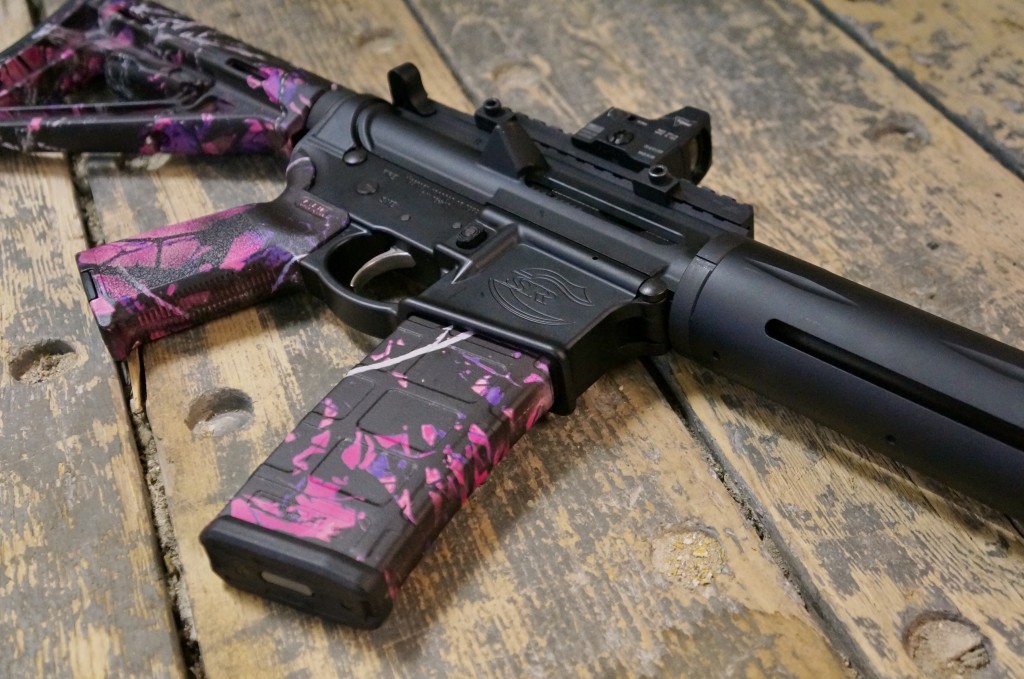
Despite their hideous finish, I couldn’t let a perfectly good MOE stock, pistol grip, and PMag go to waste. So now they’re living on my Colt Sporting Rifle. I think I’ll leave them pink, because it’ll drive tactical fanboys nuts.
Book Review: The Law of Self Defense
A little while ago I went on a bit of a rant about what I termed “gunstore lawyers”, people who have absolutely no verifiable knowledge of the laws governing the use of force but insist on sharing their suppositions and outlandish conclusions anyway, often misleading people who need to have better information. In response to that rant I was contacted by Andrew F. Branca, an attorney and the author of The Law of Self Defense with the offer to review his book here on Gun Nuts.
If you have a gun for self defense are looking to learn about the laws that apply to self defense, this book would be a great start. Mr. Braca begins by walking you through the legal process likely to follow the use of force, explaining what each step in the byzantine maze of our court system means to you and your case, as well as how a good attorney will earn their fees at each step in the process.
Subsequent chapters are broken down into covering specific principles of self defense (innocence, imminence, reasonableness, defense of property, defense of others, etc) in pretty good depth and the major points that are made are supported with citations from actual case law from a number of different states. At the conclusion of each chapter covering a principle of self defense, Mr. Branca includes a table with each of the fifty states listed and then a citation of statute, case law, or even jury instructions from that state as it relates to the topic of the chapter. Even if you’re pretty sharp on self defense in your own state, having these tables handy as a reference for those occasions when you travel out of state can be quite useful.
A number of often used, but little understood, terms are explained in clear, concise language that anyone can understand. If you read the book you will learn what “duty to retreat” and “stand your ground” laws actually mean in an objective sense and how they would apply to your situation. When the law talks about a “reasonable person” standard, you’ll have a good understanding of what that standard actually is and how it can change depending on the situation.
In addition to the explanation of sometimes difficult legal concepts and the citation of actual case law, the book is peppered with plenty of sensible advice. Even though there is a chapter dedicated to avoidance, the idea of avoiding trouble altogether whenever possible comes up several times outside that chapter. The wisdom of avoiding problems you don’t need to have should seem pretty obvious, but unfortunately on the internet where people confuse scaring people at a Starbucks with being a “patriot” folks occasionally need to hear that having a concealed weapons permit does not mean it’s a splendid idea to insert yourself into problems that don’t absolutely require your attention. The chapter dedicated to the defense of others hammers this point home. In some states defense of another person is only valid if that person would have been completely justified in using the same force to defend himself/herself from the attack. In Virginia if I walk into the Wal-Mart parking lot and I see a guy swinging for the fences with a baseball bat on another dude’s head, I can clearly articulate mortal danger to the swingee and use whatever force is necessary to stop the attack. If it later turns out that the swingee started the fight and didn’t meet Virginia’s requirement for disengaging from mutual combat, I’m still pretty much in the clear because of my reasonable belief at the moment I took action.
In South Carolina (where I sometimes go for vacation or for training) I’d be in really hot water, because under their legal tradition if the prosecutor can argue that self defense wasn’t justified for the swingee, then any force I use against the guy swinging the bat isn’t justified either. So in that situation I could find myself facing criminal prosecution based on things the other guy did before I was even on the scene. Now I ask you: How many of the dudes running around hollering about “SHEEPDOG!!!” all the time do you think have any understanding of how “alter ego” legal requirements work, or what states have them?
The Law of Self Defense doesn’t go to into full detail on each and every state, but instead attempts to be an overview of general principles with useful information for each state cited in the aforementioned tables at the end of the chapters. Big danger zones like the “alter ego” states or “duty to retreat” states are covered clearly, as are exceptions to whatever principle is being discussed. In the chapter on defense of property, for example, many states have statutory language covering it. Virginia does not…and Mr. Branca notes this in the book. While your state’s laws may not be exhaustively covered or explained, there should be enough information within the book to lead you to the right questions for further research.
I contacted Mr. Branca and suggested that state-specific guides might be useful, and found out that he is taking pre-orders for specific legal guides for Virginia, Florida, Texas, Ohio, and Georgia at a discount.
If you’re like me and you’ve been getting questions on self defense law from friends, family, and acquaintances who are new to the topic of self defense, this book is a godsend. It’s a work you can hand anyone with high-school level reading comprehension that will answer many of their questions with solid information and good advice. They’ll also get an idea of the variability built into the legal system and why black and white answers are difficult to extract from people who have experience dealing with the courts. I wouldn’t hesitate to buy this book for somebody I cared about to get them started on having a better understanding of self defense law.
In the interest of full disclosure, Mr. Branca sent me the copy I used to write this review for free…but by the time this post goes live on the website I will have bought another copy (or two) of the book for some friends, because I think it will be an excellent guide for them. If you’re looking for better understanding of the laws governing self defense and the use of force for yourself or for others you care about, The Law of Self Defense is a good start.
Links to The Law of Self Defense website have been peppered throughout this post, but I’ll put one here explicitly for reference:
The book is available on that website or through online retailers like Amazon.
Stay classy, Open Carry guys
When Todd published his “Thanks, Idiots” post regarding the Starbucks/OC kerfluffle, I read it and agreed with pretty much everything he said. Last night, I went back and read it again, including the incredible 350+ comment thread. Right now, there’s a lively debate going between several commenters and some anti-gun guy, but that’s not what I wanted to talk about. Here instead are several comments that were posted on Todd’s blog:
Either your for the second amendment or your not! Free men don’t ask for permission to carry and I don’t believe in giving up some of my rights so that I can conceal carry! Those of you that don’t support everyone’s right to carry however they want to might as well be kissing Obama’s ass! Either stand up or sit down and shut up while real men fight for our rights!
Here’s another:
as a founding member and VP of Open Carry Texas don’t worry… I have plenty of pics of me floating around…
Do you not understand rights or freedoms???? You think you are a freeman hiding your gun with a state mandated “license” that “allows” you to be sneaky???? While I can OC my AR without any such restrictions??
And yet another:
When I go on an open carry walk, that is my intent, to show my resolve and to give others hope that they can stand with me.
All of that kerfluffle ended when commenter #2 got so butthurt that he started making homophobic slurs. Not cool. This of course brings me around to the point today, which is not directed at the sort of people making comments like the ones above, but rather at the Robb Allen‘s of the world. See, Robb is an open carry activist. He’s also smart, socially adept, and even sometimes wears pants (for new readers, that is an old, old, in-joke). The point is that Robb is everything an Open Carry activist should be, which is primarily “not a dick”; with bonus points for intelligence and articulation.
So then, I have to ask Robb and the guys like him this: What the hell is wrong with the rest of the OC movement? I used to think that most OC advocate were guys like Robb, and not the toolboxes you see who saddle up the GSG-5 and go for a troll-stroll to bait local LEOs so they can post on their youtube account about how the “man” was harassing them. I don’t anymore. Either guys like Robb are the minority of the OC movement, or the toolboxes are such a loud majority that they’ve successfully drowned out everyone else to the point that reasonable, intelligent discussion on Open Carry as an activism tactic is nearly impossible. It took the post Starbucks fallout of internet chest-thumping and the madness that ensued over at Pistol-Training for me to finally come to this conclusion.
Is that it then? Because if Robb and those like him are really outnumbered, or even outshouted, Open Carry as a movement is dead.
2013 IDPA Nationals Stage 10: Rodeo Round Count
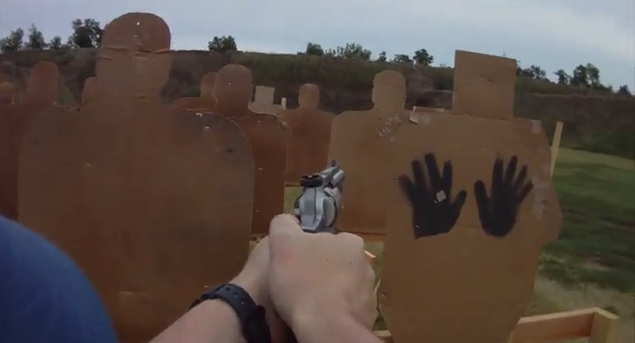
I want to take a moment and talk about one of the more interesting stages at the 2013 IDPA Nationals, stage 10. Stage 10 was called Rodeo Round Count, but should have been called “No Survivors.” What made this stage interesting was the use of humanoid vision barriers to obscure threat targets that needed to be shot. Here’s my match video from the stage to illustrate my point:
At one point during the stage, the best course of action is to shoot directly through the vision barrier to hit the threat target behind it; and as you can see from my video I did just that. There were plenty of bullet holes in that particular vision barrier, so I know I wasn’t the only one.
However, it’s the use of the humanoid vision barriers and their role in the stage’s scenario that make this the most interesting stage of the match, and as far as I’m concerned puts the final nail in the coffin of “IDPA teaches you tactics.” For the record, I love IDPA – I think it’s a great game, and will help build good gunhandling skills that could be useful in a defensive situation. However, I have long maintained that IDPA does not in any way teach tactics, and this stage is a perfect example.
In the stage scenario, the vision barriers were mentioned specifically as being representative of a crowd of people at a rodeo. The non-threat targets on the stage, designated per IDPA rules by a pair of painted hands were your friends/family in the crowd. So to make my point explicitly clear, this IDPA stage rewarded you for shooting through simulated bystanders to neutralize a threat. Obviously, if you did that in the real world, you would most likely get a free trip to a government facility where they provide you with living space, stripey pajamas, and pretty stainless steel bracelets.
I don’t have a problem with the stage in particular, because it’s just a game. I’m going to take the best course of action to get the best score possible in the game, and on this particular stage that meant shooting through a vision barrier that happened to be shaped like a person. But because the scenario specifically called the vision barriers out as a representing people, the “tactically” correct solution would have probably have not involved shooting through two or three of these barriers. Which then leads me to the penultimate point of this article: IDPA is not teaching you tactics. You will do things at an IDPA match that would not make sense in the real world, and the same applies to any gun game. It’s not tactical, it’s just a game with rules.
“It’s just a game with rules” is also the final point of this article. The rules of IDPA are constructed around specific reasoning, some of which I agree with and some of which I don’t. That’s fine, because I don’t have to agree with the reasoning behind the rules to follow them. I think that setting up a stage which rewards shooters for shooting through simulated bystanders isn’t really a good idea; but on that day it was the best course of action in the game. When you reach that point as a shooting sport, you’re officially a game and not training. Which is how it should be, because if I want to learn about tactics I’ll take a class from a tactical instructor. If I want to have a fun time wearing a vest and shooting targets for score, I’ll keep shooting IDPA.