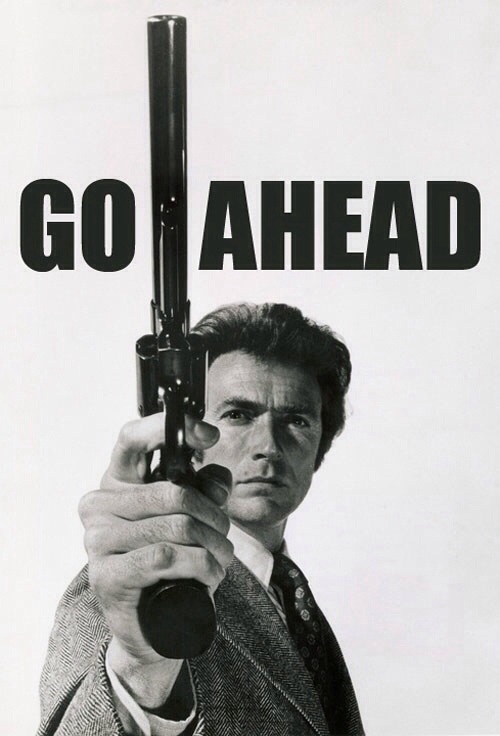
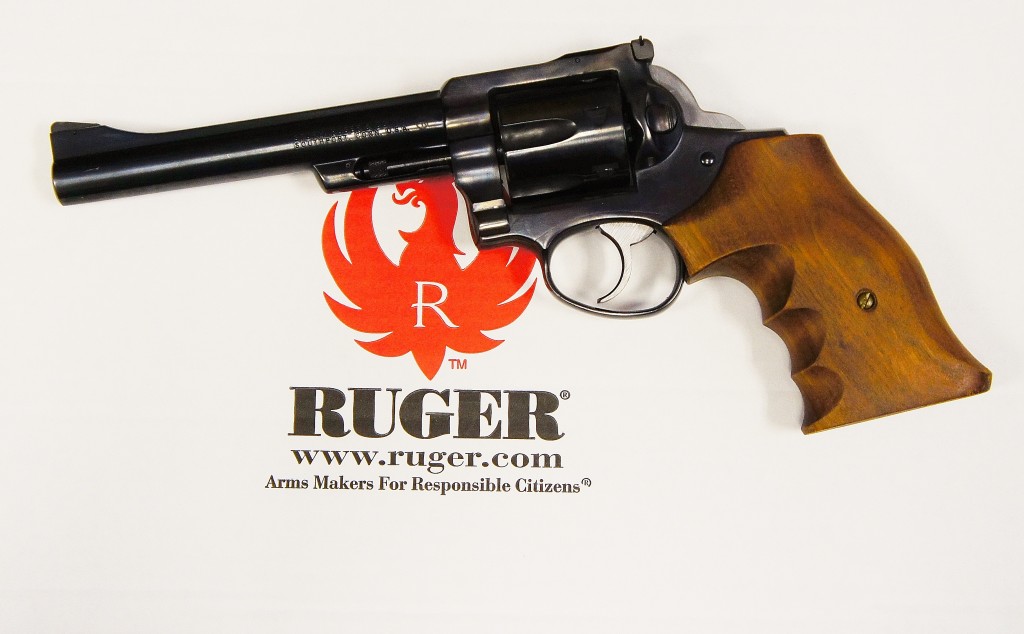
Quick, think of a cartridge/chambering that you can do everything with using factory ammo. Let’s run through the possible candidates:
9mm: 9mm is great for teaching new shooters and for self-defense, but not so great for harvesting game. I wouldn’t want to shoot an Indiana whitetail with a 9mm unless it was a contact shot.
.40 S&W: Hahahahaha no, .40 sucks. It’s terrible for teaching new shooters, and no better than 9mm for personal defense.
.45 ACP: I actually like .45 more than 9mm as an all purpose cartridge, because if you happen to have a .45 carbine sitting around, you can run some hot factory loads in it that will make it almost acceptable for medium game. It falls down in that it’s not great for teaching new shooters.
.22 LR: Great for newbies, target practice, and small game. Lousy for personal defense.
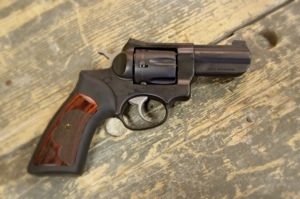
When you really look at it, the only options for truly all purpose cartridges are revolver cartridges. Break down even further, and the one cartridge to rule them all is the combo package of .38 Special and .357 Magnum. Think about it for a second. You can go to Wal-Mart and buy super light loaded .38 Special LRN for casual plinking and training new shooters, you can get +P defensive ammo, or proper .357 Magnum for self defense. You can even buy factory .357 Magnum ammo that will kill most things that walk in North America. Plus, the guns chambered for this combo run the gamut from small defensive revolvers all the way up to sexy bolt-action carbines, or lever guns if you’re so inclined.
I’ll accept arguments for other cartridges in the comments, but you have to make a strong case for your round. I will accept Magnum/Specials as one family of calibers since anything that shoots .357 Mag will shoot a .38 Special. So .44 Magnum/Special would be one caliber.
In the last couple of weeks we’ve been trying to use the Ballistic Radio interview of Justin Schnieders to learn some things about the behavior of criminal predators, and this week I want to finish up by looking at one of the most important lessons Mr. Schnieders’ unfortunate experience teaches us: Bad guys do not hesitate.
Earlier this week Caleb posted “Guns Are for Killing“, a writeup about acknowledging the reality of why, exactly, we’re carrying a gun in the first place. In it, he mentions the necessity of making your decision about what you’ll do well ahead of the moment when you need the gun…and he’s absolutely right about that. I’ll show you why…
Note that the first armed robber storms in the door gun drawn, and immediately opens fire in an effort to kill the people working behind the counter. One second they’re trying to make an honest living, and the next there’s some violent felon trying his best to murder them. The would-be murderer didn’t pause to consider the morality or legality of what he was doing. He made his choice long before he ever stormed through that door.
Justin experienced a similar phenomenon. Moved to a secondary location, laying face down on the floor, Justin was in a pretty unenviable position. When the bad guy focused on him and began to search him, the bad guy found Justin’s holster. Often in discussions of self defense you’ll hear that bad guys will flee at the first sign of a gun in the interest of self preservation. Some open carry enthusiasts go so far as to argue that no bad guy would dare pick a fight with somebody who was armed.
The man who shot Justin apparently didn’t get the memo. As soon as he figured out Justin was armed and wouldn’t give up the gun, he didn’t hesitate. He opened fire on Justin, seriously wounding him. To his enormous credit, even though seriously wounded and with gunshot wounds in his hands, Justin managed to get some shots off, deal with what he thought was a malfunction, and resume firing at the bad guy with enough accuracy to put a round into the man who had just tried to murder him. If you think it’s easy to shoot at pistol when you’ve been shot in the hands, it’s not.
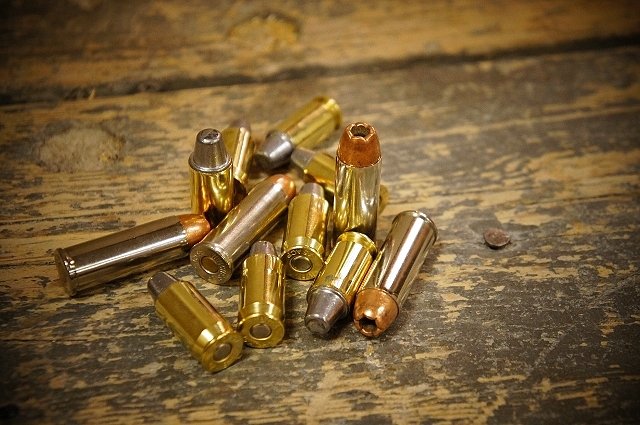
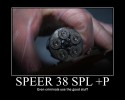
Contrary to popular belief, some bad guys do in fact know about +P hollowpoint rounds. And use them.
The picture to the right was taken by the police investigating the assault on Justin. They recovered the gun used by the perp and found that he had used all the ammo he had in the weapon trying to kill Justin. When the bad guy figured out that he was out of ammo but Justin was still shooting, then he decided to make a run for it.
As I mentioned in the series on capacity, folks often wonder how much ammo you “need” in a self defense scenario. The answer can be quite simple: More than the guy trying to kill you. Generally speaking, being the first guy in the gunfight to run out of ammo isn’t a good thing.
The man who tried to murder Justin didn’t hesitate to throw everything he had at the good in the effort to win. He planned the attack in advance, and he had experience using violence as a means of victimizing others. He made his important decisions long before the moment when he pulled the gun on a group of friends minding their own business.
This is often where discussions go off the rails. To be absolutely clear, I’m not talking about walking around with a 1,000 yard stare and drawing down on anybody who looks at you funny. That’s ridiculous nonsense pushed by people who either don’t understand the question of violence or who are ignoring it because they want to avoid making an honest argument.
The truth is simple: There are people in this world who have made the decision that they will not hesitate to take your life over trivial nonsense like the cash in a till or the iPhone in your pocket. You can see video evidence of them above, and you can listen to Justin or Jared Reston’s account of coming face to face with one in the flesh. They’re real. The violent criminal won’t hesitate.
If you want to protect yourself and your loved ones, you must not hesitate. Just as Caleb said in his article, you have to make peace with what you need to do well in advance of the moment where you are face to face with this sort of violent predator. In that moment you must act swiftly and decisively to seize upon the limited time where you can positively impact the outcome in your favor. You don’t have a choice.
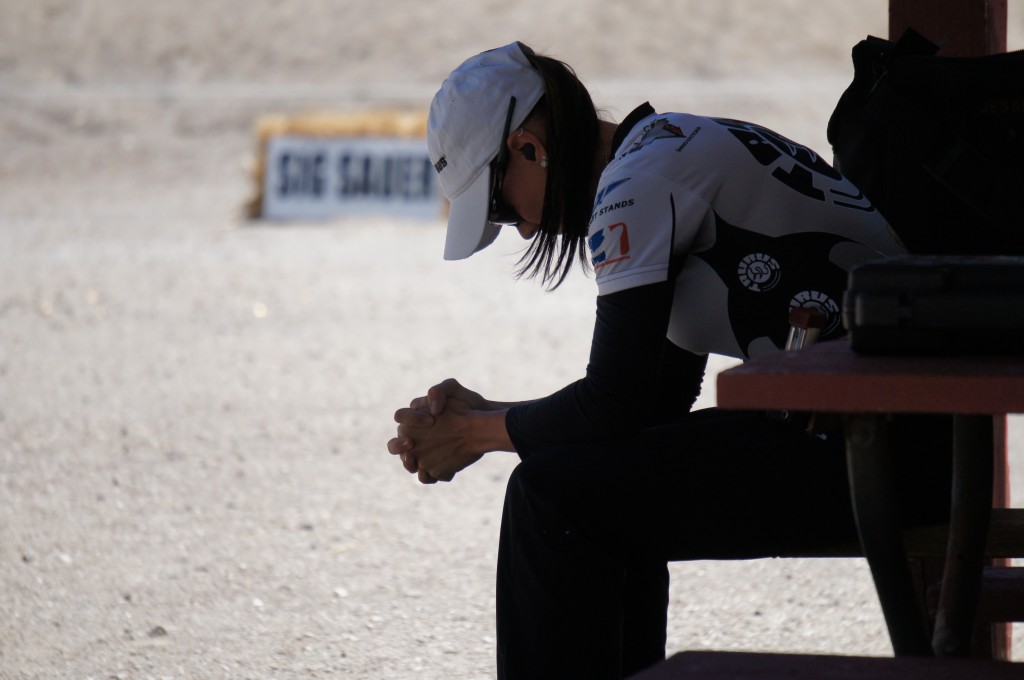
I took over 10,000 photos this year for work. This one, of Team Taurus’ Jessie Duff right before shooting the Mover at the 2013 Bianchi Cup is the best. It’s not actually my favorite, but the story behind the photo makes it the best. It captures the solitude, the emotion, and the intensity of Bianchi Cup better than any other shot I’ve taken, which is why it’s the 2013 Gun Nuts Photo of the Year.
A quote: “If you can’t explain something so that an eight year old could understand it, you don’t really understand it either.” In the shooting community, especially online there are a considerable number of people who like to take extremely simple topics and make them complicated. For example, in the Revolver physics post I intentionally used very simple math to illustrate the topic. The comments on that post are filled with nerds explaining the actual physics of the reaction, which is great and everything but also completely pointless.
Here’s what the average shooter needs to understand out of that post: heavy bullets have a higher POI for a given type of fixed sights than faster, lighter bullets. If you want to know why, the simple answer is because a slow bullet takes longer to leave the barrel, and recoil will have moved the barrel just enough to make a difference. It’s simple, straightforward, and anyone with the most basic understand of guns will get it.
But we love to take a simple concept and make it complicated, because it gives us a chance to flex our egos sound smart on the internet. We do this with shooting a lot as well. Here’s the thing – the act of shooting isn’t complicated. You line up the sights, then press the trigger to the rear without disturbing the sights. Piece of cake.
Things do get a little more complicated when you start introducing other things, like movement, reloads, multiple fast shots, but ultimately they’re still just parts of the fundamentals. Grip, stance, sights. There are no advanced shooting techniques – there are only the fundamentals executed faster and more accurately than the other guy. That’s it. No ninjer secrets to learn from tatted up faux-warriors teaching you their secret brand of kung fu. Here’s a fun fact: every single advancement we’ve had in shooting techniques since Jeff Cooper invented the Modern Technique has come from a better understanding of human kinetics. We went from Weaver to Iso because we learned that the body works better when you’re not using push-pull tension.
Keeping it simple makes the sport more accessible to newbies. Yes, there is a time and place for people with Aspergers to talk about spring rates, material hardness, and how recoil is really just acceleration in two directions, but it’s important to remember your audience. If everyone around you is wearing pocket protectors, by all means break out the graphing calculators. Otherwise, keep it simple and keep it accessible.
One of the questions raised in our Guns are for Killing post is when it’s appropriate to draw your gun. Make no mistake about this: guns are absolutely lethal force. Remember, we are not cops and we’re not arresting people. We’re armed citizens using our guns to inflict surprise violence on an attacker.
I firmly believe that the only time I’m going to draw my gun is if I’d be justified using deadly force in that situation. I don’t draw my gun to threaten people or scare them, I draw my gun to defend my life against threats of death or grievous bodily harm. Travis Haley has a great line about this in the Magpul Dynamic Shotgun video: “I don’t use a pump (shotgun) to scare somebody, I use a pump to shoot somebody.”
It’s important to know your state’s laws on lethal force. However, since laws vary from state to state, if you travel frequently it’s important to have a general set of guidelines for how you’ll act. Here are some general guidelines for escalating force. Please note, I am not a lawyer and this is not legal advice. These are simply examples of the decision process that can occur during a deadly force encouter:
Am I serious danger? If no, proceed as normal. If yes, proceed to question 2
Can I retreat or flee without exposing myself to additional danger? If yes, run away like a little girl. If no, proceed to question 3
Is the danger I’m in a credible threat of death or grievous bodily harm? If no, examine what force options are available other than lethal force. This can include pepper spray, contact weapons, hands-on fighting, or de-escalating the situation. If yes, proceed to step 4.
Am I prepared to shoot this person right now? If your answer is no, you shouldn’t be carrying a gun.
In step 3, it’s critically important to understand what constitutes credible threat of death or grievous bodily harm. Our friends at InSights teach the line “I was in fear for my life” and the ability to articulate why you were in fear for your life. These are things that you should think about well before you ever go out in public with a gun.
The escalation of force process I’ve outlined above should take mere moments, and much of it will be unconscious if you’re properly prepared. It’s very easy to skip from 1 to 4 during a violent encounter. The reason I include the retreat option is because some states have a duty to retreat, and honestly I’d rather run away and live to run another day.
As a tactical note, things like verbal commands fall into step three. An example: I was walking home from dinner, and noticed a young gentleman approaching me from across the street. I assessed that I was in danger, that I did not have retreat available, but the danger was not yet a credible threat of death or bodily harm. A verbal command of “stop right there” worked to stop the young choirboy long enough for me to affect an escape. Flashlights are also great stand-off weapons.
Make your own guidelines. Know what you’re going to do and when. Be prepared. You should be able to process your entire decision tree in mere moments, and be ready to make effective choices to defend your life.
Ten more years without plastic guns that might go undetected by X-ray machines and metal detectors. This is the ban congress renewed late on Monday night. There was little opposition to the renewal, and that includes comments from the NRA. There was however, a proposed change from a senator from New York. Sen. Schumer’s proposed changes included the requirement of adding permanent metal parts to make plastic guns more detectable. But the senator clearly misundestands that most “plastic” handguns have many metal internal parts, without which the plastic parts would add up to little more than a blunt object.
While the title of the post is a bit inflammatory, it does serve the central purpose of this post: if you carry a gun for self-defense, you must be willing to use that gun and understand that the possible consequences of doing that could result in the taking of another human’s life.
This gets tossed around a lot as “warrior mindset” or “mental conditioning” and has been addressed by some of the best and brightest minds of the self-defense and training community. Jeff Cooper himself spend a considerable amount of time on this topic, and believed that anyone who carried a pistol for defense should also have hunted and killed something at least once.
Cooper’s reasoning was simple. He believed that if you ever needed your gun for self-defense, that shouldn’t be the first time you’ve ever pointed a gun at a living thing with the intent of pulling the trigger. I absolutely agree with him on this, but I also realize that in this modern day and age, not everyone who carries a gun for self-defense even has the opportunity or inclination to go hunting. So how do we accomplish the important goal of mentally preparing ourselves for the possibility of violence?
We’ve addressed this topic many times in the past, and the first and most important thing you can do is make your decision now. If you’re waiting until the actual moment of violence to decide whether or not you’re going to use your gun for self-defense, you’ve waited far too long and it’s likely too late. Deciding when to use deadly force is an important decision; and you have to train your mind to know what your triggers are. When do you draw your gun, when you do fire your gun, what do you after you fire your gun are all things that you should know and have a plan for well before you ever tie on your heater and go to town. The best way to do that is to train & learn. Our old friends at InSights Training Center in Bellevue, WA have a great class called Street and Vehicle Tactics, which sounds operator as hell but is actually about managing possible dangerous encounters in every day life. It’s a great class. There are plenty of other good classes as well, and plenty of good information out there such as SouthNarc’s documents on Managing Unknown Contacts.
Once you’re educated, it’s thinking time. Go to your quiet place, and actually think to yourself “I will use deadly force once the following parameters have been met: x, y, z.” Write it down. Make a list of what you will use deadly force to prevent. Don’t create imaginary scenarios, but keep your categories broad. Here a couple of mine: “I will use to all necessary force to prevent an attacker from physically restraining me.” Remember when you’re making these decisions what the legal lines are in your state to allow you to use deadly force as well. But you must make those decisions now, when you’re calm and at peace.
The second aspect of preparing yourself mentally is actually related to killing. You cannot shoot someone “just a little bit”. If you shoot someone who is trying to do you harm, there is a very real chance that you’re going to kill them. There’s really no way to prepare yourself mentally for what happens after your take someone’s life, but you can take steps to prepare yourself for the moment itself. Obviously, going hunting is a great idea. Realistic force on force training with sim guns or even paintball can help. Yes, even first person shooter video games can be used as training tools in this regard. On the FPS note for a moment: we do not believe for even a hot second that first person shooters “make people violent” or any of the silly nonsense that you hear about “violent video games”, however we do acknowledge that the military has used FPS games as training tools in the past specifically because you’re pointing a simulated gun at a simulated person.
However, our bottom line is this: if you don’t know whether or not you could pull the trigger if you needed to, if you haven’t made that decision, or if you’re not willing to accept the possibility that you might need to kill someone, then you shouldn’t be carrying a gun. Guns are dangerous, and carrying a gun comes with a tremendous burden of personal responsibility. If you’re not willing to accept that responsibility, get some pepper spray or a big dog.
Now it’s ready. Mustang stocks, bobbed hammer, my personal action job, serrated rear and front sights. This gun shoots under 2 inches standing freestyle at 25 yards with match ammo.
We use cookies to optimize our website and our service.
Functional
Always active
The technical storage or access is strictly necessary for the legitimate purpose of enabling the use of a specific service explicitly requested by the subscriber or user, or for the sole purpose of carrying out the transmission of a communication over an electronic communications network.
Preferences
The technical storage or access is necessary for the legitimate purpose of storing preferences that are not requested by the subscriber or user.
Statistics
The technical storage or access that is used exclusively for statistical purposes.The technical storage or access that is used exclusively for anonymous statistical purposes. Without a subpoena, voluntary compliance on the part of your Internet Service Provider, or additional records from a third party, information stored or retrieved for this purpose alone cannot usually be used to identify you.
Marketing
The technical storage or access is required to create user profiles to send advertising, or to track the user on a website or across several websites for similar marketing purposes.