And so we have 3 episodes of Top Shot in the bag now, with only 7 episodes to go there are 13 contestants left vying for the $100,000 grand prize and title of Top Shot. Spoilers beneath the jump for anyone who hasn’t yet seen Episode 3 of Top Shot.
A question of purity
As the gap closes between the start of The Quest for Master Class and myself, I’m faced with a difficult question. As I asked on my Facebook fan page (sign up!) the Ruger SR9c that I’ll be shooting comes with two types of magazines. The first magazine is a flush fitting 10 round magazine . This doesn’t add any length to the grip of the pistol, and is definitely easier to conceal. My other option is to use the 17 round magazines that are normally designed for the SR9 full size. When used with the grip adapter, these add about an inch and a half to the length of the grip of the SR9c. They really make the gun easier to hold on to, and since I’ll be shooting this gun in competition will definitely make the gun more controllable in fast shooting.
Here’s my ethical dilemma though. I’m going to carry the gun in the exact same condition that I shoot it in competition. That means that if I’m shooting the big mags in competition, then I’m carrying the big mags. The issue arises in that I feel like using the big mags is partially subverting the whole point of the exercise – which is to prove that you can not only compete, but compete at a high level with your carry gear. I kind of feel like using the big mags with their extended and easier to hold grip isn’t in the spirit of that exercise.
But it’s not my decision to make – the Quest for Master Class is about what you want to see, so I’ll put the question to you guys. Should I use the compact 10 round mags, or use the 17 round magazines with the extension? Both types of magazine come with the pistol and are viable carry options, so the decision is yours! You can either comment here or go to my Facebook fan page and leave a comment.
I have so much trouble with that
Ex. 20:17 – Thou shalt not covet..
Covet, verb: to desire wrongfully
I was at Beech Grove Firearms yesterday to pick up the Rugers and the Sig Sauer for the HAVA Charity Auction. While there, I noticed a P220 in the case, which I have an irrational attraction to, but have always resisted because it’s a .45 and I need another .45 ACP like I need a hole in my head.
This one was a 9mm. 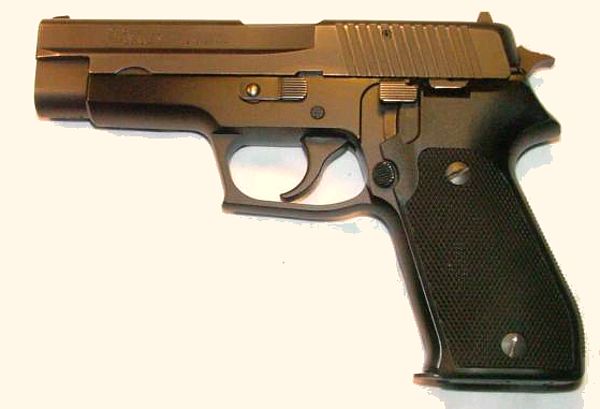 And like the gun in the picture from Guns.Ru, it had the American style magazine release, not that idiotic heel-type release. PLUS it even had a reasonable price tag…and a spare magazine.
Needless to say, the 10th Commandment fell by the wayside on that one; in fact the only thing that kept me from walking out of there with a Sig P220 9mm was the potential wrath of my wife.
That and I had already done a NICS check for three other guns and I really don’t want a visit from the feds. But still, a full size Sig with the aluminum frame in 9mm…do want.
Fundamentals
Let’s talk about speed for a second.
In the video, Todd of Pistol-Training.Com executes a 7.31 El President Drill from concealment using an appendix carry holster and an HK45. For those of you new to Gun Nuts, the El Presidente Drill is a standards drill designed by the late Col. Jeff Cooper; starting with the gun holstered and facing away from your targets, you turn, draw, fire two shots each at three targets, reload and fire two more shots at each target. Col. Cooper believed that the drill should be run exactly as depicted in the video – your times in between each shot should be the same whether it’s a transition or a follow up shot.
Back to the video, and why we’re talking about fundamentals. Watch the press out – where the shooter transitions from holstered gun to his shooting stance. The arms come up and in to the high compressed ready position, and then are thrust out to the proper isosceles stance. It doesn’t look fast, does it? That is what is deceiving about good speed with a gun, is that it looks easy because it’s done without that “scramble”. You’ve seen someone trying to complete an unfamiliar task in a hurry – their limbs are awkward, they don’t move with economy of motion, and everything just kind of goes helter-skelter.
I recently had Julie Golob on Gun Nuts Radio, and she talked about dry fire practice. A lot of people advocate dry firing practice against a timer, but Julie doesn’t do that. She said that dry fire is your time to build that fluidity and economy of motion; dry fire is where you can perfect your techniques. I’ve been dry firing off the clock now, and you know what? She’s right. If you want to get to that kind of crisp movement in Todd’s video, your practice needs to be unhurried. You can practice speed later, but until you’ve got the movement down in the most efficient fashion possible, speed is just going to be sloppy.
Brownells AR15 magazine test
All I could think while watching this was that I could get a LOT of money for all that delicious, delicious brass.
A tale of three heaters
I went down to Beech Grove firearms yesterday to pick up the Ruger SR9c that I’ll be using for the Quest for Master Class, sponsored by Ruger Firearms and Downrange.TV. The Ruger SR9c is designed as a carry gun, so what did I do after pulling it out of the box? Whip out my iPhone and start taking pictures compared to other guns that I’ve carried. First, three carry guns together – the Ruger SR9c, a ParaUSA LTC 9mm, and my S&W Model 60 Pro Series.
 On a side note, I deeply love my iPhone. If there is one thing that has revolutionized blogging for me, it’s the ability to take decent quality pictures and upload them to the internet all from one device. Anyway, back to the guns. You can kind of get an idea for the relative size of all the guns in that picture – dimensionally speaking, the Ruger is the smallest of the three. It’s shorter in both length and height than the Commander sized 1911, and shorter in OAL than the Model 60. In defense of the 60, a lot of that length comes from the 3 inch barrel, which is a little unusual on J-frame revolvers. The weight of the SR9c is another factor – unloaded it weighs a little bit less than the J-frame and the LTC, although this was measured by the tried and true “heft” method. But it holds almost double the ammo of the J-frame, and 1 more round than the LTC. Plus, if I want to use the full size mags from the SR9 with the adapter, I can get my little gun up to 17+1 rounds of ammo.
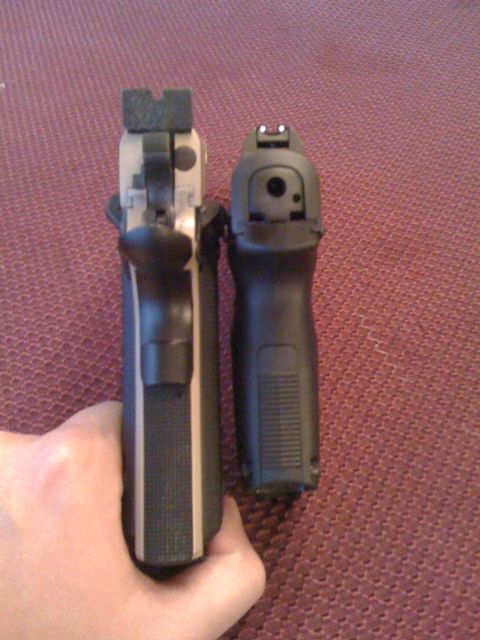 Yesterday, when discussing the merits of a long barrel vs a long grip for concealment, the topic of how thick the handgun is came up as a factor in its relative concealability. The 1911 style pistol is widely known for it’s ability to be readily concealed and carried, and the LTC, with it’s aluminum frame and 4.25 inch barrel is one of the best at it.
Yet, the LTC is in fact thicker than the Ruger SR9c. In a couple of key areas, the Commander sized 1911 is thicker than the SR9c – obviously the ambi thumb safety isn’t helping, and the awesome Crimson Trace Laser Grips are a bit bulkier than the standard grips on a 1911. But that aside, the SR9c is well, skinny. I don’t have big hands, but I’m able to get a lot of meat on the gun, which means faster follow up shots and faster hits on target.
 The Ruger S9c comes with a 3.5 inch barrel, 3 dot sights, a single 10 round magazine and a 17 round magazine with the adapter to give you a full grip profile. For the matches that I’ll be shooting this gun in, I’ll definitely be using the full grip profile magazines, although I need to be careful to not catch the meat of my hand in between the adapter and the magwell.
The trigger on both of the SR9c pistols that I have measured at about 6.5 lbs – after shooting revolvers with 8-12 pound triggers for the last year, that felt like pulling a feather. I think with a couple of thousand dry fires and some live ammo, it will settle in quite nicely. In preparation for the Quest for Master Class, where I’ll try to achieve the rank of IDPA Master in Enhanced Service Pistol and Stock Service Pistol using this gun, I’m going to be shooting the Ruger SR9c in the upcoming USPSA Indiana State Section Match. That should be a nice little “warm-up” before the Quest starts in earnest.
I think the weirdest thing for me to get used to is that the slide stop on the SR9c isn’t also a slide release. With the slide locked back and a full magazine inserted, pressing down on the lever doesn’t release the slide. You need to slingshot the slide to get it to go forward, and that’s not a technique that I’ve actually practiced that much. I’m actually toying with the idea of only doing retention reloads in IDPA matches…just to amp up the difficulty of things. We’ll see about that!
The Quest for Master Class and all future articles are sponsored in part by Ruger Firearms, who have provided the guns being used for the series that will appear starting in July on DownRange.TV. Find Ruger, and all their excellent products online at www.ruger.com.
2009 Steel Challenge Super Squad: Accelerator
Watch the Super Squad from the ’09 Steel Challenge shoot Accelerator – Todd Jarrett takes a stage win here. One of the neat things about this video is that you can learn a lot about draw mechanics. Watch how the pros all essentially do the exact same thing when drawing.
Pay special attention to Rob’s presentation, as he’s shooting Production division – that means Production holster, not a “race” holster like the other shooters. Even with that, the motion is EXACTLY the same.
Shorter barrel or shorter grip?
In concealed carry guns, you see two types of changes done to make the guns more concealable. For example, in the case of the Springfield XD(m) 3.8, you saw that the barrel of the gun was  shortened from 4.5 inches to 3.8 inches, but the grip remained the same size. That’s the same idea as the venerable “Commander sized” 1911, where the barrel gets chopped down from 5 inches to 4.25, but retains the same size grip.
On the other hand, you’ll see other compact guns that have the grip size shortened to make the more concealable; while many of these guns often shorten the barrel as well, there are a lot of 4 inch “compact” guns with shorter grip frames than their full sized counterparts. The ubiquitous Glock 19 comes to mind – while the barrel is slightly shorter than the 17, the size of the grip definitely makes it easier to conceal.
The question though is “what’s your preference”? I have messed around a bit with putting a Glock 22 length slide on a Glock 23, giving me the shorter grip frame and the longer sight radius, and while I liked the longer sight radius, the balance felt off. With the Ruger SR9c that I’ll be 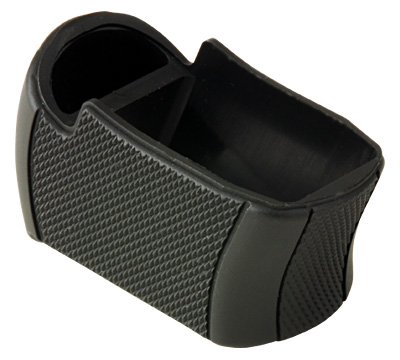 using for The Quest for Master Class on Downrange.TV, one of the options for magazines is to use a 17 round magazine with a grip extension on it. What that does for the compact is give you a gun with a 3.5 inch sight radius but a fullsize grip. The fullsize grip makes it easier to hold the gun and get rapid follow up shots.
One of the things we’ll test is the difference in effective shooting ability when using the standard flush fit 10 round magazines and the 17 round mags with the grip adapter on them.
But what I’d like to know is what you prefer for concealed carry? Would you have rather a shorter barrel and a full size grip, or a shorter grip and a full size barrel? Pretend for the moment that “shorter barrel and grip” isn’t an option (although it is) and that you’re forced to pick which one of those you would prefer. I’m honestly leaning towards “shorter barrel, full sized grip” because it makes the gun a lot more shootable. We’ll find out for sure on the Quest for Master Class!
What?
Weirdest search term I have probably ever seen in my referral links: “man weigh 150 pounds and 5′ 8″.
Actually, I’m 5’6 and I weigh 147 now.