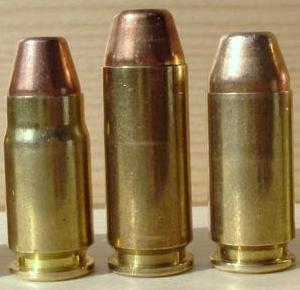
If you haven’t heard, the Texas DPS recently decided to replace their P229 pistols chambered in .357 sig with 9mm M&P’s. My friend Todd reported that the FBI is considering making the switch to the 9mm as well. A number of departments who issue .40 S&W, .357 sig, and .45 ACP sidearms have switched to 9mm pistols or have been rumored to be considering it, leading many people out there to ask why a department would “downgrade” to a 9mm. Let’s explore some of the reasons why agencies are looking at going to 9mm pistols…
Terminal Ballistics:
We’ve talked about terminal ballistics in this space before, so I won’t attempt to re-cover all that ground today. It’s worth repeating, however, that since 1986 a number of government agencies have been gathering data on shooting incidents and attempting to measure the real world performance of issued ammunition. Careful research in the lab on ballistics media and even live tissue testing has led to the development of ammunition in all the major service calibers that does all you can reasonably expect from a handgun round. For most tasks relevant to self defense, there really isn’t a significant performance advantage to the larger calibers. This is particularly true of the .357 sig which performs essentially the same as good 9mm offerings. The worries I’ve seen about the Texas DPS “downgrading” their sidearms amuses me, given that they’ve been using a round that has proven to offer 9mm performance for years.

Cost:
Given that there’s no significant advantage in terminal ballistics for going with one of the other calibers, the extra cost of ammunition gets harder to justify. You’re not getting any more performance bang for your carefully budgeted buck. Agencies typically buy ammo in greater numbers than the individual and so don’t see as much of a price difference as you might in the local funstore. Well, at least until the ammo panic started. The fondly remembered days of Winchester White Box 100 round packs at Wal-Mart for $9.99 probably won’t be seen anytime in the near future. Still, when you need to replace issued firearms you have to factor in the cost of feeding them whether the agency is buying the ammo or the individual officer is buying ammo to train on his/her own time. If there’s no significant terminal ballistic advantage, why go with more expensive ammo?
Reliability:
A number of pistols popular in law enforcement offer far better overall reliability when chambered in 9mm rather than .40 S&W. The Beretta 92 has racked up quite a good record in law enforcement service. The Beretta 96 hasn’t. The 9mm Glock family has done very well as an issue sidearm while their .40 caliber offerings have been problematic from day 1. Glock has made numerous attempts at solving the problems, but none of them have proven to be the magic bullet that puts them to rest. An agency that has experienced problems issuing Glock .40 caliber sidearms might find going to the more predictable 9mm models quite appealing. This isn’t to say that there aren’t any reliable .40 S&W firearms, as some built quite a reputation for reliability…typically guns that were designed from the ground up as .40 S&W weapons rather than 9mm designs scaled up to be .40’s.
Durability:
Along the same lines, guns in 9mm have often proven to be more durable in the long term than their .40 caliber or .357 sig brethren. The Beretta 96 has a tendency to bash itself to death if not carefully maintained, (which most departments do not do) and even when carefully maintained could be expected to exhibit a shorter service life. A Glock 17 can generally be expected to outlive a higher number of rounds than a Glock 22, and both can be expected to live longer than a Glock 31. Here again the original design plays an important role. Sig’s P229 sidearm in particular seems to do quite well in the durability department in .40 and .357 sig, but it was designed for these calibers from the ground up. The all steel S&W 4006 developed quite a reputation for durability matching that offered by the S&W 5906…another all steel tank of a sidearm.
Training:
Agencies have an obligation to train their personnel up to at least a minimum standard of competence. They have to do this with personnel who vary considerably in size, strength, aptitude, and attitude. Most who wear a uniform and tote a sidearm are not really firearms enthusiasts who can be relied upon to invest a great deal of time and effort into developing their skill with their issued sidearm. It’s often left to firearms instructors (usually only a part-time gig) to try and bring people up to that standard of competence in a very limited amount of time with a very limited amount of ammunition. Even in large, well-funded organizations with full-time instructional staff instructors have often found that people who struggle to meet minimum standards with a .40, .357 sig, or .45 ACP often perform significantly better when handed a 9mm pistol. Even though the standard issue weapon for the FBI is the Glock 22, they’ve been issuing 9mm sidearms to agents who struggle with the standard issue weapon for quite some time.
Marketing:
This one is kind of a biggie. The dirty little secret of agency X buying Y gun is that manufacturers often make some sweetheart deals to entice departments to switch weapons. One of the reasons why there are so many Glock .40’s in police holsters today is because during the bad old days of the assault weapons ban Glock offered a great deal on .40 caliber guns with the intention of selling the department’s trade-in guns and the newly lucrative high-capacity magazines on the civilian market. Glock has even been known to basically give guns, ammo, and related items away to departments just for the marketing. (*cough*45 GAP*cough*) Everybody in the industry does this kind of stuff. All the major players employ salespeople who whisper sweet nothings into the ears of agency employees with budget authority, especially those who currently carry a competitor’s product.
Pistols are machines and with enough wear and tear they do require replacement. Generally it’s a bad idea to let a fleet of issued weapons get to the point where they’re experiencing major failures on a regular basis before replacing them. The major failures may only happen on the range, or they may happen when one of your officers is trying to stop a violent felon trying to kill them…and the ol’ morale takes one hell of a ding when that happens. When a department makes a switch like the DPS, potentially any combination of the factors above (and some other ones not mentioned because no sane person wants to read a treatise on government contracting) can play into the decision. Caliber warriors may want to argue about the .05-.10 difference in bullet diameter, but in reality the decisions are governed by a number of rational and irrational factors that you’d have to know all the players and circumstances to completely decipher.
Should you switch to the 9? I can’t say. Some of these factors may impact you, some of them probably don’t. Only you can make that decision. One thing’s for sure, though…I think we’re going to see a lot more departments issuing 9mm sidearms in the future.