I like the song, but the video is 10,000 times more awesome than the song by itself.
Slight change of plans
Due to the unfortunate fact that I’m a wee bit under the weather, tonight’s Gun Nuts will be a “Best of” episode, where we’re going to recap what I still feel is one of our finest shows, the “Chicks and Guns” episode. Our discussion on the increase in gun sales and black rifles will be next week. Sorry, but believe me it’s for the best.
Tonight on Gun Nuts Radio
We’re talking gun sales, black rifles, and Veteran’s Day. Listen live tonight at 9pm Eastern at www.blogtalkradio.com/gunnuts, and as always you can join the conversation by calling us live at (347) 539-5436.
We’ll discuss the recent run on guns, as well as recommendations for buying an EBR, and we’re also going to have a special segment honoring our Veterans. Don’t miss it tonight, www.blogtalkradio.com/gunnuts!
Smith & Wesson Combat Masterpiece
When I was a young warthog, I had a coffee table book about “The Modern Handgun”, or “The Fighting Handgun”; I’m honestly not too sure of the title – but the title isn’t what’s important. What is important are the contents of the book; namely the author’s obvious bias towards wheelguns. Although the book was written post WWII, it was clearly written during the heyday of the revolver, when every cop in America carried a 4 inch .38 Special and the Air Force was issuing the Combat Masterpiece as a service sidearm.
And that brings be back to the revolver that I have in the title of this piece – you see, the book that I must have read 200 times as a child had a wonderful picture of a vintage Model 15 Combat Masterpiece in it accompanied by a couple of pages singing the praises of the .38 Special cartridge. For whatever reason, both that image and that revolver have stuck with me. Maybe it’s the name: “Combat Masterpiece” makes the gun sound like a handcrafted Jedi lightsaber (whatanerd), some kind of precision engineered machine ideal for the rigors of mortal combat. Or maybe it was the looks of the gun that have kept my fancy all these years. There’s something about the gun that just says “this is what a revolver looks like”.
I have mentioned that I’m building a 1911 – however in addition to that project, I also really want to start competing with a wheelgun. As I was perusing the internets searching for a suitable competition revolver. I was messing around with a lot of ideas, some of which involved maiming perfectly good revolvers, when I suddenly rolled back around to the Combat Masterpiece. It’s a 4 inch, six shot .38 Special; there are about a jillion smiths who can tune up a Smith & Wesson trigger, and you can get the excellent Safariland Comp III speedloaders for it, which are a lot faster than the HKS speedloaders.
My only concern would be durability. Sure, Jerry Miculek fires about a gazillion rounds per year through his Smith & Wesson revolvers, but if he breaks one than the Performance Center fixes him up a new guns most rickey-tick. Right now, I shoot about 1k rounds a month through my main match gun, my Para 16-40. I tack on about 500 more rounds through various other guns. Assuming I picked this revolver thing, I would be shooting around 1000 rounds of standard pressure .38 Special through this gun every month. Not knowing a lot about Smith revolvers, I’m concerned as to whether or not it’s going to hold up to that kind of shooting.
I know that some of you guys are seriously experts on the whole Smith and Wesson thing, so should I just get a different revolver, or should I look for something special with this gun, etc? Inquiring minds want to know.
Forged vs. Cast
If you hang out on internet gun forums long enough, you will eventually hear people arguing about forged frames vs. cast frames on firearms. The argument is that a forged frame will hold up better over a long period of time than a cast frame. Not being a metallurgist, I decided to go out and get some education on the difference between forging and casting, and I was actually pretty surprised by what I found out. Before I did some research, I was generally part of the “forging > casting” school of thought, not for any good reason but rather because that was what appeared to be the general consensus, and since I was relatively ignorant on the issue, didn’t feel like sticking my head up. I knew my Paras had a cast frame, but they seemed to be fine so I didn’t worry too much.
Now, I kind of knew what went into forging a frame, but to give you a basic idea, a forged firearms part is made in much the same way you see swords being made on the Discovery Channel, albiet with more modern tools. Essentially, modern forging takes a bar of steel, heats it up and then whacks it into shape with a multi-ton hammer and a set of dies. Pretty much the same process that’s been used since we discovered metal, just faster and with better tools.
With casting, the most common form used by the firearms industry is investment casting (note: I could only find a couple of manufacturers that specify that their cast parts are investment castings, Ruger and Para are a couple of them) which uses wax molds to create the shape of the part being cast. Investment casting requires some machining after the part has been created to remove burrs. However, with modern CNC machines combined with investment casting, it’s possible to produce extremely uniform parts with little to no variation between the parts for a lower cost per unit that forging.
Before I continue, I need to restate that I’m not a metallurgist, so take that for whatever it’s worth. However, in my research I’ve found that it seems like the most important part of creating a cast frame for a firearm is the heat-treating process. Apparently, when the steel is heated to the melting point, the grain structure gets bigger (steel has grain structure? Huh. -ed), which means that if the heat-treating and cooling process isn’t done correctly, then you’re going to end up with a crappy part. Bigger grain structure = weaker steel, it would seem.
I can’t find anything that indicates that a properly heat-treated investment cast frame is any less durable than a properly heat-treated forged frame; however what I do find are a lot of references to cast frames and parts made in places with spotty quality control, steel of an unknown variety; which leads me to wonder how those places are heat treating their cast frames.
On the flip side of casting, Ruger uses investment casting for their guns, including their revolvers, and if you’re a reloader you know that there are pages in the reloading manuals labelled “Ruger Only”. I think what it comes down to is that if you’re really worried about a cast frame, then don’t buy a gun from Joe’s Fly By Night Arms Co. located in some third world hellhole. I’m pretty comfortable saying that if you buy a gun with a cast frame from a reputable manafacturer such as ParaUSA, Ruger, or STI, then your gun is going to last for more rounds than the average person will ever put through it.
Glock for Sale
For a multitude of reasons (mostly good ones) I’m selling my Glock 24 in .40 S&W. I really, really liked this gun, it just has gotten to the point where it doesn’t make me feel warm and snuggly inside like a revolver or a 1911, and in the months since I picked up my Para in .40, I just never got around to hauling the Glock out. I feel bad, because this is a gun that deserves to be shot, and it shoots well, so I’ll send it off to a good home.
You can bid on the Gunbroker auction by clicking on this link. In addition to the gun, you get the factory ported Glock barrel, the non-ported Storm Lake barrel, an Uncle Mike’s kydex holster, two magazine holders, 4 magazines (two of which are high cap magazines), a Houge gripsleeve; plus the gun has a 1st Generation Crimson Trace sight built in and adjustable Trijicon night sights.
Don’t get scared off by the “Buy it Now” price, the reserve is set way lower than that.
Selling a gun is a sad thing – but I’m not a collector, I’m a shooter; and this is a gun that deserves to be shot, and shot a lot. Since I don’t shoot it that much, it should go to someone who will.
ParaUSA GI Expert
A picture has surfaced of the as yet to be launched GI Expert pistol from ParaUSA. Here is the gun that should be hitting around Q1 2009, like after SHOT. Click the image to enlarge.
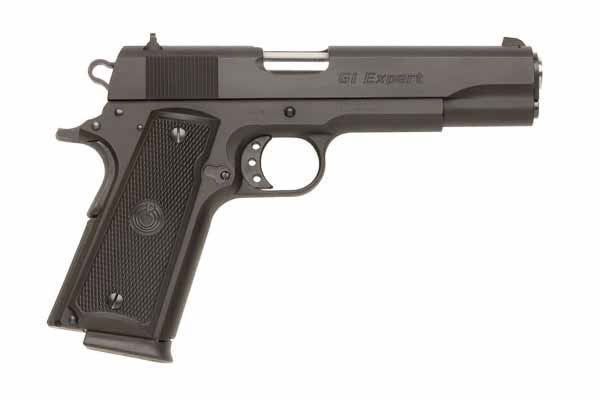
As you can see from the picture, it’s not exactly a “true” GI Pistol, in that it comes from the factory with a skeletonized hammer, speed trigger, and lowered ejection port. Presumably, this is due to the fact that the pistol is part of Para’s new “Expert” series, which are going to include a new line of polymer pistols from Para as well this .45 ACP and a line of rifles.
While I haven’t seen any official numbers on pricing for the GI Expert, I’d expect it to be priced in a region where it would be able to compete with entry level 1911s, but come from the factory with more features than your standard GI .45.
I’m looking forward to seeing this gun in 2009.
Gun Porn at USPSA Area 2 Championship
Dave Sevigny with a textbook speed reload.
Dave Sevigny leading Production Division
Stats heading into the final day
A couple of quick comments. The Area 2 shoot is always one of those that I want to go to, primarily because it’s in the southwest at a time of the year when I’m freezing my trigger finger off up here in Indianastan.
Secondly, it seems like Team S&W is trying to become the Yankees of Production Division, scooping up lots of good talent to pack their guns into top 5 finishes, which is a pretty awesome strategy. Production is dominated by Glocks, M&Ps, and Springfield XDs at the competitive level, so it will be interesting to see how this shakes out over the next few years.
Tactical Rifles
With the current boom in the sales of tactical rifles, or EBRs, I thought it would be timely to link to NSSF’s fact sheet on the tactical rifle, and where it fits into the industry.
Tactical rifles and accessories are a booming trend within the firearm industry. Actual sales figures are impossible to report accurately because many manufacturers are privately held companies, and ATF statistics do not distinguish between rifle types. However, anecdotal evidence is plentiful. Manufacturers say they’re backordered, tactical firearms now outsell traditional rifles, etc.
If you read the entire presser, you can see that the market for tactical rifles has been exploding in the past few years; obviously it’s blowing up right now. Assuming for the moment that a new AWB would be mush harsher than the Clinton ban, one of the possible consequences of it would be to not only put a lot of people out of work, but to decrease federal tax revenues as well. Like any other rifle, tactical rifles are subject to the same excise taxes levied on all firearms – banning their sale would have a significant impact on lowering the revenue collected by the Federal Aid in Wildlife Restoration (Pittman-Robertson) Act of 1937.
Maybe you’re thinking “so what, I don’t own tactical rifles, so a ban doesn’t hurt me”. Well, that’s where you’d be wrong; because of what the money collected by the Pittman Robertson Act goes towards.
Funds from an 11 percent excise tax on sporting arms and ammunition [Internal Revenue Code of 1954, sec. 4161(b)] are appropriated to the Secretary of the Interior and apportioned to States on a formula basis for paying up to 75 percent of the cost approved projects. Project activities include acquisition and improvement of wildlife habitat, introduction of wildlife into suitable habitat, research into wildlife problems, surveys and inventories of wildlife problems, acquisition and development of access facilities for public use, and hunter education programs, including construction and operation of public target ranges (emphasis mine).
A loss in revenue for the Pittman-Robertson act affects all of us in a negative way, because even if you just shoot rifles, or .22s, or whatever, you’re going to have fewer places to shoot, fewer opportunities for training, and if you’re a hunter you’ll have fewer game animals to hunt due to a loss in funding for wildlife conservation acts.
This is why I’m constantly beating the drum of “unity”. We’re not just hunters, or competition shooters, or EBR guys – we are all quite literally in this together. Just because you don’t own a tactical rifle doesn’t mean that you don’t benefit from the insane sales numbers of tactical rifles. Just because you don’t shoot .223 doesn’t mean that you don’t benefit from the fact that .223 is FLYING off the shelves. To mangle the quote, we must hang together or we shall certainly hang separately.
CDC Lead Ammo study
Shows no health when eating meat harvested using traditional lead rounds.
A Centers for Disease Control and Prevention (CDC) study on human lead levels of hunters in North Dakota has confirmed what hunters throughout the world have known for hundreds of years, that consuming game harvested with traditional ammunition poses absolutely no health risk to people, including children, and that the call to ban lead ammunition was and remains a scare tactic being pushed by anti-hunting groups to forward their political agenda.
Good to know. I remember reading a somewhat hysterical news piece in the local rag last year which ran right before deer season about the horrible dangers of eating meat that had been shot with traditional lead ammo. It is comforting to know that the CDC has said that it does not pose a danger, even to children.