Sometimes, the simple things in life are the best things. The nice thing about a gun that’s been used before it came to my hands is just that – I don’t feel a need to baby it along, I just maintain it, lube it, and shoot it. I don’t need to worry about wearing the finish off the slide with countless presentations from the holster, or the grips getting mommicked up if I really mess up a reload.
CNN pushing for a lead ammo ban
In a recent article on CNN.com, the most busted name in news is looking in to the issue of bans, both prospective and actual, on the use of lead ammo. It’s nice to know that when you need up to date, CNN will bring you news that you read about on blogs back in November. In all seriousness though, it’s disturbing to see this meme perpetuated in the legacy media, as the last thing we need right now with a potential AWB hanging around is for people to start trying to ban lead ammo “for the children.”
The Minnesota Department of Natural Resources followed with its own study, which found that when lead bullets explode inside an animal
Note the hyperbolic word “explode”. As far as I know, no modern centerfire ammo “explodes” inside game. Fragments, perhaps, or expands, certainly, but explode in this case is a perfect example of a “weasel word” being used to scare the readers about the dangers of “lead in your deer.”
“The CDC study confirmed what hunters have known for centuries: Consuming game hunted with traditional [lead] ammunition has never been shown to pose a health risk to anyone,” he [Ted Novin, with NSSF] said.
NSSF is right on this one – lead ammo does not pose a health risk to people – people have been eating game harvested with traditional lead based projectiles for literally hundreds of years, with no documented ill effects. Calls for a ban on lead ammo are simply another way that the anti-gun lobby seeks to drive people out of shooting – as if ammo wasn’t expensive enough, they want all your ammo to be “earth friendly”.
Shooting Science: The Stance
In action shooting sports, the most fundamental aspect of shooting is not the gun, the grip, or reloading – the first aspect of high-speed competitive shooting is the stance. The vast majority of modern practical shooters all use the “modified isosceles stance”, which is best illustrated with the below images:

In image 1, professional MMA fighter Ryan Gruhn demonstrates the fundamental “boxing stance”. Note that the fighter is squared up towards the target, with the weak side leg (for a right handed shooter) advanced and the strong side to the rear. From this position, Ryan can advance, retreat, and deliver punches and knee strikes with power and precision.

In image 2, Jim Wilson is demonstrating the “combat” or “modern” isosceles stance. Note the similarity to the MMA fighter’s stance – the shooter’s hips are square to the target, the weak side foot is advanced, the knees are bent – all of these are combined to give the shooter the ability to deliver fast, accurate shots, while maintaining the ability to be mobile in a hurry.
The key aspects of the modern isosceles stance are the soft knees, and the extension of the arms. The knee and foot position allow the shooter to get mobile quickly, and that speed (which will be covered in a later post) is essential to practical shooting.
When shooting in a modern isosceles, the key muscles areas that end up under stress are the quadriceps, hamstring, and if you’re like me, your calf muscles. My calves get a little more stressed because I tend to shoot almost from the balls of my feet, which results in a little bit more stress placed on the calf muscles.
The issue with the isosceles is that coming in and out the stance throughout a long match can cause fatigue on the quads and hamstrings. The best way to train for that is to do one of my all time favorite exercises, the basic lunge. To train up your endurance and strength with this exercise, make sure you do it at least three times a week. The first day, do 5 or 10 repetitions per side – making sure that you switch your leading leg and repeat the reps on the other side. Then on the second day, add another 2-5 reps to each side, gradually increasing your number of reps with each workout.
The key to increasing your strength and endurance in your stance will help you provide a stable shooting platform – if your shooting stance is stable, it will allow you to deliver your shots with more accuracy and precision. There are plenty of additional exercises which will add to your stability and strength in your “fighting stance”, however for the basics right now, the lunge is enough. Remember to concentrate on your form – doing a lot of reps with sloppy form is a good way to hurt yourself. It’s better for you and your body to do fewer repetitions with proper form.
For Friday, we’re going to take a look at some additional exercises that will help with your stance, including core strength exercises and upper body work to aid in holding a 3 pound gun at arm’s length for the duration of a pistol match.
Trijicon announces new ACOGs
From the Trijicon Press Release:
Trijicon, Inc.®, the world leader in Brilliant Aiming Solutions™ for hunting, law enforcement and military applications, has developed new optical variations to its renowned Trijicon ACOG® models – compact telescopic sights with dual-illuminated reticle patterns for use in low light or at night. Additionally, Trijicon has announced a brand new Trijicon ACOG line of scopes, measuring just four inches long.
In 2009, the following enhancements will be available to select Trijicon ACOGs:
* Green reticles will now be available in many ACOG models, in addition to red and amber. Appearing at the center of the color spectrum, green allows the human eye to adjust to it very quickly and appears very bright in low to no light situations.
* Horseshoe reticle patterns, developed at the request of the United States Military, will be available on the ACOG 4×32 (TA31H) and 3.5×35 (TA11H) model scopes, allowing for very fast target acquisition.
* Reticles calibrated for the 6.8 SPC round, allowing for the conversion of an AR15 into an excellent hog and deer hunting rifle.
Also new for 2009, is a shorter, more lightweight Trijicon ACOG 1.5x magnification model. Measuring almost an inch shorter than the current Trijicon ACOG 1.5x model, this four inch long scope will offer a reduced profile and lighter weight, making it an excellent optic for carry handles or on a flat-top SBR (Short Barreled Rifle). There is also a newly designed circle dot reticle for faster target acquisition. As with all Trijicon ACOGs, the new 1.5x model is dry nitrogen filled to eliminate fogging, is waterproof to 328-feet, features multi-coated lenses to provide superior clarity and light-gathering capabilities with zero distortion, has battery-free illumination, is encased in a forged 7075-T6 aircraft-grade aluminum housing, and utilizes built-in fiber optics to automatically adjust the brightness level and contrast of Trijicon’s illuminated tritium reticle.
Additionally, new ACOG models will be available with green reticles, as well as horseshoe shaped recticles that were requested by the US Military. For more information on Trijicon and their products, check out www.trijicon.com. Now all I need is a rifle on which to mount an ACOG…
Fully Suppressed revolver
At The Firearm Blog – apparently, the Germans weren’t happy with suppressed HK pistols, and someone had to go and figure out a system to effectively suppress a S&W 625 revolver, in .45 ACP. The system is actually quite ingenious, as the cylinder gap is covered by a plate that swings out to allow access to the cylinder for reloading, but during firing is closed and prevents a significant amount of noise from escaping the cylinder.
Oh those crazy Germans.
The Science of Shooting
It’s no secret that I’m deep down the rabbit hole of competitive shooting – I’m hooked, and I’m not quitting any time soon. While I approach the shooting sports through the traditional means of focusing on accuracy, sight picture, etc, I also bring a completely different background to my approach on shooting sports, namely that of athletics. Throughout high school and college, I was a competitive martial artist and even a bit of a baseball player. I’ve always been interested in physical fitness, and the science behind athletics. It’s that passion that I combined with the shooting sports, in the hopes of not only developing myself as a shooter, but developing myself as an athlete as well. In upcoming weeks, we’ll look at the science of shooting from an athletic point of view, including training and exercise tips, as well a physical examination of the types of movement and muscular development that can aid an action shooter to get faster times and better scores.
In the past, we’ve looked at the importance of grip strength to the shooter, and what you can do to increase your forearm and gripping strength. I think that taking an athletic approach to the shooting sports is going to take the game to the next level – a level you can already see being displayed by top athletes like Dave Sevigny of Team Glock. The same principles of strength, endurance, and conditioning that are applied to baseball, football, and basketball can be successfully applied to the shooting sports; not as a replacement for traditional training methods, but as a supplement to those methods.
We’ll kick off the series with Part 1 on Thursday, which will cover the most fundamental aspect of competitive shooting: the stance.
The Brady Campaign to Increase Fail
I have a theory about our friends over at the Brady Campaign – they’re not really an anti-gun group, they’re actually a group that exists to make you feel better about yourself. You see, whenever the Brady Campaign utterly fails at something, no matter how down in the dumps I am, I can always say “well, at least I don’t work for the Brady Campaign.” Note the latest example, wherein the BC tries to equate semi-automatic rifles to being “the same” as full auto machine guns, the latter already being generally illegal.
It would be cute, if it weren’t for the fact that the rebuttal from NSSF cleans their little clock, and explains the difference in a way that accurate reflects the nature of semi-automatic rifles. Read the NSSF’s well-aimed response here.
It’s nice to know that no matter how much I may fail at anything, I’ll never fail as hard as the Brady Campaign.
Last Night's Gun Nuts
Last night’s show on the Alamo was an excellent show – as usual the callers were great, and a special tip of the hat to Blackfork, who was able to provide us with historical perspective on the Alamo that was invaluable for the show itself. If you’d like to download the show, just click here for the show page, or click this link to download an .mp3 file.
Also, if you’re an iTunes user, you can now subscribe directly to our feed by following these instructions for getting Gun Nuts on iTunes. Don’t forget to tune in next week, when we’ll either be talking about Open Carry, talking to Julie Goloski, or having a representative from AHSA on the show!
Glock Gun Porn
From Southpaw Custom, one of Dave Sevigny’s sponsors. Check out their main site here, and their “gallery” page at this link. Southpaw Custom does a unique modification to Glock pistols, called The Sevigny Speedway, which redesigns the magazine well to make it easier to do speedy reloads. The below gun is sporting a grip reduction, a beavertail, and a stippling job to make it easier to hold on to during rapid shooting. It’s my favorite.

This will always be funny
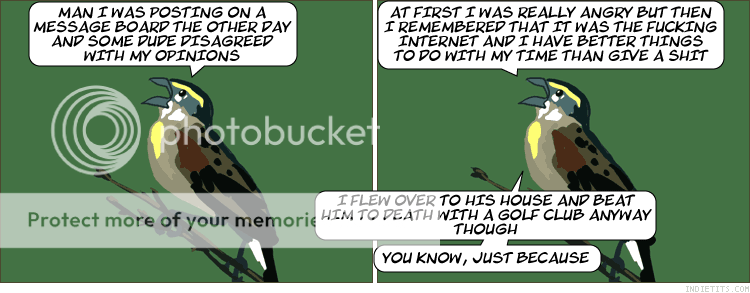
From www.indietits.com, and it’s very old.