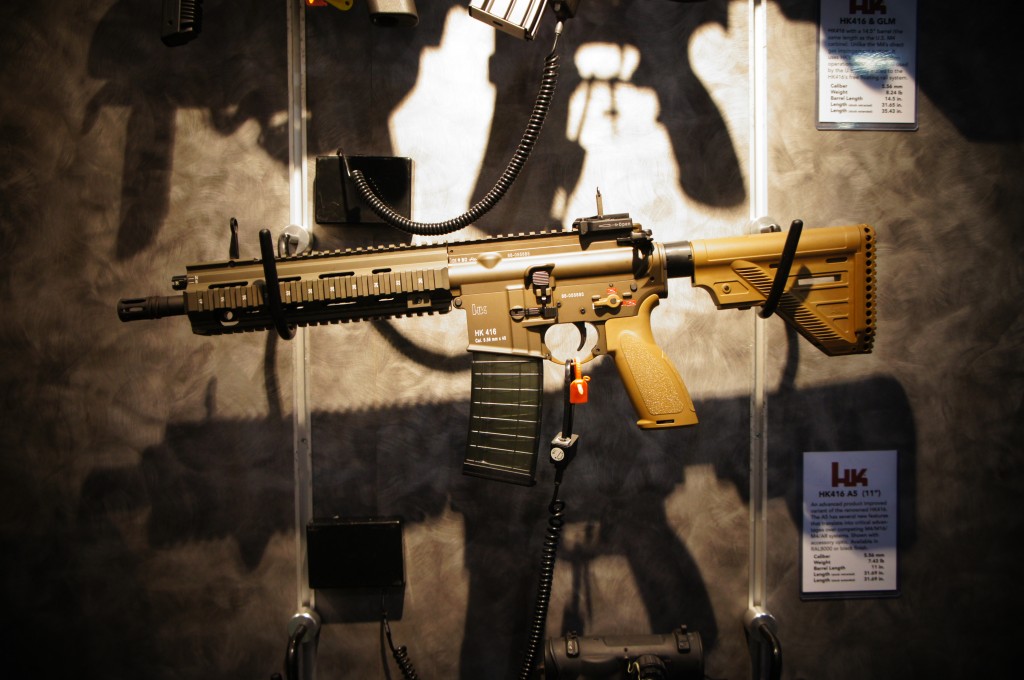
Do want. Can not have. Makes me sad. The HK416 in FDE with a happy switch.
Do want. Can not have. Makes me sad. The HK416 in FDE with a happy switch.
Shot Show 2014 is in the books, and it was a crazy year. This was my 7th SHOT Show, and for me it continued the trend started in 2012 of seeing less product, and spending more time behind the curtain. Looking back on the show, a few things did however stick out for me.
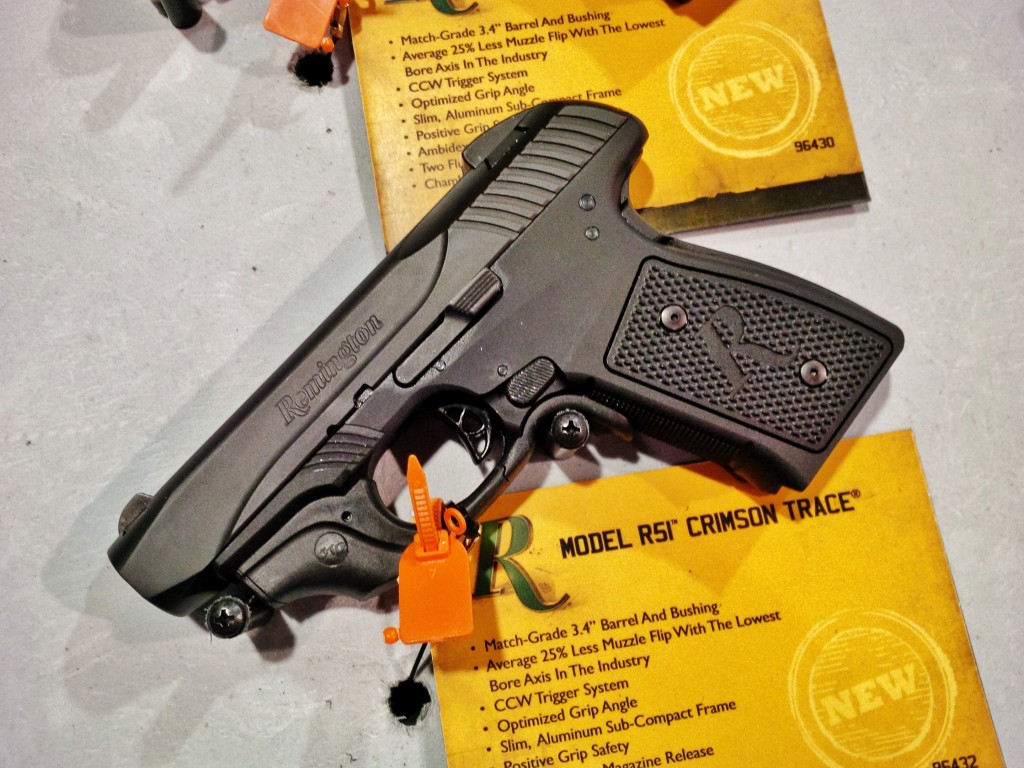
The Remington R51 is going to sell like hotcakes
Despite the fact that it is actually a lot bigger than I’d been led to expect, the R51 is going to sell. On Friday, when things are normally pretty laid back, there was still a crowd at the Remington display surrounding the gun. With its street price point of $350ish, lots of people will buy it just because it’s affordable. It doesn’t matter if the gun works as well as the Shield or not, it’s going to sell.
The Glock 42 will also sell well
Initially, I didn’t think the Glock 42 would be a big hit. Then at the Show, word on the street about their actual retail price point hit. According to Glock reps, the new 42 will MSRP for around $399, which is a direct shot at the other small, concealable guns in that price range. The greatest advantage the Glock 42 is simple: it’s a Glock. All the controls are Glock controls, but it just happens to be a wee-little .380 that sells for less than $400.
There was more new, interesting product this year than 2013
In 2013 everyone was running triple overtime shifts trying to keep up with demand for black rifles. This year, everything had settled down, and companies were actually introducing interesting new products. The major manufacturers added guns for concealed carry and competition, but very few new black rifles from the big firms. There were some, but the major emphasis at this show seemed to shift back to the concealed carry market.
More new shooter focus than previously
This was by far the most I’ve seen SHOT focused on new shooters/new CCW holders. It was also by extension the least militant SHOT Show I’d seen since 2010, which could be attributed to the drawback in warfighting expenditures under the current administration. Multiple major brands had new products specifically targeted at attracting women and/or new shooters to their company’s products. There was a general shift in the marketing tone, with less Beardy McTactical Operator Warfighter style marketing and more marketing aimed at the aforementioned new shooter demographic. That’s a good thing.
3-Gun is the king of the shooting sports hill
If five years ago you’d have told me that USPSA would be the third most popular shooting sport in terms of numbers and dollars, I’d have laughed in your face. “It’ll never happen,” I’d have said. I would have been wrong. 3-Gun is by far the king of the hill in terms of sponsorship dollars and cash prizes – $75,000 was awarded to the winners of the 3-Gun Nation shoot-offs at SHOT Show. Meanwhile, IDPA has quite wisely positioned itself at the bell end of the new shooter funnel, and for every butthurt “I quit IDPA forever” post on Facebook, three new shooters sign up.
The industry is still going strong
We’re a 6 billion dollar per year industry. That’s a lot of money. Despite attempts by foolish legislators to kill jobs and American productivity, the firearms and shooting sports industry is still going strong. I’m interested to see what affect the midterm election will have on the political landscape, and how that may resonate in the gun industry.
Until then, we’ll keep writing, and you keep shooting.

 For a few years now, I have held out on joining the NRA because, while I supported some of their programs, I didn’t feel comfortable being aligned with others. Then, after a year of discussion with members, I realized there were ways to join, while sticking to my guns, so to speak.

I spent a lot of time on the road. Last year, I logged over 90 nights in hotels, over 50,000 air miles, and racked up rental car points like a pro. I had a request from a reader to put up a post talking about traveling with guns, so here is our best attempt. Please note that any interpretations of laws are not legal advice, because I’m not a lawyer.
Step 1: The TSA
It is absolutely, 100% legal for you to fly on a commercial airline with firearms in your checked luggage. It is also absolutely legal for that same checked luggage to contain both firearms and ammunition, so long as the guns aren’t loaded and the ammo is packed in either factory packaging or a container designed to transport ammo.
To check a gun on a major domestic carrier, you must have the gun secured in a locked, hard sided container. There are two types of locked containers: a smaller locked case inside a regular suitcase, or a rifle/pistol case which is locked on the outside and contains primarily your guns and ammunition. Their are advantages to both methods. I generally recommend having your locked case inside another regular looking suitcase. Secure the gun case with a lock to which only you have the key/combination and then lock your regular bag with a TSA lock to prevent tampering by airline employees.
If you go the “lock the whole bag” route, know that your entire bag must be a lockable hard case, such as one of the luggage sized pelican cases. This route has the disadvantage that pelican cases usually contain expensive items, and could be targeted for theft.
Step 2: The airlines
The TSA does not place any restrictions on the amount of ammunition nor number of firearms you may have in your checked luggage. Those are left to the discretion of the airlines. Most airlines restrict the amount of ammo allowed in your checked luggage to 11 pounds or less. If you’re wondering, that’s about 5 boxes of 9mm ammo. However, some airlines have larger weight allowances, such as Alaska which allows up to 50 pounds of ammo in your luggage. Well played, Alaska.
Some airlines will restrict the number of guns you can carry as well. For example, United allows a maximum of five guns in your checked luggage. This isn’t a problem for most people, unless you’re flying to a trade show or possibly a three-gun match.
Step 3: Getting your guns back
Depending on which message you’ve chosen for checking your gun, your bag will show up in one of three places. If you’ve gone discreet, it will quite likely get dropped off the baggage carrier like every other piece of luggage. If you’re using a large long gun case, it might get dumped at oversize baggage. Third option, it might be held at the baggage office because it’s a gun. Be prepared for any of these.
Now that we’ve gone through the basics, here’s how this will shake out in the real world.
This is where the process can get interesting, and where it will vary from airport to airport. If you’ve gone incognito with your luggage, you’ll put the firearms declaration form inside the main bag, and likely on top of the smaller pistol case. Some airlines will have you put it inside the small pistol case. Both are acceptable. If you’re using a locked outer case like a pelican, you’ll need to put the tag inside the case, somewhere on top or in the vicinity of the gun itself. Do not under any circumstances allow the “Firearms Declaration Form” to be placed on the outside of your main/largest suitcase. It should never be placed where it could be seen from the outside of your primary bag if you’re traveling incog.
After that, the bag handling will be accomplished in many various ways. Some airports will simply take your checked luggage and have it scanned, if it alarms you’ll be summoned by security. Other airports you’ll walk it over to TSA for them to personally inspect it.
The TSA inspection is probably the most difficult part, because the TSA frequently doesn’t know their own rules and regulations. I have personally had pistol cases approved by one TSA agent as good to fly, only to be nearly destroyed by another TSA agent who said that the case was “too easy to pry apart” and declared unfit to fly. Generally speaking, don’t trust the hard case your gun came in. Go out and spend the money on a proper pistol case.
Finally, here are some general guidelines that I follow: I always print out the TSA’s web page on flying with guns. I also always print out the airline’s regulations. That way if I do run in to trouble, I have a handy, difficult to refute resource on hand to point to. Always be polite, even if you’re being bullied by a jumped up TSA thug who couldn’t hold down a job as a wal-mart greeter. I’ve had airline staff come to my aid against TSA clowns specifically because I was polite and courteous with the airline crew.
You’ll notice that I’ve not addressed state laws, driving with guns, or any of the other various topics. We’ll take a look at those in a later post, which will require even more details because of the terrible, awful byzantine nature and enforcement of state firearm laws. ProTip: unless you have a really good reason, avoid the north east coast.

One of the cooler guns from Shot Show this is the new Springfield Armory Range Officer 1911 9mm. It’s been flying under the radar a bit this week, overshadowed by the new four inch XDs. We’re big fans of the RO line from Springfield, it’s a lot of gun from a reputable maker for not a lot of money. We also like 9mm 1911s a lot, because they’re amazing to shoot. We think the Springfield Armory Range Officer 1911 9mm is going to be a big hit.

 Last year at Media Day at the Range, I made a bee line for Springfield’s bay where I fell hard for the XDs 9mm. Truth be told, I was primed to love the 9, since I had been very impressed with the 45 months earlier. This year I wasn’t expecting any major announcements, but what I found may become the sleeper success of 2014. Meet the XDs 9mm 4.0. In comparison to last year’s release, the 3.3, this one has a longer barrel… (4.0″ vs. the original 3.3″) That’s about it. But, as we all know, that really isn’t it, that’s actually the tip of the iceberg.
As you can tell from the other coverage here on the Gun Nuts site, this week is the annual SHOT show, where the firearms industry shows off their latest and greatest wares for large buyers and the gun media. I like learning about the new stuff as much as anyone else, but I like some of the old stuff even more…especially when that old stuff is belt-fed.
In last week’s post I gave a brief rundown on the unique Lewis gun, arguably the first successful man-portable machineguns. Today let’s look at the machinegun that was arguably (because everything about history can be argued) the first to fully realize the machinegun’s potential on the battlefield and in modern warfare: The MG-34.
The Treaty of Versailles placed heavy restrictions on Germany’s manufacture of weapons after World War I, but like every other gun control effort in history it did precisely bupkiss to stop the bad guys. A resurgent Germany used every trick in the book to rebuild their war machine bigger and better than ever. One of their top priorities was developing the machinegun and though it took a bit of tweaking the end result was one of the most influential machineguns in history.
The MG-34 fires from an open bolt using a metal belt that was easier to load than the canvas belts typical for previous machineguns. The weapon itself was far lighter and more maneuverable than any of the Vickers/Maxim variations the German armed forces had previously used. Instead of attempting to cool the barrel with a large complicated aluminum jacket as used in the Lewis gun, the designers created the first really good quick-change barrel system so that a machinegun crew could rotate barrels quickly without even needing to unload the weapon first. With proper barrel rotations they could sustain very high rates of fire for an extended period of time without all the cumbersome weight and bulk of water jackets, hoses, and water tanks.
When you look carefully at the MG-34 you’ll notice it has two triggers. The top trigger fires the weapon in semi-automatic and the lower engages the fully-automatic function of the weapon. Why have a semi-automatic function on a belt-fed machinegun? Good question. The Germans must have found very little utility in the feature because they omitted a semi-automatic function from the later MG-42. The MG-34 could certainly be fired very accurately in semi-automatic mode, but nobody ever toted a belt fed for careful point of aim accuracy in slowfire. You don’t often find semi-automatic function on open-bolt belt fed machineguns these days, seeming to indicate that subsequent military forces haven’t found a lot of utility in a semi-automatic function on belt feds.
The light weight, portability, and fairly high rate of fire (in full-auto mode anyway) made the MG-34 a weapon suitable for many roles…and the Germans weren’t shy about using them. They produced as many machineguns as they could and mounted them in any way they could find.
The firepower of the MG-34 was intended to be the backbone of a military assault that relied on mobility and superiority of fire to encircle and destroy the enemy. The world would apply the term blitzkrieg to this style of warfare, and the new lightweight, portable, adaptable machinegun was at the center of it all.
Getting up close and personal with the MG-34 was a mind blowing experience. The specimen I was able to play with was manufactured in 1944, a late-war production gun made after the tide had turned against Germany. Even so, the weapon’s fit and finish were extraordinary. Pictures and video really do not do it justice. You need to be able to feel the gun’s function, to manipulate the feed mechanism with your hands, to cycle the bolt, to feel the gun fire in order to appreciate how exquisitely lavish the manufacture of this weapon is. Every single piece on the weapon moves with precision and unparalleled smoothness. Just operating the belt feed mechanism on the feed tray cover makes you think that the gun functions on ball bearings.
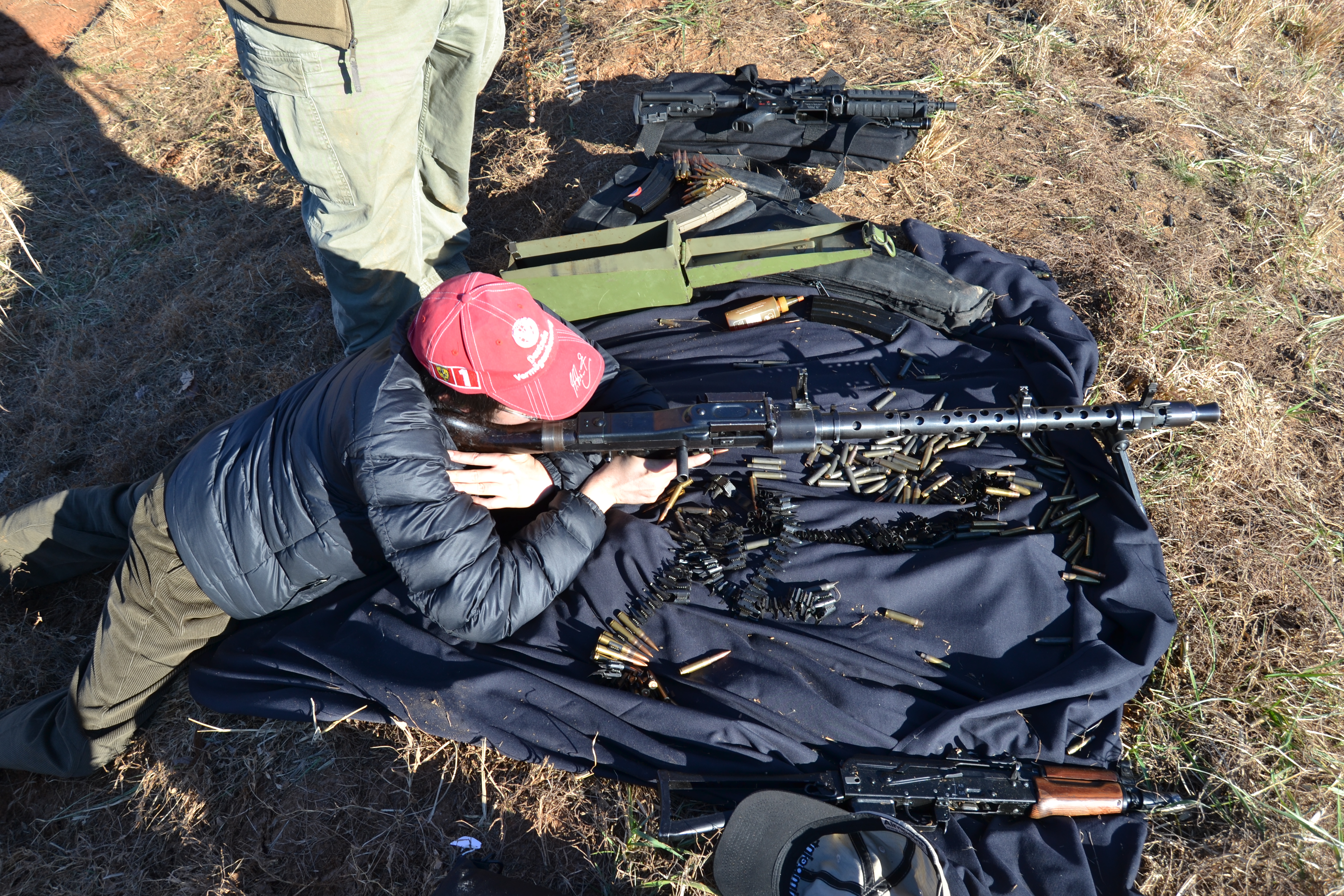
I don’t know Mauser’s exact production figures on the MG-34, but I’ve seen it suggested in a number of places that the weapon took twice as much machine time and twice as many man hours to produce over any comparable weapon of its day. In the ninth edition of Small Arms of the World, Smith says that captured MG-34’s were taken to various American manufacturers who concluded that the guns would require too many machine tools and would be outrageously expensive to manufacture. (Page 439 if you’re interested in looking that up) Keep in mind that these are American manufacturers who were turning out the M1 Garand, a beast of a weapon hewn from big chunks ordnance grade steel and originally stocked with some pretty beautiful walnut. It was (arguably, again) the most lavishly produced general issue rifle of its day, and the country that was turning them out by the millions looked at the MG-34 and said it was too expensive and involved to manufacture.
The tight tolerances that you note when handling the MG-34 are said to have made the weapon rather temperamental in the field. To an extent, all belt fed machineguns are sensitive to conditions and ammunition. This is one of the reasons why the USMC brought the Infantry Automatic Rifle concept into being, as even today’s belt-fed machineguns can stop working at inopportune moments…like when you’re charging into a building full of insurgents. The finicky nature of the MG-34 and the expense of manufacturing it eventually set the German army looking for a more reliable and economical replacement.
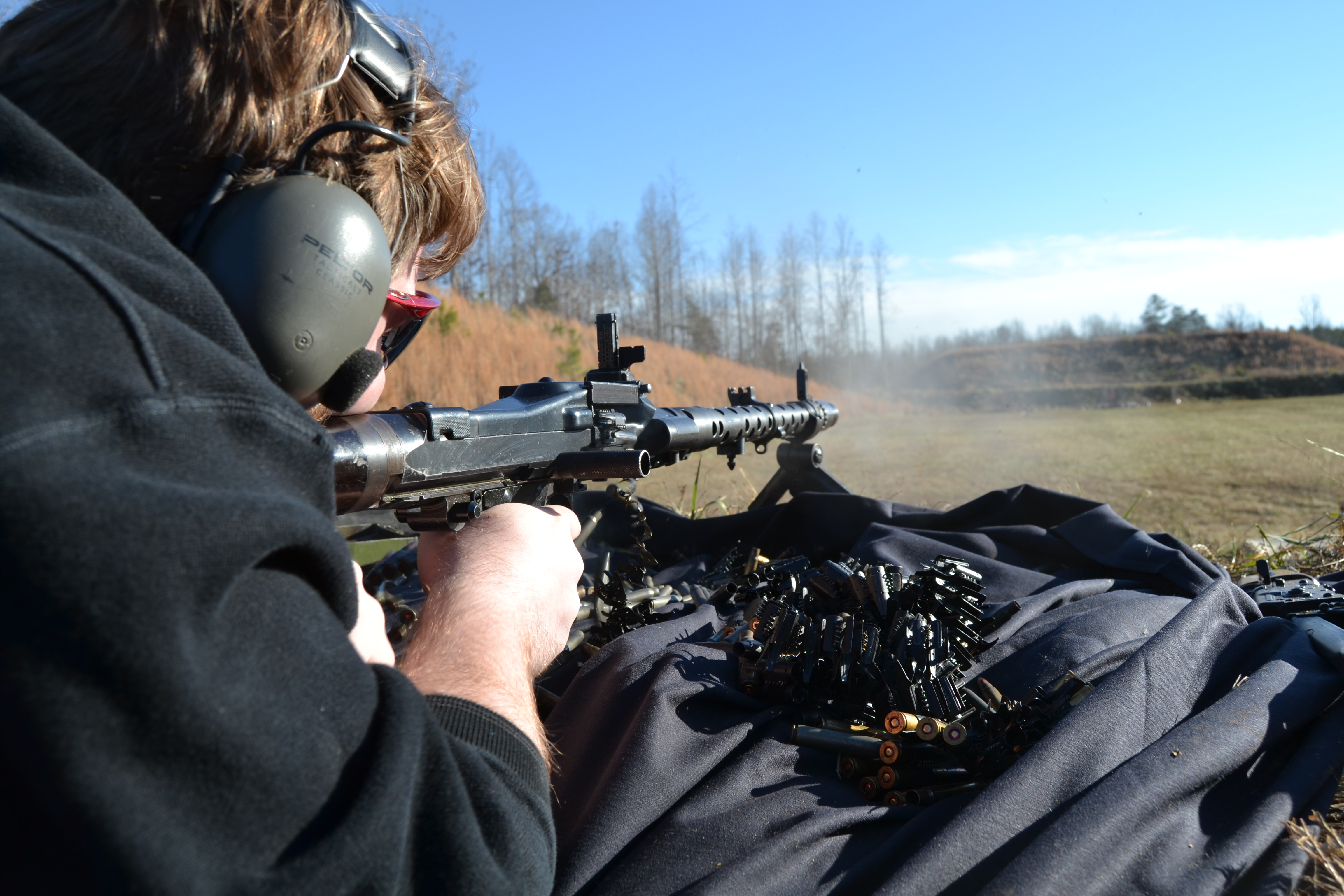
My shooting impressions of the MG-34 are not quite true to life because we couldn’t get into a proper prone position behind the weapon. When firing a belt-fed machinegun from the bipod you would ideally be laying in a prone position where you can actually dig your feet in and push back against the weapon to help control the recoil and better direct the fire on target. Without that ability the weapon tends to climb on you during a burst. The rate of fire for this MG-34 was estimated by its owner (who knows his class III weapons) to be around 900 rounds per minute. In firing the weapon I seemed to get a 4 or 5 round burst from a single pull of the trigger. Compare the rate of fire of the MG-34:
To the slower, more staccato rate of fire from the M60 machine gun:
Even with the high rate of fire and the muzzle climb due to lack of a good firing position, when firing bursts at the center of a typical steel shilouette target 100 yards away you would hear two or three pings on the steel. The sights were typical of German weapons of the period, using an absurdly thick front sight in a relatively shallow V rear notch but in the bright light of the range there was no trouble using them precisely. I could pick an exact spot on the steel, fire, and see that the first shot would hit directly at the point of aim, with the second impacting very near to the first. After that the weapon was starting to lift and it got harder to keep track of what was going on downrange. A skilled gunner in a good position could do some serious work with one of these beauties. That’s probably why Uncle Sam made videos like this:
In other footage from that video the narrarator actually says that the “bark” of the German machineguns (particularly the MG-42) is “worse than its bite.” I didn’t get that impression behind the MG-34 at all. The relatively high rate of fire certainly does eat ammo quickly and means that you launch more rounds in a burst, but for me the gun ran so smoothly I didn’t have a problem putting multiple shots on target even from a compromised position. If I were firing at opposing infantry, there would be a fairly tight cone of 7.92mm death heading for the dude in my sights. Watching the beat zone it became clear that at typical combat engagement distances whoever was on the wrong end of one of these things was going to have a very bad day.
While the later MG-42 used the newer roller locking system instead of the MG-34’s recoil operated system, much of the rest of the weapon looks very familiar. In fact, if you compare most other belt fed machineguns that came after the MG-34 to the MG-34 side by side you’ll see a great deal of commonality because some bits of it functioned so well that they’ve stuck around in more modern designs. It’s a magnificent weapon, and another shooting experience to put on your gun-geek bucket list.
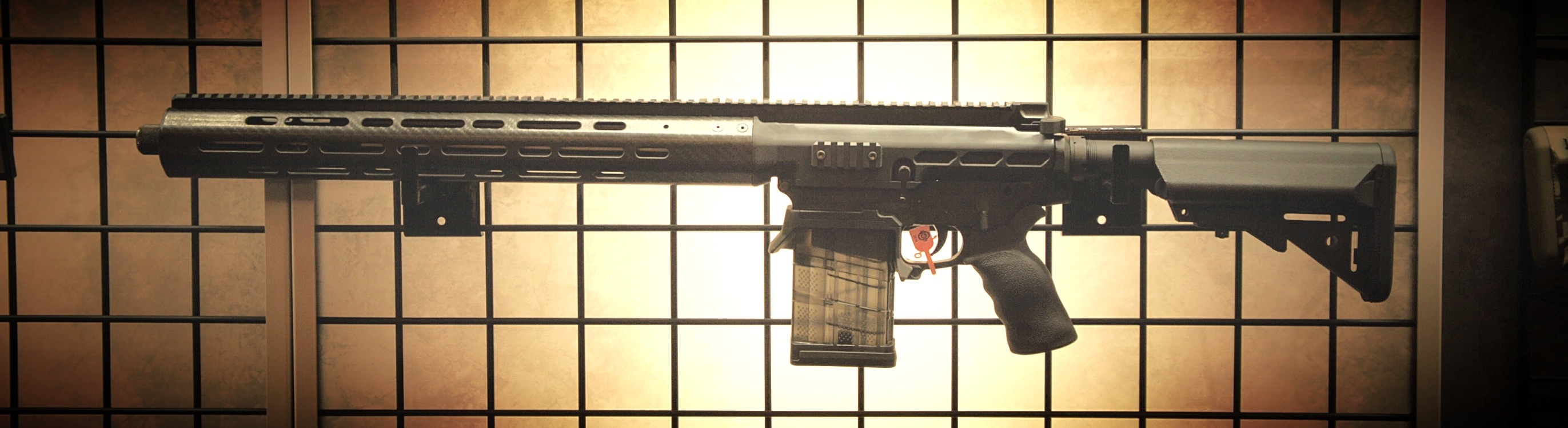
New from Lancer this year is the L30, their new dedicated .308 rifle. This particular model is the Designated Marksman configuration, so it comes from the box with an 18 inch barrel and full rail for mounting the scope of your choice.
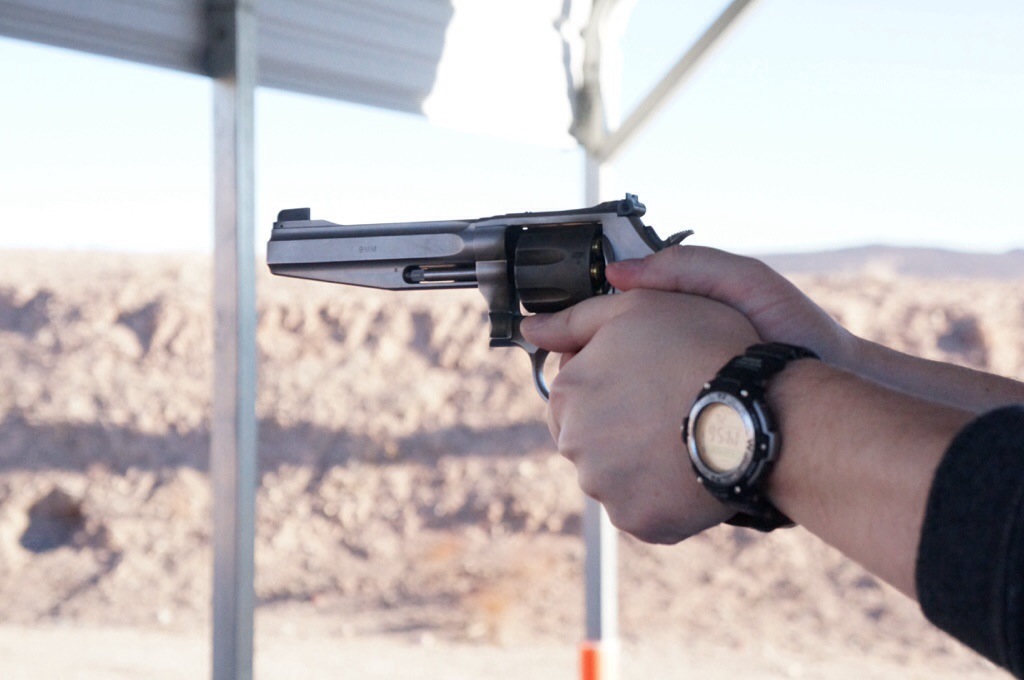
Earlier this year, Smith & Wesson announced two new 9mm revolvers. First announced was the 929 Performance Center gun, an 8-shot N-frame revolver designed with input from Jerry Miculek. Today we’re doing a review of the Smith & Wesson 986, the second gun announced. The 986 is a seven shot 9mm on S&W’s L-frame, which means that holsters for you other L-frame guns like the 686 will work for this.
The 986 features a five inch barrel, titanium cylinder, patridge front sight, adjustable target rear sights, and of course is cut for moonclips. The DA trigger is heavy but smooth, exactly what I expect from a Pro Series revolver. There is no grit, creep, or stacking whatsoever, making DA shots pretty easy even with the factory trigger. The SA trigger is light and crisp, again exactly what I’d expect from a Pro Series gun.
What I like
It’s accurate and easy to shoot. The S&W guys let me shoot way more of their ammo than they should have, so I was able to get a solid idea of how well the gun runs. I could hit an IPSC torso target at 100 yards 4/7 with the 986, and shoot tiny little groups all day long. I like how clean the DA trigger is, and the sights are perfect for Bianchi Cup shooting.
The loading and unloading is great. 9mm cartridges have a short OAL and slide easily into the cylinder, the moonclip keeps them all together for positive ejection. Also, the moonclips are just the right balance of rigid and allowing cartridge movement, which makes loading even easier.
What I don’t like
I don’t really like the factory grips. Finger groove rubber grips on a Pro Series gun seem out of place, and I would like to have to seen this gun offered with the excellent stocks from the 686SSR. The trigger is a little heavy as I mentioned, but that’s nothing that can’t be cleaned up by the lads at Apex tactical.
the verdict
Looking for a revo for Steel Challenge or Bianchi Cu, but don’t want to break you bank on a full Performance Center gun? The Smith & Wesson 986 could be the gun for you. I was absolutely impressed in my range session, and thing that S&W has a winner on their hands.