You’re on your own

Human beings are generally social creatures. Most of the higher order mammals tend to have some sort of social structure where groups of individuals work cooperatively to boost the odds of survival for everyone in the group. You see fairly complex social orders developed even among primates like chimpanzees and gorillas that scientists study to understand some human dynamics. It’s a safe bet that for however long human beings have existed on planet Earth, they formed at least small bands that were critical to survival. If someone was separated from the group either by some sort of unforeseen event or because of transgression against the standards of behavior for the group it was roughly equivalent to a death sentence…hence the reluctance many have to even disagree with people in a meeting room when nothing life-threatening is at stake. It’s ingrained that deeply to stick with the group.

Society as we know it is a very recent invention and in the long expanse of human history it represents but a tiny fraction of the human experience. We’re all inclined to think of the world in terms of our own experience, but stop and ponder for a second how many people in this world can make a phone call and have a pizza show up less than 30 minutes later. When you live in a society where you can make dinner appear at your door in 30 minutes or less, stream the latest episode of your favorite TV show to your flat screen, and re-schedule meetings all in just a couple of minutes using a little device that fits in your pocket…well…you can develop a rather warped sense of reality. When you combine our ingrained social expectations that there will be other members of the group (society at large) there to help us, and the “Hot and fresh in 30 minutes or less!” culture we grow up in, it leads to some pretty fruity conclusions.

Caleb commented earlier in the week on a report the FBI released about active shooter situations. If you haven’t read the report I urge you to do so, because it’s got some very useful information in it. Most striking to me in everything that is presented at that link is the mention of police response time. In some of the active shooter incidents police have arrived on scene in as little as three minutes, which is quite a feat when you consider the logistics of getting officers who can be anywhere in a particular geographic area to the exact spot where the shooting is happening. You can probably bank on three minutes being about as good as it gets for police/EMS response time for an act of violence unless they just happen to be right around the corner when the trouble starts.

Unfortunately the people calling the police in an active shooter event (or an armed robbery, or a home invasion, etc) don’t have three minutes. Lethal violence typically happens in seconds, not minutes. The bad guys do not announce their presence or intentions ten minutes before they start the fireworks. The police are almost always going to be reacting to an act of violence that is ongoing, meaning they are going to be rushing to the scene where people are already bleeding in a valiant effort to limit the carnage. Not to prevent it. To quote from the report: “Approximately half of the events (49 percent) ended before law enforcement arrived on scene. This points to the phenomenal speed with which these incidents occur.”

The FBI report is acknowledging a simple, inescapable truth: You are on your own.

This is to be commended, as so many times when law enforcement agencies talk to the public they urge people to call 911 and let the police handle it. Worries about liability and, of course, politics leads police chiefs and public spokesmen to get in front of TV cameras and tell people that dealing with bad guys is something the cops are supposed to do. Leave it to the professionals, they say. Maybe if Justin Bieber is egging your house you have time to let the police handle it. If there’s a dude trying to kill you, waiting isn’t an option.

We don’t like being on our own. We don’t like the thought that it’s just little ol’ us vs. the bad man. The primary reason people fear such a situation is because they feel helpless. Thankfully helplessness is easily dealt with.

When folks come to the realization that it’s up to them, they don’t sit helplessly and wait for doom…they act. The process of tackling the problem head-on does something remarkable to the human psyche. There’s something almost magical about acknowledging that it’s up to you to handle the problem. It brings focus and clarity to the issues at hand, and a sense of determination displaces the helplessness and sense of paralyzing fear that accompanies it. Toss in some reasonable equipment and training relevant to the event beforehand and that action is often pretty effective to boot. Just look at the aftermath of the bombing in Boston. People there who had some training saw the bloody carnage and in the midst of horror focused on doing something useful to fix as much of it as they could. The iconic image in my mind is the picture of a gravely injured man being wheeled to an ambulance by someone who used his belt as a makeshift tourniquet. Whether it’s rendering aid in the Boston bombing aftermath, a volunteer security guard at the New Life Church in Colorado engaging an active shooter with her concealed weapon, or passengers on a hijacked airliner rushing the cockpit to keep their jet from being used like a missile, the situation is always improved by people who figure out that they’re on their own and act on that motivation.

We don’t have to exist in the state of learned helplessness that the Dianne Fiensteins and Bloombergs of the world promote as the natural order. It’s most certainly not natural, and our ancestors would have laughed at anyone who thought that calling somebody to come save you from peril was a better solution than taking reasonable action yourself. Our ancestors formed societies and worked cooperatively to achieve goals, certainly…but they also made friends with the knowledge that when it comes right down to it, they were on their own.

There is liberty in facing The Bad Thing and making yourself more competent at handling it should it appear. Having a gun is a good start, but getting some training in how to use it effectively should be at a high priority. Expand past the kinetic side of things and look into getting yourself a decent emergency trauma kit from someone like Dark Angel Medical or Cleer Medical. Get some decent training to go with the kit. It could make all the difference to you, someone you love, or someone you’ve never even met before.

You’re on your own. It’s up to you…but don’t be afraid of that realization. Embrace it. Use it as motivation. I’ll use something Jack Baruth wrote on his blog because I think it works marvelously here:

you are fundamentally a bio-machine shaped by 17,000 ‘stupendous bad-asses’, as Neal Stephenson once said. Seventeen thousand times, your ancestor survived the famine that killed his neighbor, survived the wolf attack, survived the battle, survived the fall, the injury, the disease, the conflict. Seventeen thousand times, your ancestors survived to reproduce. You may feel like a weakling as you sit in your bean bag chair and play Candy Crush Saga, but you are an apex predator by birth.”

Having police, fire, and emergency medical response a few minutes away is a good thing and we’re better for having them…but it’s never going to be a substitute for a person at ground zero who has a plan and some useful tools.



Editorial: Getting shot doesn’t make you an expert on Gun Control

On January 8, 2011 Gabby Giffords was shot in the head by a crazy person with a gun. Her recovery from such a traumatic injury was heroic and inspiring to anyone who has been victimized by crime and survived.

220px-Gabrielle_Giffords_official_portrait

Two years later, Mrs. Giffords along with her husband founded Americans for Responsible Solutions, a PAC that advocates for further restrictions on the right to keep and bear arms. Just this week, Mrs. Giffords was in my former home state of Washington to lobby in favor of a sweeping universal background check bill that will deeply infringe the rights of the citizens of Washington, many of whom are my friends and family.

I have nothing but the utmost respect for the guts and toughness it must take to overcome being shot in the brain and moving on with your life. However, in her advocacy for more gun control, Mrs. Giffords has placed herself on a pedestal above criticism simply because she was a victim of a mass shooting. This attitude of saintly victims is nothing new to the gun control community – Colin Goddard, a victim of the VA Tech shooting was for a time a leading mouthpiece for the now floundering Brady Campaign.

Mrs. Giffords’ status as a victim is central to her support of gun control. Even when not mentioned directly, which is done frequently, it exists behind everything she says. That subtle pressure that her opinions are beyond reproach because she’s been shot by a mass shooter so she must be knowledgeable, she must be an authority. Because it’s a very emotional argument, we frequently let it slide; because of her protected status as a sainted victim of violence, we don’t call out her argument for what it is: emotion based nonsense.

If you remove what she’s saying from the gun debate, it becomes this: “I was t-boned by a drunk driver, thus I am expert on drunk driving.” Well, the truth is that you’re probably not. What you are is motivated to curb drunk driving, because it hurt you. I’m not saying that it isn’t possible for someone who was a victim of a mass shooting (or drunk driving) to become a legitimate expert on that topic. Anyone can learn, and anyone can become educated.

When someone relies on their victimhood, when their supporters use that victim status to shout down dissent and criticism, that’s when we all know that you’re not an expert. Gabby Giffords was shot. That is a tragedy, and I dearly wish her health and wellness for the remainder of her life. The man who shot her will spend the rest of his life in prison,a nd that’s a good thing.

But don’t pretend for a second that getting shot by a psychopath makes you an expert on the gun issue. Mrs. Giffords, it’s time to stop. Your status as a victim does not grant you the right to infringe on the Constitutional rights of Americans everywhere.

CZ’s P-09 Updates

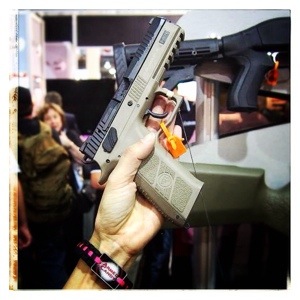
20140129-105037.jpgHave I mentioned I’m a CZ fan? This year at SHOTShow CZ brought to the table products that were better than brand new. They brought previously introduced products that had been given BIG updates for 2014. After all, if it ain’t broke… One such offering is the updated P-07 which now has the great features introduced last year in the P-09. These include interchangeable backstraps and the option to change between a manual safety and a decocking leaver. So the P-07 is now better but just a small P-09, so let’s talk about that bad boy instead.

Continue reading →

Does IDPA reward accuracy more than USPSA?

The guys at Precision Response Training have a very interesting post up that looks a the oft-repeated phrase: “IDPA rewards marksmanship, USPSA rewards speed.” It’s a thoughtful post that takes the time to look at the various scoring systems and how they actual penalize poor accuracy. I don’t entirely agree with their conclusions, but that gives us the opportunity to discuss speed, accuracy, and how they affect scoring.

Caleb IDPA Nationals Ruger GP100

First, a quick discussion of top level performance. The guys who win IDPA and USPSA matches are generally faster and more accurate than their opponents. What causes them to win is finding the appropriate balance of speed and accuracy together. To address the topic of IDPA penalizing accuracy more than USPSA, you have to look at how it applies to shooters within their own competitive set. A competitive set, or comp-set for short is a group of shooters that you’re on a relative par with in terms of skill. Unless you’re Dave Sevigny, Bob Vogel isn’t your comp-set. People in your comp-set are the guys that finish within a few seconds of each other at IDPA, or a few % points at USPSA.

So when Bob Vogel says that IDPA penalizes you for accuracy more, he’s not talking about that penalty in relation to how his overall score looks, but rather how it affects his standing against other shooters of his ability. To elaborate, IDPA uses a scoring sytem called time plus. In time plus scoring, your score is your time, plus any applicable penalties for points down, no-shoots, or procedurals. Let’s say your an IDPA SSP Master, competing for the 1st Master trophy at Nationals. There are five other shooters in your class, and you’re all squadded together. On each stage, you and two of the other shooters are posting roughly the same times, swapping leads by fractions of a second, and if you’re lucky a whole second here or there. Then you make a mistake, and shoot a no-shoot. Bam, you now have a five second penalty.

If you’re already shooting to the max of your ability to compete with other shooters of your skill level, that 5 second penalty will now follow you from stage to stage. You can keep shooting to your own max, and you will have a very difficult time making that penalty up on other stages because you’re already at your own maximum level of performance. I know, because I’ve done just that. In time plus scoring systems, making up for penalties incurred is extremely difficult, because it usually means you have to push and find another gear, which can lead to worse mistakes.

Contrast that with USPSA scoring. Same situation, you’re shooting with several guys in your comp-set competing for high A-class. You make a mistake and lose several stage points. However, because of the way USPSA awards points as a percentage of the overall stage winner, it has been my subjective experience that it is easier to erase a bad stage in USPSA than IDPA. Because most IDPA stages are 12-18 rounds, there’s not a lot of extra time sitting around to make up. However, a bad 22 round USPSA stage can be won back at least in part with a good 32 round stage, because there are more available points on the 32 round stage.

Both IDPA and USPSA penalize the shooter for poor accuracy. I don’t think IDPA penalizes you harder or worse than USPSA for accuracy. I do think that time plus scoring plus the nature of IDPA stages makes it difficult to come back from a bad stage than USPSA’s scoring sytem. But, like many things, that’s just my opinion. I’m curious to hear your feedback, so let me know in the comments. If the comments turn into another nonsense IDPA vs. USPSA thread, the banhammer will come out pretty quickly, though.

Private Citizens stop 16% of mass shootings

On the 24th, the FBI released one of the most fascinating and simultaneously frustratingly incomplete studies in recent memory: Active Shooter Events from 2000 to 2012. This paper looks at active shooter events over a 12 year span with the goal to assess law enforcement reactions and how to improve the response at the LE level. There is a ton of interesting data for us to unpack in this paper, but for today we’re going to focus on the section titled “Resolution of the event” because to the average CCW holder that’s the most interesting. This section uses 104 incidents for its base set. Note that for the purposes of the study, the average police response time was about 3 minutes. Out of 104 incidents, they had the following resolution:

  • 49% of events stopped before the police could arrive
  • 42% of events (44 total) resulted in the killer committing suicide, of which 29 killers committed suicide prior to police arrival.
  • 43% of events (45 total) result in the attacker being stopped with force, either by civilians or law enforcement.
  • When civilians intervene before LE arrives, they stop 33% of mass shootings.
  • Slightly less than 3% of mass shootings are stopped by armed civilians shooting the attacker.

Those are all very interesting numbers in themselves, and we could spend quite some time going over those. However, what’s missing from the report’s breakdown of events is one incredibly important number, and it relates to the killer committing suicide: many of the killers commit suicide only when confronted with force, as we saw in the Newton shooting. What I would very much like to see is how many of the attackers who committed suicide prior to the arrival of LE killed themselves because someone fought back? That’s a very important number.

Today though I want to focus on these numbers and how they apply to the average CCW permit holder. While I know that 100+ events is not statistically significant (sorry stats professor) it’s all we have to go on. So let’s look at the number that generated the title of this post: 16% of mass shootings are stopped by civilians. Let’s accept for the moment that the odds of being involved in an active shooter incident are relatively rare; with that being said we don’t carry our guns because we’re optimists. But if it happens, citizens, and armed citizens can stop them. Think about that for a moment. We’re not talking about some rambo’d up fantasy hero, but average citizens who are in the right place with the courage to act.

I want you to do a little exercise. Set a timer on your watch for 180 seconds. Start the timer and stare at the blank wall until it stops. That’s how long the average active shooter has to roam free before police even arrive. 180 seconds is a LONG time. I actually quite like the guidelines espoused by the .gov for civilians in active shooter situations: run, hide, fight. It’s a good hierarchy, and we’ll use that now to create a simple set of guidelines to be better prepared for an active shooter situation.

Run

  • Be aware of your surroundings. Know where the exits are, and if you’re on foot or inside a building (like a mall) know where your vehicle is in relation to where you may be exiting the building.
  • If you have other people with you, know their capabilities. Your wife dragged you shopping with her mother, can your mother-in-law run if she needs to? Do you have small children that will need to be carried? Best know these answers in advance.

Escape is always the best plan. A big part of “Run” is being prepared to skip straight to “Fight” if you should find your primary exit blocked by an active shooter. However, if you can’t Run and don’t need to fight yet, we’ll move to the next item.

Hide

  • Since you’re aware of your surroundings, you already know where a good hiding place is. A “good” spot is one that gives you the best visibility out possible while minimizing your visibility. So if you happen to be shopping at a store that specializes in 12 inch thick bulletproof glass, you’re in good shape. Otherwise, you’ll need to find a balance of concealment and visibility.
  • Don’t be afraid to do things that are socially taboo: activate fire alarms, drop security gates, etc. This is your life at stake.
  • Know the difference between cover and concealment. Cover stops bullets. Concealment just hides you from prying eyes. A good hiding spot would do both.

But what if while you’re running, the active shooter spots you? Or you spot him? What if he finds your hiding spot? Then you have no choice, it’s time to fight.

Fight

  • Be willing to fight. The military trains people in such a way so that when they’re presented with the time to pull the trigger, they don’t hesitate and are able to do their job. A civilian can do that same mental training by preparing your mind for the eventuality of the fight. We harp on this all the time: make your choice now. Write it down, rehearse it in your mind. You should be able to visualize the circumstances under which you’re willing to use force right now, when you’re quiet and calm. I don’t mean this in some kind of daydream fantasy mode either, but a serious mental decision to not be a victim.
  • Be able to fight effectively. Get training. Be confident in your skills. If there’s an active shooter 20 yards away with a rifle pointed at you, can you make that shot with a handgun? I guarantee if you can’t make it on the range, you won’t when it’s for real.
  • Be ready for the consequences. You may fail and get killed. Do you have life insurance for your family? You may succeed and then get sued by the family of the shooter, do you have a good lawyer? There are so many things that could go wrong in a situation like that; but when you’re behind your gun isn’t the time to be thinking of them. That needs to be squared away today, before the fight could ever happen.

It’s a grim reality that active shooter situations are on the rise. The mainstream media has practically printed a blueprint for every broken anti-social loser to get all the attention they could ever want. Make no mistake that the constant media glorification is the reason for the rise in these incidents. Because they’re on the rise though, we have to be prepared. If you’ve been putting off taking that training class, now’s the time. No year like this one.