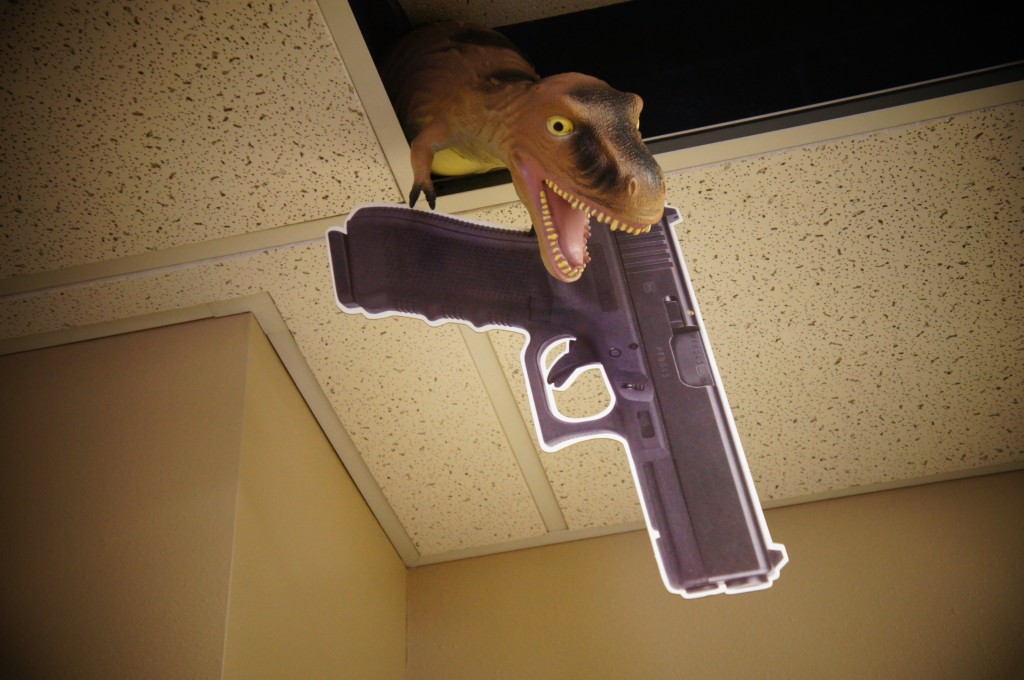
He’s going to have a hell of a time reaching that trigger with those little arms.
He’s going to have a hell of a time reaching that trigger with those little arms.

This is a pretty big deal. With over $100,000 in cash prizes, this is a pretty big payday for a lot of shooters. Read more for the full announcement:
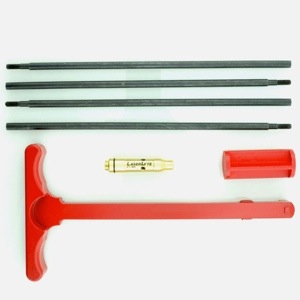 Laserlyte just sent over their new AR trainer system “Training Tyme AR LT-C556” and I’m very excited because of all the guns in my house, my AR is the one with which I need the most practice. I like this kit a little more than others I’ve tried, because there is no blue gun involved, and while that will mean a lot of extra racking of the charging handle, I will be able to practice with a real trigger and my own sights.
I figured thier would have to use of the charging handle since no live fire or blowback will be involved in use of this trainer. However, the oversized charging handle that is included with this kit, was a little surprising when I first opened the box. I mean, the thing is huge! Also surprising was the buffer block. This small round plug goes behind the buffer spring in the stock and makes the pull of the charging handle super short and quick. I am certianly not looking forward to removing and replacing my buffer spring repeatedly. It is often a nail breaking experience! The block does create a nice safety aspect though. Because the bolt moves back less than normal, there is no way for a live round to be lifted from the magazine and chambered while the buffer block is in place.
I will be watching the plastic pad on the back of the cartridge carefully. In the past I used Laserlyte’s 9mm training cartridge and found that the black plastic, that was intended to be hit by the firing pin, retained an imprint after some use and caused problems. I was told that the type of polymer used by Laserlyte was changed, so I will have to test and inspect this carefully. As usual, the battery life of the cartridge will also be in question, since even when not in use, the tiny batteries of the laser seem to run dead very quickly.
Lastly, while the inclosed “push rod”, for removal of the cartridge, makes me cringe, I will carefully use it as intended. Putting any device backwards into the barrel of my guns, automatically makes me nervous. I’ll let you know how it all shakes out.
Anything specific you would like me to test about the LT-C556? Leave a comment below.
Every other e-retailer should watch this commercial and realize that Brownells just set the new standard. 10/10 flawless victory.
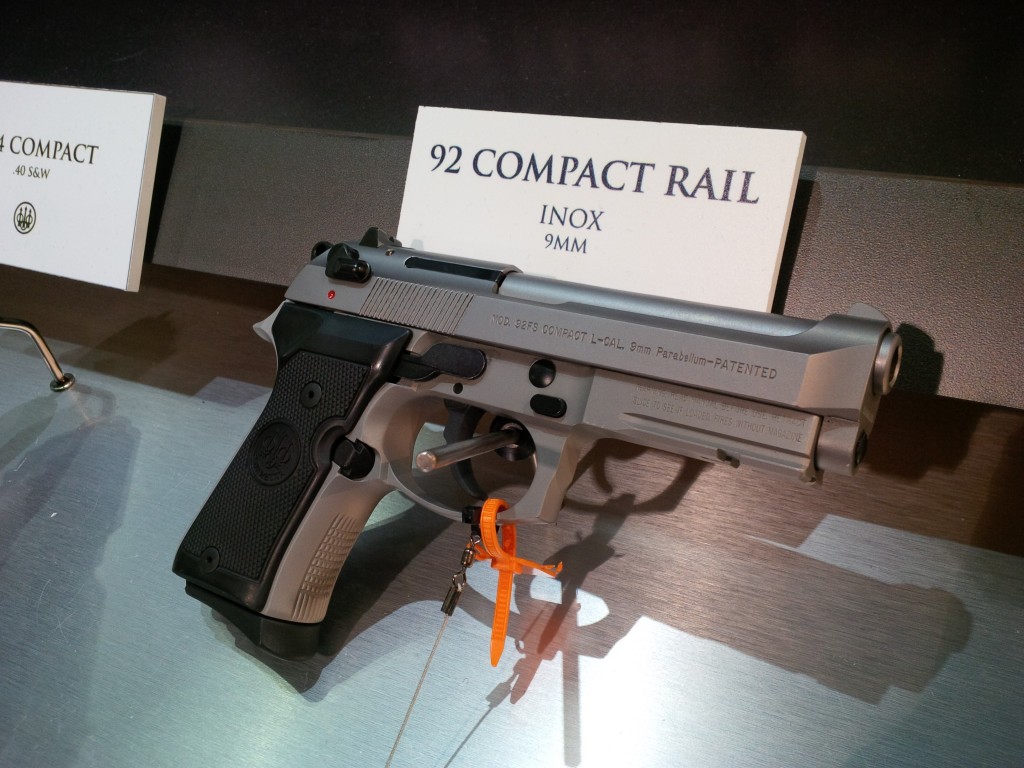
Beretta brought by my favorite gun back! Do want.
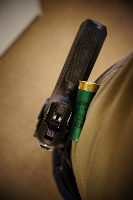
When IDPA released the new rulebook, one of the sections that got major attention were the holster rules. It had always been a bit murky on what was legal or what wasn’t, so IDPA went to great lengths to clarify legal vs. illegal holsters.
8.5.1.17. For male shooters only, the holsters must fit the shooter’s body such that a ¾ inch/19.1mm diameter dowel placed between the shooter and the firearm anywhere above the belt contacts both the shooter and the firearm simultaneously.
If you’d like to test this at home, a 12 gauge shotgun shell is 0.75 inches in diameter. I decided to test my Blade-Tech holster to see if it was legal, and much to my dismay it wasn’t. This isn’t a knock on the gear, mind you – the way the rule is constructed is so that shooters of a certain body type will not be able to use holsters that other shooters who have a “width advantage” will be able to use. Here’s my currently illegal IDPA holster:
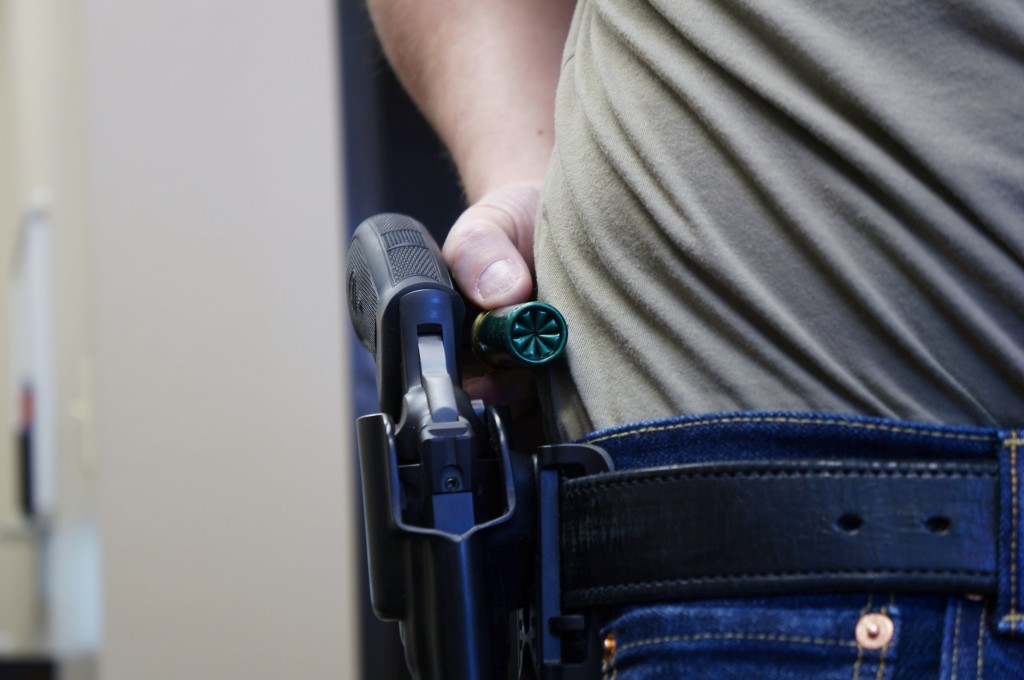
As you can see, the shell is nowhere near the gun, and even if I run it down closer to the top of my belt, it never contacts both the gun and my body at the same time. That leaves me with three options:
I guess there’s a fourth option, which would be “wear the illegal holster anyway and hope I don’t get caught”, but writing a blog post about it probably killed that one. My plan right now is to have Blade-Tech make me a different holster that would be IDPA legal, and then work with them to modify the existing holster so it’s closer to compliant with the rules.
Now, on to the rule itself: some would argue that this rule unfairly penalizes people who are skinny/fit by now allowing them to use these holsters. That’s a bunch of nonsense if you ask me. The rules are the rules, and if I can’t use this holster because my doughnut intake isn’t sufficiently high, than I’m okay with that. Using a tighter holster to the body gives up a few hundredths of a second on the draw, and while athleticism normally isn’t that important in an IDPA match, this is one case where I can make up 0.05 seconds by being a bit quicker.
So if you have a major IDPA match coming up, now’s a great time to check your gear. Grab a spare 12 gauge shell and make sure you’re within the 0.75 inch rule on your holster and magazine pouches, but only if you’re a dude. This rule doesn’t apply to the ladies because hips don’t lie or something.
Take note: here is the same model of Blade-Tech holster, but with a different gun, this time it’s a Sig P220. Note that this configuration on the same shooter is perfectly legal:
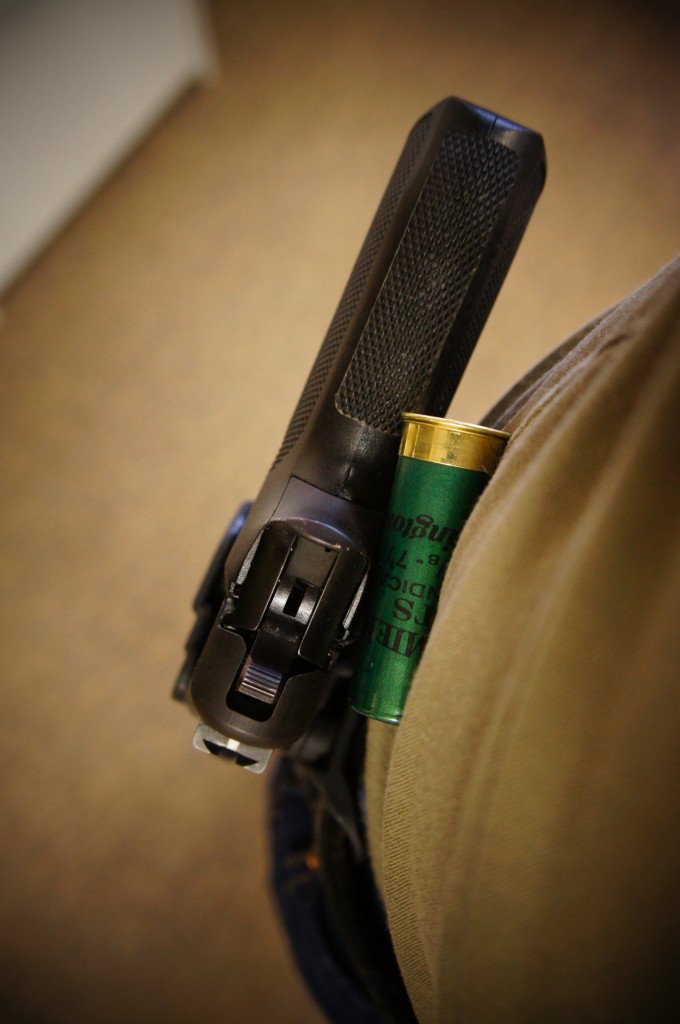
So far, the only holsters on which I’ve encountered the issue are the pictured revolver holster and one Comp-Tac 1911 holster. Just check your gear before your next match!
You needed to spin your flashlight like a boss? If so, the new SwitchBack Ring is for you!
If I can be serious for a moment, I can actually see the practical application of this product for CCW. However, the Tactical DerpStyle marketing just turns me off so bad that I’d rather stick with my Crimson Trace Railmaster technique.
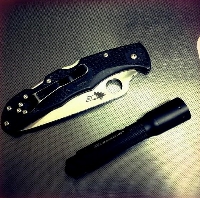
I am going to do one of those obnoxious “this is my EDC kit” posts. Because I want to talk about the desire some people have in the community to carry too much stuff. Obviously, everywhere I go I have my phone and my wallet, because you need those things. Here are the two EDC items I always carry.
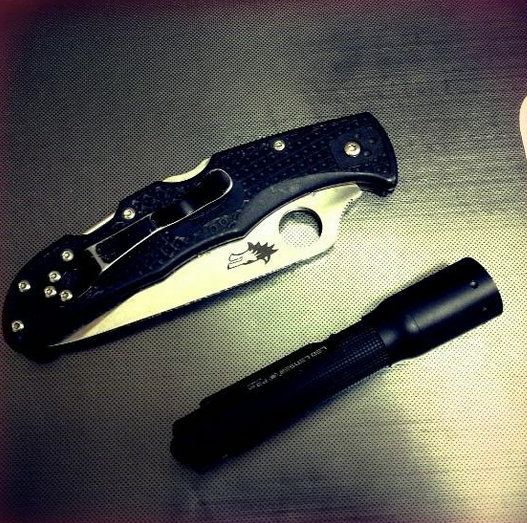
A Lone Wolf Tactical Armorer’s Tool and a flashlight. The light pictured is a LED Lenser P3 and it’s awesome because it’s lightweight, and handles all the illumination tasks I could need it to.
Not pictured is my gun, because I don’t carry every day – some days I can’t, because I’m travelling and they frown on bringing a .38 on planes. Knives are frowned as well, but the first thing I do when I get my checked bag is grab my knife. Also not pictured: a bunch of ridiculous bullcrap and a manpurse. Here’s the thing that people don’t understand – preparedness is a lot easier when you do it in a layered approach. For example, I have five of these AAA 121-Piece Road Trip First Aid Kit . One in my house, one in my office, and one in each car. That way I’m never really far from a reasonable first aid kit. I keep a travel emergency kit in our cars as well, so that I can do useful things like “signal for help” or “re-inflate a flat tire.”
Remember, we’re talking EDC here, not “it’s the end of the world as we know it.” A reasonable person’s risk assessment should look at the three places they spend the most time (at home, at work, in the car) and plan accordingly. If you spend a lot of time at the range, you might want to get a blowout kit as well in case of an accidental (or intentional) GSW.
You probably don’t need to keep fishing line in your EDC kit. Remember, we’re not talking about bug-out bags here, this is your “I leave the house every day with this stuff” kit. Glowsticks, thermal blankets and fishing line make perfect sense in a BOB, but come on, EDC? I think not. For me, the bare essentials for EDC are simple: a good knife, a good light, and (when allowed) a good gun. I see EDC pics every day that trigger my internal BS alarms, because seriously who carries a Glock 17, two spare mags, three knives, two flashlights, and a j-frame?
Here is the first independent test of the G2 RIP 9mm round. Turns out it’s not any more effective than a .22 LR. SCIENCE!
Production, Single Stack, and Revolver. If you shoot any of these three divisions (or any IDPA at all) reloads are pretty important to you. One of the best drills for training reloads is the 1 Reload 2 drill. It’s a simple drill, here’s how it goes:
It seems all so simple, right? In many ways it is, but at the same time there are a lot of moving parts in this drill that can fool you into chasing numbers that aren’t as important. Right off the bat, one of the areas in this drill that can lead to unrealistic numbers is the target distance. I’ve seen people shoot this drill with the target at 5 yards, because they’re working on the speed and manipulation part of the drill, and I’ve seen people work it at 10 yards because they want to actually have to aim (a little bit) when they get back on target. That actually does make a difference in your total time.
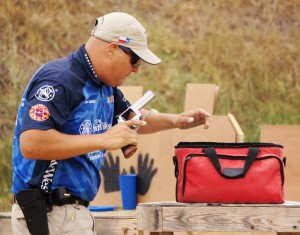
Another area where it’s easy to create false numbers is the first shot. The first shot in this drill doesn’t really matter, you’re just using it to create a split time for the reload. But if you have a really fast first shot, you can chop a few 10ths off the overall time without actually improving the important part of the drill – the reload itself.
The next moving part to watch out for is the first shot after the reload, and is also why I prefer two shots instead of one. It’s easy to do one-shot hoper drills. One shot from the holster and one shot reloads are perfect examples – you draw/reload the gun and establish a grip that’s good enough for one fast shot, but not necessarily for a follow-up shot. I’ve don 1r2 drills where my first shot after the load has been blazing fast, but then I’ve had a 0.50 split for the second shot because I had to fix my grip. Not ideal.
That leads us to the final moving piece of the drill – the last shot. When I’m practicing 1r2, I’ll usually do 10 reps, which gives me 30 shots. Of those 30 shots, I have to have 95% be hits in the designated target zone to “pass.” That means I’m allowed 1.5 misses, and since it’s hard to half-miss a shot, I round that to 1 miss for the evolution. The shot I’m most likely to miss is the last shot, for the reasons noted above.
The key to successfully training the 1r2 is to know what you’re looking for. If you try to track all the moving parts, you’ll end up chasing numbers that may not be important. When I run this, I set up an IDPA target at about 7 yards. The first shot is to the head box, then the two shots after the reload are to the body. The numbers I care about most are the reload split time, and the overall time. I care about the reload split because I’m training reloads, and I care about the overall time because it measures how well I’ve executed several different aspects of the fundamentals of marksmanship. The overall time is also more applicable to actual performance under match conditions than a static single shot reload split.
Try this one out yourself. Pick a target, pick a distance, and know what your training goals are and you’ll have a fun time working on your reloads.