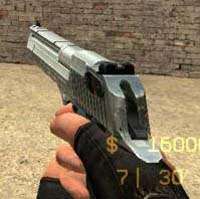
This is one of the best videos I’ve ever seen about guns in video games; hitting all the high points of the Desert Eagle and its appearance in a host of video games over the decades. I do actually want a Desert Eagle, in .357 Magnum of course. Because buying more than one caliber is silly. For our gaming friends, what do you think the most iconic video game handgun is?
This weekend registration opened for Brownells Lady 3-Gun Pro-Am Challenge. It is the first major match that has been limited to women only. The match is planned for the weekend of October 31, 2014 in Covington Georgia. Registration is only open to 200 women and within 12 overnight hours, well over half the spots had already been filled.
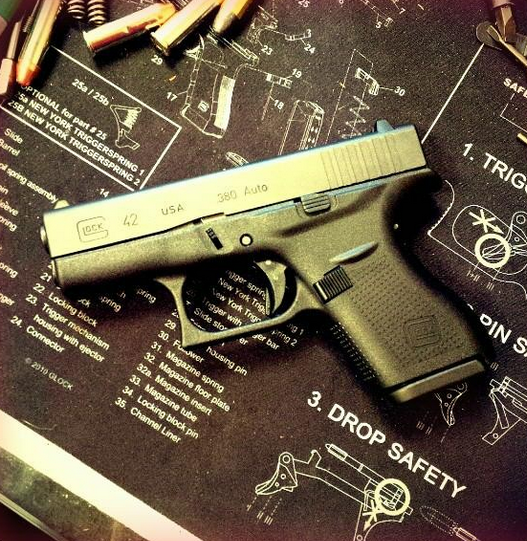
This is…actually a pretty good gun. The big advantage to this over all other .380 BUG pistols is that it’s a Glock. That means all the controls are in the same place they are on a Glock 19.
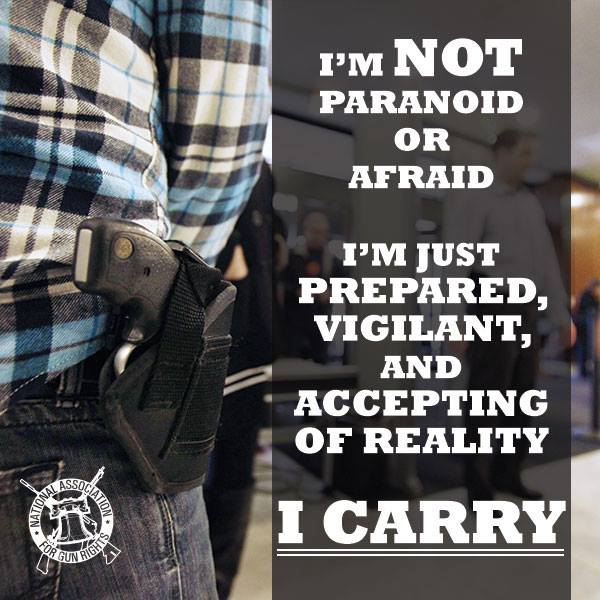
Why is it that whenever someone does an advertisement supporting carry, the image is always some soup-sandwich dude with a Taurus in a flappy nylon sausage sack of a holster? Seriously, that is probably the worst holster I’ve ever seen, and for people who are serious about carry it’s kind of insulting for NAGR to represent us with that image.
I understand that not everyone is going to carry a Glock in a Raven holster, or a Colt 1911 in a sweat leather holster. But I just can’t imagine the pitch meeting that resulted in this ad. Here’s how I imagine you end up with that holster. The scene is with a dude walking into a gun store…
Dude: Sir, give me your finest holster for concealment!
Gun Store Employee: Okay, that’ll be $80.
Dude: Give me your five dollar-ist holster!
It’s just awful. The holster is actually a bad design, it’s not just ugly. It has the added bonus of being dangerous! First, look at the distance the butt is out from the body. That means where the holster attaches to the guy’s not-a-gun belt is weak, allowing the grip to flop out. Grip flop means the holster will snag on stuff. Sweet.
Secondly, the retention mechanism is terrible. While I do applaud him for open carrying with an actual retention holster, there is no way he’ll be able to deactivate the retention on that holster in a hurry, because it’s a left handed holster. Seriously, on those terrible “strap the gun in” designs, a right handed shooter should have the button on the outside of the holster so you can attempt to unbutton it as part of the draw motion. This guy has his retention button on the part of the holster facing his body, ensuring that it’s going to be a painfully slow process if he does need to unlimber that .38 in an emergency.
Ultimately, what bugs me the most is the the National Association for Gun Rights, despite being a 3rd tier organization should know better. Was there not one serious gun guy who saw this ad before it ran? How come no one internally said “whoa, guys this is a total soup sandwich. Let’s fix his gear up a little bit.”
Seriously, an XD in a SERPA would be an upgrade for this ad. NAGR, I award you with a D-. See me after class.
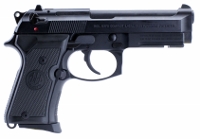
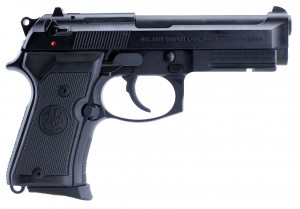
One of the things I really like to see is major firearms manufacturers sell spare parts directly to you. Beretta has added a comprehensive spare parts section to their website, including some common upgrades that shooters do their 90-Series pistols. Here’s the full page
Why is this important? Because when a company starts selling spare parts, they’re saying they understand that some of their consumers are serious shooters who will actually shoot their guns enough to warrant the spare parts. That’s a good start, but Beretta takes it a step further by actively embracing the competition/defensive community with some of the parts they’re selling. Here are three examples:
Steel trigger and “D” hammer spring – One of the most common mods to Berettas by serious shooters is to replace the factory mainspring with the “D” mainspring for a lighter trigger pull
Skeletonized hammer – Another modification for faster lock time is a skeletonized hammer
Oversized magazine button – What do competition shooters do a lot of? Reloads. An oversized magazine release makes reloads a lot easier.
Also on the new accessories website is a comprehensive list of holsters for duty and for competition, including a straight up Ghost Holster. It’s nice to see Beretta really embracing the competition shooting world and making these parts available for shooters who really want them. If you’re looking for a Beretta to get started in competition shooting, I’d recommend taking a look at the 92A1, because it has an interchangable front sight. However, the stock 92 with its fixed front sight would also be an excellent choice, because you can change out the rear sight for an adjustable sight and then simply black out the front post.
The real point of this post is simple. We spend a lot of time calling out bad behavior in the industry, so it’s just as important to call out good behavior. Beretta USA making the decision to stock and sell spare parts and competition upgrades for their guns is a cool thing to do, and I’m glad to see they’re doing it. Hopefully the trend will spread to other companies!
Here’s me doing a sub 2.50 second reload from concealment in dry fire.
This is actually a completely pointless accomplishment; a vanity drill. It’s the dry fire equivalent of bro-curls in the squat rack. Yes, it’s cool to be able to manipulate the gun quickly, but you’ll notice that I’m not doing anything other than the reload itself.
If I use the term “gamer” as an adjective for a firearm, a modification to a firearm, or an accessory for a firearm, what definition pops into your mind? Exact definitions may vary, but I’d wager few would view the term as a positive description. Typically when you hear someone referring to something as “gamer” gear, it’s said almost through clenched teeth like they’re spitting the word out in contempt. The implication is that “gamers” aren’t serious, and therefore their equipment is goofy, problematic, and counterproductive…but is that really the case?
When you look at the upper echelon of the shooting sports and what it’s typically taken for the people in that top tier to achieve that level of success, it’s rather difficult to argue that those people aren’t serious about what they are doing. I’ve interacted with a few famous competitive shooters and I’ve never come away with the impression that they are some clueless jabroni who just has a trick gun. I may not agree with everything they do, but spend any time talking to a Rob Leatham, Bob Vogel, or Jerry Barnhardt and it’s crystal clear that they’ve invested incredible time and effort into what they’re doing. There’s thoughtful analysis, useful practice, and fastidious attention to detail behind their achievements. The same can be said for shooters who don’t necessarily belong to the Super Squad. There are a bunch of really good shooters out there who may not have won a major championship yet, but will still easily clean the clock of 99.99%+ of people who will ever pick up a firearm in just about any measure of shooting skill.
The thoughtful analysis and fastidious attention to detail goes beyond technique and into the equipment that they use. You won’t find anyone who is serious about competition shooting that isn’t also knowledgeable about their equipment and why they are using it. The idea that competitive shooters don’t know about gear is specious…they know their gear very well and they can usually explain exactly why they are using X vs. Y.
Every serious competitor is knowledgeable about the equipment they’re using and works to get he most out of it.
When I say “their gear” I’m referring to using firearms, modifications to firearms, or accessories that are suitable for the goal they are working towards. Competitive shooting, whatever form it takes, is specialized and typically you see specialized weapons and equipment tailor made for the discipline. Olympic skeet shooters tend to use expensive, specialized over and under shotguns customized to their specific physiology. Kim Rhodes’ shotgun is set up for her measurements and her shooting style. She’s not dependent upon that shotgun to hit a target. It’s been set up to hit flying clay discs reliably and optimized for her particular needs in the demanding environment of skeet competition. (Anyone who thinks it’s not demanding should be able to easily go out and being home a gold medal, right?) The gun has been set up to allow her the best possible performance in her sport. It’s “gamer” gear, but there’s nothing haphazard about the gun itself or her decision to use it. A custom Perazzi is a damn good gun. I’d love to own one.
…but it’s not the gun I would reach for if I was trying to breach the doors of a building to go deal with an active shooter.
The dismissal of “gamer” gear often comes from the “tactical” side of the house which is quick to point out that equipment specialized for competitive endeavors is often inappropriate or even counterproductive for use on the two-way range. This is certainly true, to an extent. Ms. Rhodes’ shotgun is a fine weapon, but no infantry platoon on earth would be better off with her shotgun than a decent belt-fed machinegun. Similarly, Ms. Rhodes would find an M240 to be particularly ill-suited for her purposes in the Olympics. We all recognize equipping an infantry machinegunner trying to achieve fire superiority with a double-barrel shotgun or an Olympic skeet shooter trying to hit clays with a belt fed as a silly exercise. (Although belt fed machinegun competitions would make the Olympics more awesome) It’s clearly the wrong tool for the job.
Does it follow, then, that every bit of equipment used in competition is unsuitable for consideration by people who are primarily concerned with using a firearm as a tool of personal defense? Nope. Understanding what’s what first requires understanding the frame of reference for competition gear and how it differs from requirements for defensive gear.
We use cookies to optimize our website and our service.
Functional
Always active
The technical storage or access is strictly necessary for the legitimate purpose of enabling the use of a specific service explicitly requested by the subscriber or user, or for the sole purpose of carrying out the transmission of a communication over an electronic communications network.
Preferences
The technical storage or access is necessary for the legitimate purpose of storing preferences that are not requested by the subscriber or user.
Statistics
The technical storage or access that is used exclusively for statistical purposes.The technical storage or access that is used exclusively for anonymous statistical purposes. Without a subpoena, voluntary compliance on the part of your Internet Service Provider, or additional records from a third party, information stored or retrieved for this purpose alone cannot usually be used to identify you.
Marketing
The technical storage or access is required to create user profiles to send advertising, or to track the user on a website or across several websites for similar marketing purposes.